Key Takeaways
- Ronnie Fieg, founder of Kith, joined Noah Callahan-Bever on Complex's Idea Generation to mark the brand's 15th anniversary with the release of a book chronicling over 1,800 sneaker collaborations designed across his career.
- Fieg explains that Kith has grown to 23 physical locations without ever wholesaling, licensing the brand at scale, or taking on outside shareholders, and describes the meticulous season-by-season buying and design process behind a target sell-through rate of 85 to 90 percent.
- Fieg reveals a forthcoming collaboration with Nike built around his favorite 16 Nike silhouettes, timed to Kith's Sweet 16 anniversary, and discusses the three-year development of Kith Ivy as the opening move in a hospitality expansion unlike anything else in the brand's world.
Fifteen years into building Kith from a single sneaker boutique into a self-funded global brand with retail locations across three continents, Ronnie Fieg has a lot to account for, and a book to prove it. The 1,800-plus sneakers chronicled in his anniversary release are a timestamp of how far he has traveled from his early days as a head buyer, and they set the stage for a conversation that goes well beyond footwear.
Sitting down with Idea Generation host Noah Callahan-Bever, Fieg gets into the deliberate restraint behind Kith's growth (no wholesale, no licensing at scale, no outside shareholders), the polarizing launch of Kith Ivy and his vision for hospitality, and the seven-hour creative session with Virgil Abloh that shaped how he thinks about product. He also opens up about the birth of Kith Treats, why he handed a very exclusive sneaker to one of the brand's loudest online critics, and what the upcoming Nike "Sweet 16" project means for Kith's next chapter.
So I have to ask, given your creative director role with the Knicks and your attire at this moment, is Jalen Brunson the greatest Knick of all time?
Damn, we're gonna get right into it, huh? The answer to that is yes, I believe he is. I think about that a lot. I thought about it a lot since he scored 45 in a close-out game in game five, but to me, in my lifetime, I got to see Patrick Ewing play, and he was my favorite Knick, and also, I think, the greatest Knick in my lifetime until Brunson took the court. And then I did a lot of research, being in this role, a lot of research on the championship teams, the previous two, and there are some really great players between, well, Clyde is one of my favorite players of all time, so it's not such an easy yes or no, but I feel like with the Knicks team, with that specific team, what they were able to achieve, I felt like, against the Spurs, where they were serious underdogs going into that series, they were able to overachieve in ways that I didn't think was possible.
And Jalen Brunson, aside from being the greatest Knick of all time, I also know these guys off the court, so it's also about the team and their personalities and also who they are off the court that really resonates with me. And I think I pay attention to that more ever since I worked with LeBron on the documentary that I produced and directed. It was a Long Live The King documentary. And I got to really appreciate the regiment that they're in during the season and what they go through to be the players that they are. But these guys are really special. And I got to meet their families and their spouses and their kids. I spent time with Josh [Hart] over the summer and KAT, we got to put a Kith Treats ice cream bar at his wedding, which was fun. But these guys are really great guys. I was with Jordan Clarkson yesterday and a couple of other times in the last couple of weeks. Jose Alvarado was at the store yesterday and I got to spend time with him. He's expecting a kid right now. And just seeing them off the court and their personalities and how they live their life off the court and outside the game, I think is really special.
The last time that we sat down in an environment like this was in 2017, nine years ago now. I'm curious, since then, obviously yourself, Kith, have experienced a lot of change. What would you say have been the most consequential decisions that you've made in that nine years?
I think it's been around growth. It's been around team, how to grow the team, how to grow the company. Some of the decisions, I think, have been polarizing in the sense of where we've gone outside of traditional retail. So getting into other aspects, or what I consider other aspects of our world, but other categories that aren't typically the roadmap for a brand like ours. And I think that that's been really beneficial to the company, but also it's become confusing to those who aren't used to seeing things like that. And that's what it's supposed to do.
Which of those decisions was the most controversial?
I would say Kith Ivy was probably the most controversial, but that's also the latest, so I'm feeling it most recent. It's controversial as to people's understanding of what it is. The expansion of Kith getting into hospitality, which is just the beginning of a category of business that I want to explore in a way that hasn't been explored in the past. So I think that it's as polarizing as it was, I think, when we either designed a car for the first time or designed a boat with Cigarette. And for people that want to stick us in a box, streetwear is a part of our foundation and how we started. But what we've evolved and progressed, how we've evolved and progressed over time, I think has taken us to a new dimension for what the brand represents at this point. And it's not to say that we still don't cover every part of the spectrum that we specialized in from the beginning. These are just added building blocks to help evolve the brand.
When we talked last time, you said that some things weren't meant to scale, in reference to the brand, because I think we were talking about you keeping the business vertically integrated, and that this is your baby and that it can be small and that's okay. I don't think that there's any other way to characterize what Kith has done in the nine years since, other than scale. What about your ambition changed in that period?
It's funny you say that because if we have 23 physical locations today and we're 15 years in business, that's like a store and a half every year that we're opening. Which is still relatively slow in the growth that we can have if I wanted to explore other regions of the world and have this type of growth where we could roll out stores a lot quicker. And I've had that opportunity on my plate and decided that that's not the way that I'd like to approach the growth.
We've grown a ton since we met last. But the truth is, we still have not wholesaled. We still have not licensed the brand. And we still have not grown at a rate that we can't control by doing it tastefully. So at this point, I always try to maximize the potential of anything that I am working on. And it's no different today. I think we've had opportunities based on my lifestyle, based on how much I've traveled and how cultured I've become through traveling and through visiting different businesses and having my passion for hospitality. I've wanted to infuse my lifestyle into what the brand can represent in the future.
Whether it was Tommy, Nautica, Ralph [Lauren], some other bigger brands, I think a large part of their business has either been outlet doors or licensing product and also licensing the brand outside of the country and having partners in retail, or going down market like Nautica did. So when you think of the growth path that those other brands have had and how we've grown, we've been very strategic and meticulous in how I've wanted to grow the brand and where the brand is today. And I also have a view as to what it's going to look like the next three to five years. And it'll be a very different formula as to what people have been used to seeing.
Is it difficult to impose that discipline on the business?
Not when you don't have shareholders to please. So the beauty of everything that we've done is the fact that we're self-funded and all of the money has gone back in. And the spaces that we've been able to build at $1,300, $1,400 a foot at retail, that's probably three, four X what people are used to seeing from their other favorite brands. And I think that the decision to do that has created incredible spaces where people spend their day, especially on the weekends. People spend a lot of time in the stores and we pay attention to that. And that's because people come in, they either have relationships with the people in the shops, and that was the goal from the very beginning, for people to feel welcomed. I think we spoke about that the last time we spoke. And also because we have a lot to offer now in the spaces between food and beverage and the accessories and multi-brand and footwear and then obviously our house brand.
What, if you were to imagine the pie chart of your sales within your locations between house brand, footwear, multi-brand, accessories, food and beverage, what does a healthy breakdown of that look like to you? And what are the differences in the margins?
Well, good question. The margins on footwear are about 50%, 45 to 50 on multi-brand footwear. And then the margins on fashion, on apparel, are usually somewhere between 60 and 65. And that's because you're buying from a middleman, so you're buying it at wholesale and then you're selling it at retail.
The margin for us varies for our house brand. It's not that we haven't still focused on multi-brand apparel and footwear. It's just that the demand for our brand was exponentially higher for what people were looking for and what people wanted out of the spaces. And what that split looks like, I can't really speak to that on this pod.
Save that for Business of Fashion.
Yeah, exactly. I mean, I've turned down Business of Fashion for numbers since the beginning. And it's because it's not formulaic as to how we got here. It wasn't a goal for a number as to how we got here. I've been doubling and tripling the buys based on demand of how fast product was selling out.
The cardinal sin in retail is you see a piece on display, you ask for your size, and they don't have your size. And then it's like, the person either knew they were coming for that, they traveled, they were looking through the whole store, they finally found a piece that they liked, and then you don't have their size. We've obviously grown the business there just to make sure that people have a great experience in the store and that we don't sell out a product two, three weeks into the season when we're releasing product in August for fall and it hasn't even gotten cold yet, but you can't buy a jacket.
So I think that those fundamentals have stuck with me since the beginning. And as time goes by, we sharpen our swords, and I have an incredible team, planners and merchandisers to help me buy. I'm still doing the buy myself. I still spend a ton of time on that. And I think that people, and we speak about this now internally, on how sometimes we make it look so easy, because people see the end result of product and they don't have any idea what it takes and how many hands touch the product before the product touches the shelf. That's why I do these type of podcasts, so that people have the education and the know-how and understand how it's done.
How is it done?
If we sit down and design into a season, for example, like this past fall that just released, we'll sit down and we'll ideate the season. The first thing we do is we look at the season before, or like the year before, same season, comp season. And we say, look at what we've done. Then we look at sell-through from that season. We understand what sold well, what didn't sell well. And luckily, overall, sell-through on our product has been very good. But you could still refine always. And I think that that's how we got into this place where we're very cohesive in the way the collections look.
When we do that, we then go and understand the categories of business we want to cover. And then we go look at fabrics. And we go to shows for fabrics. We dig in crates. I have a whole fabric team. I have a fabric room with a lot of different headers. And what we do is we design, simultaneously we're looking at mood boards for the type of bodies we want to create. And then we're mood boarding fabrics that we want to stand for for the season. And then we'll CAD up bodies. So we'll design new bodies within categories and then have those CADs on a board. And then we have all of these fabrics that we're looking through. So we'll have a room full of fabrics and then go through the fabrics, decide which fabrics we love. And then we'll have boards of fabrics and boards of bodies.
And then the most important part of creation in this step, I think has a lot to do with tact and also experience to understand which fabrics can be applied to which bodies. And that's when sometimes you see collections and you're like, I love the shape and the pattern, but why is it in this fabric? Or why is it in this color? And I think what we've gotten really great at is applying fabric to bodies and having that tact of knowing, A, how we're evolving and progressing our collection. Does it move the needle? Does it evolve what we've done before? And also, will people bridge what they've liked with what we've done before versus what we're going to introduce as new? Can we bridge that gap? Does this fabric bridge the gap? Will people see this as a natural evolution of what they wear?
So that's the next exercise. And then from there, it goes merchandising and design, they come together and they ideate together as to how we're going to evolve certain categories of product.
Is that an occasionally friction-filled relationship?
Yeah, yeah. By the way, if it's not, you're doing it wrong. Because the merchandising portion of the business, they are supposed to be very good at analyzing the business and making sure that you have categories that the merchandiser knows people want and making sure that you have it covered. And then the designer is typically trying to move the needle and saying, this is how we're going to progress and really move things forward. And aesthetically, sometimes it can be, and as a creative director, I'm working with both.
How do you mediate those disputes?
It's in a room together. And by the way, we all love each other. And at this point, I will say a big part of the success is having consistency in the seats so that we're working together and we understand the way we think and we also appreciate each other's ideas. The best idea in the room should always win, and when you have consistency and tenure in those seats, it really helps. So it goes from merchandising and design for ideation to then development and production for a sample that comes in.
And then up until very recently, I was fitting all of the men's product, right? And I was fitting for upwards of four or five hours a week on the product because I used the time of the fitting to make decisions on whether the fabric was right for the body and also making changes whether I thought the body was right for the collection, so I would have the context of the collection there when the samples come in, we're trying on a good portion of the collection and I could see what all the product looks like in one place and then the decisions that we're making on the fly, we're getting an idea of costing at that time, we're getting an idea of whether the fabric is right, whether the body is right and then we're making decisions there for the next round and then the next round comes in and we fit again.
So these are already more steps than the typical brand will do because in a lot of situations I think for brands where they have a body or a product that works, they'll run that same body in another fabric but not fit it — which is why sometimes you walk into a store and it might be your favorite brand and you're trying something on and you're like, this doesn't fit the same way, and it's not because they switched factories, it's because they didn't refit the garment. So we don't cut corners in any which way. We're fitting every single garment in every single fabric, every single season.
So that's a lot of work and within that you have merchandise and design and then you have the tech designers that are part of the fitting. So you have tech and design, production, development, merchandiser and myself all in one meeting making decisions on the fit — and during the fitting, not just on the fit. And then from there the product goes into a buy once we confirm the product and then it goes into planning and buying and merchandising. They're in the room and they're basically putting a North Star mock buy in front of me and I'm going through each SKU product by product on the buy.
So I do that for 5,500 SKUs a year and I'm going through it and I'm looking at the product and we're making decisions based off of the past business that we've had, the present where we currently are and then the future of the stores that we're opening if we are opening any and trying to account for that.
What is considered a good batting average? Batting average meaning sell-through?
Target sell-through for us is between 85 and 90%.
So when you're making these estimations on the buys, your goal is to?
We're buying against that. We're buying against what we think would be 85 to 90 throughout the season. So you have selling by week and it's very methodical in that way. So the balance of the creative portion of my job versus the business side — that's a little bit like being an actuary and also a gambler to some degree.
By the way, that's what business is in any which way.
Yes. But I think that the split between the two is what I think differentiates myself and the business from others because typically there isn't a person sitting at the helm working on both and directing both. So a creative director will sit down and at the buy, a creative director wouldn't even be in the buy. But I'm not only sitting at the buy, I'm finalizing the buy. I'm buying every single SKU. So there's a lot of time spent there. I spend about four hours a week just buying.
Crazy.
And then once we buy it, it goes to production and then the production team is in touch with the factory, you have to get time on the line and then you're setting up a timeline. And then from production it goes to logistics and then logistics needs to plan on when the product can come in to meet a date for the release date and then the product is either getting aired or boated depending on when we place the buy and how long it took us to get there.
So we're giving ourselves time but if a second round sample isn't correct and we go to a third round sample, all of a sudden you need to air that product. So then logistics is split and you have people working on boating or airing and it becomes a different tracker for the same collection between what gets boated and what gets aired — and that's between, it could be in one collection, it could be 20 factories making the product for that one collection.
So then the product comes in and you have the team who's receiving the product and then you have the team who has to shoot the product and then you have the look book, the campaign and e-com and then you have the editors that need to edit the product and then you have the VM, the visual merchandisers in the store who are setting up the product in the store and then from there we open the store for the collection and then you walk in and you buy it and you think, oh, this is a nice product, I'm gonna buy that — or I don't really like that product. But regardless, the amount of work that goes into every single SKU is tremendous.
Is protecting that process paramount to creating a great product or can you make great products at the expense of the process?
When we're working on a season, I'll go back and look at 10 years of a collection. So if I'm designing fall, I'll look at the past 10 years of fall. I'll sit down and go through all the collection. I'll be like, holy shit, 10 years ago we made a silhouette that would be really relevant today but we can make changes to that silhouette. I'll sit down with my tech designer, we'll work on a new pattern for that piece.
So when you say protecting the process, this is a process that we've developed on what's right for us and it's been a learn-as-you-go situation for me and I'm learning every day still because I'm looking to get into product that pushes the envelope. So as we get into three-layer jackets and shearling coats and leather sport jackets and made-in-Italy accessories, the amount of detail that needs to go into the product and also the consistent lens that needs to make it feel like our brand is very unique to the brand itself. And this is not only for our brand — everybody has their own process.
Let's zoom out for a second. You mentioned earlier that streetwear is sort of a foundational element of the Kith brand but that obviously you've grown in all of these different directions over the last 15 years. You were recently put as number one on Complex's streetwear power ranking. I'm sure you were aware of this fact. Do you believe that Kith is a streetwear brand and does it make sense for you to appear on that list?
I believe that we started there and I believe that we still cover aspects of streetwear but I also believe that we do more than streetwear. Streetwear at that time was graphic tees and hoodies. We do that still. We have the fun part of the brand which is Kith Treats. We have a lot of fun with graphics and sometimes we work on some of these projects whether they're with Warner Brothers or Disney where we work on some of my favorite nostalgic — I would call them icons or franchises — that I think are really relevant to me and what I love and obviously they've been relevant to a lot of other people because they've done well. But that to me is more of a streetwear product where it's the typical streetwear graphic on a tee and we still do that and I love that.
I love that part of the brand because the younger end of the spectrum is a very important customer and a very important fan of the brand that I want to make sure we cover because I don't forget about the kid that I was when I first entered the world of streetwear. I'm 44, I have two girls, I have a family and there are days that I still want to wear a Kith Treats tee but for the most part I'm wearing product that has gotten more sophisticated as I've grown with age and that's normal. To put it in one bucket is really wrong to do.
Outside of your brand, just as a person that's observed and been a part of the culture for years, why do you think the term has become so controversial or polarizing?
I don't find it to be controversial at all. It's just about your meaning or everyone's definition of what streetwear is. For example, if you take a The North Face Mountain Jacket, a Gore-Tex The North Face Mountain Jacket, is it streetwear? A couple of brands have collaborated on that product, streetwear brands, but does it make it streetwear? It's a technical piece but that's my point — it depends on the purpose of the piece.
If I'm producing a suit that is worn to a wedding, you can't call that streetwear. If I'm working on a knit sweater that you're wearing with a pair of chinos and a loafer, I don't know that you can call that streetwear. But people want to categorize a company into a bucket so they could describe what it is. What's Kith? One word, streetwear. To me, it's not streetwear. It's a lot more than streetwear.
Streetwear doesn't mean that you're not being thoughtful and making great product. We are. But streetwear to me, what it stands for, is how I was first introduced into the culture. It was product that I was wearing that I loved that we still create today. So it's a category of the company that we create but we also do a lot more than that. Is a boat streetwear? Is a car streetwear? When we work on on-mountain product and people are skiing down the mountain wearing Columbia product, is that considered streetwear? The answer to that is no. So then why is it so confusing as to the definition of streetwear?
People could say, if you could wear it in the street, it's streetwear. Then everything is streetwear and that could be someone's definition. But I have a definition that I grew up with that has been the core basis and the start of this company. So I have a lot of love for the category but I also have a lot of love for what I wanted to do and aspire to do outside of streetwear.
On that list, number two was Supreme. Do you have any relationship with James Jebbia?
James and I saw each other while we were quarantining. I saw him in the Hamptons and we took a walk and we spent like an hour together and had a pretty good conversation. I've always respected Supreme. I've always loved what they've been about and what they've done and how focused they've been in what they do. They're one of the godfathers of this world. So I give a lot of credit to James on what he's been able to do.
What did you guys talk about?
Honestly, we shot the shit and we were talking family stuff, life, a little bit about business. This was now four or five years ago so I don't remember exactly but it wasn't anything specific. It was just a catch-up kind of thing.
Speaking of titans of the industry, another gentleman who I know you had a close relationship with was Virgil [Abloh], rest in peace. What was the nature of how you two got on and what information you two shared?
Virgil and I had a really close relationship. He's probably the person I respected most in my world of product and what we were trying to do. Although we were on two different paths, we both respected our creativity on the highest level and he came to my office a long time ago — this is back two offices ago — and I had my personal office in the back of the space and we spent seven hours in that room. I remember I canceled my whole day. We didn't even get up to go to the bathroom. We just spoke for seven hours and that was the first in-depth conversation that I had with him very early on.
His favorite project of mine was Kith Treats and then it became the Paris store when I told him — because I took the Paris space two years before we opened. So I gave him a glimpse into that. And then when we went to Paris for Fashion Week, there was a time when I came up in that same office building. I was coming up the elevator, he was walking into the elevator, I was like, what are you doing here? He's like, oh, actually I was gonna call you because Kanye is doing his pre-collection in the space below yours. I was like, oh shit, that's crazy — and at the time I'd never met Kanye.
So this was the first time I met him. This was his first Adidas collection, his first show. He was doing the pre-collection in the space below me. Virgil comes up alone and he was like, Kanye wants you to come down and come see the collection. So I come down, I take a walk around and he's showing me the different types of footwear and at the time it was the 300, the 750 and the boot — those were the three shoes in the first collection. Kanye took me through all of the product and asked me what I thought about the footwear and I was like, I think the footwear is great. He was like, hey, I wanna have a meeting with you at your office with all the footwear. Can we do that? I was like, yeah. He's like, all right, I'll be up in an hour.
And then we had a long table in my conference room. It was him, Jerry [Lorenzo], Virgil, Don C, I want to say Matt Williams was there but I don't remember, and the head designer for Yeezy and a designer from Adidas at this table. We were sitting down and looking at the shoes and all having conversation about the design and that was a pretty crazy time. I was giving him feedback and that was the first time I got to meet Ye.
And then my relationship with Virgil from there — Virgil and I worked together on an Off-White capsule and then we worked together on this Off-White boot and he told me about what he was gonna do with Nike.
This was The Ten?
This was The Ten and he was asking me for my advice on the deal. I was giving him some feedback on how I thought the deal should be structured. I've never quite had a relationship with someone where I was able to speak at that level about what I was doing, like going back and forth with each other on ideas that were really groundbreaking for what we were trying to do.
What was it about the nature of the relationship or about him that sort of allowed that?
The way he was such a free thinker and didn't have — because he didn't come from retail the way I did — he wasn't stuck within the boundaries of what retail was and what making product was supposed to do or be like. Typically a lot of people follow a formula that they learn after working, you know, they obviously interned and whatever, but he didn't have the traditional knowledge of retail. So he was able, from a different perspective of working with Ye on the kind of things that they were able to work on — whether it was music and their rollout strategies and being as creative as they were — they got to take elements of that and apply it to product.
I thought that point of view he had was always very interesting to me. Because he's an architect by trade, and applying the different elements that made Virgil so incredible — and he really was a genius with his design sensibilities by what he was absorbing in all different elements of the culture, and then also taking what he learned within the architecture field, and applying that into how he rolls out product. It was incredible. It was really incredible. And that's why he's irreplaceable. We'll never get to see a genius like that again. And Ye, in many ways, was the same.
What were the most remarkable or inspiring things that you got from your time with Ye?
The greatest story that I have about Ye — and this is so incredible, because I think about this at least once a week. Ye comes into the store and tries on a pair of shoes. I get a call when he comes in, and I'm in the office having a meeting with Asics. They're sitting on the other side of the desk and they're telling me that Ye walked in. So I put the camera on my screen. And at the time — I'm getting chills — at the time it was the manager, the salesperson, and an intern. So I tell them, close the doors and let Ye shop by himself.
So he tries on a pair of shoes, and he hears a song come on. He didn't like it. So he gives his phone to the manager and goes, put this on, please. Start from track two. This is what I remember from what the manager told me. So he puts it on. I'm watching. Now he's sitting on the bench trying on a shoe, and then this song comes on. And he gets on the couch and he performs. This is months before Yeezus came out. He performs seven Yeezus tracks for three people in the store. Standing on the couch, performing the tracks, and nobody had heard this music yet. So I'm sitting here in this meeting, so upset that I can't be there. And the seventh song ends. He puts his shoes back on and walks out. And I'm like, this is insane.
And what I loved about the dynamic between Virgil and Ye — I've been with them when they've gone to a few different clubs. But I've been in clubs where he'll just plug in and play a new track that nobody's heard for the audience. And that is what's missing from today's music. Today's music and these artists, they're so formulaic as to how they roll out their music, and sometimes they're overthinking what they should be doing. Ye was just genius, and Virgil, it was both of them. They'd play the music in the club and get people's reaction — just hear it in a club and see the human behavior before they put the music out. That concept stuck with me for a long time. And I feel like the industry as a whole is missing that behavior. Like, absorbing human behavior of exploring something for the first time in a setting. That's what the world is missing.
The thing with Kanye is he is interested in everyone's opinion, regardless of whether or not he will take it or do anything with it. But I can remember being in Hawaii during the Twisted Fantasy sessions, and stopping the delivery boy, and being like, hey, come in here and listen to this, and just playing some so-called half-finished music and being like, what do you think of the drums? And Q-Tip, and real producers are sitting there like, what?
It's so, it's actually my favorite part. My favorite thing about Ye is that.
So, two things I'm gonna mention. Going back to the opening of the Paris store, we went to a club — I want to say it was Club 77, or some shit. I don't remember what it was called. For the opening of the Paris store, Virgil comes up to me and goes, yo. Because we took the whole VIP section for the opening of the store, and it was a big party. And Virgil comes up to me, he's like, yo, I have a surprise for you tonight, and you're gonna love it. And I go, oh my god, this is gonna be crazy.
So we're hanging out, and then all of a sudden Virgil comes on and plays the intro. It was a 20-minute intro to "H•A•M." And I could show you on a text thread of me begging him for six months to send me this intro, because I never heard it again. And it was this goth, just insane sound. You know the beginning of "H•A•M"? There's like a whole — so I heard that and I went nuts, and then when the song started, Ye came out and performed. And there's this video I still have of Jerry [Lorenzo] — this is pre-Fear of God — and Matt Williams, and I think this is the Been Trill era if I'm not mistaken. Ye came out and performed, and Virgil was telling me I was gonna love that night for the celebration, because he was gonna bring Ye out.
And then, fast forward — and this will be the last Ye story — I'm in Miami at the Faena, and I'm leaving that day, and I see Ye eating, or I'm outside eating breakfast, and Ye sees me, and Ye calls me over. He's with Matt George, and I sit down and I'm eating with him, and he goes, what are you doing today? And I was like, oh, I'm flying back. He was like, actually, I'm here looking for an apartment for Kim. And my wife is from Sunny Isles, so I know the area. I was like, you should check out a few spots. Then me and him ended up taking a drive to look at a few spots, because I put him in touch with one of my realtors.
And then from the spot we looked at, he was like, yo, I want you to come to the studio. I was like, I can't, I got a flight to catch. He was like, yo, I want you to listen to some shit. I was like, okay, let's go. We get in the car, and then on the car ride he was playing me beats, and he was just starting to freestyle with me over the beats. We were looking at shit he was seeing out the window and he asked me to record it so I could give it to him. Like, I still have it. I would obviously never send it to nobody. And then we went to the studio and Timbaland was in the studio.
Going back to Virgil and the virtual side of things — what he's been able to do for the industry, and the feeling people had for the level of disruption he was able to cause, I think will forever be remembered. He set the bar that high, with what he did at Nike, obviously, and what he did at Louis, and what he did himself with Pyrex, and the Rugby's, and just the Rugby product. And we were one of the first retailers to carry Off-White. That was the other part too, and we were very successful carrying Off-White. So I got to spend a lot of time with him, and we kept in touch, and that's someone who I miss every day. I miss him so much. And the industry, I think, misses him, even if they don't think about him. It's a feeling, it's like a void that people have with him missing and not being here.
You mentioned this very early introduction happening around them wanting to show you their footwear, and it makes me think of this book that we have right here. In it, you have a chronicle of over 1,800 pairs of sneakers that you have designed over the last 15 years. This seems like more than a book, perhaps a statement, a testimony.
It's my Bible.
Where do you think that this places you in the annals of footwear?
There's like a very arrogant answer that I have. I'm trying to think of how to not sound arrogant in saying it, but it's just three decades of — how many other people could put together something like this? I don't think there's another person that has done or worked on this array of footwear in their career, because I come from the brown shoe and boot world before it evolved into athletics. Getting people to love Sebago the way that they did when I was working on it, basically introducing Sebago to my world — that was incredible. And then taking my love for Clarks and my passion for Timberland and bringing people into that world early on. I'm not talking about today. I'm not talking about 2006, 2007.
So I really lived this shit. And I saw somebody comment on one of the posts that I put on my story — I think it was Sneaker Freaker or somebody — and they put, yeah, he really worked on that many shoes, as if to say I didn't. I've worked on every single SKU in that book. I've had many people work with me, I've had footwear teams that have worked with me, but I've worked on every single one of them. And obviously I've had many incredible talents work with me, but my hands are so deep in the jar. I'm leading this and involved in every aspect. I'm involved in every lace or lace lock on the shoe. There's not one element of a shoe that I am not behind in this book.
Which makes me really proud of looking through the history and seeing the progression by brand, because that's the way the book is set up — by brand and chronologically — so you could see the evolution through the years. Otherwise you wouldn't be able to see the evolution clearly.
It's a crazy feeling because I haven't been able to see all of my work in one place until this project. I'm always thinking ahead and looking forward, and I'm always working on two years' worth of projects at the same time. But then going and looking and being able to have a view on everything I've done, I knew that would be the way I needed to celebrate 15 years. Because there are so many different ways we could celebrate — we could celebrate with spaces, with our line, with our collection, with campaigns — but I decided that the footwear element is the anchor of the company, and the anchor of how I feel about product. It's always gonna be my true love. So this is my life. My whole life is in one book now. So much of how I remember certain eras or milestones in my life are associated with shoes that released at the time. Chapters in my life are based on shoes.
I have to ask, collecting this and memorializing it in this way, and knowing you as someone who looks forward more than backwards, how do you top it?
I don't think it needs to be topped. I think we need to add upon it, but I don't think it needs to be topped. This, to me — there's so much in this book that if I wanted to never reference anything new and just go back, which I would never do, that's what this book allows. There's such a wide spectrum of product that it serves so many different purposes, from classic product to performance product and everything in between. It's really special.
How I think we evolve from there, what certain projects in that book meant as before-and-after moments for the brand — for example, LeBron. You look at the LeBron 15. I have a shared patent with Nike on the design of what we released, and then we have the on-court version with the zipper down the middle, and then we have the lifestyle version with a strap that wraps around the air bag. That was a before-and-after moment for sure.
And I think our relationships with a lot of these brands have been so great. There are moments in time where, like, when we released the Clarks Samba — bringing Clarks and Adidas together and releasing the Crepe Soul Samba — I remember what that did to the industry. I remember the phone calls I would get from leaders of different brands across the industry saying, that's an incredible product, it just matches up so well. And moments like that, where that then evolves into a Wallaby on a Boost Soul or a 4D Sole — for the purpose of, I want a comfortable Wallabee I can wear all day, and if it's cold out it's hard to wear a crepe, or even in the summertime when it's too hot. Having a style for that, and working backwards from that, I think is incredible.
But topping the book and the product inside the book is not the objective. The objective is to do right by this book. With writing the next chapters. I just want to make product that would fit well in this catalog in the future, which already is a high bar by brand. And the way we've evolved and progressed over time, we're now designing our own silhouettes for a lot of these brands. It started even back then with the Pippen, with the Maestro — we redesigned the Maestro — and so with Nike or Adidas that I just mentioned, we're designing new silhouettes.
And by the way, the learning process of how to bring Clarks and Adidas together — because Adidas didn't typically put uppers on crepe soles, and having to ship the crepe from Clarks, and then having to work on the temperature and the rounds of samples — they're in here. So what this book is supposed to do is give people an understanding of the evolution of one project, of where things start to where things end up, and then seeing the amount of work and the amount of sample rounds it takes to make a good shoe. Because somebody will say, well, what's the big deal? You just put a Samba upper on a crepe sole.
Well, yeah, that's what you would think if you didn't understand shoemaking, you know? That's what you would think if you didn't understand from a developer's standpoint what kind of nightmare that can be. That's what you would think if you thought that any typical last will, and the last of a shoe is the shape of a shoe, can fit on any tooling, like a Wallaby upper on a Boost tooling. Well, no. Like, now you need to change the last to make sure that the tooling can fit the last, but then you don't want to jeopardize the DNA of the shape of a Wallaby. So so much work, intricate work, has gone into that. Yet there are people, and this is the problem that I mentioned before, sometimes we make it look too easy because we just give people the finished product. But it's conversations like these that people can learn from and understand that the process is a lot longer. So greatness takes time. Greatness takes investment, you know? And it takes bringing people together and having like-minded ideas on what the purpose of a project could be. So getting Adidas and Clarks to both be at the table and say, this could be great, was very important.
What are you most excited for looking forward?
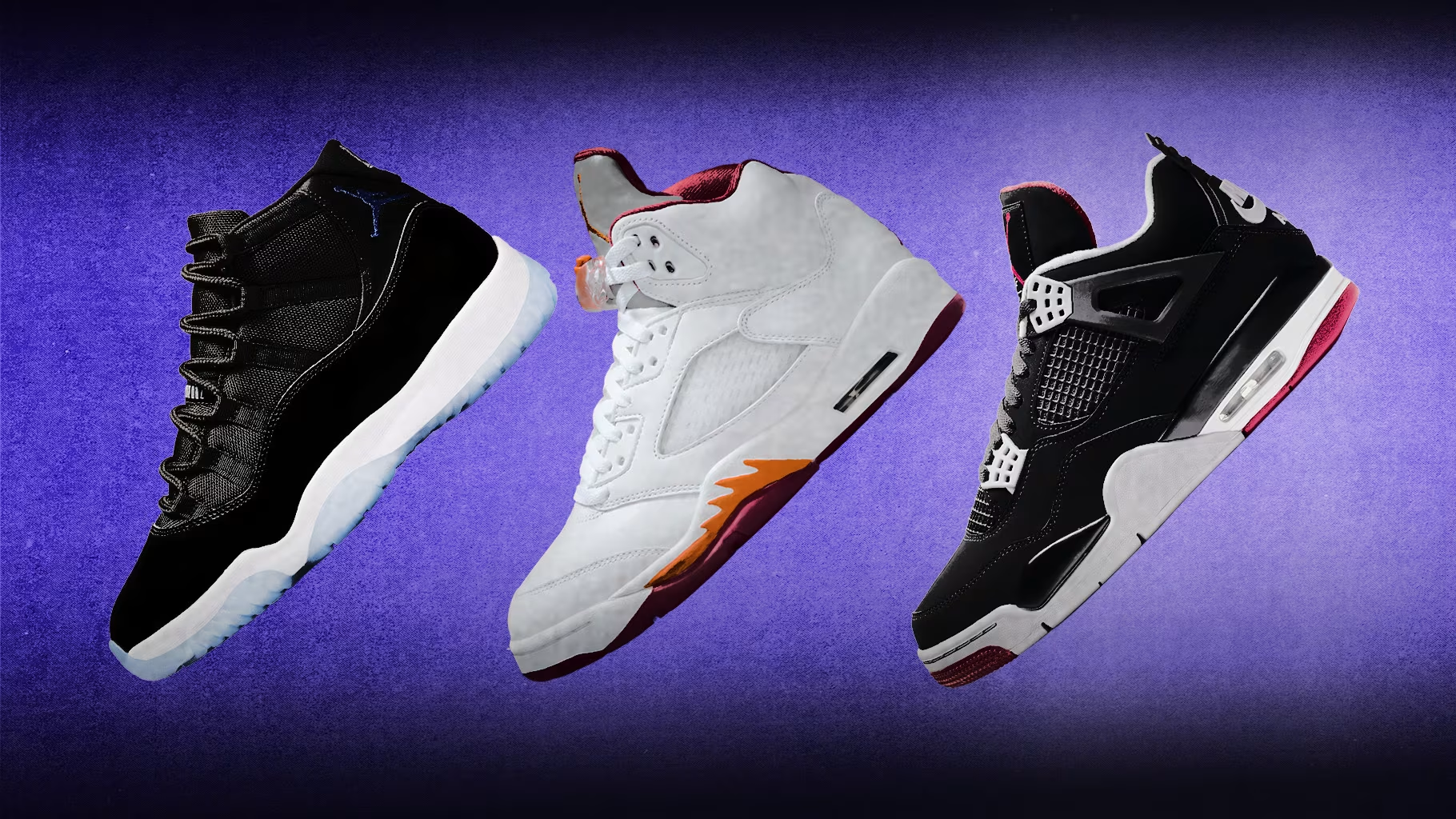
There's a project that I'm working on next year. So I've developed a great relationship with the CEO and the president of Nike. And I think Elliot Hill is an incredible human, first, but also his philosophies on the brand, very much on board for. And through the relationship and us wanting the same things for Nike, right, we came up with a concept because he stepped in a little later, or my relationship developed with him a little later than I would have liked for the 15 year, because I wanted to work on a big project for the 15 year. But then next year is also gonna be a big year because having two girls and thinking about them growing up and this thought process of me working on the kid's product while thinking about my girls growing up and us turning 16 and the idea of Sweet 16 for my girls, I came up with the concept of Sweet 16 for the brand. And then next year, getting to work with Nike on my favorite 16 Nike silhouettes.
So there's not much more that I wanna tell about that yet. All I can say is that that's gonna be a very special moment. There are many special moments leading up to that, but right now, because it's fresh in my brain, I just came back from Portland and we got to work on some amazing product, and I have such passion and love for the footwear industry. I want all of the brands that I love to be doing things that matter the most to people who collect like me. And I wanna be that purposeful when thinking about it.
And I've seen a couple of great examples of that recently. Some of these collaborators that are coming in with different products, I'm not gonna mention one over the other because I don't wanna favor one over the other because there are a lot of them that I think are doing great work. But restoring the feeling, and the era that I come from, so I'm from the mid-90s era of working retail, and I think within my community or my peers, there are only a handful of people that come from that era. Only people that come from that era can understand the max potential of individuality and what that can mean to a store. When people come in and they're shopping for their own taste and wanna be put on to brands in the shop that they're not currently aware of, or the purpose of certain product, that can really change the way you feel about product for your lifetime. And that's what it did for me, is seeing people gravitate towards product when they weren't on social media or led to some sort of product based on their algorithm. It was based on the sense of individuality, which is such a lost art at this point.
You mentioned this sort of evolution of sneaker culture, and I think we both lived through this from the 90s when there was a hunt for exclusive product, which meant trips out of town to weird mom and pops, then eventually the advent of consignment stores, and then what I would describe as peak sneakers, probably the last 10, 12 years, maybe 15. What do you think the path forward is for the culture, having hit this sort of saturation point and now enjoyed both ebbs and flows, where does it go from here?
It goes back to purpose. Product only should or need to exist based off of purpose. And the purpose needs to be transparent. And I think that that's where a lot of the industry has gotten lost. Someone mentioned this in a podcast I listened to recently, I think it was Jimmy Iovine, it said marketing is empathy. The businesses that we love, or the brands that we love, have very large businesses. And those businesses, for the most part, have shareholders. And double digit growth across the entire industry became impossible because there just aren't enough feet. It's just that simple, right? And how many pairs of shoes can people have in their closets? So when the balloon just expands, what happens is that one day you wake up, you open up your closet, you have too many shoes in your closet, and you're like, oh shit, I need to clean this shit out. Then you start to clean it out and you start to edit. That edit is like our job. That's like merchandising on the purpose of why we need to stay in people's closets and the purpose of why people should buy the product in the first place.
So if we can stay in tune, and when I say we, I mean the industry as a whole, as to why people buy product in the first place and what makes people hold onto product and cherish product, it can't be as disposable as it's been. And it has to serve purpose. The purpose of the kid's store is to have the best footwear wall in the world and have a selection from the top tier distributors in the world, or top distribution from those brands. It has been a challenge. And it's because all of these brands at one point, all of them, I'm not singling out anyone, have seen our tier of distribution as a moneymaker when in the past it was the top of the pyramid that trickled into the commercial part of the business. But when our tier becomes commercial, it's only a matter of time. And we've surpassed that time. We're on the other side of the mountain, I think, now. So now it's going to edit from here. It's gonna continue to cut until the feeling can be restored.
So when I work on these projects, having that knowledge, like I know what I'm trying to bring to the audience. I know what I'm trying to bring to the market. Through hard work and dedication and passion, I believe that I can make a difference. And that's really what it comes down to.
You mentioned the empathy and the working from the feeling backwards. And I have to ask, recently you have made a micro habit of gifting some of your most vocal detractors very exclusive footwear. What is the feeling that you are hoping to solicit with that move?
Just a reminder. It's just sending people a reminder. And I've only done that a couple of times, but it's not worth us speaking about it as news. It was more done on a personal level. I didn't expect the person to post it. That's not the purpose of why I did it. It's just a reminder of like, hey, I'm human. And this is something I never understood is like, how can people, everybody's entitled to an opinion. However, how much your opinion should count should be based on what you know, on the education that you have and what you're speaking about. But now everyone wants to be a critic and they're speaking on shit that they have no idea about. And in some cases, they even admit that they don't even know what the fuck they're talking about, which is the most mind boggling shit I've ever heard. I'm not here for that. I wanna let the work speak for itself and that's what that is. Letting the work speak for itself. And sometimes they don't know the work exists so I gotta remind them.
On the one that you sent to Chris from the Complex Style Pod, you said, from your quote, "favorite elevated licensing brand." So I take from that, it's something about that phrase that rankled you. Can you tell me what exactly about that got under your skin?
Yeah, how do I explain this? Like, when you hear your business and 15 years of your work, 31 years doing this shit and the amount of hours I spend on it, then for that to be belittled and narrowed down to be called an elevated licensing brand when the licensing portion of our business is less than 5%, I can't let that just pass without having to address it with someone who sits under the umbrella and labeled me number one in streetwear. And then they had a conversation where they spoke on it. But it was very important to me to then reach out to him in the way that I did and then we ended up speaking and then he came to the office and then he got to see everything that we do and I think he was pretty surprised and uneducated on our business and then got to see the reel on the product that we make and then I took him for dinner at Kith Ivy and then he got to see a little bit about the world that I built and for the purpose of why I built it.
He got to understand that through walking through and again, letting the product speak for itself, just walking through product where he then tried on a bunch of products that he liked and I don't think he really knew about the product that we made. And then he ended up going to the store in Miami and sending me a picture of a couple of things that he liked.
And by the way, I don't hold a grudge at all and it's not about that. The words didn't upset me. What upset me was that if you're gonna be speaking under a Complex microphone and have a pod where you're giving your point of view, you can't talk about your favorite brands in streetwear, because that was what the podcast was about, have Kith be one of them but then speak on an arcade game and say, hey, this is what we do, and I made this product and I made the year before as the product that you're speaking of. It's just a lot of it didn't make sense. So I just wanted to educate him and be like, hey, this is what we do, this is who we are, and I think he left the office feeling very differently about the brand.
But somebody who follows the brand closely, and there are many that do, and the business is successful, it's not successful from nothing. So there are a lot of people who follow the brand closely and understand the progression, the evolution, they've been a part of the evolution, they've seen it and felt it. Where if other people don't follow closely, they'll see a serial collaboration and then they'll see a Giorgio Armani collection and they can't bridge it. They don't understand how to bridge it because they don't know me.
I know that you see all of the sort of discourse online and obviously operating at the scale that you do, there is discourse about the brand.
I'm not focused on the discourse. I see some of it, yes, for sure. I mean, we all have eyes and ears.
What do you think is sort of the most misunderstood thing about the brand or the consumer?
I don't think the brand is misunderstood by anyone who follows the brand, but anyone, again, like I just explained, anyone who isn't following closely isn't able to bridge what we do. The problem is people hate what they don't understand. That's just natural for people, you know? And A, that's not great, but B, and most importantly, I was hoping people would get curious, just the human race, and not necessarily based on what they feel about Kith, but for people that don't follow it closely, it's just flashes and they're not able to link those things that they see, and that's okay. And the thing is, the product is not made for everyone. It's just made for people that know the difference.
People that know the difference about what?
I think it's for people that know the difference between good and great. I want to make great product and I want to make product that makes people feel, you know? And sometimes people will hate the product and the product is not for them and they could be vocal about that, and then on the opposite end, there are people that really love the product and appreciate it, you know? So at the end of the day, I can't please everybody even though I think Kith pleases the majority of a spectrum, like meaning, not the majority of people but the majority of the kind of consumer that we can impact. We cover so much. So we have a point of view on every category that we cover and that point of view sometimes is received, I would like to think most of the time is received well, and sometimes it's not received well and that's okay.
A couple of years ago, you posted on Twitter a thread about the sacrifices that you've made along the way in order to build Kith, and this included missing family events and friends' birthday parties and this kind of thing, and at Idea Generation, we reposted this and it was very polarizing in the comments. Looking back now, your life has changed quite dramatically. You are a father of two, you're married. How do you feel about those sacrifices now in retrospect?
Yeah, now they're just bigger. The sacrifices are bigger. Now it's time for my kids, taking time away from my kids, taking time away from my wife. And I think the understanding, I wouldn't be able to do this without my wife being who she is and understanding, you know, Kith was three years old when I met her and she's seen the growth and has been my biggest supporter. So if I didn't have an understanding wife that knew that this is my baby, this is my third baby, really my first, then it wouldn't be possible. But I have a great support system.
And most importantly, and I can't stress this enough, my team is the reason why I'm able to do what I do. The team is the reason I'm able to think the way I think, and when I say think the way I think, I mean I'm pushing the envelope, and typically I think that people in my position are worried about how far they can push things because they're worried about execution. And luckily for me, well, I wouldn't really chalk this up to luck because the team has been strategically placed. How to assemble a team that lets you work backwards from great ideas so that you have the support that you need across all the categories.
I think that ultimately everyone in their position has had to grow at the same rate that the brand has grown, and the brand and the company has grown tremendously. So the stress that it puts on every seat is also pretty significant. We've done a good job hiring by hiring very capable talent that have been willing to take on the growth. Can't say that for everyone or for many companies, where all of a sudden they need to be thinking about Ronnie's, and food and beverage, or they need to think about what we're doing in Kith Ivy from a hospitality standpoint, aside from all the other things that we've grown and gotten into. I continuously am throwing wrenches in the program knowing that it will sometimes exhaust the system, but having an incredible system there to support it.
You think it's controversial now?
I think in 2026, generationally, attitudes towards work have changed somewhat dramatically.
What is the key to your sort of curation of staff, and also can someone thrive at Kith that does not make Kith their life?
Passion is key. You don't have to make Kith your life, but you have to love what you do at Kith. And the passion will allow you to make the hours count. And everybody, by the way, this isn't only for Kith, and I truly believe this. If you're not passionate about what you do, you should quit today. I think passion will make people work harder, and I think passion will have people be twice as efficient. Because if you're doing something and you're not into it, you're not gonna do it to the best of your ability, right?
And I think that passion has been rewarded at Kith. I will say that. And I think that that's the difference maker. I think every brand should focus on hiring people who love what they do. It's kind of cliche to say it, but to me it makes all the sense in the world. The difference is executing that is pretty difficult, because at Kith you're not signing up for a job description. You're signing up for executing certain tasks, but then you're also asked to be part of the growth in wherever we go. And we're consistently going in different directions.
You also talked before about the challenges of being a boss, in so much as the necessity for confrontation and uncomfortable conversations. How has your approach to those conversations changed?
Conversations with who?
Internally, as a boss. When we talked in the blueprint, you were saying that you think you're a good leader, you enjoy leadership, but being the boss at times is taxing because it necessitates uncomfortable conversations.
Yeah, if it was taxing then, or I made you think it was taxing then, eight years later the staff has more than quintupled, so it's taxing and it's tiring. But that's why I approach it like a sport. The difference between eight years ago and today is today I'm hyper-focused on sleep and food and exercise and how I work out and lift. I really treat this like an athlete would. So if I go into the office and I have ten meetings a day back-to-back, I need to be as enthusiastic about the last meeting as I am about my first. I need to be in a creative mode for half the day and then make critical business decisions the other half of the day. So it requires me to be very alert and on my game.
There's no difference, because this is a sport to me. I'm doing it to be the best, but I'm not really competing against anyone. I've never seen us as competition to others. I've always looked at what we've done in the past and always tried to be better at it, so I'm always trying to be the better version of myself. That still stays true today, but what I'm doing to go about it is different from what I was doing yesterday.
What part of the business keeps you up at night?
No part of the business keeps me up at night. When I go home, I'm home. Now it doesn't mean that I'm not checking my emails or Slack, having ideas in the middle of the night, writing them down. But if I'm up at night, it's for a good reason. When I say good reason, I mean it's for a creative reason. I have ideas. But there's nothing that really keeps me up at night in terms of me worrying about the business.
I'm always worried about the business, so again, it's like having a kid. Do your kids keep you up at night? No, but you're always worried about your kid. It's kind of the same thing.
You mentioned having plans as far as five years out. When you close your eyes and think about what Kith should look like in five years, for the 20th anniversary, what does that look like?
I'm already working on projects in 2029 right now, so I have a very clear idea as to where we'll be then. And I don't think there's anyone in our world that's thinking about — and I wouldn't say the business, just thinking about the purpose — the way that I am, in the sense of what the brand can do, how the brand can be a part of people's lives.
What do you mean when you say that?
Okay, so I'm a very ambitious person.
I picked up on that.
Yeah, you've known me for a long time, Noah. You know that I don't sit still. My life has changed so much over the course of 31 years of working in this industry. I'm trying to incorporate every facet of my life into the business, and that's how I've opened up stores. If you think about where I travel — between Japan, LA, Miami — those are the first stores, that was the roadmap for the business. But now it's very different from that. Now the brand has the power and the ability to get into other facets of business.
So food and beverage was one of them. To be able to do what I'm doing with Ronnie's and where I'm gonna take Ronnie's, it's endless. The ideas that we have when we sit down and think about the future of what that looks like, it gets me very excited. And then what Kith Ivy represents is a whole other facet of business. So in tackling hospitality, how that's gonna look and what that's gonna feel like for the brand, I'm starting to explore that in ways that no one in our world is doing. That's exciting. I gotta be excited, I gotta be inspired. So for me to be inspired, I need to push the envelope and do things that are new, to take the brand to places it's never been before.
I mean, why wouldn't I try to do things that aren't typically what these companies should be doing? Why wouldn't I do that? If you apply to seven universities, you're gonna pick the best university and try to better yourself in the best way possible for what your roadmap in life can look like. My life has been that. I'm trying to take steps into becoming the best version of ourselves.
Kith is not a typical brand, and I've shown that. Whether or not people wanna see it collectively or not, I've shown that Kith is very multifaceted in what it could do. Just because I'm making sandwiches at Ronnie's, that doesn't mean I can't make an incredible coat in a collection. But people try to — and that's the thing. In this industry, you'll have the subcultures of these snobs who are into menswear, and in their minds they're like, if he's working on something with Kith Treats in a different category of the business, we can't respect what the menswear piece looks like. But I can literally teach those people what that could look like. I could sit down and show them how a product is made, which I'm sure they don't necessarily have a clue. They think within parameters, and I don't like to be in that position.
If I wanted to focus on one thing and become a denim brand and be the best denim brand, I think I could come close. But I can make really great denim and have that be a small percentage of what we do and do a lot of other things. That's who I am. I started collecting Marvel cards, and then that led to footwear, and then from there that led to watches, and then that led to cars, and I'm still collecting all of those things — still collecting Marvel cards and footwear and watches and cars. To me, it's additive. What I plan on doing in the future will not replace, it'll just be additive on what we do.
What are the moments that still give you the biggest dopamine hits as an entrepreneur, as a creative, as a businessman, 15 years into this business?
I think those new areas of business is what does it now. Kith Ivy was a three-year project. It took me a year to design it and then two years to build it, and what we were able to build — I walked into that space for the first time after it was finished and I almost broke down. It's a lot of work. There's so much love that goes into it.
And this space too. When I walked into West Hollywood for the first time, I was actually pissed the first time I walked in because a lot of things were wrong. But then getting through the punch list and then the end result of what it is and what it stands for — it's a home for people. It's a space that people spend their Saturday.
Walt Disney, when he built Disney World, there's a plaque at the front gate, and it essentially says you're leaving today and you are entering tomorrow, the future and fantasy. The idea is that parents and children, all your worries are melting off your shoulders as you walk into this park. I'm sure as a father you've been to a Disney World. What is the feeling that you are hoping to impart when someone walks into a Kith store or walks into the Ivy? I'd love to compare the two.
They don't really compare. There's a red thread, but they don't really compare. The genius of Walt Disney is to be immersed in a world when you walk in. Every facet of what you're doing feels like you're a part of that world. What allows you to do that are the characters and the rides, and living through your kid when they see it for the first time and the emotions that you have. I was crying like a baby when I took Maya to Disney for the first time.
With Kith, it's very different. What I want people to feel there — let me walk you through the Kith Treats concept for a second. I don't think I've ever told this story publicly. Originally, I used to go to Club Med on vacation. In Turks and Caicos, Club Med, which was super run down, but some of the best times. In the cafeteria, they had this white chocolate bread that I was obsessed with. I probably gained five pounds every time I went. So I grabbed the chef and I was like, please, let me fly you to New York.
When I rebuilt the Brooklyn store, the Kith on Flatbush and Bergen, the window — what I wanted, my dream, was for people to pass by or walk past the store and smell the white chocolate bread that I smelled in the cafeteria. That was step one. I started to link the two. I was like, hold on. I walked in here and wanted the chocolate because I smelled it. And it made me so happy just to smell it. And then I ate it and I was even happier. So then I was like, I want people to be happy shopping the store. Let's add an element of happiness.
So I was gonna open a white chocolate bread space. It was gonna serve one item, this white chocolate bread. At the time there was a place called Cafe Bari on Spring and Broadway — that's where Nike ended up. But before Nike took the space, it was this really iconic cafe where all the models were hanging out, and the son of the owner, Bari, later became one of the partners or founders of Baked by Melissa. When I wanted to open this white chocolate bread space, I brought him on board and we were gonna do this thing together. I originally had the idea of having a cereal bar, but the white chocolate bread was winning in the race.
So we brought the chef to New York and he gave us the recipe. But after the chef went back, we were trying to make the bread and we couldn't make it the same way. I had this idea of a cereal bar from like 20 years prior — different flavored milks, different cereals — but we were still trying to get the white chocolate bread right.
So one day we're taking a walk to the deli for Danny to buy some cigarettes. He walks in, I'm standing at the front, and I see the dude behind the counter throwing frozen fruit into a machine and pulling the lever, and it's coming out soft serve. I'm like, what the fuck? That's awesome. Then I look right into the aisle of the deli and I see the cereal aisle. I'm obsessed with cereal — I had to quit cereal because it was getting crazy. And I'm looking at the cereal aisle, and I'm looking at the guy pulling down this lever, and I'm looking down, and I'm standing in front of a refrigerator and I see a tub of Breyers.
So I walk into the aisle, I grab a box of Frosted Flakes, and I come to the guy, and I grab the Breyers out after he's finished with the customer. I was the only one in the space. I was like, listen, I'll give you 20 bucks if you throw a couple of things in there. He's like, into what? I was like, into the machine. Just throw a couple of things. So I gave him the Breyers, and it wasn't like the deli had a scooper, so I took a spoon and we had to wait a few minutes to melt it a bit. I grabbed a bunch of ice cream out of the tub and then I had him pour a cup and a half or so of cereal in, and I had him pull the lever. Danny's standing next to me, and I remember looking at Danny and being like, we're gonna be billionaires. This is the greatest idea ever.
So he hands me the cup, and I taste it, and I'm like, oh shit, this is insane. I was like, I'll give you another 20 bucks if I can go back there and see what that machine is. So I go back there and there's a number on the machine. I call on the way to Cafe Bari, and it was an expensive machine — like 13, 15 grand, I don't remember what it was. So I ordered two of them. I don't care, I gotta buy these machines. I had them shipped to Cafe Bari, and we installed the machines three days later and we started throwing everything in the machine. He was selling pastries, and we were throwing muffins in there and mixing cereal with everything. It was such a great time because it was exploring something brand new.
Nobody has ever done that, you know? And that was the birth of the space, and I completely changed the concept, and then that's when Kith Treats was born, and the concept of it was just to make people smile. So the first day that we opened the space, the store was really busy inside, and R.I.P. to Clark, he DJ'd the event, and I remember we're standing outside, and everyone's inside and focused on what's happening inside. I'm focused on what's happening outside because the window was facing the street, and I was paying attention just to everyone's faces that were having this ice cream, and every single person smiled, and that became a new high for me. That was like, the dopamine that you're speaking of, that was it, right? It was like, how do I make people smile, right?
And if I could do that, by the way, it was gonna be a loss leader. I wanted to lose money with Treats when we first opened it. Even though the original idea, when I first tasted it, I was like, this is crazy, this is gonna make a ton of money — and then I was like, how many ice creams can we sell? And the thing about Treats is that you can't package it because it gets stale. When you freeze the cereal, it gets stale. So I knew that it wasn't gonna be this crazy business, but ultimately, I wanted it to be a part of every store that we opened because I wanted people to be able to experience the brand in different ways than buying the typical products we were selling. So that was a really fun time.
And then that evolved into now Ronnie's, which what I'm trying to do there is just make the best New York sandwich, right? The pastrami sandwich in LA has taken off. It's a major hit and it's also my favorite sandwich I've ever had in my life, but there are a couple of sandwiches on that menu that are incredible. So I have plans on what I'm gonna do in New York with that. And then in London, the burger has taken off and it has become incredible. So I'm really excited about Ronnie's and seeing that, having that feeling again of starting a brand from scratch is incredible, and having it be under the umbrella is even more incredible because you have the like-minded consumer that thinks already like me — because I'm the consumer — that's gonna be able to indulge and experience this product. And that's what it was built for. It was built for that same consumer.
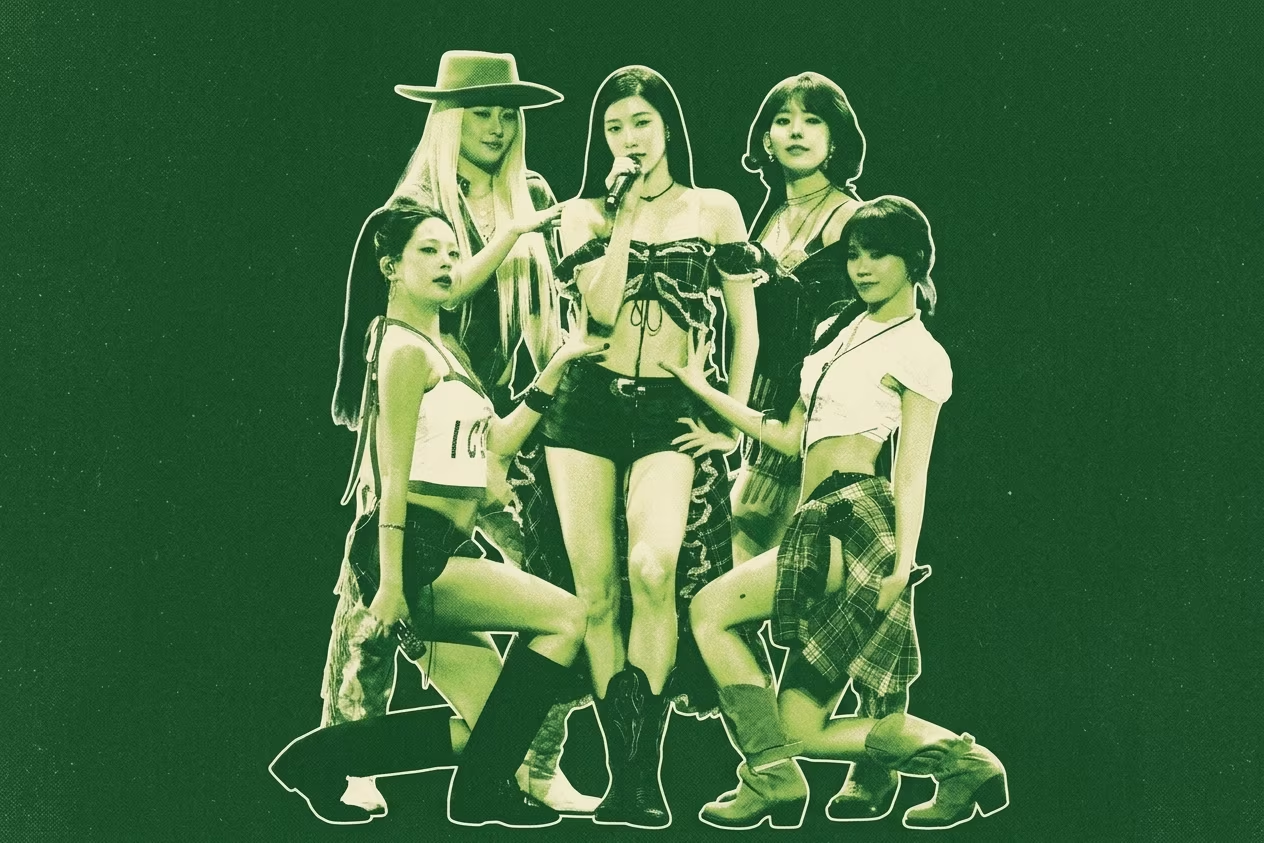
Earlier this year, you put out the collaboration with Lisa from Blackpink, and when being interviewed about it, you mentioned that getting it right in the women's market had taken a little longer than you thought. I'm curious, what were the challenges and what was it that sparked that breakthrough with that product in particular that made you feel like you got the category correct?
So that's a good question. I think, well, first of all, when I say to get it right, getting it right was the big brother which was the men's collection, and that's what it's been for both women's and kids. And it's sort of unfair to compare the three because men's started from the very beginning, and then women's came on a little bit later, and then kids came even later than that. And now we're at the average sell-through across men's, women's, and kids. So it has reached the same success that men's has, right?
So getting women's right was a tough lesson for me, which was staying the course and being consistent. And again, I think it took having my lead designer — both of my lead designers, I should say all three of my lead designers for men's, women's, and kids — they're super, super talented. But it's so important for them to have a cycle, a full cycle to learn from. And in this world, in this business, the consistency is so much more important than people give credit to. Having someone in the seat for a long enough time will sharpen your sword even more so than anything else you can do, because they learn from the mistakes — and it's not mistakes. If you make a product that people don't buy, it's not a mistake, it could be timing. Military comes in and out of fashion, metallics come in and out of fashion, fabrics come in and out of fashion, animal prints in and out of fashion, and then certain fits come in and out of fashion.
So sometimes getting the data and seeing what people gravitate towards under the subculture of the brand — so there's the market and then there's what people would want to gravitate towards from the brand itself — and sometimes there's misalignments depending on where people come from. Like if I have a designer that comes from another brand, they're used to the consumer gravitating towards a certain product one way. That's not gonna apply to Kith.
So it took time to have consistency there. And Katie on the women's team, she's very talented, she understands merchandising in a great way, because like we mentioned before, that can be a battle. But she understands it. So there are some designers that come in that have that merchandising element. And I think that Vicky on the men's team, who's really, really talented and has become such a close friend of mine throughout the process, she's gained that talent through her tenure here. So we're learning together, and that's a beautiful part about it — the design team, we've all kind of looked at selling and understood what people want from the brand together, and then we've ideated against that together. So it's a culmination of many different people in the room and ideas that we all have together that makes it successful.
Last time we talked, I asked you about whether or not you were being solicited for any inbound interest in buying the brand, and you told me there was a folder in the lower right-hand corner of your Mac where all of those emails would go. Is that still true?
It's still a folder.
Would you consider — are there any circumstances that you think that would be the right move?
Not today, not today.
You also talked about, in that moment, wanting Kith to remain a family business and for your, at the time, sort of hypothetical son or daughter to run the company one day. You now have two daughters who are real little people with thoughts and ideas. In the light of that reality, do you still have that aspiration for them?
I don't know if I want my kids to go through some of the shit that I go through, man. And again, it all looks incredible for the end result of what people see, but behind the scenes, I come home with migraines a lot, and I try to shut off when I get home, but it's a big responsibility when you have that many employees that work for the company and that rely on you to make the right decisions. So I'm not so sure. I haven't given that a lot of thought. My eldest is five. So I haven't thought about that much, to be honest.
How do you navigate it when you have made what you feel is perhaps the wrong decision?
This is gonna sound crazy, but there's no such thing as the wrong decision, because I'm now thinking for the brand. I'm not thinking for myself. I'm thinking like the brand and myself are synonymous at this point, because I've been doing this for so long that decisions on what I think the brand needs are second nature to me. Even when it's pushing forward and doing things for the first time.
Yes, those conversations with my CFO could be puzzling at times when I'm like, hey, I think we're gonna invest into — even for Ronnie's, for example. It's just a feeling that I have that I think we should do. And I'm thinking for what the brand — the brand has pivoted so many times.
Thinking about, for example, the show that we did in front of the store last year. That was a very expensive production. And it almost rained. That investment was north of a million dollars, that show. And it was on the forecast, it wasn't gonna rain. I'm tracking it for two weeks until the day before, no rain. Now, the day of, we're looking at it and it's like rain, no rain, rain, no rain. And then an hour before the show, I'm sitting inside the store in the dressing room, very disappointed with myself, very disappointed that I thought it was 100% gonna rain because it was showing thunderstorms.
It stormed right before, like 15 minutes before people were supposed to get there. And I'm looking at the radar live on an iPad and it was supposed to come and just rain like where we were for the next hour. And it literally took a left turn. The storm just took a left turn. I'm watching it live and clear up, live. We were like two seconds away from texting everybody not to come. And it wasn't about the money — it was about how much time and effort the team put into making that happen, because I decided four months before the show that we were gonna have a show, which was a crazy wrench in the program to begin with. And I was more worried about their feelings than mine.
But then the show happened and it was incredible. And the people that came to the show — it was just an incredible New York City moment.
And then I think back to the dinner that we had in the stadium that night when we launched that collection. We set up this incredible dinner — we do the dinners, we did the quarry with Giorgio — like we wanted to have a follow-up moment for that. People were already expecting us to have these extravagant moments for these dinners. And I was like, okay, we're gonna build the design around this. There's this girl that works for me, her name is Jen, and she's incredible at producing these amazing events. And we put together an incredible dinner and it rained out of nowhere, and we had to change the location inside the stadium. It was a ton of money spent and gone, but it was worth it.
So sometimes things don't pan out the way you want it to and it's a huge investment, but sometimes the juice is worth the squeeze regardless. And you need to think about, okay, what happens if the worst case scenario occurs? And for me, it's still worth trying to execute it.
You've talked a lot about both the singularity of your vision and also the trust that you have in your collaborators and your team. Can you think of a specific instance recently in which you allowed someone else's decision to trump your own gut or instinct?
It happens a lot. I have a merchandiser that works with me, his name is Alex, and we go back and forth constantly around what we think release dates should be, when things should get placed on the calendar, how much product we should buy. And then I have my special projects team where we think about what projects end up on the calendar, what we do and what we don't do.
Golf is one of those examples. I said originally, for quite a while, I'm not making golf product because I don't play golf. This brand has been about me and my passions and I don't play golf, I don't want to do it. But my COO and my VP of product, his name is Michael, he's been with me for a very long time, probably 14 years. Nick has been a day-one guy — Anacone, you know him. They're golfers, they take it seriously. So at one point I was like, this brand stands for more than just me. There's company culture here, and Michael's in product. If Michael wasn't in product and it was just Nick, it would be an issue, because Michael plays golf so I know his point of view. He can have the brand's lens and work through the brand's lens because of how long he's been there. That one was loud. But it made it easier for me to make that decision.
And even though I am not a golfer, my point of view on the hard goods — because I designed the hard goods, the all-black set, the mixed metal pack, and we have things coming in the future — I thought that my point of view, applying that to golf without being a golfer, is what actually golf was missing. So it ended up being a great combination. We had great chemistry between what Michael brought to the table and then an outside point of view with what I brought to the table. It was great.
You have 15 years here of work and a lot of success and a lot of growth, both personally and with the brand. When you are having your by-myself meetings, thinking about your own leadership, the way that you present, the way that you create, what are the goals that you are putting on yourself for the next year?
The goals that I've always had — for example, when I first took on the Sebago project back in the day, I forced myself to fly to the Dominican Republic where the shoes were getting made and I stayed there for three weeks to work the lines. I wanted to really learn how shoes were made throughout the process. Every single position within the factory was vital to the completion of the shoe, and I needed to immerse myself in that and learn how to make a shoe from scratch. So that when I thought about what I wanted to apply to the shoe, I could think about it through the process of how the shoe was made and the capabilities of what could be done.
You don't want ideas to go to waste. You want to work backwards to be efficient. You need to know what the factory is actually capable of doing before you start to dream up anything. So I stayed there for three weeks because I actually designed product there — new silhouettes, designed with a pattern maker, and then saw the patterns being cut, uppers being sewn, uppers being cemented on tooling and then lasted and thrown in the oven. I was a part of all of it — the hand-sewn construction. There are guys that are literally hand-sewing with needles by hand. Sebagos were made by hand.
So my goal going into anything new, and where I take this thing, would be for me to be as researched as I can so I can make sure it's the best version of itself. With Ivy, for example, I needed to do so much research into what the materiality of the space can look like and feel like, and visit so many different spaces and be inspired by so many different spaces before I could have a point of view where I know it could then be the pinnacle within that category.
So I just want to still be able to learn at the same rate before I push the brand into anything new, so I can make sure that it's in line with the greatness of what we've been able to accomplish to date. That would be my goal.
Great, well, Ronnie, thank you so much for your time and your candor and wisdom. This was really great.
Appreciate it, man. I hope I talked enough shit.