It’s the day before Casablanca’s Spring/Summer 2027 show, and head honcho Charaf Tajer is juggling several things at once. Casting is underway; lighting and soundtrack are next. Across Paris, a venue is being transformed into something regular fashion-show attendees won’t recognise. “We’re making it look completely different,” he says.
The building has become an important part of Casablanca’s journey. Designed by Brazilian architect Oscar Niemeyer, it was something Tajer passed every day on his way to school, staring up at a structure that looked like nothing else around it. “It feels like a kid’s drawing,” he says of the former Paris headquarters of the French Communist Party: a few simple shapes, topped by a bowl that appears to float on five or six pillars. Now, Casablanca has shown there, “in the area where I grew up and walked by as a kid with dreams.” That homecoming says a lot about Casablanca. In an industry that has drifted towards the modular and muted, the brand has stayed uncompromisingly bright. For Tajer, colour is essential to self-expression. He describes Casablanca as design infused with positivity, and believes that positivity can still be deep, even if there’s resistance to the idea. In France especially, he says, people assume “to be deep, you gotta be dark or sad.”
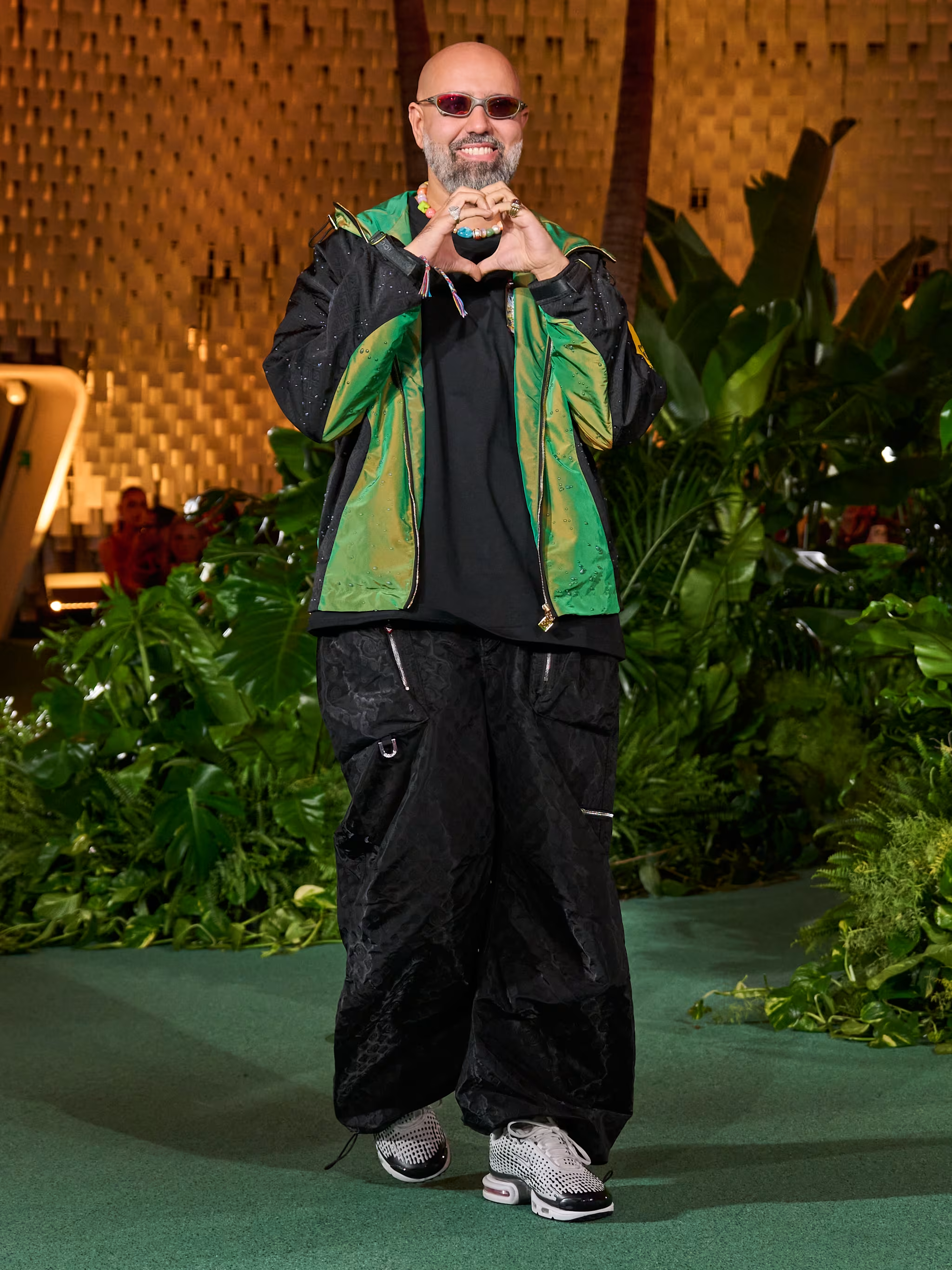
Casablanca’s SS27 collection is called AMOR E PROGRESSO, a rewrite of Ordem e Progresso, the motto on the Brazilian flag, with love in place of order. 24 hours after we speak, the free-flowing venue has become the alternate universe he promised: the aluminium strips 36ft above us in the auditorium glistening in reds and purples, with models carrying surfboards and shimmering with water beads. For the length of the show, you could have been beachside in Rio. Niemeyer’s signature curvature also flows through the runway looks. Silk wrapped around swimwear. Football shirts turned up in formal looks. Sportswear sat alongside embroidery, while animal prints and snake detailing ran across both. Womenswear moved in asymmetric hemlines.
The show notes describe a collection in which apparent opposites coexist, which is exactly how Tajer talks about the country the show is dedicated to. “We don’t know what tomorrow is made of, right? That feeling is even more apparent in Brazil,” he says. “But still, they keep it positive.” He is careful not to romanticise it, and says more than once that Brazil has social problems everyone knows about. What he admires are the moments when people from every background share the same space. “There is no private beach,” he says. “Everybody is together.” He thinks the rest of the world has noticed too. “They managed to make us wear yellow and green, which are not easy for us to wear.” Where the American flag was once the one you saw on every jacket, he adds, “today, I feel like Brazil replaced a bit that flag.”
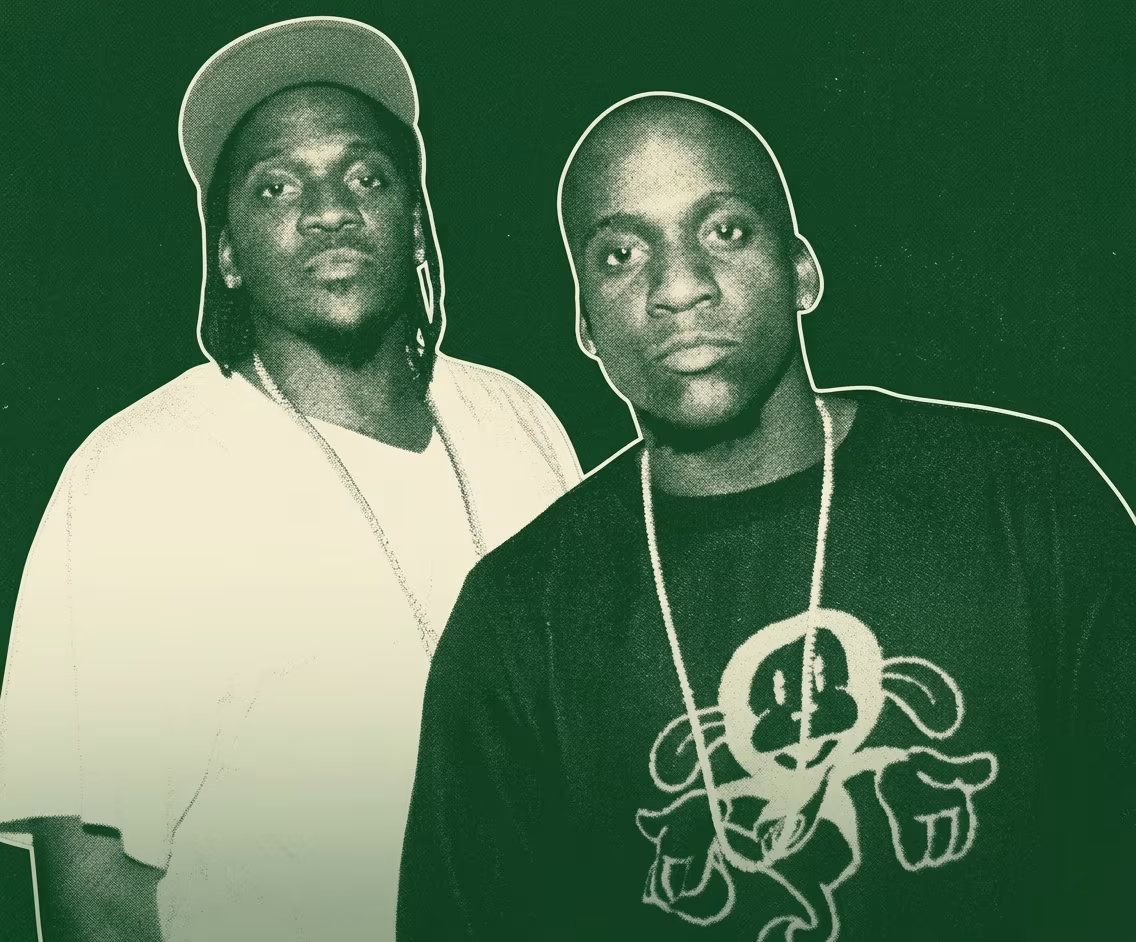
Brazil reached Tajer through music first, and through Jorge Ben Jor above all. “Without Jorge Ben Jor, I would never understand that you can be so complex in your art, but still so positive,” he says. But it wasn’t only the songs. He admires the way Ben spoke about himself as a man, refusing to be reduced to a category, and how he stayed within reach of ordinary listeners. He calls him “so forward-thinking and accessible. A true man of the people.” He puts Gil Scott-Heron alongside him, too: “I've always been very, very deep in his music,” he says, describing the two as “two sides of the same coin.” Those same instincts explain why New York rapper Jim Jones, who has been popping up frequently on the brand’s feeds, makes sense as a Casablanca muse. Tajer grew up a true hip-hop head, on Dipset and Jones’ solo records. He rightly credits Jones as one of the first in US hip-hop to wear Chrome Hearts, long before everyone else. “First of all, I'm a fan of Jim Jones,” he says. “He’s really a design guy. I can tell.” What he recognises is someone who cares about “the design, the details, the shape, the wash of the denim.”
That love for craftsmanship came from a less obvious place. As a young intern, Tajer worked backstage at a Rick Owens show at the Palais de Tokyo. He found a room full of people in black, bombastic silhouettes that, frankly, weren’t for him. But he still found the experience fascinating. “I remember thinking, ‘This is so extreme, but so cool.’ I knew it wasn’t for me. I’m just not someone who would wear that. But I love that those clothes connected to such a cult audience.” He didn’t go home and start drawing like Owens. He took the principle instead: do the thing that is completely yours, and the people who think like you will find it. When I ask whether Casablanca is an antidote to conformity in fashion, he pushes back. An antidote implies a disease. “Alternative” is the word he settles on. “Imagine you have only Italian restaurants,” he says. “You want a Japanese restaurant, an Indian restaurant. You need variety.”
Tajer sees the paradox of a regimented industry “when we’re supposed to be the industry of creativity.” And for him, that creativity can be as simple as wearing colour. “I have no problem wearing colour—it should be a normal thing.” It is perhaps one of the clearest examples of what he means by Casablanca as an alternative: making something bright and expressive feel accessible enough to become part of everyday life. One measure of how far that idea has travelled is how often it gets copied. Tajer remembers seeing knock-offs of a designer he admired in fast-fashion shops as a teenager and understanding that the man had changed how people dressed. Now it happens to him. “It’s cool,” he says. “It shows that we impacted how real people dress today.”
I can vouch for it. My own wardrobe is about as stripped-back in colour palette as it gets. A few years ago, this became an issue at my sister’s disco-themed wedding in Australia, where I had packed nothing remotely colourful enough in my suitcase. The solution was hanging in a shop in Melbourne: a fake Casablanca shirt. When I confess this, Tajer smiles. He loves the idea of that journey, that an idea can reach the other side of the world. “Things are accessible now,” he says. “With good ideas, you can create something new that people across the world will resonate with.” He sums up his brand’s journey in one line: “It's like an idea that becomes a drawing that becomes a shirt that becomes a brand that becomes my life. And then it becomes the life of many other people that work with me.”
Ask Tajer to predict where Casablanca goes next and he declines the premise. Living in the past or the future “is never good,” he says. “This is where the worries come from.” It is the same thing Brazil taught him: today is like this, tomorrow will be something else, “but you always come back from it. You get stronger.” One thing Tajer will commit to going forward is a mood. “I project for the brand, as I hope for all of us, something positive in the future,” he says. “And no matter what happens, it’s gonna be bright.”