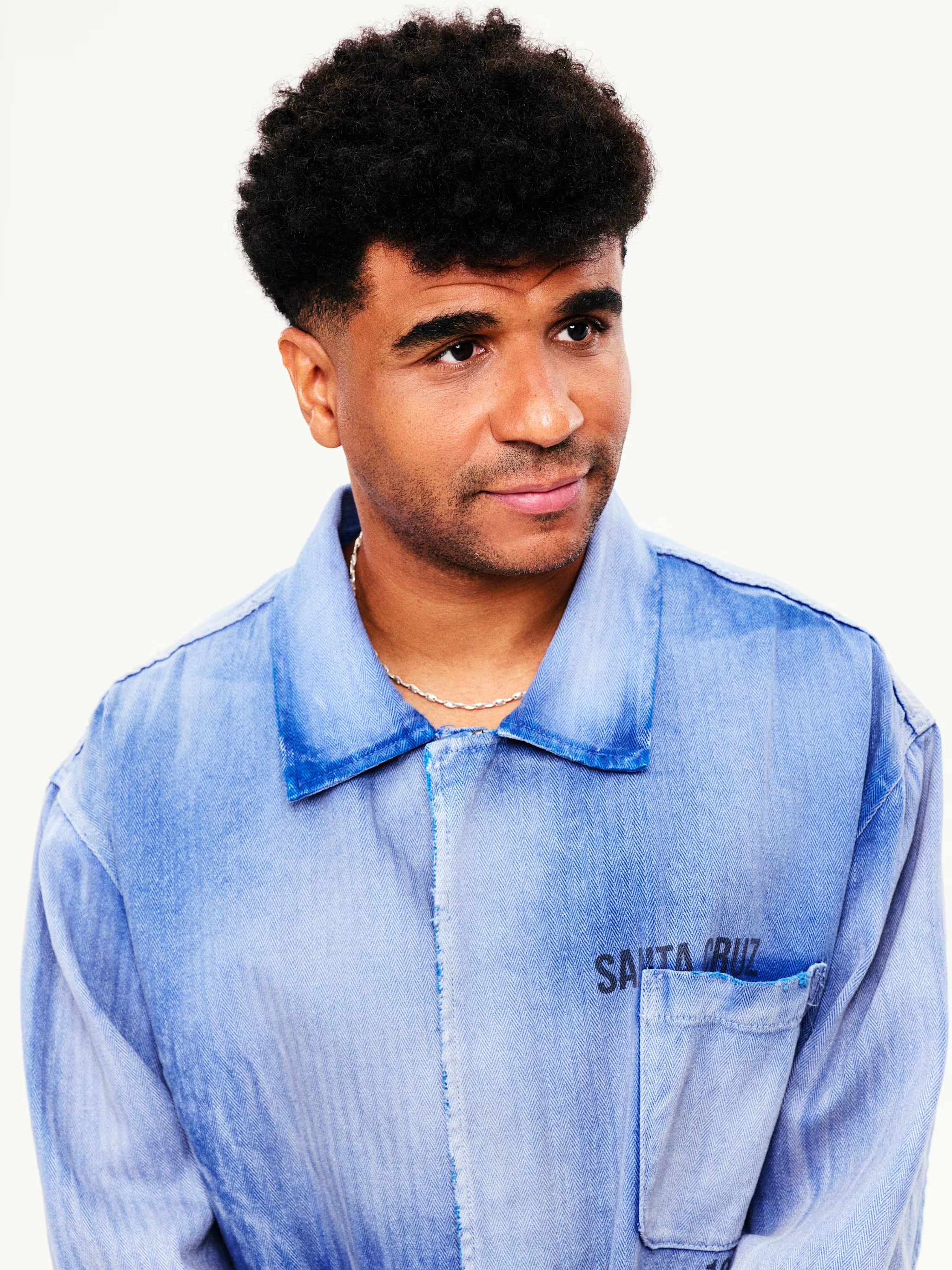
For more than two decades, super-producer/DJ Jamie Jones has been moving through house music’s ever-evolving landscape without losing sight of what made him fall in love with it in the first place.
From growing up in North Wales, where BBC Radio 1 was effectively his gateway to the wider dance world, to building house stables like Paradise, Hot Creations and Hot Natured, Jones’ career has always involved looking forward while taking cues from what came before. “I’ve always prided myself on trying to keep my own flavour, my own basslines, my own sort of vibe,” he tells me from his hotel room in Ibiza, where he plays every Wednesday night at Amnesia with his Paradise club night. “As my career’s grown, genres have changed and things have evolved, but I have always fed off inspiration from the old and the new and tried to put my own twist on it.”
Jamie Jones’ appetite for music discovery can be traced back to his teenage bedroom, where he was teaching himself to mix records after hearing house icon Carl Cox explain the basics during a Pete Tong Radio 1 segment. Before the clubs came the music itself; he was hooked from the start, drawn to it before he had the freedom to chase it around the country as a raver. His 2009 remix of Azari & III’s “Hungry For The Power” would eventually change everything, going on to take on a life of its own after not getting the response he’d hoped for when he first played it out in Miami. But for Jones, it’s never really been about success for its own sake: “When people come up to me and tell me, ‘I got into house music because of you,’ that’s honestly amazing to me.”
Now, with a few decades behind him and a new generation watching, Jones is starting to notice just how quickly the years have flown by. “All of a sudden, people are calling me ‘Uncle’,” he laughs. It’s a funny shift from being the youngest person in the room to becoming one of its longstanding figures, but Jones is still as busy as ever. Voyager, his new event series which kicks off at new London venue Ironworks on Oct. 3, will bring together old tracks, new voices and fresh ideas—while upcoming music with Emmanuel Jal, new Hot Creations material, a Hot Natured project and an orchestral-house LP with Kate Simko point towards another busy year ahead.
The Welsh house music pioneer talks us through his new project, Voyager, two decades in the game, and why he’s excited about the next generation of DJs and producers coming through. Tap in below.
COMPLEX: So, you’re set to open Ironworks in London on October 3 with your new Voyager concept—which I’m personally looking forward to attending. But what is Voyager trying to say about your journey so far? Is it a reflection of where you’ve been, a look at where you’re going, or something else entirely?
Jamie Jones: I’ve been releasing music and touring for a little over 20 years now, and one of the things I’ve really prided myself on is trying to keep my own flavour, my own basslines, my own sort of vibe. As my career’s grown, genres have changed and things have evolved, but I have always fed off inspiration from the old and the new—what the younger guys are doing—and tried to put my own twist on it. There were a couple of things that led me to launch Voyager. I did this OtherWorld show for Coachella and III Points in Miami, which involved playing a lot of my own music alongside a special visual show—and that was great—but I really wanted to make it more than just about me doing that for an hour and a half. After I did a 2010 set at Paradise Festival in London last summer, the response really rang home to me how special some of those moments were in the early days of my career. I don’t like looking back and just focusing on everything that’s been done, but this felt like the perfect way to bring together the new singers I’m working with, the older singers, that old-school vibe with the new school, and the new guys I love bringing in to play at my nights. That’s one of the things I love—I love listening to them and feeding off that new energy. So this is just a way to bring it all together.
There’s been a lot of talk around the new Ironworks project and your involvement with it. What exactly is your relationship with the venue? Is this your venue, a partnership, or are you there purely as the artist launching Voyager?
[Laughs] Really? I wish I owned it. No, no, no—I don’t own it. We were trying to do Paradise Festival again this summer, but we couldn’t use the same venue; Junction 2 couldn’t use the whole site again, so we searched for a long time to find the right place to do a festival in London, and then we couldn’t make it happen. I spent a big chunk of my adulthood in London, so I know how exciting it is to go to a new venue. When the same guys who worked on Paradise Festival were doing this new venue, I thought, “You know what? That sounds cool.” We were part of Drumsheds for the first couple of years with Paradise as well, which was great, and I was there in the early days of Printworks. I’ve done all these different venues, and I just like that experience. My first experience as a promoter, long before Paradise, was putting on these raves just off Brick Lane called DJs Can Dance, in a warehouse. So I know what it’s like being young in London and going to a new warehouse space—it’s exciting! This was just about being part of that and working with them; that’s it. I wish I owned a giant piece of land near City Airport, but I don’t.
Ironworks is such a huge space, so how do you maintain that intimate, underground feeling when you’re suddenly playing to thousands of people?
One of the things I’m thinking about now is that, when I’m playing, I try not to think too much about what’s going on around me; I try to feel it. Sometimes you’re in a massive space and you’ve got to start playing, and you can feel that the energy needs lifting. It has a lot to do with the acoustics as well. If a space has enough bass, you can play a little deeper because people are getting that energy from the bass grooves. If there’s not enough bass and it’s a bit rattly, people tend to feed more off the hi-hats and stuff like that, so you have to play a bit more like that. We’ve always got a bunch of people on stage, so I’m constantly reading the room and seeing how people are responding, and whether it’s the right moment to go a bit deeper or whatever. For this show, I’ve been slowly working on a lot of my older tracks over the last few months. When I made them back then, there weren’t even YouTube tutorials on how to mix records, so they’re really rough. The ideas and originality were obviously there, but the standard of mixing and mastering just doesn’t quite match up with how things sound now on big sound systems.
So what I’ve been doing is going back and—not remixing them, as in changing the tracks—but just beefing up the bass and changing some of the kick drums, because you have access to so many better sounds now. I’ve been doing that with a couple of tracks and I’m going to be playing them this summer, and they sound so much better. I’m going to do it with a bunch of old tracks, because sometimes I’ll play an old track, or somebody will ask for one, and compared to a new, fully mastered and engineered track, it just doesn’t match up. We actually just did *Benediction* as well—the same structure, same everything, just beefed up the sound—and it sounds incredible now when I play it. I did the same thing with “Hungry For The Power”, which I had remixed and remastered a couple of years ago just for myself to play out. I started playing it again and it just worked. Everybody listens to these tracks at home on Spotify or on headphones and they sound fine, but when you take them to a massive sound system, they’re not as good as the current stuff.
Talking of underground house, I don’t think I’ve ever heard anyone ask you about the impact your 2009 remix of Azari & III’s “Hungry For The Power” had on young Black people. That track seemed to turn a whole generation into ravers—people who may never have imagined themselves as part of house culture. Were you aware at the time of the doors that remix was opening, particularly for young Black people discovering house music through you?
I wasn’t aware for a long time, no. I mean, the mad thing about that tune is, and I’ve said this before, I finished it on a little MIDI controller in my apartment when I was living in New York. I’d agreed to do the remix because I loved the original and they were on a really strict deadline. I said, “Yeah, I’ll give it a go.” I got paid barely anything for it, but that’s okay [laughs]. I did alright out of it. I finished it around February and went to Miami in March. I’d already sent it in and they’d accepted it, and I played it for the first time at the Miami Music Conference, at Nikki Beach. It was alright, you know? It didn’t really get much of a reaction, and I didn’t play it again for a long time. Honestly, if I’d had more time, or it hadn’t already been submitted, I probably would have gone back and done a different bassline or something. But it was already too late. A few months later, it was released, and then I started seeing Pete Tong playing it on the radio, and even people like Sven Väth playing it at Amnesia. I was like, “Whoa! Okay.” Then it just happened, and obviously it became one of the biggest tunes of the summer. It changed my career, changed my life. That was the summer I got the [Resident Advisor] No. 1 DJ thing and all that, which is a whole other story of stress, to be honest [laughs].
But it was kind of mad, and I definitely noticed how it was crossing over into more of a Black crowd, more people who were maybe into R&B and stuff. People were telling me about it and I was like, “That is so cool.” I tend not to think about things too much, but one of my subconscious—and sometimes conscious—goals in my career has always been to make music that really touches me, that’s a bit weird and lets me go somewhere, and to have it reach as many people as possible. When people come up to me and say, “I got into house music because of you,” that’s honestly amazing to me. That’s what I want to do: get people into this music, because it’s done so much for me. Those moments you have on the dancefloor listening to our music, if you’re getting a good set, it just opens you up as a human being—to people, to experiences. It makes you want to go out and explore the world. So if I can help people do that, fantastic!
Taking it back a bit, you grew up in North Wales, and you’ve talked about being the only Black kid for miles around. When you look back at that kid now, what do you think music gave you that your surroundings couldn’t?
All I really had was [BBC] Radio 1. There were no pirate stations, so I’d religiously listen to Pete Tong’s show. I remember trying to climb onto the roof to make some kind of aerial to pick up other stations, but I was in the mountains in Wales so there was nothing. I was about 15 when I first heard things like Stardust and the first Daft Punk records on a Friday evening, and I was just like, “Whoa!” My best friend’s older cousin and his sister were into dance music and had started going to Ibiza, and there were rave magazines, so I started getting more into it. In the early ‘90s, coming off the back of acid-house, dance music was so big in the UK. You had all these records in the charts—Two Unlimited, Urban Cookie Collective, “Gypsy Woman”—all these classic tunes that were just chart music at the time. It was wicked! Then I got into drum and bass and hardcore.
I never really knew what it was like to be in a rave until I was 17 or 18—old enough to travel. I was mad into speed garage, and I remember spending all my money from working in a sports shop on one white-label garage record at this record shop. Me and my best friend, who’s still my best friend and now lives in London, bought tickets for a garage rave called Sun City in London. When the tickets arrived, they had two little bottles of champagne attached to them and said “strictly over 21s”. We were only 17 or 18, so we couldn’t risk travelling all the way down and not getting in. The only thing we could find that was 18-plus was a Basement Jaxx event; they had just blown up and were doing a party in Brixton. We thought, “Basement Jaxx are wicked,” so we went down there and it was mad! I remember sitting on the stairs at about 4am, next to one of the guys from Basement Jaxx, who was just out amongst the crowd. It was just different times, but I had a great time. That was my first experience of travelling to raves; I just loved the music. I had my Walkman, but I didn’t get into dance music through raving. A lot of people go to a rave because a mate takes them and then fall into the music. For me, it was the other way around—I just liked the music first, and then the raving followed.
When did raving start to turn into producing and DJing for you? Was there a particular moment when you thought, “I want to make this music myself,” or was it something that developed gradually alongside your love of dance music and going to raves?
Honestly, producing and DJing was happening before I was even going to raves. I remember there were these magazines called Eternity and Dream. They were like Mixmag and DJ Mag, but more focused on rave culture. They’d send people to the raves, take pictures of what everyone was wearing, cover the DJs who were playing, and then on the back page there’d always be an advert for some shop in London selling starter DJ decks. I used to see that every week, and when I was about 15 or 16, I was begging my mum to get me this belt-drive mixer setup. I eventually got one. Up until that point, I was into happy hardcore and drum and bass. I remember going to a record shop in Bangor and buying a couple of hardcore records, but I put them on and thought, “Ah, I don’t know about this.” Then a new record shop opened in the town near me, and I started listening to Masters At Work records. I went from hardcore into US house, and the next few records I bought were things like Kim English’s “Nightlife” and Byron Stingily. The problem was, I didn’t know anyone else with decks, so I had no idea how to actually mix. It seems so obvious now, but I didn’t even know how to match the speeds of the records. I remember being completely stuck for about two months, until there was a little segment on Radio 1 with Carl Cox, in the middle of Pete Tong’s show, where he explained how to mix: take the first beat, count it in—one, two, three, four—use the slider to match the speeds and then fade them together. I was like, “Whoa! That’s what you do?” After that, I was in my bedroom every night mixing.
I was producing at the same time. I had a PlayStation and there was a game called Music 2000 where you could make basic beats, and I got completely hooked on making these little trancey tunes. I almost failed my A-levels because I was spending so much time on it [laughs]. When I moved to Ibiza, I used my friend’s laptop because I didn’t have one of my own. Eventually, when I started putting on those raves in London, around Shoreditch and Brick Lane, I made a couple of grand in cash and was able to buy my own laptop. Although I actually got scammed in London first. It was my first year at uni, I needed a laptop to make music, and this guy stopped me in the street and said, “You want to buy a laptop?” I said, “Yeah, how much?” and he replied: “Five hundred quid.” My mum had given me an emergency credit card, so I took £500 out, they took me into a car, and I walked away with a bag that turned out to be full of newspapers. I was 19, a kid from Wales in London... Eventually I got my Mac, started making some tunes and got them released. So it all worked out in the end.
How much do you think growing up outside the traditional London club scene actually shaped the sound and attitude that you’ve developed?
You know what? It’s a really good question. Who knows? I probably would be more into urban music if I’d grown up in London. Very possibly. I grew up around my cousins, and they were all into hardcore and more stuff like that, so maybe that influenced me. Going to Ibiza really early, when I was 17, probably influenced me as well—having that experience and listening to that music. But saying that, when I went to buy those first records, I could have gone and bought some drum and bass records… I did love jungle; I remember there was a TV advert for a dance music compilation—it was Jungle Mania 2, and I guess they must have done so well with Jungle Mania 1 that they had enough of a budget to put adverts on ITV or whatever. I remember seeing it and thinking, “Oh, that sounds wicked. What is that?” I hadn’t really heard anything like it before. I don’t know if they had a jungle or drum and bass show on Radio 1 yet—maybe they did, but I don’t think so. That was the first time I really heard jungle, and I was like, “Oh, okay.” I used to listen to that CD on repeat. So yeah, having limited access definitely probably influenced me. Listening to Pete Tong, for example, I think there’s definitely something in that.
Do you think having limited access to different sounds influenced the way you developed your taste and creative instincts? Do you think that’s why you gravitated towards certain sounds, including the weirder stuff, or do you think you were naturally drawn to those sounds anyway?
I just think there’s something in you. For example, me and my older cousin, who was a year or two older than me at school, had access to the same mixtapes. You could buy mixtapes from the raves, and they’d have these ten-packs. I always gravitated towards the happy hardcore because I liked the musicality of it. Funnily enough, now everybody, including me, plays snippets of older tunes—old disco, old soul, whatever—and that’s basically what happy hardcore was. I remember a tune that had “You’re as cold as ice” over a happy hardcore beat. It’s actually quite similar to this movement now where people are playing techno with samples of pop tunes in it. I always liked those breaks. I loved the combination of those musical, soulful, disco tunes with a ravey beat. My cousin, who was probably a bit angrier and moodier than me, liked gabber. I didn’t like gabber—it was too fast and aggressive for me. I didn’t get it; it didn’t have enough groove. Not that happy hardcore had that much groove, but there was definitely something there. I think I always gravitated towards the musical side of things. Even with drum and bass, jungle and garage, I liked the melodic element mixed with a tougher, ravey beat. Some people just like the beats, but I was always drawn to that combination. That’s probably why I gravitated towards New York house pretty quickly, which is obviously very soulful. You can trace that back to Paradise Garage and Black music, so I think that was always in me.
As far as the weirder stuff goes, I’ve always liked weird sounds, but I like it when the weirdness is complementing something sexy. Some people get off on the weirdness itself, whereas I like it when it’s doing something with the music. So, to be honest with you, I think I probably would have ended up in a similar place anyway. You can say that about people like The Martinez Brothers, for example. They’re Puerto Rican-American, but everyone else at their school was into hip-hop and stuff, and they gravitated towards house music. I think it’s just in you. I think I would always have ended up in house music.
Do you still get nervous when you release a new tune or play a new tune out for the very first time?
Yeah, big time! Honestly, I don’t get nervous playing in front of people; you can plonk me in front of 10,000 or 15,000 people and I’ve got no nerves at all—I’m just so used to it. But sending my songs out to friends, that’s when I get nervous. Not so much when they’re being released, because by that point you’ve made the decision—they’re ready to go, it’s out there, and I try not to think too much about how well they’re doing. My manager will be like, “It’s hit whatever streams,” and I’m like, “You know, it’s cool.” It’s nice when things are successful, don’t get me wrong, but for me, a successful tune is one that I play out and get that feeling where people are really into what they’re hearing. When it has that moment, that’s success for me. That’s exactly what happened with “Hungry For The Power”: I didn’t get that reaction the first time I played it. I’ve had it many times since, for sure, but that first time I didn’t. Sometimes I think about how many tunes I play out for the first time and don’t get that reaction, and then I just pack them away. They probably deserve to be played a good few more times. I’m not saying they could be the next “Hungry For The Power”, but maybe I should give them more of a chance. I’m definitely very skeptical of my own music. That’s just how it is.
You’ve built huge platforms like Hot Creations, Paradise and Hot Natured, and over the years you’ve seen the scene change and evolve. What excites you about the next generation of DJs and producers, and what do you think they’re doing differently?
I think it’s a really exciting time. With every generation, you learn from the people who came before you. I remember watching DJs like Luciano, seeing what they were doing, what worked and what didn’t, and subconsciously taking notes on how I’d approach things if I was in their position. I’ve always loved house music, but one thing I took from techno was that it was always trying new sounds and pushing forward. I’ve seen so many waves come and go: minimal, then Hot Natured and Hot Creations and the deep house movement, then tech house, then a period when things got harder and techno blew up, followed by melodic techno. Now everything seems to exist side by side because the scene is so much bigger. It’s really nice to see house music having its moment again. Max and Luke Dean getting into the Top 10 with “Can’t Believe” reminded me of the deep house we used to release; the Prospa guys are smashing it too, as well as the ANOTR guys who are doing some wicked disco-influenced stuff. A lot of these guys have been on the dancefloors at DC10, Paradise and Amnesia, so they’ve seen how careers develop. What I like is that they’re pushing themselves rather than just playing the genre they’re known for. The key is balance. You can’t just play hit after hit because the crowd wants it, but you also can’t go too far the other way and lose everyone. You’ve got to leave a set still excited about the music you played. If you lose the tastemakers, the buzz eventually disappears. The guys coming through now seem to understand that.
You’ve gone from being one of the younger DJs in the room to having a new generation of artists looking up to you. Do you ever think of yourself as an elder statesman of the scene?
It’s mad because, yeah, I used to be the youngest in the room. I’d hang out with Damian Lazarus and all those guys when I was younger. I remember spending time with a very early Sasha—not friends with him then, but I’m friends with him now—and being in a villa with all these older DJs, just this young kid hanging out with them. Eric Morillo and that, you know? Then, boom, all of a sudden people are calling me “Uncle”. I’m just like, “What?” I was like, “Oh, yeah. Where did it go, man?” [Laughs] You don’t really realise what’s happening, but the reality is I’ve been doing this for a long time. I remember this funny one: you know Clive Henry from Peace Division? He’s a good friend of mine, and he helped me get my foot in the door at DC-10 back in the early 2000s. He was a resident there at Circoloco, and I’d made a mixed CD or something that he liked, so he helped me out. I remember being in a car with him, going to an after-party or something in Ibiza, around 2003 or 2004. I said, “Yeah, this is my third season.” Then I asked him, “How many seasons have you done?” He was like, “Oh, man, I’m coming up on my 21st season.” I remember thinking, “21 seasons in Ibiza? That’s crazy!” I’ve done 26 now, so I’ve surpassed that [laughs]. Those years go quickly, but it’s been amazing.
What’s next for you over the next six to twelve months? Is there an album or other major projects coming that we should be looking out for?
I’ve got a track coming out next month with Emmanuel Jal. He’s a vocalist who did a really big track [“Gorah”] with Nitefreak on Diplo’s Higher Ground label a couple of years ago. It’s kind of my version of Afro-house—techy, but with that Afro influence. Then there’s an album that I basically started working on it at the end of the pandemic and have just been releasing songs from it, one after another, so we’re going to put them all together as an album package at the end of this year. It’ll include the songs I’ve released over the last three years, like “Lose My Mind” and the track with Channel Tres [“Got Time For Me”], along with two or three new ones. I’ve also got a Hot Creations single coming, which is a bit more clubby. I’ve been playing it all summer, so that’s coming out, and then we’re looking at an updated version of “Benediction”. We’re hoping to release that at the beginning of December. There are also some remixes of “Benediction” coming early next year, which will build towards the first new Hot Natured single, which we’re planning for around March. We’ve done about two-thirds of a Hot Natured album as well. I don’t know if that will make it out next year, but we’ll try to.
I’ve also got this album I’ve been sitting on with Kate Simko from an orchestral project we did called Opus 1 a few years ago. We did a show at the Barbican with a full orchestra, and we finished the album two or three years ago. Once the pandemic finished, I was wrapped up with everything else, and I’ve also had three kids in that period so it just got pushed back. We want to do some shows with that as well. It’s a bit like the Carl Craig orchestral projects, where you do special shows in places like the Royal Albert Hall. We’ve got an orchestral version of “Hungry For The Power” that we’ve played, with loads of strings added to it, and it sounds really cool. There’s also an orchestral version of “Tonight In Tokyo”, plus a bunch of new songs. We have two or three songs on there with Jem Cooke also. So, yeah, there’s lots of stuff I’ve been working on for years that’s finally coming together.
Sounds hectic!
It is hectic but, actually, once the summer’s over… The hectic part for me is mainly the touring. I’ve been playing every Wednesday in ibiza for about 18 weeks, but all this music has been in the works for a year or more. Now comes the fun bit: letting people hear it. I’m especially looking forward to doing some Hot Natured shows with the guys next summer, and some shows with Kate and the orchestra as well. Exciting times ahead, most definitely.
For tickets and more info on ‘Voyager’, head here.