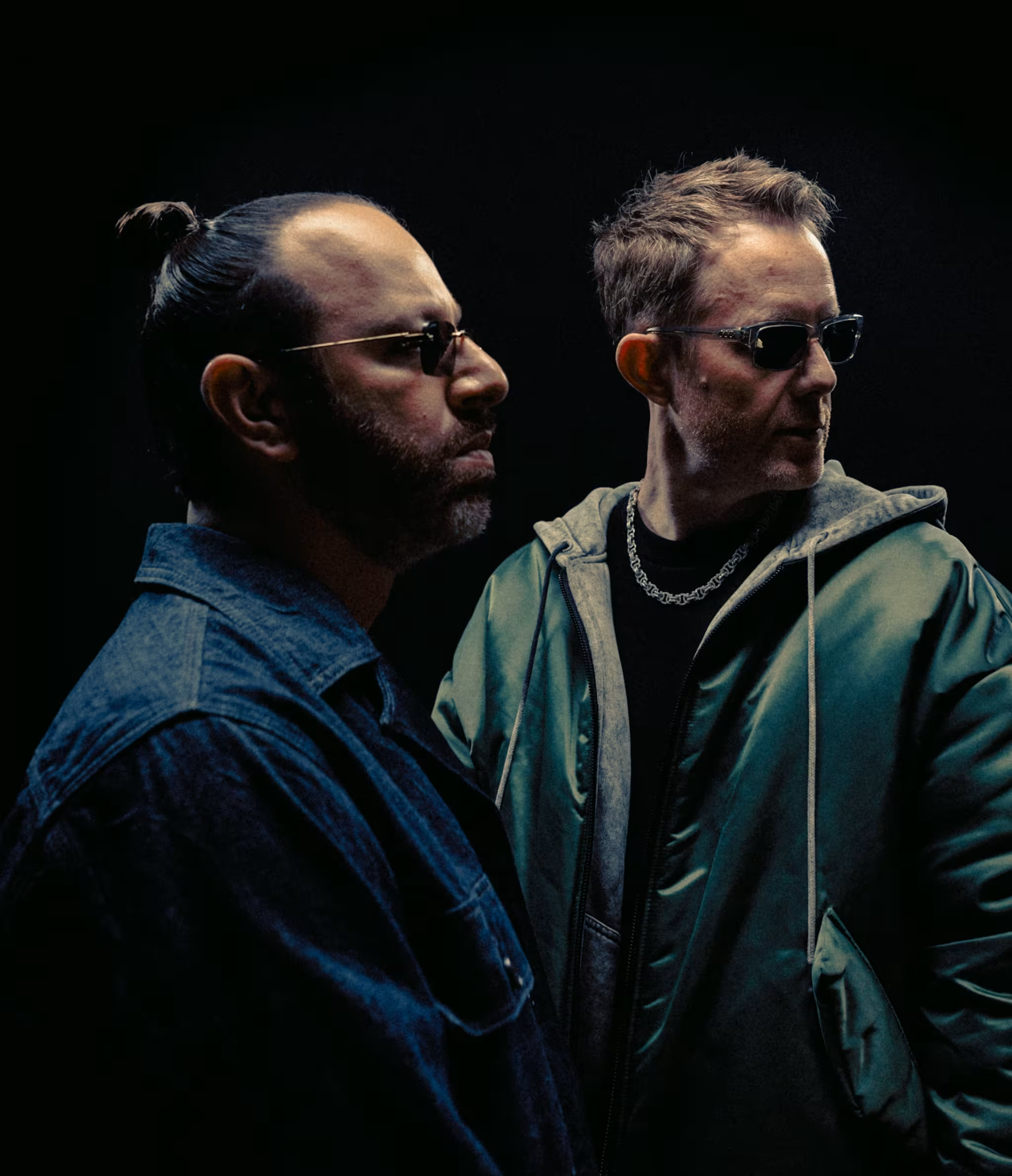
18 years ago, Chase & Status released their debut album, More Than Alot. It captured a moment: an apex for late-stage dubstep, when the once-minimal sound was merging with D&B and finding its footing in the States. It was also a key moment for the London-based duo, aka Saul Milton and Will Kennard, who had been grinding away on a run of well-received singles, including takes on Top Cat and Capleton anthems, that earned them kudos in the scene.
Their cultural capital hasn’t waned, either. Quite the opposite. In 2026, C&S stand atop a formidable back catalogue, a monument to their credentials and a testament to their staggering contact list. With Generic Everything, their seventh studio LP, the boys have issued a manifesto, railing against the bang-average and the creatively lazy. They mean it, no doubt, but the 10-track album also plays out as the duo defining their identity. Since More Than A Lot, they’ve been defined as a D&B duo, even when big chunks of that album were dubstep. Subsequent albums have played with that definition ever since, taking in rock, punk, rap, grime, even R&B and the occasional 4x4 flirtation.
On Generic Everything, in their battle to vanquish mediocrity, they spread out even further—we’ve got grime legend D Double E on house music, road rap don Giggs on hardcore, UK driller Blanco on dubstep, euphoric breakbeats with soul star Debbie, and more. D&B is still there, and probably always will be, but it’s becoming increasingly difficult to say it defines them. You’ll see that on their upcoming tour, too. Saul, who plays guitar on much of the album, tells us excitedly that the live-band setup they’ve been teasing with the Section 63 format will be writ large as they travel the world over the coming months.
Is this a transition towards a more conventional band format? It’s hard to say, but with Chase & Status, you can’t count anything out. Complex UK caught up with the duo to dig deep into the new album, their roots, their future, and the threat of banality (and AI).
COMPLEX: You’ve just released your seventh studio album, Generic Everything. Congrats! We had a relatively quiet year for releases last year—I’m assuming that was while you were working on this—but you kicked things off with a trio of singles: “Through The Pain”, “Doing It More” and “Homework”. Why did you decide not to include those on the album?
Will: Yeah, good question. Firstly, they’d already had quite a lot of exposure by the time we finished the album, and in this day and age, if you fill an album with songs that have already been around for a long time, it can feel a bit like a cop-out, and people might feel a bit shortchanged. People are used to discovering new music on an album rather than hearing music that’s already been out. That was probably the biggest factor. But also, we thought of those three songs very much as a project in itself. It had also been a long time since we’d released music, and we were worried about having had a number one single with our last song, “BACKBONE” featuring Stormzy, and then releasing an album off the back of that, with everyone sort of comparing the two. It was basically an outlet for us to make some grimey, underground, industrial music that wasn’t trying to be a pop record or a number one record, and just have fun with it. Stylistically, I think it works really nicely as a little trilogy and a setup.
Alongside this new record, you’ve issued a manifesto of sorts, where you talk about the push and pull between your creativity, external pressures and the fight to stop everything becoming formulaic. Do you think, in such a fast-changing musical and technological landscape, these pressures are worse now than when you started?
Will: Sort of. I think the temptation to be lazy is higher than ever. Back in the day, you really had to graft to make anything that sounded like a good electronic record because it was so hard to get equipment, software and samples. So, in that process of grafting comes the creativity, the journey. It’s almost irrelevant what you end up doing, because that process is the art form. Now, theoretically, you could do that entire process, which might have taken months or years, in 30 seconds.
Saul: The only parallel I’d draw with when we were coming through is that, back then, music production was changing from analogue to digital, so there was a similar conversation. For a while, there was a weird transition where people started using digital, and songs sounded shit because people weren’t quite used to it or how to make it sound good. Now, music sounds maybe better than ever. You can make it sound fatter than ever before, and all the technology is there. So, I’d say right now we’re in the early stages of this madness. It’s a very odd stage where certain people are creating entire tracks by typing words. Some people will use it as a tool, and so on and so forth. We’re only at stage one. Let’s see where it goes, but there’s always that transition period where it’s very frightening. It won’t be the end by any means.
You sound optimistic.
Will: We’re always optimistic about the future. We’ve always been really interested in future technology, and we never want to be nostalgic. That’s why we’ve still got careers. It’s hard to be too doom and gloom because, otherwise, what’s the point of anything? Don’t underestimate humans’ ability to eventually go against the grain. The best stuff in culture and art is always the stuff that goes against the grain. If that grain is an influx of AI slop or lazy art, someone will eventually do something that goes against it. The cream will rise to the top, and I still believe that cycle will repeat itself again and again.
Saul: I also believe that confidence and conviction will guide you. If you’re confident that the music you’re going to make is on a different plane to the slop, you’re all good. If, however, you’re making music that you feel might not be as good as AI-generated stuff, then you really need to get better at your craft. If I was petrified that AI was going to write a better song than us, then I think we’d be finished. It’s a headspace thing, really.
For me, every one of your albums has a distinct identity. Presumably, there’s always an archive of unfinished ideas and tracks that don’t make the cut. Do you put all that to one side and start fresh, or do you dip back into the archive? What kind of conversations do you have when you first sit down to write?
Saul: For me, personally, once you’ve written an album, you don’t want to write anything else ever again. It’s over. It’s done. Then, over time, with zero responsibility or direction, you just start making tunes. It’s innate in us. We just make tunes, right? With or without success, we make tunes.
Will: Sometimes you just hear something that piques your interest.
Saul: Yeah, and then you start making music again, and before you know it, you’ve whipped up a few demos that might have a particular sound or feel. Nine times out of ten, those little ideas are nowhere to be seen in the finished product, but they set you on a path. It’s quite corny to say, but it does happen organically.
At 10 tracks, it’s quite a lean album.
Will: It was a question of time with this one. As artists—and I think anyone who makes anything will sympathise—you’re never quite ready with anything. Nothing’s ever finished. You can always tweak something, improve it or change it, and you eventually get bored of things. So inevitably, you either continue down that route forever and it becomes a hobby, or you set yourself a deadline—or someone sets one for you—and you have to work towards it. At that point, we didn’t want to compromise by putting a bunch of half-finished demos or things we didn’t feel were working properly on the record. These were the 10 songs we were genuinely happy with and felt worked well together as a project.
Saul, I remember hearing you say in an interview that you’re your own harshest critics. Do you think that helps you or holds you back?
Saul: It can only help.
Will: Well…
Saul: It can only help because putting out something that’s below par, or doing something just for the sake of it, never works. Quality control is super important.
True. But are you going to keep yourselves up at night over something like a single snare sound, or…
Saul: —absolutely!
Will: Thirteen versions with just different hi-hats. Hundreds of versions of each song.
Have there been any moments or particular collaborations that have made you rethink the way you approach composition or the way you make music, or that you particularly cherished making?
Will: Lots of our records start with one idea and then change completely, very quickly, because we feel they’re becoming predictable. “Disgruntled” is a good example of that. We started off with this J Hus rap vocal, and the immediate thought was, “Maybe we do something like ‘BACKBONE’?” But that felt predictable. So Saul got out a bass guitar, and suddenly we were making this kind of London punk record with J Hus’ vocals. Initially, Hus was like, “What the hell is this?” Then we put Irah on it, and there you go. Everyone would expect J Hus and Chase & Status to sound like “BACKBONE”, but hopefully this has a different feel. It’s fun performing it live. We find there’s a moment in every song when we ask ourselves, “Should we do it like this?” The D Double one’s a good example of that. Saam Sultan is another—he thought he was coming in to just write a liquid drum & bass record with us, and we ended up writing a record that sounds like old N*E*R*D or something. We’re constantly trying to keep people guessing. I don’t know what Little Simz thought she was going to do with us, but probably not what we ended up with.
So what’s your process for choosing featured artists? There’s a definite emphasis on newer artists on this album.
Will: It’s definitely important for us to represent new music. If we had an album without any new, young artists on it, we’d look at each other and feel uncomfortable, because we talk about championing new music. We’re inspired by what’s happening now, so it’s really important to have young artists on the record who are doing their thing. Certain artists have a particular attitude, and those are the ones we’re drawn to. Every single artist on there, without a doubt, has their own individual energy, aura and voice. They’re also predominantly British artists, because we’re really into British culture, and Britishness is important to us and our music. They all represent that brilliantly, too. We’re just obsessed with British scenes and British music. The UK builds underground scenes better than any other country. There’s such an amazing melting pot of creativity here, so naturally, we gravitate towards those scenes. We love it.
Saul: We’ve always flown the flag for British music, and we always will. That’s not so much from our side of things, in electronic music, but I think there’s been a quest for a long, long time to show the world that UK rappers, R&B singers and vocalists are up there with the best. For years, American audiences didn’t understand what our guys were saying; now, we’re at a point where people like Skepta and Giggs are huge all around the world. People understand and appreciate what our cultural scenes are about, and it’s a great time for those artists to make their mark around the world. Being part of that, pushing UK music and showing the rest of the world that we’re a force to be reckoned with, is really important.
The most recent track, “Essa Ta Quente”, with Skrillex—what’s the story behind that?
Will: We’ve known him forever, pretty much since his career started. It was around the same time as ours. We’ve been talking, hanging out and vibing for literally the last 15 to 20 years. For whatever reason, the timing was never right, which is sort of how things work in life, but the stars finally aligned. So we linked up with him and showed him some of the stuff we’d been working on. He just said, “What the hell is that record?” It was an early demo, and we said, “Cool, do you want to see what you can do with it?” He basically injected his magic into it, and the rest is history. We came out of Boomtown, and it was really nice to finally pull it off because we’d been talking to Sonny about doing something together for a long time. He’s probably even busier than us when it comes to touring, so the fact that we managed to make it all work in time for this album, and that it’s been received so well, is really, really nice for us. It had always annoyed us that we’d never actually collaborated with Skrillex on an original song, so that was a really cool moment.
It’s got a very different vibe, with the whole Baile funk influence. Where did that come from?
Saul: We’re really interested in Baile funk, Brazilian rap and the rawness of it. When you listen to that music, it’s all about these big, raw, uncut vocals and a minimal but fat-sounding combination of drums & bass. It’s really stripped back. For me, it encapsulates that old, dancehall-inspired sound. It’s got elements of soundsystem culture, but rooted in the favelas. We always like to try putting things together that you wouldn’t normally expect to work. So it’s about asking, “How can we make this work with drum and bass?” In this case, how can we do it with Baile funk? We did it by using drums that aren’t your standard drums, claps or kick drums—different, weird-sounding percussion—and making the track sound unlike every other D&B tune. What works with Sonny is that he doesn’t really make music at 174 or 175 BPM, or at the same tempo as drum & bass. He hardly ever does, and hasn’t for years. That kind of individuality is something that always attracts us to an artist, and hopefully we can make music that stands out a bit, too.
One thing I’ve always wanted to ask you about was your cameo in 007: First Light. Like, how did that even happen? It’s quite random [laughs].
Will: They approached us and it was a pretty easy opportunity to say yes to. They told us they had a scene in a nightclub where they wanted us DJing. They sent us some early sketches of our avatars, which they tweaked a bit, and in the end, they were pretty accurate. Even down to the movements—my sister could really see Saul in the way he was moving, and the way I was moving was quite typical of me, which is mad, really. We were big GoldenEye fans growing up as well—who wasn’t back then?—so it was a real honour to be asked to make some original music just for the game. We didn’t really know what to make of it. We did it, and the amount of feedback we got was mad! I haven’t really properly played the game, but apparently it’s proper sick.
Were you big gamers back in the day?
Will: Pretty big, yeah...
Saul: For a bit, then making music became the game. That became my computer game. Growing up, though, I was insanely obsessed with Street Fighter and Street Fighter II.
You’ve already had quite a busy summer with all the festivals and everything. Presumably, you’ll be touring the album next. What have you got planned?
Will: A massive tour. Definitely with a live band, which is exciting, because I think we’ve talked about how this record has that live energy. It’ll be a chance to bring more of those featured vocalists on tour with us and expand the travelling family we already have, which is amazing. The mix of people performing with us is what makes the live show what it is. It’s a global tour, so the whole of next year will really be about getting out there and doing our thing.