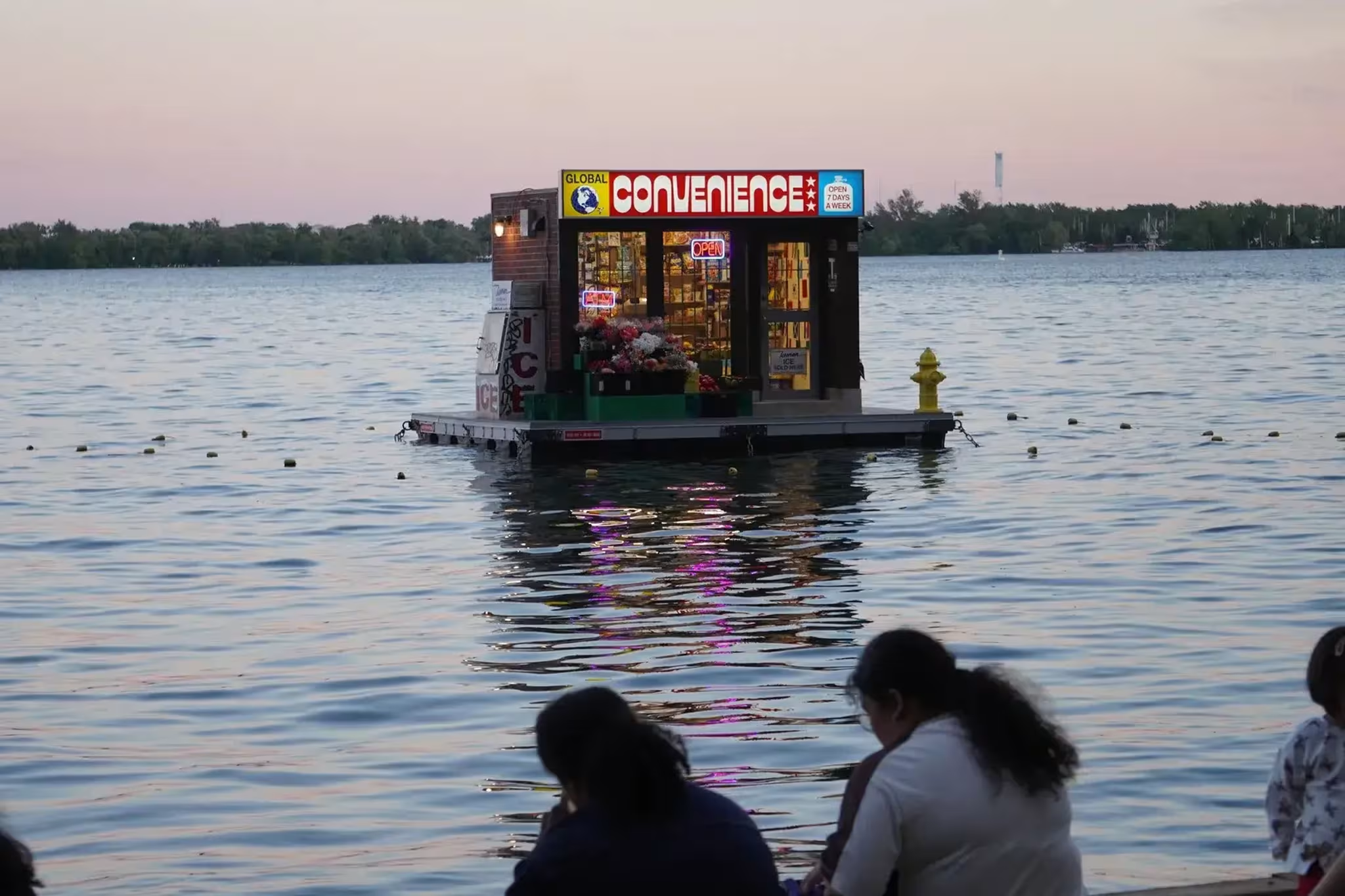
If you’ve walked along Toronto’s waterfront this summer, you may have spotted something unusual floating in Lake Ontario: an entire convenience store.
Complete with colourful signage, flowers, refrigerators and shelves packed with snacks, drinks and everyday essentials, the tiny shop looks surprisingly convincing from shore. There’s just one catch: You can’t actually go inside. And no, they won’t deliver your chips by boat.
The mysterious store is actually Global Convenience, a temporary public art installation floating in Harbour Square Park Basin, near the Jack Layton Ferry Terminal.
Created by Toronto-based artists Trevor Wheatley and Cosmo Dean in collaboration with Puncture, the arts-focused production company led by Rashad Maharaj and Spencer Cathcart, the installation takes one of the most familiar fixtures of city life—the neighbourhood corner store—and drops it into a place where it seemingly doesn't belong.
And that's exactly the point.
Commissioned as part of Waterfront Toronto's 2026 Floating Public Art program, Global Convenience explores migration, globalization and the everyday spaces where different cultures intersect.
"A convenience store is one of the most recognizable and universal spaces in the world," the artists explained in an interview with Waterfront Toronto.
While developing the installation, Wheatley and Dean studied convenience stores and signage from Japan, Brazil, Turkey and the United States and sourced international products to stock its shelves. The result is a fictional business that looks like somewhere you might have actually wandered into before.
That's particularly fitting in Toronto, where independent convenience stores often reflect the neighbourhoods—and people—around them.
"These storefronts (corner stores, bodegas, flower shops) are often places where conversations begin, languages mix, and newcomers find their footing," Waterfront Toronto explains.
Putting that familiar storefront on Lake Ontario adds another layer. Toronto's waterfront has historically functioned as a point of arrival and exchange, making the floating shop a nod to the movement of people, products and cultures that helped shape the city.
The timing is fitting, too. Global Convenience arrived as Toronto welcomed visitors from around the world as a host city for the 2026 FIFA World Cup earlier this summer. Rather than responding to that international moment with another monument to sports or spectacle, the installation focuses on something considerably more ordinary: the small businesses people encounter every day.
Of course, constructing a convenience store in the middle of a harbour presented some unusual challenges. Every part of the installation had to account for wind, weather, weight and buoyancy, requiring the artists to use lightweight materials and rethink parts of their original design.
The illusion becomes especially convincing after dark.
The artists took what they described as a "crash course in solar power" to illuminate the installation without connecting it to the electrical grid. At sunset, its signage, exterior lights and brightly lit interior switch on, leaving what appears to be an open convenience store glowing in the harbour.
But no matter how inviting it looks, visitors aren't supposed to get any closer.
Waterfront Toronto describes Global Convenience as being "recognizable from every angle and yet kept intentionally out of reach." It's meant to be viewed from shore, turning something normally defined by accessibility into something you can see but never enter.
There are echoes here of Prada Marfa, the famous non-functional Prada storefront installed by artists Elmgreen & Dragset alongside a highway in the West Texas desert in 2005. Both works take familiar commercial architecture, remove its practical purpose and place it somewhere unexpected, forcing viewers to reconsider something they might otherwise walk past without thinking twice.
But where Prada Marfa plays with the language of luxury retail, Global Convenience celebrates something considerably more democratic: the humble corner store.
Global Convenience was selected through an open-call competition for Waterfront Toronto's Floating Public Art program and is the sixth floating artwork installed at Harbour Square Park Basin since the program launched in 2019.
For Wheatley and Dean, the hope is that seeing a convenience store bobbing in Lake Ontario will make people reconsider the real ones they pass every day.
"If people walk away thinking about the small spaces they pass every day, and the artifacts of globalization embedded within them, that would feel like a meaningful outcome," the artists said.
You can see Global Convenience floating in Harbour Square Park Basin at 25 Queens Quay West, near the Jack Layton Ferry Terminal. It's visible from the waterfront promenade and Harbour Square Park and will remain on display until the week of October 5.
Just don't swim out looking for snacks.