Key Takeaways
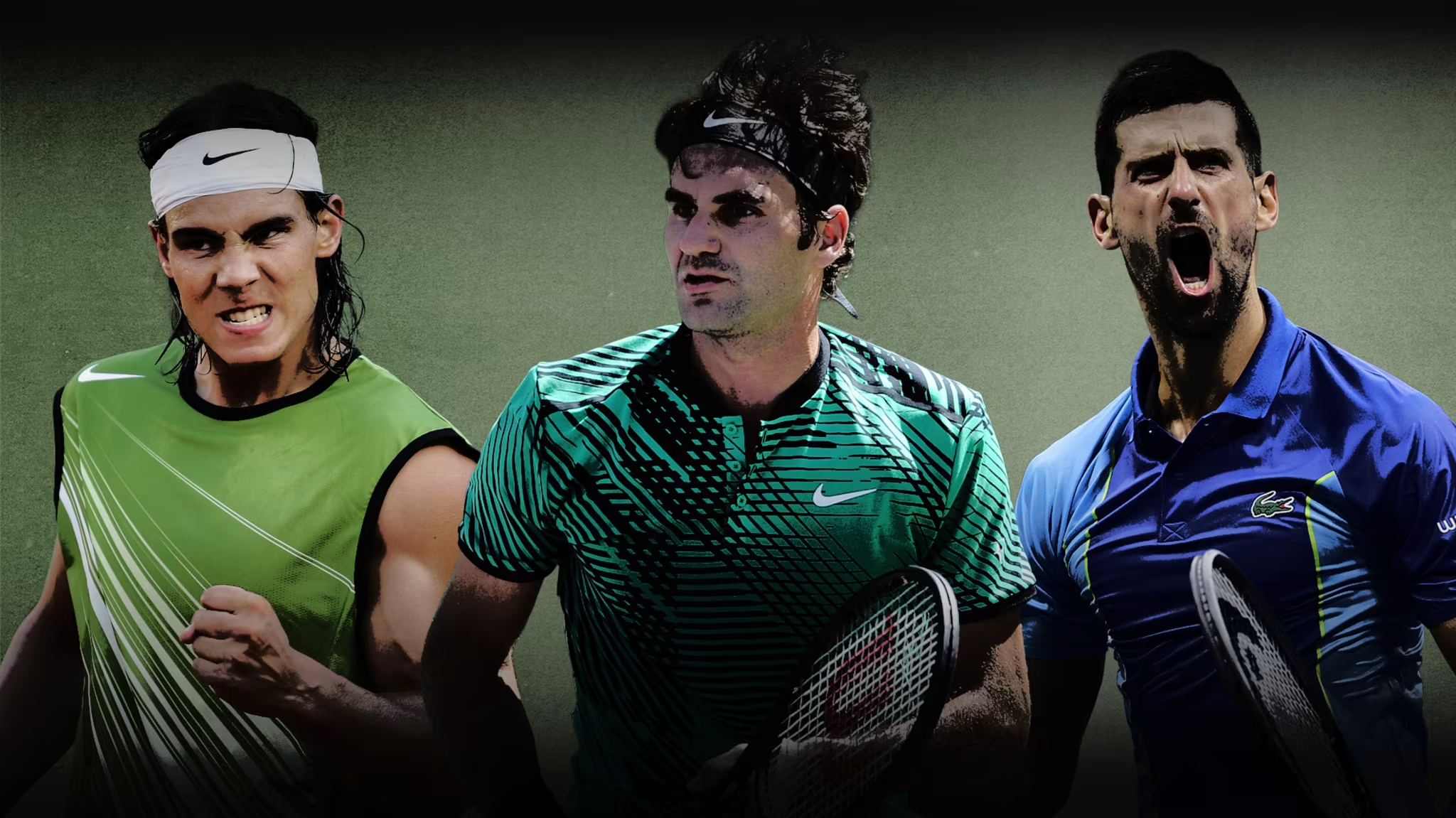
- This GOAT debate compares Roger Federer, Rafael Nadal, and Novak Djokovic across their skills, signature matches, head-to-head records, and career achievements.
- Federer leads in serving, net play, and aesthetics, Nadal owns the greatest forehand and unmatched clay dominance, while Djokovic tops the backhand, defense, return, and mental-toughness categories.
- The piece crowns Novak Djokovic the GOAT based on his 24 majors, record 428 weeks at No. 1, Masters 1000 lead, winning records against both rivals, and longevity into his late 30s.
At first, the greatest rivalry in tennis followed a simple champion vs. challenger narrative.
Roger Federer ascended to world no. 1 with his win at the 2004 Australian Open and would hold that ranking for a record 237 consecutive weeks. From 2004 to 2007, Federer won 315 out of 339 tennis matches (92.9%). He was almost unbeatable—except when he faced a lefty in capri pants from the island of Mallorca; eight of Federer’s losses during that time were to Rafael Nadal, the Spanish bulldog who was stacking French Open titles each spring and nipping at Federer’s heels for the top spot.
Nadal finally overtook Federer following the 2008 Wimbledon final (widely considered the greatest tennis match of all time) simultaneously taking his No. 1 ranking and ending his streak of five consecutive Wimbledon titles. But by that point a third man had entered—and disrupted—the rivalry.
Novak Djokovic announced his arrival in August 2007, when he defeated Nadal and Federer back-to-back to win the Rogers Cup and reached the 2007 US Open final where he fell to Federer in three tight sets. Four months later, he won his first major at the 2008 Australian Open.
Federer and Nadal’s fervent fan bases initially viewed Djokovic as an interloper—an eager-to-please Serbian with a looping forehand who, ugh, did impressions. To them, Djokovic was a spoiler, there to ruin the latest chapter in the Federer-Nadal H2H. But he would soon join them at the top.
Federer, Nadal, and Djokovic would go on to dominate men’s tennis for the next 15 years. From Wimbledon 2003 to the 2023 US Open, they combined to win 66 of 81 majors played. Sometime during that stretch it became clear they were playing for more than just trophies. Each match between them—but especially the ones at the four majors—had historic implications hanging in the balance. These were the three best male tennis players of all time. But who was the best?
With Roger Federer’s induction into the International Tennis Hall of Fame this weekend and Novak Djokovic beginning his quest for a 25th major at the US Open, it’s time to revisit the GOAT debate. We will look at more than just numbers and break down their games and careers to come to a conclusion.
This is Federer, Nadal, Djokovic: The Ultimate GOAT Debate.
Shop New Arrivals on Complex
Serve
With his perfect form and deceptive ball toss, Federer is one of the best servers of all time. Though he topped out at around 125 MPH, he still finished third all time in aces. But this is a lot closer than you’d think. Djokovic had one of the steadiest second serves on tour, often handcuffing returners deep and to the body, and was incredibly clutch late in sets and in tiebreakers; Federer and Djokovic each won approximately 65 percent of tiebreakers, the best mark in the sport. Nadal was no slouch either. His lefty serve out wide in the ad-court was like a cheat code he could dial up on break point and he proved he could go flat and big during his run to the 2017 US Open title.
Verdict: Federer, Djokovic, Nadal
Forehand
The Rafa Nadal forehand is the greatest weapon in the history of men’s tennis. Inside-out. Inside-in. Down the line. Crosscourt. Topspin. Heavy Topspin. On the run or from the center of the court. Rafa could hit any shot at any time for a winner. Federer’s forehand was nearly as good. He was a master of first-strike tennis, often taking control of the point with the first forehand of the rally. Djokovic’s wasn’t an aesthetically pleasing shot but was never a weakness either. Plus, the most important single stroke in this three-way rivalry was a Djokovic forehand (more on that later).
Verdict: Nadal, Federer, Djokovic
Backhand
Once again, this is pretty straightforward: Djokovic owns the best backhand of all time. His two-hander is steady and penetrating and is responsible for the huge shift in his H2H with Nadal that occurred in 2011 when Djokovic started hitting his backhand heavy and crosscourt, forcing Nadal to stretch wide to his forehand side. Djokovic won seven consecutive finals over Nadal in 2011 and 2012 while deploying that tactic. Though unflashy, Rafa’s backhand was rock-solid and acted as more than just a defensive shield. Federer’s one-hander was a work of art, one of the most gorgeous shots in tennis, but was susceptible to heavy topspin on high-bouncing courts, which explains for his lopsided 2-14 record against Nadal on clay.
Verdict: Djokovic, Nadal, Federer
Defense
All three are amongst the best defenders in tennis history but nobody got to more balls than peak Djokovic—and no one transitioned from defense to offense as suddenly, although Nadal is a close second.
Verdict: Djokovic, Nadal, Federer
Mindset
Djokovic is the most mentally tough athlete since Michael Jeffrey Jordan, another rabid competitor who thrived on perceived slights and disrespect from opponents and fans whether real or imagined. Nadal was content to turn every tennis match into a war of attrition, confident in his ability to break the player across the net. Federer never retired mid-match during his career spanning 1,526 matches. But there were times against Nadal and Djokovic where he clearly seemed rattled.
Verdict: Djokovic, Nadal, Federer
Return of Serve
Verdict: Djokovic, Nadal, Federer
Net Play
Verdict: Federer, Nadal, Djokovic
Flair/Aesthetics
Verdict: Federer, Nadal, Djokovic
The Numbers
Grand Slam Titles: Djokovic - 24, Nadal - 22, Federer - 20
Grand Slam Finals: Djokovic - 38, Federer - 31, Nadal - 30
Masters 1000 Titles: Djokovic - 40, Nadal - 36, Federer - 28
Overall Titles: Federer - 103, Djokovic - 101, Nadal - 92
Weeks at No. 1: Djokovic - 428, Federer - 310, Nadal - 209
Consecutive Weeks at No. 1: Federer - 237, Djokovic - 122, Nadal - 56
Head to Head
Djokovic vs. Nadal: Djokovic 31-29
Djokovic vs. Federer: Djokovic 27-23
Nadal vs. Federer: Nadal 24-16
Five Essential Matches
5. 2013 French Open Semifinal, Nadal d. Djokovic 6-4 3-6 6-1 6-7 9-7
Fifteen months after their epic in Melbourne, Nadal and Djokovic went long again, this time on the clay at Roland Garros. Nadal was 57-1 at the French Open entering this match but was not an overwhelming favorite; Djokovic had defeated him two months earlier in Monte Carlo and had split their last six matches on the dirt. But Rafa was the bolder player in the fifth set and benefitted from an uncharacteristic Djokovic mental error when he stumbled into the net during a point, leading to a Nadal break that leveled the match.
4. 2017 Australian Open Final, Federer d. Nadal 6-4 3-6 6-1 3-6 6-3
Federer entered the 2017 Australian Open as a 35-year-old 17-seed six months removed from his last match (a loss in the Wimbledon semifinals to Milos Raonic). But in what would be his greatest triumph he came back from a break down in the fifth set to win the title in a brilliant display of shotmaking and grit. As ESPN commentator Patrick McEnroe put it, he “out-Rafaed Rafa.”
3. 2019 Wimbledon Final, Djokovic d. Federer 7-6 1-6 7-6 4-6 13-12
Federer was poised to win his 21st major and, almost as importantly, vanquish Nadal and Djokovic in back-to-back matches, a legacy-defining tournament that would have altered the GOAT debate moving forward. But at 8-7 40–15 he failed to convert two match points on his serve, ended up getting broken, and then lost a fifth-set super tiebreaker. Though Federer was the better player for the bulk of the match, Djokovic was steadier on the big points and took home the fifth of his seven Wimbledon finals.
2. 2008 Wimbledon Final, Nadal d. Federer 6-4 6-4 6-7 6-7 9-7
The 2008 Wimbledon final can be viewed as the series finale in Part I of the Federer-Nadal rivalry with Nadal’s three-year chase of Federer ending in the early evening twilight at Centre Court at Wimbledon. The fourth-set tiebreaker remains tennis at its highest level.
1. 2011 US Open Semifinal, Djokovic d. Federer 6-7 4-6 6-3 6-2 7-5
Djokovic’s slapping forehand return winner down two match points in the fifth set is the most important single shot in the history of men’s tennis. Later on, after losing the match, (the second consecutive year he lost to Djokovic in the US Open semifinals after blowing two match points), Federer called it “a lucky shot.” Djokovic clearly got inside Federer’s head during this match and never loosened his grip as he’d go on to win 8 of their final 9 matches in Grand Slam tournaments.
The Case for Federer
The most dominant stretch during the Big Three Era was Federer’s run of five consecutive Wimbledon titles (2003-07), five consecutive US Open titles (2004-08), ten consecutive Grand Slam finals, and 23 consecutive Grand Slam semifinals. He played the most aesthetically pleasing brand of tennis and likely would’ve won more hardware had the surfaces remained faster and lower bouncing.
The Case for Nadal
A true one-of-one, no one played with a style like Rafa Nadal. His dominance on clay will never be equaled by any player on any surface and his record 14 French Open titles is tennis’ most unbreakable record.
The Case for Djokovic
The numbers don’t lie: Djokovic owns the head-to-head over Nadal and Federer, made more Grand Slam finals, and more Slams than his rivals. The Masters 1000 shields are the icing on the cake.
Final Verdict
Federer’s impact on the game both on and off the court can’t be overstated and his rivalry with Nadal pushed the sport to new heights. But, in the end, Novak Djokovic surpassed both of them. He was the best player during tennis’ best era. Then, while his rivals dealt with injuries that eventually forced them into retirement, Djokovic’s dominance extended into the 2020s. He made the semifinals of all four majors in 2025 and made the Australian Open final at 38 years old in 2026!
The answer is Novak Djokovic.