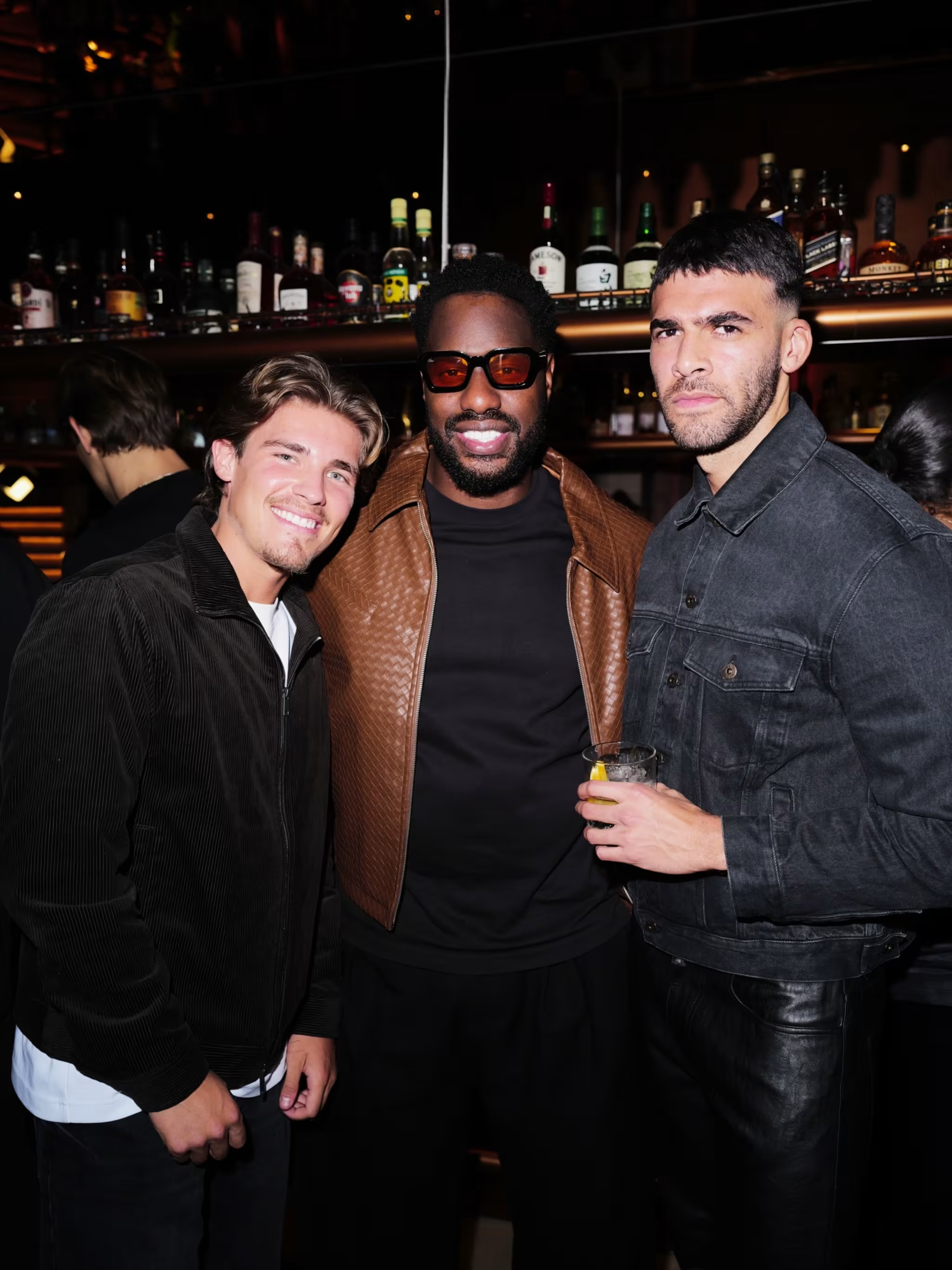
Tucked away in London’s Marylebone, the newly-opened club, 77, is transformed into an ACASO world: the room is drenched in deep red, with visuals spilling across LED screens and an atmosphere that feels more Ibiza than London. The soundtrack moves through deep cuts, unreleased IDs and custom edits, creating the kind of night that feels effortless, but is anything but.
Founded in 2025 by Aaron Murrell and Archie Burnett, ACASO began with a night out in Marrakech—at Club Coya, Aaron caught a DJ set that instantly grabbed his attention. After Shazamming the tracks from said set, he realised he’d stumbled across the world of Afro-house. Inspired by artists including Francis Mercier and Keinemusik, he began exploring the wider scene before calling Archie, a fellow house-music obsessive, and bouncing ideas. Though Afro-house has roots stretching back more than three decades, its global rise has accelerated over the past ten years. In 2025, MIDiA Research and Splice named it their genre of the year, while its sound continues to dominate clubs and festivals worldwide, from South Africa to London, New York City and beyond.
Aaron and Archie saw an opportunity to bring that energy to the UK, soon linking up with DJ Don Huell, whose Cooba clothing brand and luxury-led aesthetic aligned with their vision. Uniting their experience across music, events, fashion and creative direction, the three officially launched ACASO. What began in London quickly expanded beyond the capital, taking them to Manchester and Marbella before arriving in Ibiza for their debut at Nocturna this year.
We caught up with Aaron, Archie and Don to discuss ACASO’s beginnings, their approach to building a modern nightlife brand, and what comes next.
COMPLEX: At what point did your curiosity around the Afro-house sound you were hearing in Morocco become an idea you wanted to actually build something around?
Aaron: I went on a few holidays in 2024, and I remember being in Morocco hearing the Afro-house of that time. I was in Coya, Shazamming songs the DJ was playing, thinking, “This is house, but melodic, with all these vocals.” I came back home and kept playing the tunes and DJs like Francis Mercier, and it made me want to look into the sound more. Then I found Keinemusik and started to understand how they build their tracks and who they work with. I followed every DJ in that space on Instagram, trying to understand where the sound came from and the people behind it. I figured that, if I was going to try and capture this brand of music, I needed to speak to someone who was already immersed in it. So I called Archie and mentioned there was a DJ out there with a clothing brand called Cooba that I liked the look of. Archie said, “That’s my friend, Don.” The synergy was already there.
I could see that London didn’t have many brands playing that sound yet, but I knew the trend was coming. Look at Keinemusik in Cannes a few years ago—Drake was with them! Black Coffee with Burna Boy, Central Cee mixing with Afro-house… I started clocking that this was going to be the next big thing. People had always listened to UK rap, R&B and Afrobeats, but I felt Afrohouse could be the bridge into something more commercial. When I started seeing the calibre of people coming out for it and the culture building around the music, I thought: “Let’s launch ACASO.”
Don, how long have you been DJing for? I remember you doing sets when you were running Cooba—how did that evolve into now?
Don: It actually started during COVID: I bought a pair of decks, became a bedroom DJ and started putting mixes out on SoundCloud. I’ve always been a big fan of the Soulection movement—that broad, eclectic sound—and that’s the direction I channelled mine in. A few years on, I was playing more often, deep into the Euro circuit, and Afro-house—back in 2022, 2023—was already becoming the thing. Now it’s one of the biggest sounds across all genres. I played my first set out publicly about a year and a half ago, and it compounded from there. ACASO came six months later, once I felt properly refined and ready to bring my sound, my way, to London's Afro-house scene. That first event in Mayfair was a hit; the guestlist, the crowd, it felt elevated, right in my lane.
That was my first real chance to show what I could do—not just technically, but in song selection, reading the room, being bold enough to do it exactly how I’d always wanted. People saw Afro-house played with other influences woven in—R&B, hip-hop, old-school touches. That’s the platform ACASO was built on. People know they’ll hear something they’ve never heard before. I make a lot of mashups myself, dig deep for music, and every ACASO since has been a chance to lean further into that. That’s largely what’s driven ACASO’s success and exclusivity—other DJs have since elevated the sound even further. What’s so beautiful about it is that it’s not just an event; it’s got its own identity, grown naturally. Authenticity’s a cliché word, but ACASO embodies it, because it’s true to my core. 75k on TikTok, close to 20k on Instagram—a year’s worth of work.
When you began, what was the ideal scenario for ACASO?
Aaron: We had a massive event on Halloween, but it was around Christmas—about six months in—when things really shifted. After Theata, we were walking around and passed Outernet, a venue Don had been to before. We said, “One day, we’ll do an event here.” Somehow, we ended up getting the only date they had available: May 6, 2026, the anniversary of our launch. Doing Outernet was a big statement—that’s when we knew we were operating on a different scale. Instead of doing a run of 250-capacity nights, we could start looking at places like Marbella and Ibiza, venues with much bigger capacities. For every event, you have to DM the page to get the ticket link, so the demand is intense. Even with our recent London and Manchester events, hundreds of people have missed out; that’s why the schedule is so packed. We’ve had to create spin-offs of our main nights, giving people the chance to experience something close to the ACASO world even if they miss the headline event.
Going from party-goer to being behind the decks and behind the scenes—what do you see in ACASO that works on both fronts?
Don: Good question. It’s a completely different perspective. When you’re involved in the music, creative direction and running the brand, then switch back to experiencing it as a guest, your perspective completely changes. You start noticing all the small details from the other side. The most important thing for us is that our customers matter, and that means creating a new experience every time—bringing new energy, new edits, new music, and constantly reaching out to different DJs and producers. We never want someone to leave thinking, “That was the same as last time.” Every event needs to feel fresh, and that’s what keeps people coming back.
What excited you about bringing Afro-house to Nocturna in Ibiza?
Aaron: I always say, “Ibiza never dies.” It’s the pinnacle of club culture—you’ve got Ushuaïa, Hï Ibiza, UNVRS—and there’s still no ceiling for what can happen there. Some of the biggest brands in Ibiza, like Solid Grooves and East End Dubs, started in the UK, so we knew there was an opportunity for ACASO to make that journey too. The Nocturna opportunity came through Tokyo Industries, the UK-based company behind venues including Theata and One Ninetyfour, with around 48 venues across the UK and Europe. ACASO won Best Brand within the group at their awards, and when they opened Nocturna beneath the Los Felices Hotel in San Antonio, we were one of the first external brands they approached. It felt like the perfect fit. Nocturna is Ibiza’s first no-phones club, and the whole concept—the red aesthetic, high-end feel and smart dress code—aligned perfectly with what we’re building with ACASO. It felt like the right place to take the brand to Ibiza for the first time.
And how do you think it went?
Aaron: It was a great night and genuinely one we will never forget. Seeing so many faces who normally come to our UK shows fly out to Ibiza just to experience ACASO abroad, in the party capital of the world, meant everything. That’s the loyalty that makes this brand what it is.
One thing I’ve noticed is how intentional the branding is. It not only looks incredible, but there’s clearly something deeper behind its appeal. What do you think has made ACASO so popular so quickly?
Archie: I think ACASO’s popularity comes from bridging a gap, bringing a luxury crowd to venues they might not otherwise go to, and creating nights built around genuine moments. Don is constantly making new tracks and mashups that people haven’t heard before—sometimes even Aaron and I haven’t heard them. People film them, share them, and it becomes, “What is this?” We want people to leave with that feeling of, “I’ve never heard that before.” It’s also about bringing friends and relationships together, which feels increasingly rare in London right now, where everyone seems to go to the same handful of places. We’re creating nights where people know everyone will be there, somewhere you want to bring your friends, but also somewhere you feel part of something. I think that combination of discovery, community and a sense of occasion is what’s made ACASO grow so quickly.
Don: I think that speaks volumes about our team. We’re small, but that’s where the magic happens. I’m heavily involved on the creative side, which is a natural extension of my background in clothing. When you’re doing what you’re meant to be doing, everything starts to fall into place. At ACASO, we know our lanes; uf I’m signing off on the creative, no one else needs to cross over, and that keeps everything consistent. The same goes for Aaron and operations. We’re all working towards the same objective: to build the best Afro-house brand in London, and eventually beyond. We keep the standards high, so when people arrive, they feel that. Everything is meticulous, everything is thought through, but there’s still a natural flow to it because, ultimately, we’re just normal people who want to have a good time too. One of the things I always remind the team is that what we’re doing has an impact. Music moves people; it can genuinely change lives. We’ve had girls travel down from Brighton on their own, telling us that we’re giving them something they can’t find anywhere else. That’s special, and it’s powerful. You have to protect that.
Are there other countries or cities you want ACASO to make its mark in?
Aaron: We did Marbella in May and, in our first year, we worked with some of the most prominent venues there: Newscafe, VUDU and Mogli. Most brands aren’t doing that in their first year. Ibiza has been incredible too. Like we mentioned before, Nocturna’s a new venue with a no-phone policy, so people are completely immersed in the music and the experience. The plan now is to take ACASO across Europe—rooftops in Amsterdam, Gothenburg, Stockholm, and Mykonos next year. Then New York, when the opportunity is right. We’re not looking to rush it; we want to build ACASO properly in each market and make sure the experience translates wherever we go.
There’s a resurgence of London nightlife right now—how do you see the current climate of event-making?
Aaron: It comes back to people and, honestly, to dating. London nightlife got to a point where certain places felt boisterous, or you’d be perceived a certain way for going. Now people are going out in groups for the experience, not to be seen a certain way—it’s normal. Dating's rough enough right now that people want experiences instead. When we drop a date, it sells out three months ahead.
Archie: With ACASO, people know it’ll be safe, prices aren’t extortionate, and they’re guaranteed a good time. We show them venues they wouldn’t otherwise go to and, hopefully, it keeps growing from here.
You return to club Reign on September 27. What would you say to anyone thinking about coming to their first ACASO event?
Don: Come ready for something different from your normal night out. Every guest who’s been says the same thing: it feels like a journey. The sound is curated in our ACASO way, and our brand is built around creating memories through music. So, just come with an open mind and be ready to make a new memory.




