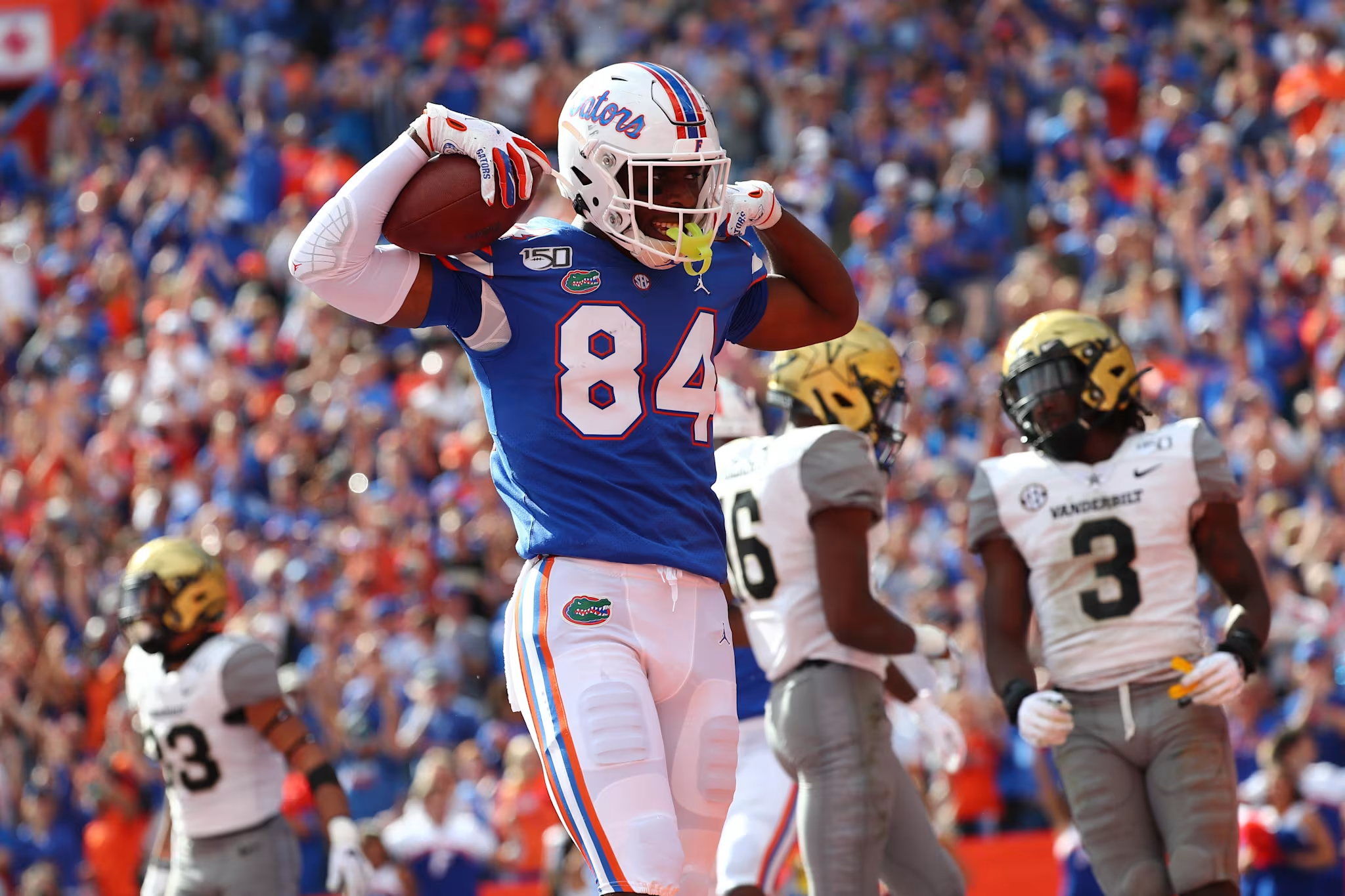
Nov 9, 2019; Gainesville, FL, USA; Florida Gators tight end Kyle Pitts (84) celebrates as he scores a touchdown against the Vanderbilt Commodores during the second half at Ben Hill Griffin Stadium. Mandatory Credit: Kim Klement-USA TODAY Sports
The NFL world has mostly shifted its focus to the offseason with Super Bowl LV here. Franchises are feverishly trying to fill their coaching staffs, front office roles, and plan to address key needs on their roster. We’ve already seen the transaction wire feature a huge trade, and more look likely to come as free agency nears.
The prospects atop mock drafts have been household names for months, and will be picked apart to death before the end of April. But these players can ball, and feature special traits that allowed them to dominate at the collegiate level. The difficulty in evaluating them is whether those traits are strong enough to elevate above their competition in the NFL.
Comparisons are hard because usage is affected by many outside factors. We’ll focus on movement skill and the eye test for how 10 of the best playmaking prospects compare to today’s NFL stars. Some of the comparisons aren’t as lofty as the Hall of Fame names that some might toss around, but there’s absolutely no shame drawing similarities to a Pro Bowl-caliber player.
Trevor Lawrence, Clemson
Comparison: Deshaun Watson
The clear-cut best prospect in the 2021 class and for-sure top pick, Lawrence had an illustrious and esteemed collegiate career. The fact that Urban Meyer came out of retirement to take the Jaguars job to rebuild the franchise with Lawrence is as loud of a statement as possible about what one of the greatest recruiters of all time thinks of his talent. Lawrence has an incredibly high upside thanks to his blend of arm talent, strength, awareness, poise, and knack for playmaking.
His mobility and potential for creating when a play appeared over is what separates him from most prospects since Andrew Luck. He routinely keeps his eyes downfield to find chunk plays, and his accuracy beyond 10 yards has massively improved over the course of his career. He’ll throw the occasional forced pass for a turnover, but the big plays greatly outweigh the negatives.
The Tigers’ offense didn’t have to change much from when Watson was behind center to Lawrence because of their similar profiles. Both were highly intelligent and consistent passers, and could transcend the scheme with their rollouts movement within the pocket. Andrew Luck would be another good comparison, but Lawrence has avoided interceptable-throws better than Luck did.
Justin Fields, Ohio State
Comparison: Dak Prescott
It seems some cooled on Fields after a solid, but uneven junior season. It would be a mistake to ignore the context to the offense around him and his struggles, and overlook the playmaking Fields was capable of. The efficient QB can transform an offense quickly in the NFL.
Fields is accurate to all levels thanks to a strong arm, excellent touch, and ability to understand defender’s leverage. He rarely puts the ball into harm’s way, and has shown he self corrects as well as anyone. His improvement on his deep passes in 2019 occurred over the first three games of his Buckeyes career, and his footwork became more consistent.
Getting Fields out of an offense that featured deep receiver-option routes and inexperienced freshmen will mitigate concerns of how long he holds the ball. While he can improve his processing, the offense at Ohio State wasn’t designed for him to make all pre-determined reads. He’ll benefit from that long-term.
He’s a great pocket passer and dangerous outside of the tackle box. His blend of efficiency and physical prowess to connect on chunk plays is reminiscent of Prescott. The Dallas QB was not nearly as refined as Fields is already, so teams can expect the Buckeye to be a top young quarterback quickly into his career.
Zach Wilson, BYU
Comparison: Kyler Murray
The toughest comparison at the position in this class is Wilson. The recent flurry of undersized, athletic passers with accurate and strong arms has changed how the position has been viewed. Guys like Johnny Manziel, Baker Mayfield, and Murray represent a spectrum of styles within the archetype, and give a tiny sample of what to expect from newcomers.
Wilson might be the best of the bunch. While Manziel had his off-field demons, he also had some similar on-field limitations as Mayfield and Murray. None of the three passers like to sit in the pocket and wait to see receivers progress through their routes, and their impatience leads to issues that hinder the offense despite their talent level.
Wilson is the same way. He has an arm as powerful as Murray, and as accurate on the move as anyone not named Patrick Mahomes, Aaron Rodgers, or Russell Wilson. Seeing him extend plays was one of the best parts of the 2020 college football season.
But Wilson does it too much and doesn’t trust himself in the pocket enough. His learning curve will be massive coming from an independent school, and especially because he was a one-year wonder like Murray. He has great potential but don’t be surprised if his flash outweighs his impact at times.
Trey Lance, North Dakota State
Comparison: Colin Kaepernick
There’s likely not a clean comparison for Lance. Like Wilson, Lance is in a uniquely small group. There’s been few examples of a playmaker who runs as well as he does, and has the arm talent that can make any play.
The raw talent is worth banking on as a developmental project for the right staff. Lance isn’t consistent throwing beyond 10 yards thanks to his elongated motion and sloppy footwork, but the plays that connect are beautiful. Putting him into a zone-heavy, play-action-based attack can devastate defenses with chunk plays and quarterback scrambles.
His raw stats overstate what he was responsible for at North Dakota State, and adjusting to NFL reads will be even more difficult than usual because of the talent difference. Barring significant improvement to his mechanics and becoming a stellar processor in the pocket, it’s possible Lance will oscillate between exciting and frustrating.
Mac Jones, Alabama
Comparison: Nick Foles
Coming off a hot run with insane efficiency numbers and overall production, Jones took the leap to the NFL. It’s debatable as to whether he should’ve since he had just over one-year of starting experience. Evaluators will struggle with his overall impact on the offense compared to the talent around him.
Jones’ physical traits are good-enough to be an NFL starter, but certainly not great. He throws short of his receivers or behind them too often to be a consistently good starter who maximizes his playmakers. The dominant surrounding cast he benefited from may not be nearly as helpful as Alabama’s was.
He’s good at executing what’s there, though, and plays confidently. His arm is strong enough and his placement has stretches of brilliance. He’ll have to get better at throwing his receivers open and where they’ll be instead of where they are at his release point, or else he’ll be a fringe starter.
A team will roll the dice on Jones, most likely in the second-round, and he could be worth that value with the right mechanical tweaks and if he’s a high-level processor. But he’s the most scheme-dependent talent in the top-five quarterbacks and the biggest risk.
Kyle Pitts, Florida
Comparison: Darren Waller
The top receiving playmaker in the class is tight end Pitts. Arguably the best tight end prospect ever, I’d argue that Pitts is the most dominant big receiver since Julio Jones. Teams can evaluate him as an outside receiver and be completely justified in doing so.
Pitts can play in-line, the slot, or outside and have athletic advantages regardless of his matchup. He creates great separation thanks to impressive speed and acceleration, fluid hips on his cuts, and has a high-level of nuance to his route-running. And of course, he’s an incredibly dominant player at the catch point thanks to his size and hand strength.
He could be Allen Robinson if he purely played receiver, but he’ll have similar athletic advantages at tight end as Waller. Good luck trying to single-cover him.
DeVonta Smith, Alabama
Comparison: Calvin Ridley
We’ve rarely seen a receiver with the body type that Smith has excel in the NFL. The biggest fans of the Heisman Trophy winner will point towards Hall of Famers Marvin Harrison and Isaac Bruce. Both were excellent route-runners and creators after the catch thanks to top-notch acceleration and balance.
Smith might be the modern day version of those players, but that’s a lofty comparison. He plays fast and can win over-the-top, but his 4.5 speed won’t consistently get it done in the NFL like it did in college. His production will depend on whether offenses feed him in creative ways like Alabama did, and how much he can win on an island.
The most likely outcome is still a highly-productive receiver who isn’t a Hall of Famer. Players like Calvin Ridley, DJ Moore and Tyler Lockett are still big-time playmakers but have some physical limitations that require scheming open. Smith can be a justified top-10 pick if he’s in that range of production.
Ja'Marr Chase, LSU
Comparison: Antonio Brown
The most dominant playmaker in 2019 was 19-year-old Chase. The 6’0”, 200-pounder played much bigger and faster than what he’ll test out at, and his game-breaking ability makes him an extremely attractive option for offenses that need an instant contributor. Chase plays with the tenacity and sharpness that few regularly display.
The way Chase cuts on his routes and whips through his breaks is almost identical to Brown. AB overcame his average size to be a Hall of Fame producer thanks to his attention to detail, well-roundedness, and short-area explosiveness. Chase has that same potential both as an outside receiver and slot.
His hands are the best in class in terms of maximizing his catch radius and finishing the play through contact. He’ll be a safety valve early in his career, but can also threaten to go deep thanks to his ability to play physical and find space with solid, but unspectacular long speed.
Jaylen Waddle, Alabama
Comparison: Stefon Diggs
The best Alabama receiver of all in terms of well-roundedness might be Waddle. He has an incredible resume in terms of big plays, creating highlights at every level of the field, and even as a return man. He has the athletic traits to become a leading NFL receiver one day.
Waddle is blazing fast. Some evaluators have him as the top receiver in the class because he’s faster than Smith and Chase, and projects more as a game-breaker than those two. Everything from his frame to play style is similar to the NFL’s leading receiver this past season, Diggs.
Getting Waddle into a less-stacked offense will help highlight his impact. Trying to guard him with man coverage with one deep safety is a recipe for disaster for the defense, and if that translates to the NFL, he’ll be a massive steal even as a top-12 pick. Taking him as the first receiver should be on the minds of every front office even though the other two top names produced more.
Patrick Surtain II, Alabama
Comparison: Byron Jones
The lone defender on our list is the cornerback most likely to hear his name called first. Alabama blue-blood prospect Surtain is much like his father was on the football field. A playmaker who can lock down an opposing offense’s top receiver thanks to his long reach, quick closing ability and great awareness.
As with any tall cornerback, Surtain can be beaten on quick-hitting routes and on scrambles because he’s not as quick-twitch as some shorter defenders. He compensates well though, and keeps his head on a swivel at all times. He’s rarely seen out of position in man or zone.
Putting Surtain in a man-heavy or Cover 3-heavy scheme would give him the platform to star as a rookie and beyond. His pure cover skills are great, and the physicality he embraces with receivers projects well. His willingness to tackle is the lone eyesore to his game, but that shouldn’t stop any team from investing into him in the top 7.




