Street Fighter, the new movie based on the video game fighting franchise, won the box office race this past weekend, earning over $51 million worldwide. Though not as successful as other video game adaptations this year (Mortal Kombat II, Resident Evil), Street Fighter will at least earn back its $80 million budget, allowing its inevitable sequel (more on that later) to move forward.
The film is pretty bad, objectively speaking. But earnest enthusiasm and self-awareness push Street Fighter into that elusive “so bad, it's good” territory. The fights are ridiculous but game-accurate (E. Honda performing the Hundred Hand Slap is particularly entertaining). Several of the jokes land really well. And there's some genuine emotional pull at the climax—enough that if you're a fighting game fan, you can rationalize your ticket price. Something this visually intensive is best appreciated on a big screen.
We already did an Easter egg roundup when the trailer launched this summer, and we tried our best not to overlap that article with this new one. Here are 18 more Street Fighter Easter eggs, delving into the franchise's obscure lore and Hollywood history.
Shop Street Fighter on Complex


Popcorn bucket
Before we get to the Easter eggs, we would be remiss not to mention the official, wearable Street Fighter popcorn bucket on sale at the concession stands. It recreates Guile's signature flat-top haircut. I saw a guy wearing one in front of me at the theater, reaching up to eat the popcorn on top of his head. It'll cost $40 if you're in the mood to look stupid but feel awesome.
Tournament date
We see that this tournament takes place in 1993, even though Street Fighter II launched in 1991. But 1993 is still a significant date in Street Fighter history, because that's when the first official Street Fighter II Turbo Championship took place in Tokyo, Japan.
Anime sequences
The flashback scenes are animated and portray Ryu and Ken as folklore heroes with otherworldly abilities. Kill Bill, directed by Quentin Tarantino, uses a similar mix of animation and live action to achieve the same effect.
Mike Haggar scandals?
In the montage after Ryu’s disappearance, newspapers flash across the screen. One of these newspapers has a subheadline mentioning a Mayor Haggar scandal. Mike Haggar is the main playable character of Final Fight (1989), a Capcom arcade beat 'em up. In that game, he's the mayor of Metro City, and he takes a hands-on approach to crime in his city. Street Fighter and Final Fight canonically share the same universe, and several Final Fight characters have crossed over into Street Fighter as playable characters.
Fake Asian
Guile calls out Dan Hibiki (Andrew Schulz) for pretending to be Asian to sell his kung fu teachings to gullible people. In the original Street Fighter Alpha games, Dan Hibiki is Japanese. Guile's insult is a backhanded way of acknowledging the “yellowface” trend of casting white actors in Asian roles.
The Dolls—Juli, Cammy, etc.
There's been some online controversy about Cammy's portrayal in the movie, which many fans view as wildly out of character. But it's important to remember that Cammy is still a brainwashed henchwoman of M. Bison's at this point in the timeline. She and the other “Doll” assassins make cameo appearances in the movie. Notably, we see Juli, who debuted with her partner Juni in Street Fighter Alpha 3 (1998).
Who’s Don Sauvage?
Eric Andre plays fight announcer Don Sauvage, who made his debut as a non-playable character in Street Fighter V (2016). You can see him in the background of Balrog's casino stage in that game, carrying his signature bullhorn.
Who’s Joe?
If you don't know Joe, who enters the tournament and "wins" it by default, you wouldn't be the only one. He's one of ten non-playable combatants (along with Birdie, Gen, Adon, and Sagat) in the first Street Fighter (1987), whom you must defeat one-on-one. The original Street Fighter arcade game was not widely successful and gained retroactive fame after the wild success of its sequel.
Guile’s Charlie reference
Guile references Charlie. In the games, Charlie is Guile's deceased friend. After Bison murders him, Guile enters the second World Warrior tournament to avenge his death. Charlie debuts as a playable character in Street Fighter Alpha 2 (1996), which is a prequel to the original series.
Balrog’s fight music
Balrog performs two of his signature moves in his match with Ken: his Dashing Punch and his Headbutt, infamously one of the most damaging throws in Street Fighter II. 50 Cent plays Balrog, so his song "Many Men" plays during his featured scene.
The film features several nostalgic needle drops. "Come Out and Play" by The Offspring plays during Ryu and Ken's escape from Bison's fortress. "What's Up" by 4 Non-Blonde recurs throughout the film, first during a karaoke scene, and last during the film's funniest sequence.
Zangief’s spinning clothesline
Zangief performs a variation of his signature Spinning Clothesline when he separates Ryu and Ken from fighting in the bar
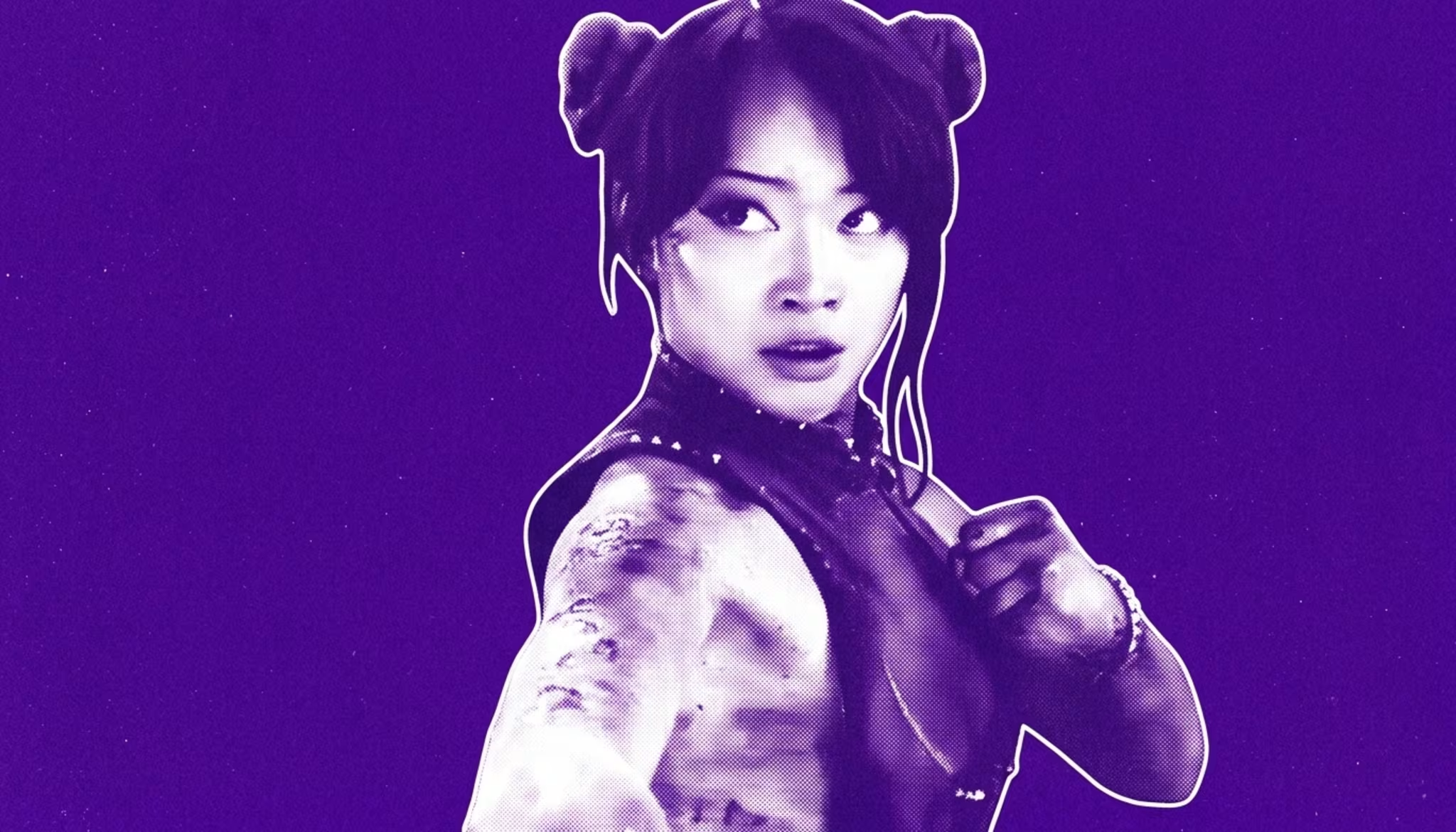
Callina Liang is Chun-Li
We've already covered how actress Callina Ling replicated Chun Li's signature moves. But Ling also wanted to look the part in addition to playing the part. To do that, she trained her legs for six weeks, two hours a day, and grew her thighs by 2 and a half inches. She deserves flowers (and more roles!) for that sort of commitment.
Justin Wong cameo
Justin Wong is the winningest player in Evo history, with nine tournament wins to his name. He, along with competitive player Yipes and streamer Maximilian Dood, have cameos during the prison sequence, when Blanka and Ryu are fighting inside the cage.
Blanka = Jimmy
Blanka mentions that his name is Jimmy. In the video game lore, Jimmy was lost in the Amazon jungle after a plane crash. If you beat the game as Blanka, he's reunited with his mother, Samantha, at the end of the tournament.
“It was Tuesday…”
The movie pays extended tribute to Raul Julia, who stole every scene in Jean-Claude Van Damme's Street Fighter (1994) as M. Bison. He filmed his role while dying of stomach cancer, and he passed away before the film opened.
Like Julia's Bison, this movie's Bison also has an ostentatious painting of himself in his room, posed in homage to Napoleon Bonaparte. He also paraphrases Julia's most famous line: "For you, the day Bison graced your village was the most important day of your life. But for me, it was Tuesday."
Demon teleport
During his climactic fight with Ryu, Akuma performs his signature Demon Teleport, then follows it with the same combination command throw he uses in Street Fighter 6. He also performs his Level 3 Critical Art near the end of the fight, also from Street Fighter 6.
Ryu end credits
The movie ends with Ryu in the center of the frame, back turned, walking off into the distance. It's a direct homage to his character ending in Street Fighter II, which similarly sees him walking towards the sunset.
Mid-credits scene
The mid-credits scene is an animated sequence, in which M. Bison tracks down and meets with Sagat. As the only Street Fighter II boss who does not appear during the live action sequences of the movie, Sagat is teasing a sequel, in which we'll probably get the unresolved Ryu rematch.