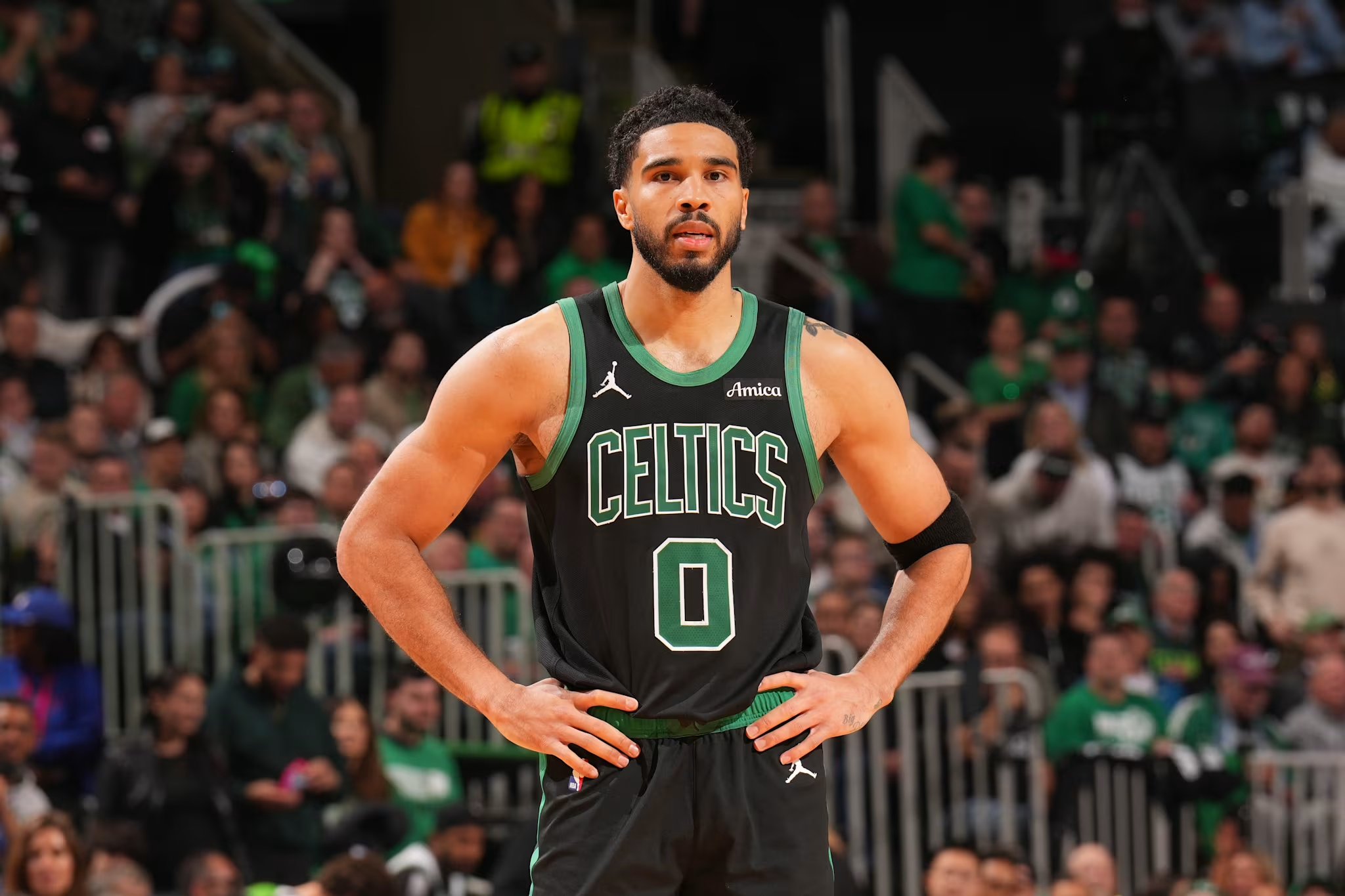
On May 12, 2025, Jayson Tatum suffered a torn right Achilles tendon while diving for a loose ball during Game 4 of the Eastern Conference Semifinals.
He returned to the Boston Celtics lineup exactly 298 days later, an unbelievably quick recovery time from such a major injury. Perhaps more remarkable was the fact that, at times, Tatum resembled the four-time First Team All-NBA forward who guided the Celtics to the 2024 NBA Championship.
At just 28 years old, Tatum has now experienced nearly every facet of life in the NBA, from being an upstart to the glory of winning a championship to rehabilitating a major injury. Now entering his first full season back, he leads a Celtics team that looks much different from the squad that walked off the floor following their first round playoff exit in May.
Complex recently caught up with Tatum to discuss his recovery, his comeback, the new-look Celtics (exit Jaylen Brown, enter Paul George), and why he rewatched Kobe Bryant’s Muse over and over again.
Complex: I want to take things back to the beginning a little bit. What were your thoughts once the adrenaline wore off and you realized the severity of your injury?
JAYSON TATUM: It was rough. It was really a traumatic experience. I just remember being on the court, kind of getting carried off, getting in the wheelchair. But I knew, as soon as I heard it, I knew what happened. So it wasn’t like I got to the back and then they told me. I mean, they confirmed it, but I already knew. It was just real emotional for me. I was already in an emotional environment, [playing] a series-tying playoff game.
So I just kind of remember being in the back, and I had a towel over my head, and I was crying. I just kept hearing voices, my teammates, coaches, my mom. People just kept checking on me. But once I took a shower, I came back to the hotel. We were here in New York, so I was laying on the couch. I was just sick. I was just like a sad dog, laying on the couch. I just could not believe that it had just happened.
But you ended up returning really quickly. Through your journey with Vertex Pharmaceuticals and JOURNAVX, what have you learned about the recovery process and your overall pain tolerance?
That’s a loaded question. So, yeah. My story, for me, started when the next day I had surgery and I was prescribed opioids. So I get out of surgery at like 7 o’clock. I take the medicine at 8 o’clock. I’m supposed to take it every four hours, at 12 and at 4. I remember I was laying on the couch, I couldn’t move, and my trainer kept coming in at midnight to give me a pill, then at 4 o’clock. And I remember it was like 6 or 7 o’clock, he came in, and I told him, “Yo, I can’t take this anymore.”
The medicine made me feel super out of it and dizzy and nauseous. Like, I felt crazy. I’d rather deal with the pain. And I always say there are so many different steps of rehab. At two weeks, you get your stitches out and then you go into this really large boot and you get crutches. You still really can’t put weight on it. At four weeks, you can put like 50% [weight-bearing] on it. I remember my surgeon, Dr. O’Malley, we had a conversation about, you know, the truth is, you tore your Achilles, you had surgery, you haven’t put any weight on it in a month. You might experience some pain. And then that’s when we talked about other options, and he mentioned [Journavx]. It’s a non-opioid for moderate to severe acute pain. When I took it, my experience was I didn’t experience any pain and I didn’t have any side effects. So it just really gave me the confidence to attack that next phase of rehab.
It’s just so important because, thankfully, I didn’t have any setbacks in rehab. Once you have a setback in one area, it just kind of sets everything back. So not dealing with pain at that time and having the confidence just really allowed me to move forward.
It’s wild how managing pain can remove a lot of the fear, worry, and obstacles that come with recovery. But even with that, there’s still a mental side to the process. What did you learn about yourself mentally throughout your recovery?
I would say that with modern medicine and technology, especially in the professional world, physically, you’re gonna get back healthy, right? Everybody’s timeline is different.
Mentally is the toughest part, right? Especially when you have a non-contact injury. It’s like, “Oh, I lunged forward. I’ve done that a million times.” And then one time it gave out. So that fear, that’s a different kind of fear, right? I was worried about the first time I had to walk up steps because now I’ve got to push off this leg. So I would say that the mental battle of being injured and coming back is by far the toughest because even when you do all these tests and see all these doctors and trainers, and everybody is like, “Physically, you’re clear. You can go play,” you have to be confident in your own body to do certain things. Because you know what it felt like before you got injured, and trusting that again takes time.
What parts of your game do you feel have sharpened over time?
I sat on the bench for 66 games last season. I sat next to the coaches and I saw the game through a different lens, through their eyes, hearing their conversations. It just gave me an opportunity to see it in a different light, which I learned a lot from.
You’ve discussed how much you admired Kobe Bryant. As you know he tore his Achilles late in his career. Did you look back at his recovery process and what that looked like?
Yeah. I mean, he had a documentary come out called Muse about when he tore his Achilles and his journey. I’ve seen it 20 times before I got injured. I’ve seen it 20 times after. He’s my biggest basketball inspiration, and I just had a lot of downtime.
He tore his [Achilles] in, I want to say it was like 2013. Everything is progressive, and rehab formulas change. Things that they were doing and that they learned from, people keep taking it forward. I think that’s important. Because you never want to compare yourself when you’re injured, right? I've even talked to guys that have unfortunately had this injury after me, and I ask questions. The first thing I tell them, I’m like, “Yo, don’t compare your rehab to anybody else. You’re your own person.”
Everybody’s body is different. Everybody reacts to things differently. So because of the fact that I came back sooner than other guys, I don’t want anybody to get discouraged, or vice versa. Just go at your own pace. You always gotta do what’s best for [you].
Looking forward to this season. Your new teammate Paul George also managed to bounce back from a severe injury. What have you learned from him just in general?
What I would say is, after my injury and going through rehab and coming back, you just really have a newfound appreciation for all other athletes, in different sports or your sport, who have experienced a serious injury. Because you can empathize and understand what they went through and how hard it was for them to come back. So I just tip my cap to anybody that has had to go through a serious injury and had to fight to come back, because I understand how tough it was.
What do you think will be Paul’s impact on the court?
We got somebody that’s been very elite for a long, long time. His ability to create his own shot, obviously how well he can shoot it, very high IQ, obviously always been a great defender. We got a guy that’s coming in with a chip on his shoulder. Myself and the rest of the team are super excited to have him. We all understand that this is a new challenge for all of us, and we’re just looking forward to figuring it out together.
You guys are now chasing the Knicks who won their first championship in 53 years last June. What are the difficulties about trying to repeat?
Quite honestly, I remember after we won, the next season when we came back, I remember the first day of training camp, [Celtics head coach] Joe [Mazzulla] sat in front of us and we had the banner in the facility.
We acknowledged it. We were like, “Yo, we accomplished something incredible that will forever be remembered.”
And then he was like, “All right, that was last year.” He was like, “We’re not repeating. We’re not defending anything. This is a new season. We are trying to go win a championship.” That all resonated with us at that moment. Obviously, we didn’t win, but we tried our best to let the previous season be the previous season. We took ample time to acknowledge and enjoy what we accomplished, and then we started training camp. Everybody around the league was 0-0—and we were trying to go win a championship.