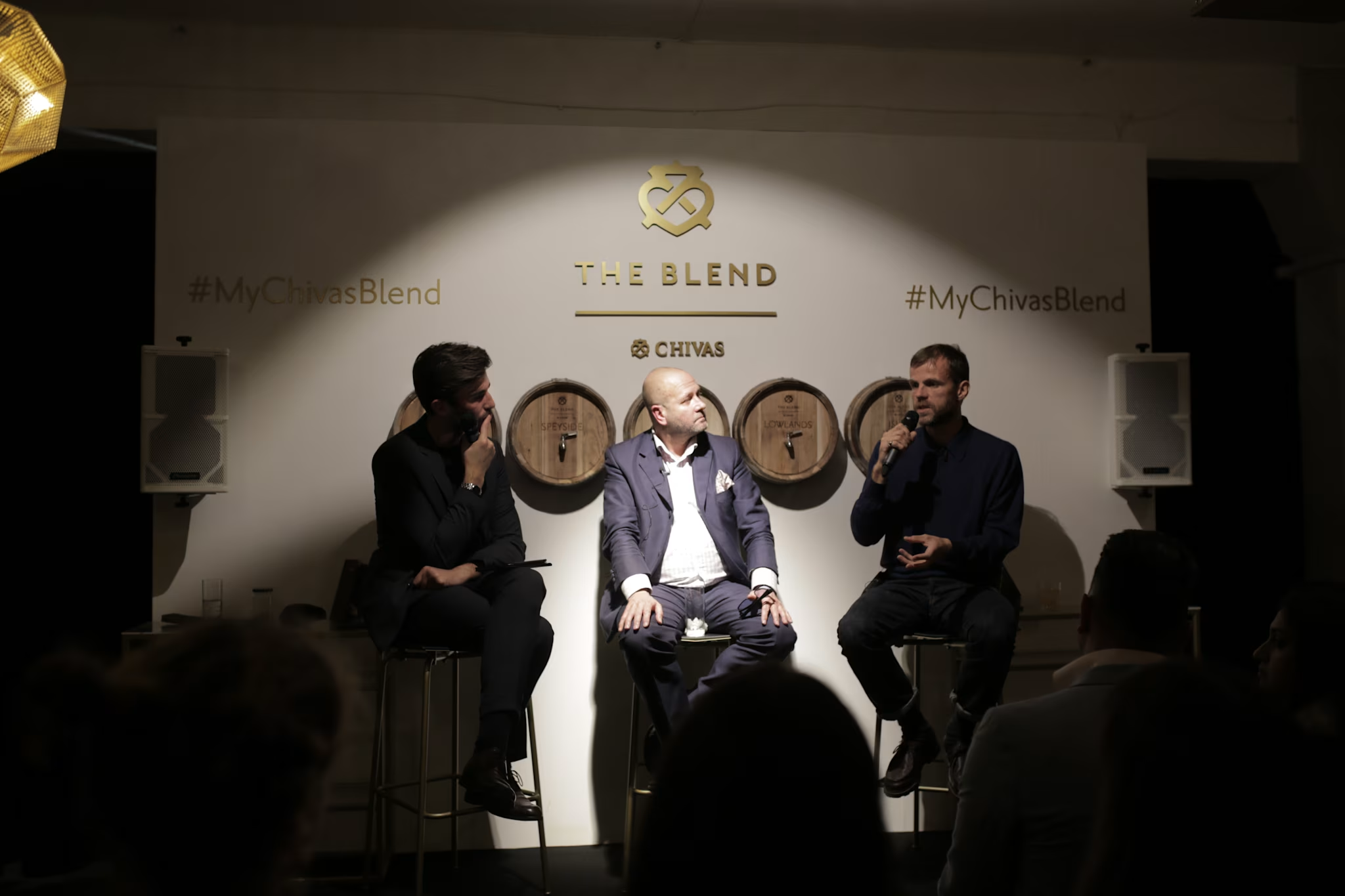
Ewen Spencer talking at the Blend, image via Chivas Regal
Over the course of his career, photographer Ewen Spencer has been a voyeur for some of the most important movements in British cultural history. He became one of the unofficial photographers of grime's first wave in the early-00s, worked closely with Mike Skinner for The Streets' generation-defining first two albums, and, through it all, he has provided a lens into youth movements and youth cultures that are often overlooked. As part of Chivas Regal's The Blend project, Ewen spent an evening in conversation with Paul Hallam, a photographer intimately associated with the Mod scene of the 1960s and someone equally important in documenting the ever-evolving subcultures of modern Britain.
Before this evening started, Complex sat down with Ewen to talk about his involvement with grime, the history of British youth culture, and what happens to our subcultures in the age of the internet.
How did you get started as a ‘grime’ photographer?
I wouldn’t call myself a grime photographer, I started just making pictures of the Northern Soul scene in about '96, which is where I came from, that was my background, my scene, my subculture. Then I moved from that to approaching magazines with my pictures of the Northern Soul scene, I spent about two years photographing it, my own people and extended scene. Then I just went in to photographing different clubs and parties for Sleazenation. Sleazenation was just a place for me where I could hone what I was doing and understanding where my interests really lay and that was in subculture and style and what was happening on the dancefloor, which at that time was where it was invented and designed and discussed in manifest, it would happen on the dancefloor. It doesn’t so much now, and I think the point where it changed was probably with grime, I think that’s where it stopped being about the dancefloor. I traversed through a lot of different scenes for Sleazenation and eventually the Face magazine in '99 and then I started photographing the garage scene in about ‘98/99 and then I was capturing lots of other aspects of youth culture and I started working with Mike Skinner, and Mike then introduced me to the grime scene in about 2002/3 when he was making A Grand Don’t Come For Free.
Was it hard to gain the trust of artists or people you were photographing?
At first it was. I was a 30 something white bloke from Newcastle upon Tyne. That’s my identity. For me I wasn’t really that interested in the music as much as in the whole scene and the energy and the creativity of that. If you put that into a context of subculture, style and music and what that creates and what it embodies then there was a really interesting scene happening with grime. The people I’m working with are creative, they’re artists and they’re performers and they want to be seen, so I was visualising their scene and if I could prove that to them quick then I’d gain their trust and they’d stop thinking I was a ‘fed’ as they’d call us. So I was no longer a suspicion, I was part of it. Within about a year that happened, and I was part of what was going on. That just sort of built and built and built and after about two years I could pretty much gain access where I wanted. I committed a lot of time to that scene. But I had done garage before that, and I had done other scenes before that.
So was the progression from garage into grime quite logical?
In a way, but I’d stopped with garage in about 2000 when I went to Ayia Napa and I was fed up with it then. Then I was working with Mike and The Streets, I was doing a project with the Face magazine about the nation, about England and youth culture and I was going to sixth form discos, I was going to Rock in Cornwall. I was photographing just teenagers in general, a generic ‘teenager’ and what that meant socio-politically.
When I started making pictures at the tail end of 2003, it wasn’t even grime. For me, that era of between garage and grime was a mucky, murky place and I’m glad I didn’t have anything to do with it really, because I wasn’t interested in it by then. I was interested in other stuff then. Garage was dead, in my opinion, as soon as Ministry of Sound put out that album, Rewind, and I shot that cover. Then it was over, because it was visible and it was in Ministry of Sound.
If garage died when it became visible, has grime died?
Grime’s becoming something else, and it should do. It should become something completely different. And it needs to hurry up, because nostalgia is not sexy. Looking back all the time at something and trying to interpret it as exactly how it was is not going to work because that’s just nostalgia, and nostalgia is fairly odious, in my opinion. It should be getting reappropriated and changed into something else, and I think it is. I think there’s lots of interesting stuff happening, and I’m looking forward to seeing what happens next. I think the established people will probably help nurture that and turn it into something else. You can see people like Lord of the Mics doing things like that, they’re bringing people through and bringing them on the road and trying to get them out there to a new audience and trying to change it a bit and push it a bit, and Boy Better Know, they’re all doing elements of that and it’s good. It’s got to keep moving forward, they cannot hang on to what it was.
In those early days of grime, did it feel like you were part of a movement?
I felt like I was photographing something important. It felt like something was happening that was going to change things, because it was about people’s experiences in Britain and they were talking about what it meant to be young in Britain at that time. To be photographing that, definitely you could sense the excitement that was coming off of people in the room and the hope and that’s dead exciting.
I think there’s something interesting about the idea that garage was aspirational and grime was reality.
Grime was reality, but grime was also about being anonymous, not being in the spotlight and not being ostentatious. It was about being hooded and capped and anonymous tracksuit and low down. It went back to the drawing board in that sense. I liked that as well, because the MC became the God and that was happening more and more in garage but that’s when garage went wrong. Because garage was about music, it was about the dance floor, it was about the dance. As soon as you got people talking on the mic too much that was it, it was over. We’ve all been to raves where someone just can’t shut up on the mic, and it’s like “we’re here to dance, we’re not here to hear you banging on.” The idea was that they were there to compliment and hype things up a little bit.
I definitely felt I was part of something happening, but it’s not my scene, it’s not something I’m a part of. I loved being a part of it for that moment when I passed through, I’ve moved on to other things. It’s great the pictures were published; I just wanted to show it for what it was.
Do you feel stuck with a 'grime photographer' label?
I don’t feel stuck with it at all. I think people who know my work understand that I’m someone who photographs subculture and style. If you look at my more recent work it’s much more progressive, it’s talking about what young people are in to now. I’ve just had an exhibition in Brighton which talks about the future British youth, how they’re interesting in their own style and defining themselves in different ways, how they’re more networked, they live online a lot more, it’s less about what’s happening in the street and more about living in the hypothesis elsewhere.
So how do you think the internet has changed subcultures?
Subcultures don’t exist in the city centre, the suburbs, the rural areas. They exist online. That’s how the internet's changed it, because it’s a massive reference bank, a massive library online where you can go and discover as much as you want about what it is to be a >suedehead, or a skinhead, or a mod, or grunge or whatever, all those tribes. It’s very accessible now to discover something more about that and I think at the time, grime was at the beginning of that. It changed things and it helped define the grime scene. The bit rate and the sharing of music, the exchange of music, now it’s become the exchange of everything, style, information, content, the whole thing it’s just all there. You don’t have to wait for The Face magazine to come out or Sleazenation once a month. You just click online and it’s all there, so that’s the difference I guess. I don’t feel annoyed by grime, I was chuffed to be a part of it but it’s ten years ago, it’s a long time ago. I had that exhibition a long time ago, that book came out over ten years ago, I’ve done an awful lot in ten years.
You’ve photographed so many different types of youth culture. Was there one strand that ran through them all that got you interested?
For me it’s just always been about soul music, that’s the beginning of it all. Black music in that sense, I think its always sort of pushed and channelled and encouraged people to try different things and dress in a different way. That idea of the rave, just good music, bass driven music that’s very British. I think that’s the thing that keeps moving it along, I’m always interested in what the music’s doing and we’ll see what comes after. I go to Naples and I photograph Neopolitan kids, I go to Marseille and I photograph rude boys in Marseille, because I’m interested in that kind of counter culture that isn’t academic.
Those two cities have a reputation as very counter cultural cities.
Yeah, they’re two cities that are multicultural, they’re big ports, they have a history of a massive mix of people coming and going and as a result they have a mix of people and a clash of cultures that conjures up a great image, and a great anarchic attitude, a confidence, music, and a look. That for me always conjures up something a bit more interesting, more lively. That’s what it’s all about really: fun. Fun’s underrated. I think people take themselves a bit too seriously, especially when it comes to making pictures, people can be a little bit series, a bit academic. There’s a place for that and it’s important, but I think it’s also good to look at raw fun.
So that’s what you’ve been following?
Just life. People having a good time. It’s all autobiographical. When I was young, I wish I’d had a camera and photographed my pals, but that wasn’t the case, it wasn’t available at that time and I didn’t have the nous really to do that. I was too busy having fun. But then I’ve followed my nose. I’ve done what I did when I was a kid, and just followed that energy.
What was it about Chivas Regal and The Blend project that made you want to get involved?
For me it’s the idea of the blend. I think the blend of old and new is the success of British street style. Historically the re-appropriation has kept the wheels moving. Youth look to the past and reinvent to discover new ways of wearing classic pieces mixing it up with the contemporary, creating new genres.
I’m looking forward to talking with Paul. He didn’t feel he was a photographer, he was making pictures because he felt that he was compelled to make those pictures because it was his friendship group, his scene and he just made those pictures because he felt it was important to document what he was doing. But he would never call himself a photographer, and I think it’s kind of interesting that, that he’s come from that place. He picked up a camera and he captured what he was doing. There’s a great quote from Nick Knight, the great British photographer, where he says “if you want to make a great photo book, just a give a camera to a 16 year old kid and ask him to make photos of his pals and put them away for 15 years. Then bring them out again and print them and it’ll be a great book.”
Because that’s how it works, it’s all cyclical. It’s all sort of cyclical, it all comes back round, it’s all re-appropriated and then it becomes something else and something new is born out of that and that’s what’s exciting about it all really. That’s why I think British subculture keeps reinventing, no one does it better. From the casuals, to acid house, to garage and grime, jungle in between. It just keeps reoccurring.
You can find out more about Chivas Regal's The Blend project here.