Image via Getty/ Ethan Miller
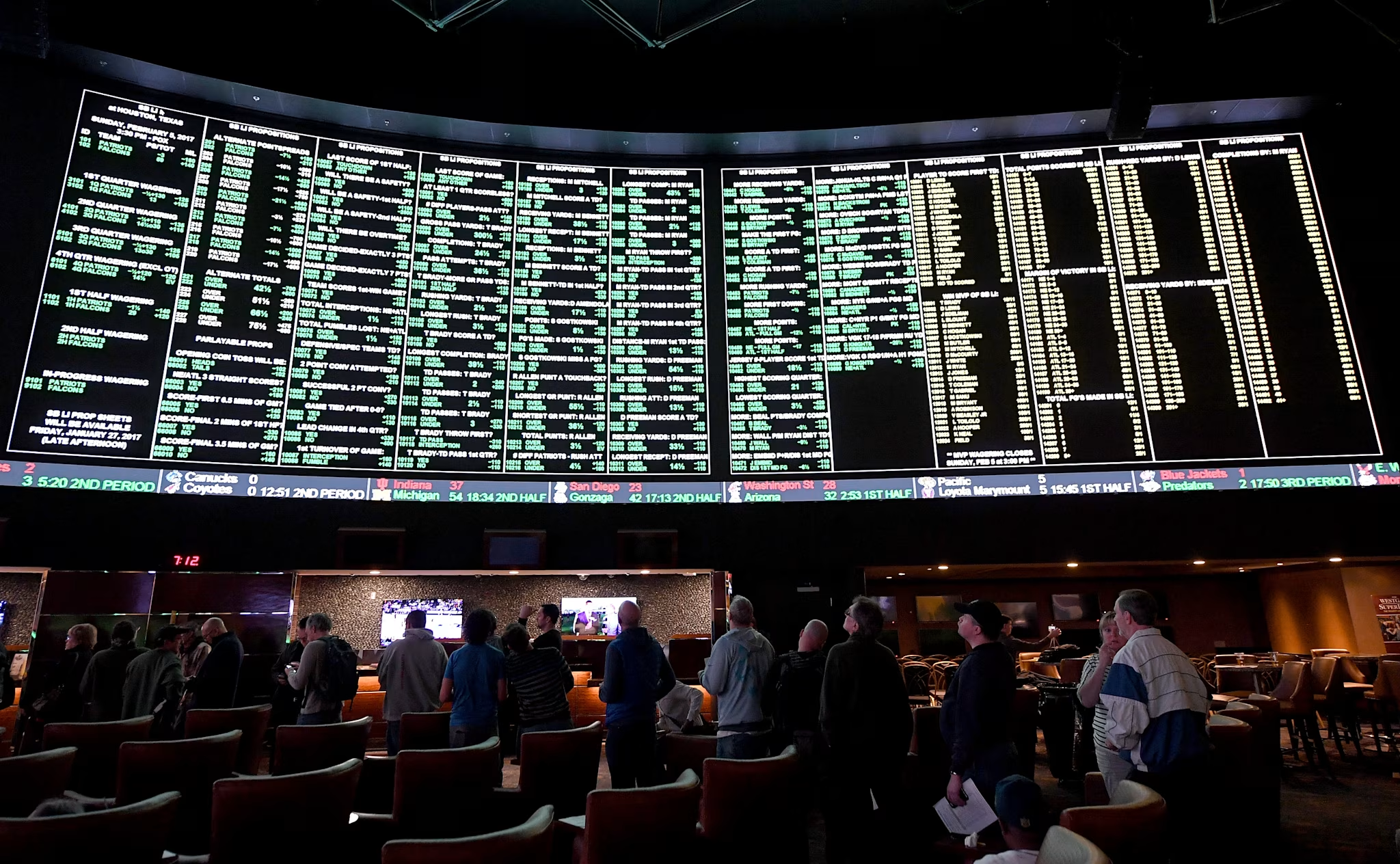
Thanks to the Internet, which has made it possible to place bets on everything these days (NBA? Yup. NFL? Of course. Liga Venezolana de Beisbol Profesional? HELL YES! Not that we know anything about that...), sports betting is now a 24/7/365 business. And it's a BIG business, too. Billions and billions of dollars are bet on sports every year, and Super Bowl Weekend is one of the busiest times for sportsbooks all over the world. Industry analysts are already predicting that the bets placed on Super Bowl XLIX between the Patriots and Seahawks—both legal and illegal—will total almost $4 billion. So…yeah. The betting business has never been better.
But despite this, it still seems like there are plenty of people out there who have absolutely no idea how betting lines actually work. They see "Patriots -1" or "Patriots/Seahawks Over 47" or "Super Bowl XLIX Coin Toss—Coin Will Land Heads -103" and are like ¯\_(ツ)_/¯. So to help those people out, we put together a list of Everything You Need to Know About How Betting Lines Work. Whether you're planning on betting big on the game this weekend or just want to be able to hold a conversation with the guy who put his life savings on the National Anthem coming in at under 122.5 seconds (a real bet, by the way), we suggest going all in on this guide.
What is a betting line?
Before you understand how betting lines work, it'd probably be helpful for you to know what they are, right? Right. Well, we'll try to keep this as simple as possible for you. Because even though betting lines aren't that difficult to understand, they're also what usually throws the average person off and deters them from wanting to learn more about sports gambling. So here are the four of the most common kinds of bets as well as what we hope are easy examples for each of them:
Point spread bets: By definition, a point spread is "a forecast of the number of points by which a stronger team is expected to defeat a weaker one." It's essentially a point total that illustrates how much better a sportsbook/Las Vegas oddsmaker/bookie thinks one team is better than another team. So for example, the Seahawks were an eight-point favorite against the Packers during the NFC Championship Game a couple weeks ago. That meant that if you wanted to bet on the Seahawks with the spread, you would have needed them to win by more than eight points to cash out, which they didn't since they only won 28-22. But if you had the Packers as an eight-point underdog in the game, you would have won your bet even though Green Bay lost the game. So as you can see, the point spread is designed to force you to make a decision. Do you want to bet on the team that should win a game even though they're going to need to win by a certain number of points or the team that probably won't win but that can win you money if they lose by less than a certain number of points?
Moneyline bets: Not up for the stress that betting the point spread can bring? We don't blame you. There's nothing worse than taking a team like the Seahawks -8 and watching them win in stunning fashion…by six points. It'll make you wish you had taken the moneyline, which is a betting line that involves you simply picking a team and cheering for them to win. It doesn't matter if they win by two or 52; if you bet their moneyline, you win. The catch (there's always a catch!) is that you have to lay more money—a lot more money in most cases—in order to turn a decent profit on a moneyline. For example, the Seahawks' moneyline was -280 when they played the Packers, which meant that you would have needed to bet $280 to win $100. By comparison, you would have only needed to bet $110 to win $100 if you had taken the point spread. And if you had taken the Packers moneyline, which was +240, you would have won $240 off a $100 bet. But after the game, you also would have been kicking yourself for not taking the Packers +8 since they ended up losing the game but covering the line.
Point total bets: Simply put, this type of bet involves betting on how many points total two teams will score during a given game. You can either bet that the total score will be over the point total or under the point total. The Seahawks/Packers point total was 45 at most sportsbooks just before kickoff. And those people who bet the "over" won since the final score, 28-22, equaled more than 45.
Proposition bets: You've probably heard a lot about prop bets this week because most sportsbooks create tons of them for the Super Bowl. However, prop bets are available for most sporting events and deal specifically with whether or not certain things will happen during a game. For example, "Will there be a safety?" or "Will Player A score a touchdown?" Some of the Super Bowl prop bets are a little bit more ridiculous—"What color will Bill Belichick's hoody be?"—but the concept behind them remains the same and each answer to the question comes with an assigned betting line.
Who creates the betting lines that are used by sportsbooks?
Now that you know what betting lines are, you're probably wondering who comes up with them. Does Las Vegas just pull the numbers out of thin air and go with what sounds right? Uh, no. As we mentioned earlier, sports gambling is a billion-dollar business, so a lot of thought goes into creating betting lines. And while companies like Las Vegas Sports Consultants have helped sportsbooks create lines in the past, just about all sportsbooks have in-house oddsmakers that are in charge of creating betting lines in the weeks and days leading up to games.
How are betting lines created?
As recently as 10 or 20 years ago, oddsmakers didn't have very much information on teams at their disposal. Sure, they could scrape together stats based on box scores and such. But they couldn't figure out the average 40-yard dash times of two teams simply by pressing a couple of buttons. Today, they can look up just about anything—and we do mean anything—in the blink of an eye in order to help them compare and evaluate teams. So while things like records and the weather still play a large role in the betting lines that are set, oddsmakers are now able to use advanced statistics in order to pinpoint exactly how many points Team A should beat Team B by. And it's actually kind of scary to see how close they usually come to being right.
How do sportsbooks make money?
When oddsmakers create betting lines, the goal is simple: To get people to wager on both teams equally. They want just as many bets to be placed on Team A as Team B. Now, we know what you're thinking: Doesn't that mean that they just end up breaking even? No, they don't, and it's because of the "vig" (also known as the "juice") that's attached to each and every bet that a sportsbook takes.
Here's how it works: When you place a wager in order to win, say, $100 on a point spread bet, you'll be required to bet slightly more than $100. The amount varies depending on the vig that your sportsbook charges. But in most cases, you'll likely be required to place a $110 bet in order to win $100 back. Sportsbooks do this because, assuming they're able to get people to wager equally on both sides of a bet, it allows them to guarantee that they will make money. So when you lose a $110 bet to a sportsbook, you're usually not giving them that entire amount. Rather, they're using $100 of your money to pay off someone else's winning bet and pocketing $10. Doesn't that make you feel a little bit better about losing? Er, maybe?
Why do some sportsbooks offer different betting lines than other sportsbooks?
Once upon a time, there weren't many reputable sportsbooks out there. So there was a lot more consistency from one sportsbook to the next. But today, there are so many of them that it's not uncommon for betting lines to differ from one sportsbook to the next. One might be offering the Patriots -1 in Super XLIX, while another has the game as a pick 'em and another has the Seahawks -1. But there's quite a bit of copycatting that goes on within the sports gambling industry. So while there are some differences from sportsbook to sportsbook, there's not as many as you'd think and sportsbooks routinely keep an eye on other sportsbook in order to make sure that their lines aren't too different from all the rest.
Why do betting lines change?
At the end of the AFC Championship Game a couple weeks ago, the Patriots were actually +2 or even +3 at some sportsbooks. But once people started placing wagers on the game, the line changed very quickly and, before long, the Patriots were -1 on the point spread.
Lines change all the time for a number of different reasons. Sometimes, an injury to a key player will do it, while other times, a sudden weather change will cause a line to fluctuate. And if a professional bettor—known as a "sharp"—places a large bet on one team, that could also cause the oddsmakers to raise an eyebrow…and change the line. An oddsmakers' job is never done and, right up until the start of a game, lines are constantly moving.
Will the betting line ever change for a wager that has already been placed?
No, which can be both a good thing and a bad thing. For example, if you were able to bet the Patriots +3 back on January 18, you're sitting pretty right now. They're actually the favorite in the game according to most sportsbooks, so you've got a favorable line. But if you took the Seahawks -3 at that time, you're probably not feeling all that great about your odds. That's not to say that you won't cover your bet. But you'd definitely be feeling a whole lot better if you had the Seahawks getting a point right now as opposed to giving three. It's why it can be a gamble putting in a bet so early. But it's a gamble that some people are—not surprisingly—willing to take.
Why do some point spreads have half a point attached to them?
Because oddsmakers hate you and want you to agonize over your bet. Okay, okay, so that's not why they do it. But every now and then, you'll see Team A with a point spread of -6.5 or Team B with a point spread of 10.5 and think, "What? There aren't any half-points in sports!" But you can treat these spreads the same way as you'd treat a regular point spread. If Team A wins by more than 6.5 points, you win. And if Team B loses by less than 10.5 points, then you win. You also have the option of "buying" half a point and making those lines -6 and +11, but "buying" points will cause your odds to increase and instead of paying a $10 vig on a $100 bet, you may end up paying a $20 or $25 vig for an extra half a point. Come to think of it, maybe the oddsmakers do hate you after all.
When is the best time to place a bet?
We wish we knew! But as a general rule of thumb, a lot of "square" bettors—another name for inexperienced bettors who don't use statistics to make their bets—tend to place bets on favorites just before the starts of games. And at times, it results in the betting line for the favorite rising quickly. So if you're going to wait until the last minute to place bets, it's typically a smart move to bet the underdog. It obviously doesn't always play out like that. But it does happen a lot before big games like the Super Bowl and key college football matchups and proves that "squares" can influence the line just as much as "sharps" do with their bets.
Is betting on sports legal in the United States?
Now that we've got you all ready to run out to the bank so that you can throw down a couple Benjis on the big game on Sunday, there's something we should tell you: Sports gambling is not legal in most states in the U.S. Obviously, Las Vegas features quite a few legal sportsbooks and states like Oregon, Montana, and Delaware also allow sportsbooks to operate in some capacity (Delaware, for example, has sportsbooks but they're only allowed to take "parlay" bets, which are bets that include more than one team). But for the most part, sports gambling is illegal in the U.S. That won't stop online sportsbooks like Sportsbook.ag, BetUS.com, and Bodog.com from taking your money and allowing you to bet, but you'll likely be breaking the law when you do it.
But hey, after reading all this, at least you'll know what you're doing, right? Ha. Just don't forget to give us our "vig" if you break the bank this weekend.




