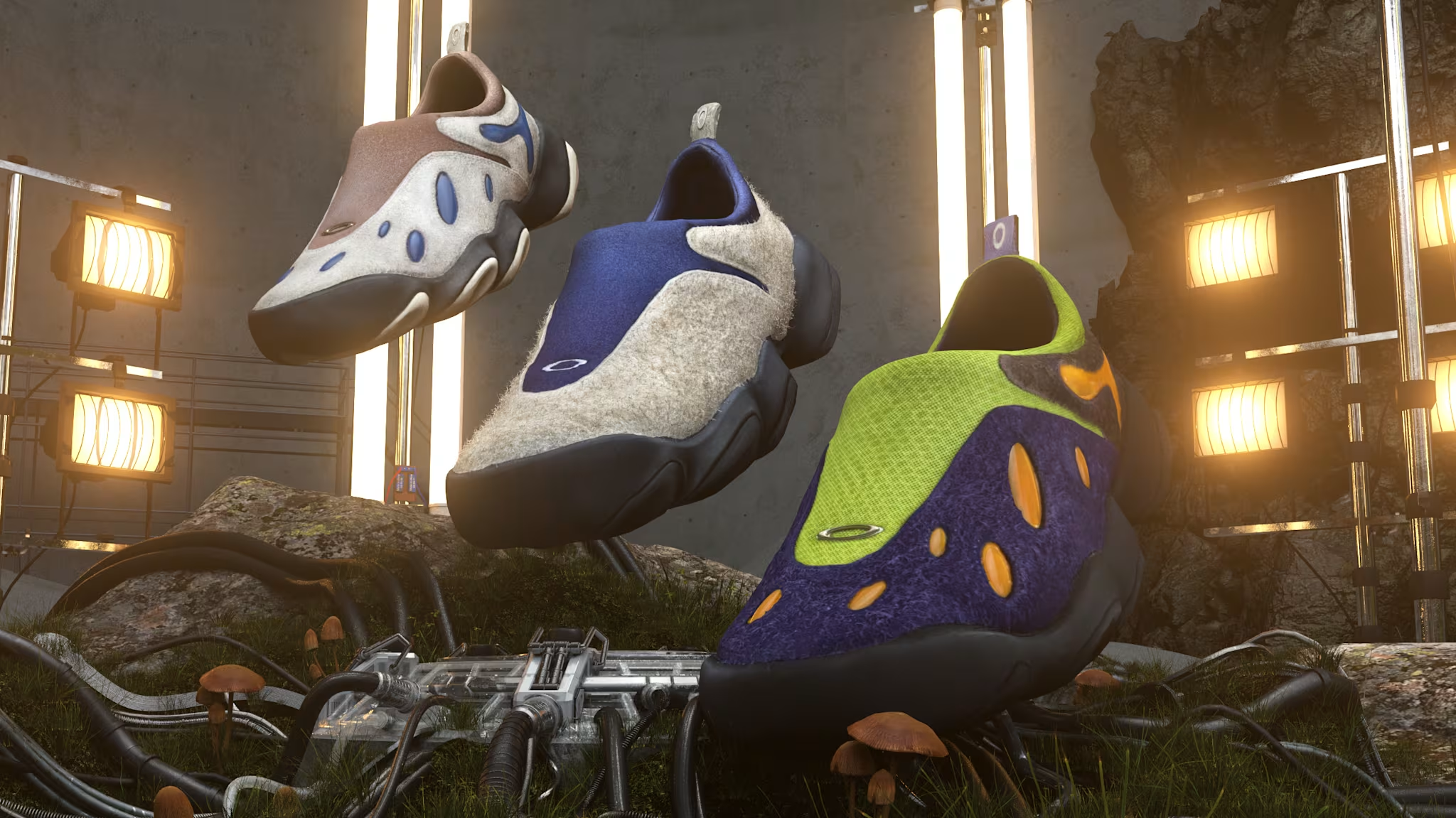
Image via Oakley
Bringing back a shoe from years past is no easy feat. At the designer level, tasks like sourcing hard-to-find archive models, re-creating molds, and finding comparable materials can halt a retro project before it gets off the ground. By the time the shoe winds up in the hands of a nostalgic consumer, they’re ready to pick it apart with a magnifying glass to see how it matches up to the original. It can be a daunting process—there are several stories in the sneaker industry of retros being abandoned or significantly altered due to these limitations—but when brands are able to nail it, the juice is more than worth the squeeze.
For Oakley, which is known more for its eyewear than its footwear, there’s less of a precedent when it comes to bringing shoes back. Reissuing its Eye Jacket glasses (made famous by Michael Jordan) or the fan-favorite Frogskins is one thing. Re-creating a shoe that’s over two decades old is a different beast entirely. Would a brand that’s not a major player in the sneaker space be able to get it right?
Enter Brain Dead, the Los Angeles-based clothing brand that founder Kyle Ng says functions as more of an idea company than a product pusher. A longtime fan of the eyewear company, Ng had a particular affinity for the obscure Oakley Flesh, a slip-on shoe released by the brand in 2000. Despite being off of shelves for 20-plus years, the Flesh has managed to find relevance with today’s moodboard-driven social media consumption, regularly appearing on curated Instagram accounts.
Brain Dead and Oakley’s initial talks revolved around working on glasses, but plans changed after Francesco Milleri, CEO of Oakley parent company Luxottica, suggested that Ng’s team work on footwear. Then, when Ng and Brian Takumi, vice president of product creative catalyst at Oakley, began plotting a Brain Dead x Oakley collaboration, they saw the potential for something bigger. Rather than a one-off collab, the two entities have come together to launch the Oakley Factory Team, a reimagining of experimental Oakley projects from the past seen through a futuristic lens.
The first launch from the Brain Dead-assisted Oakley Factory Team is the Flesh, which releases today in two colorways with updated design details for $165 apiece from wearebraindead.com. A third non-collaboration colorway launches May 3 for $155. Ahead of the drop, we caught up with Ng and Takumi to find out exactly what the Oakley Factory Team is, what the process of reissuing the Flesh was like, and what we can expect down the road. The interview, lightly edited for clarity, appears below.
Can you tell me a little bit about what the Oakley Factory Team is? Is Brain Dead part of it?
Kyle Ng: So basically a year and a half ago or two years ago, I met with Brian and the team over at the Oakley headquarters due to our fascination with Oakley. I think we were connected just off the idea of mutual respect for the companies. And I was probably collecting a lot of Fleshes at the time. Think someone like Dylan [Radloff] who’s part of the Oakley team saw that I was wearing those. And I think we mentioned the idea that we’re interested in footwear and Brian being the archivist of all Oakley and obviously the creative director, he ran me through the whole brand and lineage of what Oakley is about and what they have done in the past and where they’re going in the future.
This idea was spearheaded off the bat, where they came to us and the Luxottica CEO [Francesco Milleri] was like, “Hey, we wanted to get an Oakley shoe made again and would love for you to help create it.” From that perspective, Brian and I, we’re just thinking about it and I’m like, “It’s cool if it was a Brain Dead Oakley shoe, but what’s cooler is if we’re producing the shoe and teamed up and created a project that reminded us of the early R&D eras of a lot of businesses.” And funny enough, I was playing a lot of paintball at the time. They always called the teams, “the factory teams”, “cap factory team.” Or this idea of factory teams being the R&D research for companies and just using their tools and products.
I think I saw something within the Oakley Factory Team. And I just love this idea of like, “Oh, I’m someone who wears the products. I wear Oakley’s I wear it on my feet. I wear them on my eyes. I wear helmets, goggles, etc.” What if Brain Dead was the factory team to Oakley through that idea. What Brain Dead represents, we’re not just a product creator, we create ideas a lot, whether it’s content, movies, art, etc. What if we were this extension that probably they want to experience this great avant-garde quality in the nature of Oakley, but as a larger company with the big ship at the helm, it’s hard to move.
A lot of the business core, business was built off crazy ideas off the bat, from what Brian told me. And he could speak upon that himself. But the idea of this character, Max Fear Light, was a story that was created a long time ago of this iconic visionary, who Oakley was based off of. We wanted to be this extension of that idea of how conceptual Oakley has always been and bring into a new generation where this could be a window for Oakley to experiment not only in product, but concept.
Brian Takumi: To add to that, to give you more context, Oakley back in the day used to have factory pilots, which were exactly as Kyle said, the test pilots, the ones who were trying new things. I think as we got into this partnership, it wasn’t to force Kyle into being, “Hey, use factory pilots and bring it back.” As he was saying to give Brain Dead its own identity of what it would be to Oakley than just saying, “Kyle, just be a new factory pilot.” We thought it more meaningful that Brain Dead was able to own its own thing and be the Factory Team and create its own entity with that then necessarily just bring back the factory pilot program.
I think that sums it up pretty well. With regards to the Flesh itself, were there any challenges that you ran into trying to bring it back?
KN: Well, number one, there was no real archive of it. So basically, the hearsay and that’s the funniest part, I don’t know how much we want to go into this, but pretty much as Oakley is a bigger company, the idea of archiving was probably not the first and foremost of a lot of the eras. They have amazing extensive ideas of art direction, etc., but the product in itself, they’re moving so fast. So a lot of it was us doing the archiving, finding, sourcing on eBay, etc, and grabbing a lot of the items we wanted to create, like the Flesh. Then we reimagined it and basically, had to retool the whole thing. Create it with the classic in mind, but with also evolving it. The original one had a full rubber outsole. Basically that means the midsole was rubber, the outsole was rubber, and it was very heavy. We definitely wanted to evolve it where the midsole is EVA [foam] now, and the outsole is rubber. Again, we wanted to keep that as traditional as possible, but at the same time, I think important not to, especially for Factory Team, not to be just a reissue project, but to be something that looks at Oakley as something that was way ahead of its time and finally making something that it feels contemporary now. It was too futuristic back then. Now, it’s just getting to that point.
Brian, was there anything you wanted to add as far as challenges? You laughed a little bit there when I asked the question.
BT: As Kyle mentioned, when we had this conversation about bringing it back, as he said, it was really starting from scratch. Fortunately, they had the means and liaison to actually go figure out how to re-create it because a lot of that stuff didn’t exist anymore from back in the day. Without a partner like Brain Dead… they were probably the only ones who could have brought this thing to life the way they did.
The Flesh model has, I guess you could say, a cult following on social media. A lot of the Instagram hiking and outdoor pages, you’ll see it on there a lot. How much did that interest on social media play into the decision to bring it back? What made now the right time to bring the shoe back?
BT: I think, we were seeing a lot of the stuff, a lot of the comments that were showing up and I think as Kyle said, the shoe was ahead of its time back then and the world’s finally caught up. All the footwear we were doing in the late ‘90s and early 2000s, Kyle said, even for them, it was reimagining what it could be versus just a reissue. Even when we started footwear back in ‘98, it was the same thing, with Shoe One, Shoe Three, the Flesh, the whole mindset was always reimagine what’s possible. The Flesh was something that was along that line. The name “Flesh” came from, it was literally meant to be a second skin flesh on your foot.
That’s why it has the very biomorphic feel of it. The shape, the sculpture was meant to basically re-create your foot. So this idea about it, and I think that’s where the content that Kyle and team produced very much resembles that the testing, his mindset behind the Factory Team really brings to life Flesh and the way they illustrated it in the content was this extension of a person. Seeing what’s going on today, as Kyle said, 20 years later, the world’s finally caught up with what Flesh is or was.
Kyle, you said you were a pretty big fan of this shoe. You mentioned you had some personal pairs ahead of this. Did you come into the Oakley partnership specifically wanting to bring back the Flesh?
KN: I think we purposely thought that there’s an opportunity with the Flesh because I love them. And we were in conversation about doing eyewear and that’s always cool, but our company, we don’t always just try to do the obvious for the most part. We always try to push it. And I grew up where my uncle, for every Christmas, I’d get an Oakley backpack with Oakley sunglasses with an MP3 player in it or some shit, and the watch. I’m sitting with my dad’s Romeos right now. It was just this idea, it really was built into my life.
I didn’t get into it because of Michael Jordan or Dennis Rodman, you know? There’s a sense of my whole design aesthetic was really based off of Oakley and the idea of the fictitious science fiction element to it leading to, how do I say, elevated dreams and goals that a company like that can imagining strive to and succeed in ways, but also probably, it’s never going to beat that, because it’s almost too science fiction. And I love that about it. It’s very aspirational. I think I really admire that concept. So when it came to them, again, we didn’t want to just start with eyewear. We wanted to go into something that was a little deeper and that’s where the shoe really felt right.
Totally. And I want to talk about the whole story behind these colorways and some of the changes you all made to them. Obviously, I’m getting a lot of sci-fi, futuristic themes. And the addition of those gel pods, am I understanding that it’s the first two colorways have the pods and those are the Brain Dead collaborations and then the follow-up without the pods isn’t, is that right?
KN: Yes. So the design inspiration was the era of Oakley and the Sony Walkman and the idea of the Panasonics and this biomorphic aesthetic of what I remember a lot as a kid. Just thinking about the shapes, seeing the sketches that Brian showed me of the original Fleshes and shoes like the Chop Saw, were really inspiring to me. There’s something about it, calling a shoe the Flesh, there’s something really AI about it. This idea of artificial intelligence, something like an off world. I wanted this biomorphic element. If you think about Oakley, what it was looking like, I think at the time is very different, but it’s very post-apocalyptic, which is very science fiction at the time. Very Blade Runner, referencing this era that was definitely in pop culture.
Now with that, we’re so ingrained with so many different forms of science fiction where it could go really further than just post-apocalyptic. We wanted to make it feel new and fresh. And made it feel live rather than dead. And I think James Jannard [Oakley founder] was a genius when it came to these concepts, but it’s our job to, again, push it to the future. So the shoe should feel alive and intelligent, which is what the gels were supposed to feel like. It was this idea of a new direction with early sketches that look like those gels that were never added. Then we really want to put those back in there in our form to almost feel it’s… A lot of the branding in the videos was this idea of intermixing with X-Metal.
If you don’t know what X-Metal is, Oakley was designing a lot of eyewear that they called X-Metal. These were forged in Las Vegas, and they created a factory that forges eyewear, which is insane. It’s fucking insane. And what we want to do is, well, the Flesh is obviously just the flesh of the bone, the bone is the X-Metal, let’s make that feel the biomorphic element like a Guyver suit, or this idea of organic form first. And that’s the new metal. It’s not hard post-apocalyptic metal, but it’s flesh of the bone, the bone is actually alive and morphing around it. So really our take on where Oakley can go. It’s more intelligent, metallic and intelligent, morphic shapes.
Brian, the third one, the one without the pods. Would you say that it’s pretty faithful to the original? Pretty close one-to-one? Aside from the EVA on the midsole, I guess you did mention.
BT: Considering we didn’t have a deep archive of stuff, they did a pretty good job of re-creating that thing. As Kyle said, the old one was solid rubber, so it was pretty heavy and the way they were able to basically stay true to the form or update it with modern construction, I think is going to bring that thing to a whole new level than it was originally.
Kyle, I want to talk to you just a little bit about your approach to footwear in general. You mentioned how Brain Dead doesn’t really do the expected. And I definitely noticed that, even when you work with a traditional brand, an Asics or a Reebok or a Converse, I feel it’s still something that’s not in line with the normal trends. You have climbing shoes, you have the wooden clogs. Do you say you intentionally try to steer away from what everyone else is doing? Or is it just you doing your own thing?
KN: I think so many people in the industry consider it a culture. But I think culturally, it’s not a culture to me. I think a lot of this, obviously there’s a culture to be in that culture, but that’s not a culture where I resonate with it. I come from it from more of a style perspective and my individual interests. So my interests are climbing, Oakley, skating, or whatever it is, all these interests. Or a wooden clog. The stories built around those interests create their own unique, full form [concept] rather than the idea of, I need to go down this route because this is the cultural relevance of what I should be interested in. And there’s nothing wrong with that. I think it’s just more of this idea of, I think, of course I love Jordans. I love clogs. I love Vans. I love Converse. And these are companies that all have a similar language, but at the end of the day, where in there can you find the deeper stories that make something completely unique?
There’s only so many companies in the world. It’s like making a movie, there’s only so many stories, but it’s the pizza toppings that create new pizza. So you make a pizza, you find all the different topics that create something individual. And I think that’s where Brain Dead is trying to find its little pocket where it’s like we have the movie theater, we have our focus on so many different things that are just not apparel in itself.
And that’s what it is. It’s just you as a person behind you. I see so many things that would put you all together and that’s who you are as Riley, or Takumi has all his stuff. And that’s why Takumi is who he is. And that’s what the branch should be. Not just like, “Oh, I’m going to do this because it sells or I’m going to do this because that’s what would equal to this.” I think that’s why we wanted to start with Oakley shoes first. Because if you ask a lot of people about Oakley footwear, people know that shoe via you said blogs or Tumblrs or whatever you want to say, but at the end of the day, most people don’t know where that comes from or what it’s called.
That’s the beauty in it is that, it’s so great because it’s undeniably a beautiful shoe and it’s inspired everything. But the stories that we can create with these beautiful products that are undeniable to just like a Jordan, just like a Converse or Vans, is that you can go so far in the story because it hasn’t been fully written yet or fully examined. And that’s what’s the beauty of where the Factory Team will be in the future.
You’re obviously the first brand to bring back this shoe. You worked closely with Oakley on it and it’s a shoe that people are into. Did you feel pressure to nail it and to get it right being the first brand to work with them?
KN: It’s really scary. But at the same time, this feels like I’m bootlegging a shoe. It feels like a fan video or something that you’re just going to be like, “We released this thing.” We have boxes at my house like a year ago that were just these Oakley shoes in an Oakley box that we designed. And I obviously talked to the team, but it’s definitely a funny thing where we talked to Italy and then it will show to Takumi like, “Do you know this stuff?” He’s like, “Oh yeah.” But it’s crazy because it’s such a big company. And this is such, almost like a small niche concept that it really is this X-Files of Oakley.
It’s this weird laboratory that people know what’s happening, but we’re just so gung-ho. We’re like just do your thing, and that’s what’s so beautiful about it. It feels like no pressure because it doesn’t even feel real. And then we’re at a point where it’s real and we have the final products and everyone seeing the content and everyone’s excited. So there’s no point where you actually can feel the pressure because they just let us cook. Then we already have the meal out before. Everyone’s [not] like, “We expect this, we expect this.” There’s no expectation because it didn’t exist.
For sure. And Brian, I see all the footwear behind you. You’re probably familiar with retros and re-releases . Did you feel pressure to get it right this time around?
BT: I think while we saw all the hype out there. We saw, as Kyle said, you go through all the Tumblrs and archivists who were posting things. Actually seeing it really come to life has been surreal as he said, because he said, there wasn’t pressure or expectation because no one really knew what fully to expect. But I think as he said, as things started to progress, as the sample started to come in, as the content got made, it was so exciting to see it be so real. As you asked about how well was it re-created then on top of that Kyle and Elia [Fornari, Brain Dead vice president] sharing the initial sketches of their evolution of it, which seems so off in the distance when we are looking at those and now to actually see the final product. It’s such an exciting thing to see the original come back to life and then the Brain Dead ones evolve it even from there.
I want to look forward. If you all can tease a bit, are there any Oakley retros maybe coming on up or plans to expand on newer footwear?
KN: I think we could say some of it. We won’t say the models, but let’s just say there’s future and past involved.
BT: I think there’s a lot of future stuff. As Kyle mentioned, the inspiration from Max Fear Light, there’s a commercial Oakley did in 1992, this year is the 30-year anniversary of it, and that was a key inspiration for a guiding light of the brand. I think there’s some exciting things coming in the future that… The past is definitely inspiring the future of Oakley and what it can be. As Kyle else said, no one wanted this just to be a reissue thing, not just for Brain Dead, but even for me as a brand, the future of Oakley isn’t going to be defined by what we did 20 years ago. It’s going to be defined by what we do in the future.
Kyle, I know you’ve had a few brands [prior to Brain Dead] like AXS Folk Technology and Farm Tactics. You’ve been around this space for quite a while. I was just wondering what are some of the biggest things you’ve learned in the industry?
KN: I mean, I think the thing is that, as a designer, I started working as a young kid, just with my own company off the bat. I was doing a lot of freelance work and then started Farm Tactics. And it was all learning this craft of making clothes. At that point, I was definitely not the ultimate clothing maker, but I found the avenue and I was there at the right time. And then when I started AXS Folk Technology, it was more menswear. Then I crafted my skills and just made more apparel. But what I realized at the end of the day is that none of this apparel or product mattered unless there’s storytelling. And at the end of the day, what my strongest perspective was that people probably liked what I was about and who I was, and what I was too worried about a lot in the early phase was more just the idea of trying to fit that mold, right? Of “I want to do menswear, I want to do this product,” and not just trusting in who I was as a person, which is like, I’m into so much shit. So I love all this type of stuff from basketball to skating, to paintball, whatever you want to say, games, etc. Brain Dead was really this avenue where I was able to make merchandise for a lifestyle. That was the goal, to make product that spoke almost as the merchandise for a band, but it’s for the things that I love. I think that’s where Brain Dead has seen a lot of success is the idea that you go culture first or start with what you’re trying to portray. Then the merchandise follows, because people can resonate with what you like.
I think the Flesh and what we do with team Factory Team is another extension of this, of just something that we’re very interested in from Oakley. It’s just something we’re interested in. To me, it’s not a product company, it was this idea company that I feel very strongly about. I think from there, that’s where this merchandise of these ideas come from. I think that’s where I think I feel almost, I don’t want to say the word, it sounds really pompous. But I feel invincible with ideas because I think there’s a point where if you feel fully confident in yourself and what you do and your interests then I believe a lot of people share the same interests and share the same hobbies that you do and that you are the voice as you get bigger to speak for them.
At the same time, give back to the community that services you. So the success will happen in this almost symbiotic relationship by servicing the community for all these things, and then they give back to you by supporting you. I think what’s really happening, especially with projects like this with Takumi is, this community that loves Oakley are showing so much interest in Oakley. And the new people, once you paint the picture for them and [they] understand what this was about, then they will service Oakley and it’s just going to grow into their mainline business as well. It’s not really a business strategy. It’s just a strategy of life.




