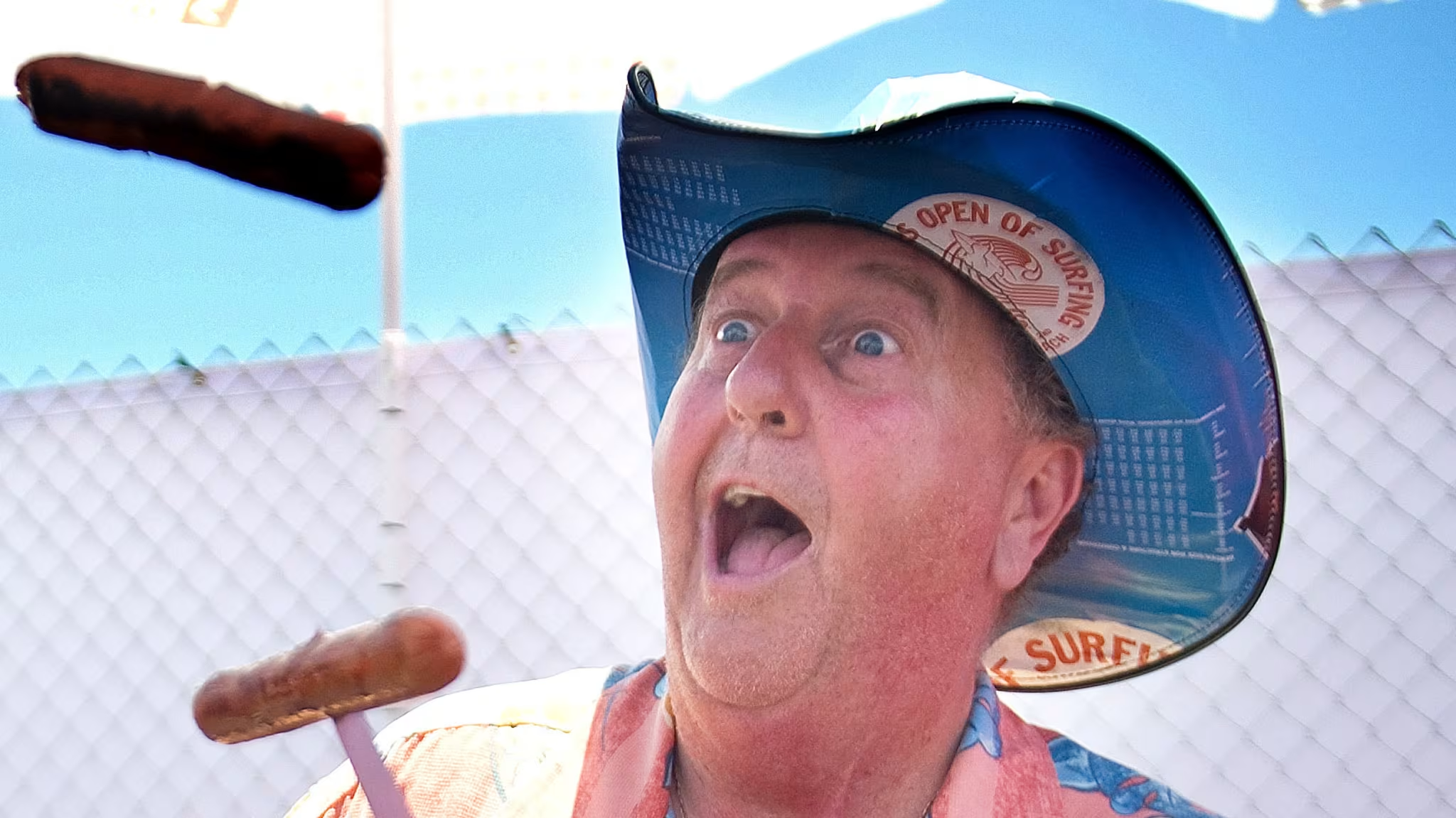
Steve Van Doren, the vice president of events and promotions at Vans, is almost 2,000 miles from where he lives but still very much at home here, on a rooftop underneath the hazy sun of a Mexico City afternoon. This—the grill where he prepares meats, the adjacent bowl that skaters popcorn in and out of, the party thrown on behalf of the iconic sneaker brand his father co-founded—is his domain.
Van Doren, with cartoony curls of hair pushed to the back of his head, is a sturdy 66-year-old who is perpetually dressed in a smile and a Hawaiian shirt. He is confident that no other executive in the footwear business is as active behind a barbecue as he is.
“There’s no way,” he says, expanding the category. “I don’t care what business they’re in.”
Nobody at Vans has been more active than him in endowing its customers and partners with generosity-as-marketing. For many years, he has made quesadillas for snowboarders and prepared thousands of pairs of free sneakers for Warped Tours. He is the avuncular man handing out pizza before the Nas concert and sweeping the empty cups into trash cans after it’s over.
The venue for Van Doren this afternoon is not a literal residence but a place where the brand lives, the latest of its House of Vans spaces that host concerts, skateboarders, and events tying back to Vans in all sorts of ways. Japanese Breakfast and Hot Chip play free concerts to mark the opening weekend in December. Inside the black building is a mural by Marcos Castro of two towering skeletons overlooking the ramps that line the walls. There are ceilings that stretch high and galleries across several floors, many of them spilling with tattooed people and simulated smoke.
The place will make no money for Vans—it is one gigantic marketing expense. It’s the embodiment of Van Doren’s trade, of spreading the brand’s cool via community outreach. It’s also a place for him to mix in.
“It’s just my nature to be able to engage with people,” Van Doren says.
Those people include legendary Vans-affiliated skateboarders like Tony Alva and Christian Hosoi. Van Doren, winding through his life in the industry, rattles off names like these in not totally linear tales, flipping between decades and eras in the company. Tony Hawk has recently become acquainted with Vans. Weird Al used to come by the warehouse in California, picking through samples for the most absurd shoes he could find.
Van Doren remembers how much the brand blew up after Sean Penn wore Vans in Fast Times at Ridgemont High in 1982, making its checkerboard sneakers famous. He remembers taking the shoes international after that. He lived through the bankruptcy that nearly crushed his family’s namesake. Van Doren navigates these vignettes in conversation, bringing them out with a faintly Bostonian timbre that has stuck with him since childhood. He is a shoe dog, a living document of where Vans has been in the past half-century.
For most of the time he’s been alive, he’s been in the business of selling sneakers. The Van Doren family moved to Southern California from Boston when Steve was 8 years old. In Anaheim two years later, his father Paul, his uncle James, and Gordon Lee opened the Van Doren Rubber Company, the first iteration of Vans. From its opening in 1966, the son was a fixture at his father’s workplace.
“I grew up with my dad. My dad always was a person that, you know, we’re in the factory, we’re sweeping the floors, and we’re cleaning the bathrooms, and we’re opening stores, and we paint the walls,” Van Doren remembers. “We build the racks, put the shoes in, we work in the warehouse. He was always a hands-on person, so that’s the way I’ve always been.”
The lessons of Paul Van Doren, who died in May 2021 at the age of 90, are a lodestar for his son. He’s found a way within the company to commemorate those that live up to that standard. For this, there is the Van Doren Give a Shit Award, made for employees who go out of their way to care for each other. Steve originally mistook the award’s swirling shape to be a Dairy Queen coil of soft serve, rather than a poop emoji.
Before Vans had history or foundation to stand on, the company nearly evaporated in the 1980s. As Steve Van Doren tells it, his uncle tried to push the brand too far from its core in skating, urging Vans to branch out into a wider range of athletic shoes.
“He wanted to be like a Nike or Reebok or Adidas and stuff,” Van Doren says. “We made all these shoes up, and they were made in America—cost a fortune.”
In 1984, Vans filed for Chapter 11 bankruptcy protection.
“I saw my dad this close to losing everything in his life,” he says.
His father held on, paying back his debts over three years and enjoying an outsized level of demand building up in the interim while the shoes were scarce. He sold the company in 1988 for $74.4 million and stepped down from the board in 1991. He retired in Nevada, Florida, California, and Kentucky, where he raised horses. Though he died a rich man, he was frugal. He would balk at paying 39 cents for a doughnut despite having $75 million in the bank. Steve pauses at this characterization—noting that he’d asked for the money in a bag.
The younger Van Doren never rebelled against his destiny of being a shoe dog, but has fought back against bosses in the business who were not his father. A higher-up at VF Corp, the parent company that purchased Vans for $396 million in 2004, once tried to tell him that he couldn’t use his personal credit card to make Costco pilgrimages to buy food for Vans events. Van Doren insisted he was doing it to save money for the company. The VF exec shot back that he went hunting with VF’s CEO, who would be hearing about the insubordination.
“I don’t give a shit who you go hunting with; bring it on” was Van Doren’s response. “I ain’t gonna lose this thing.”
Like any sound-minded American man, Van Doren knows the worth not only of the superstore’s membership pricing but also its hotdog meal deal. No matter the size of his spend at Costco, he is adding a trip to the front-of-store cafeteria afterward.
“I don’t care about it. I’m getting my hotdog on the way out,” he says, “and the drink.”
The disagreements with Vans’ owners over expense squabbles or asking permission before embarking on a mission, have not been enough to disenchant for him the brand his father started.
The exception here is the time around 1994, when he quit for a day in protest against a company president, installed by corporate leadership, that he disagreed with. (Vans was at that point owned by McCown De Leeuw, the investment firm that bought the company in 1988.) Van Doren recalls him with disdain as a pompous ass dressed in suits and scarves. Sales were slumping and blood pressure among employees was high. He was an ungrateful leader, one not even impressed with a weekend when Van Doren managed to sell $250,000 worth of overstock product peddled at California flea markets.
Van Doren decided he’d had enough and called his father, who arranged for a lawyer to give notice that his son would be leaving the company. Van Doren says that his being at the brink was enough to prompt McCown De Leeuw’s founders to fly in, plead with him to stay, and oust the president. They threw his letter of resignation back at him.
“I didn’t want to leave,” he says, “but I don’t want to work if I’m not appreciated.”
From there, he never had a problem. He also had carte blanche for events and promotions at Vans.
Van Doren is very much the heir to a sportswear fortune, and he lives a comfortable life. One imagines, especially given the sum his father had scurried away, that he has the money to buy every Hawaiian shirt there is and hence does not need much more to make himself happy. The way he relives his battles, though, and the number of them he has to recount, is evidence that he is not in his position purely off nepotism.
After Vans financed the skate documentary Dogtown and Z-Boys in 2001, he traveled to Sundance to scheme up ways to skirt the film festival’s rules for promotion around its premiere. He brought a $30,000 budget to Spring Break in Daytona at the turn of the ‘90s, holding volleyball competitions at hotels along the beach and awarding $1,000 to the winners because “they need money for beer.” Van Doren also set up skaters doing demos in a Daytona nightclub called the Coliseum and hired an illusionist friend of his to perform, four-legged, decked out in Vans.
He is willing to prove his mettle on the spot, issuing me a hypothetical challenge.
”I can give you $100,000 and I’ll take $10,000. You go open an ice cream store and I’ll open an ice cream store. I’m gonna kick your ass,” Van Doren says. “I learned from the best, which is my dad.”
That he speaks in small-business metaphor may be a reflection of where he sees Vans in relation to more dominant competitors in sneakers. The main example used for contrast in Van Doren’s stories is the “giant monster” Nike. He went to war with them over the US Open of Surfing, which Nike sponsored for a number of years in the early 2010s.
Van Doren, who had hosted a booth at the event for a decade, was told his brand wouldn’t be allowed.
“They threw my little tent out because they wanted to be God,” he says.
Never one to obey corporate mandates, he fought back in every way he could. He remembers the campaign as a four-day ass kicking. There were airplanes wearing Vans Off the Wall logos buzzing above the competition. He hired what he calls a pope-mobile, installed a ramp on the car, and drove around throwing Vans shirts out to the gathered crowds. He commandeered an office at a local surf shop, where his future son-in-law operated a machine that could pump out 3-foot-tall, V-shaped clouds to float through the enemy’s airspace.
Van Doren kept coming back until Nike pulled out of its sponsorship of the US Open of Surfing after the 2012 event.
“They kinda come into a planet and just take it over, and then they move on to something bigger,” he says.
Vans may not have the market share of Adidas or Nike, but it’s still a truly pop cultural brand. It’s benefitted from viral moments, the most recent being the Slip On-looking shoes worn by Squid Game participants. Van Doren says he’s never seen the Netflix series—“I know about it, but not really”—which should give you an idea of how overblown the wild claims of it rocketing sneaker sales were.
He did, however, participate in the “Damn Daniel” meme, linking up with the boys behind that Vine video in 2016 and bringing them to the Loma Linda University Children’s Hospital in California to visit patients. He brought 150 pairs of white Vans to give out to the kids, delivered in a sneaker car. Only later did Van Doren realize that letting the high school freshmen, who were too young to have driver’s licenses, helm the shoe-shaped vehicle was a bad idea.
Those kinds of outings are the most salient in the stories that Van Doren shares looking back on his career. He jokes that all the travel he’s done for work preserved his marriage, giving his wife reliable breaks from his presence.
It’s understandable, then, that he felt anxious as the coronavirus pandemic seized the globe in 2020, stopping all motion that wasn’t essential. He’s frustrated that workers at the Vans HQ in Costa Mesa, California, still haven’t been able to fully return to the office regularly.
“You just can’t have a culture working from home,” he says.
Van Doren has still made his way out, driving around in his RV once the US started to open back up. He called on Vans stores across the country to check up on associates when COVID-19 first hit. Then he called all the stores in Europe. Then, he says, he gave away 27,000 pairs of shoes and tens of thousands of bandanas to front-line workers and people supporting them. It’s a reaction that he springs to naturally.
“Every time there’s a flood somewhere in the country,” he says, “I don’t ask VF or anything. I just get it and go.”
When Hurricane Katrina hit, he grabbed a truck and drove to Houston to donate sneakers to displaced Louisiana residents. When fires broke out in Chico, California, in 2018, he drove up with 6,000 pairs of shoes and socks. For him, there is a certain duty to respond, to show that the Vans mission is greater than just selling sneakers.
“It was always about people, my dad always said,” Van Doren says.
Though Vans is owned by a corporation that did $13 billion in revenue last year, he still sees it as a family business. Van Doren is an executive at Vans, but he separates himself from that group, othering them. To himself, he is a pirate. The empire, the house that Van Doren built, is personal for him, an American dream written out in his last name.
Related Stories

Vans Employees Protest Vaccine Mandate
A small group at the sneaker brand's California HQ staged a protest against its COVID-19 vaccine mandate. Here's Vans' vaccination policy and the response.

Tinker Hatfield on NFTs, Paying College Athletes, Michael Jordan, Prince, and Everything Else
The legendary sneaker designer's latest project is an NFT with Oregon Ducks player Kayvon Thibodeaux. In this interview, he discusses the collab and much more.