
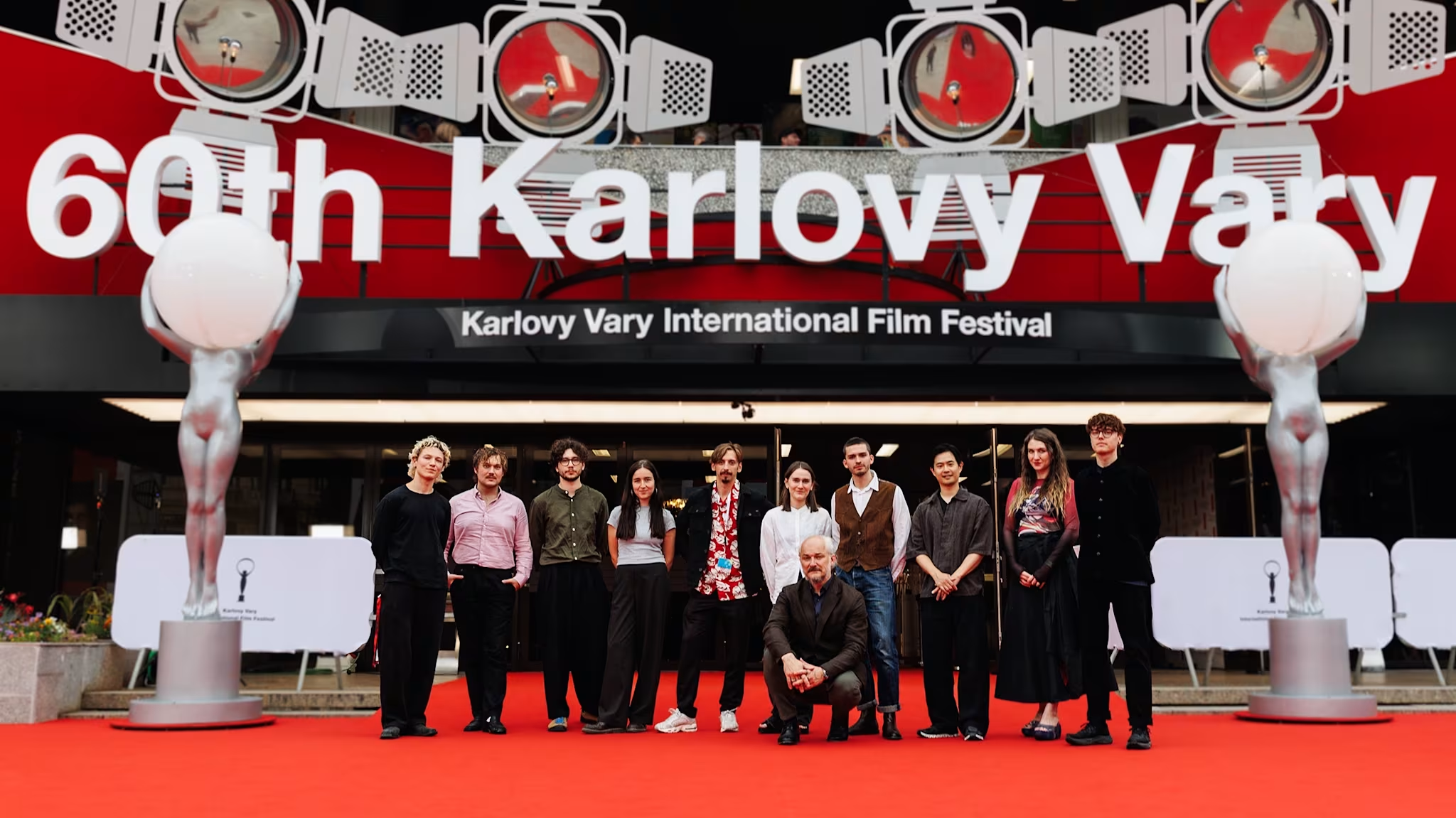
Breaking into the film industry takes more than talent. For emerging directors, securing funding, building the right relationships and getting work in front of the people who can help shape a career can be just as challenging as making the film itself. Future Frames, a programme held each year at the Karlovy Vary International Film Festival (KVIFF), aims to help address those barriers. Organised by European Film Promotion (EFP) and supported by KVIFF headline partner Allwyn, it brings ten emerging European filmmakers together to present their work and take the next step in their careers.
Every summer, thousands of film fans descend on the spa town of Karlovy Vary, a couple of hours west of Prague, Czechia, for a week of premieres, screenings and industry events. KVIFF sits alongside Cannes, Venice and Berlin in the continent’s top tier of film festivals, attracting Hollywood stars (Dustin Hoffman, Harvey Keitel, Maggie Gyllenhaal and Jesse Eisenberg were among this year’s guests), emerging filmmakers and some of the biggest names in world cinema. But while the premieres and celebrity appearances inevitably attract much of the attention, some of the festival’s most important work happens away from the red carpet.
The ten directors selected for Future Frames spend the week presenting their work, building relationships across the international film industry and attending an awards ceremony at which one of them will be announced as the recipient of the Allwyn Residency. Upon becoming headline partner of KVIFF in 2023, Allwyn, the multinational lottery and gaming entertainment company, expanded the Future Frames programme by introducing the Allwyn Residency—a month-long residency in Los Angeles, awarded annually to one director, featuring mentoring, job shadowing and meetings with leading figures from across the U.S. film industry. Since launching in 2015, Future Frames has introduced more than 100 filmmakers to the international industry, and this year’s cohort includes directors from France, Germany, Czechia, Spain, Croatia, Finland, Slovenia, Lithuania, Sweden and Switzerland.
The Future Frames programme combines screenings with mentoring, networking and meetings with agents, producers, distributors and other industry figures, giving early-career filmmakers access to the people, networks and opportunities that can be difficult to find at the start of a career. Speaking to filmmakers, festival organisers and industry figures throughout the week, one message surfaced again and again: talent might open the door, but access, relationships and the ability to make the most of them are often what determines what happens next.
Future Frames is intended to create exactly those opportunities. Away from screenings and interviews, directors spent the week watching each other’s films, comparing notes and building friendships with fellow filmmakers from across Europe. Just as importantly, they were introducing their work to producers, distributors and sales agents, speaking on panels and learning how to present themselves in rooms full of people who could help shape the next stage of their careers. Making a great film is only part of the challenge. Learning how to explain it, champion it and build the relationships that sustain a career can be just as important.
Those experiences also chime with Allwyn’s ethos: supporting emerging filmmakers by opening doors and recognising that careers are often built through a series of small breakthroughs, rather than one defining moment. It’s an approach that extends beyond Future Frames, with the company committed to supporting initiatives that create opportunities and strengthen communities, including its lotteries and the recently launched F1 Allwyn Global Community Award in partnership with Formula 1.
One person did ultimately leave Karlovy Vary with the Allwyn Residency. Swiss-Korean director Hae-Sup Sin was selected by the jury after impressing with Ban Dal (Half-moon), earning the month-long residency in Los Angeles. But by the time the final recipient was announced, it was easy to see why so many of the directors had told us they already felt like they’d won.
Meet the Future Frames Class of 2026
Ten directors. Ten countries. Ten very different stories. Their films span deeply personal, timely and often challenging subjects, reflecting many of the questions and experiences shaping life across Europe today. We spoke to each director about the inspiration behind their film, what they learned making it and where they hope the journey goes next.
Teilo Quillard (France)
Zampano — A coming-of-age drama exploring the relationship between a father and son through the world of the flying trapeze.
“It’s mostly from my childhood. My father was a catcher in the flying trapeze, so I grew up in the circus company watching his feats. One of the biggest things I’ve learned is that you have to let go in the editing room. You work with what you’ve got and do what’s best for the film.”
Watch the full interview below.
Ollie Launspach (The Netherlands)
kiss kiss bang bang — A deeply personal documentary exploring how Ollie Launspach’s gender transition affects his relationship with his girlfriend, creating an intimate portrait of love, vulnerability and change.
“I made a film about my relationship and the influence of my gender transition on my girlfriend. It’s a very personal film. At some point, I rewatched all the material we’d shot and realised that she wasn’t the problem—I was."
Watch the full interview below.
Marie Lukáčová (Czechia)
Orla — A modern fairy tale about a young girl challenging the social structures around her, inspired by classic Czech children’s films and reimagined for a new generation.
“I realised it’s not really possible to make fairy tales nowadays in the same way. Kids are surrounded by visuals all the time, so I wanted to create something that feels like one gigantic Instagram scroll for 20 minutes. I’m really grateful to my producers. We’ve worked together for five years and, through them, I found so many incredible people. By the end of the process, we became close friends, all digging for the same thing: the film.”
Watch the full interview below.
Júlia Coldwell Serra (Spain)
Nobody Barks (Ningú borda) — A drama with darkly comic undertones about a woman who accidentally kills her nephew’s dog and invents an elaborate lie to hide the truth.
“I decided to take all the possible risks I could. Before this film, I was always making very safe choices, but this time I followed my gut—and it turned out well. I think it’s so common to have doubts in this industry because you always feel the imposter syndrome. But then I realised I’m not very good at anything else, so I guess this is my calling.”
Watch the full interview below.
Jozo Schmuch (Croatia)
Shallow Ground — A supernatural drama set 30 years after the Croatian War of Independence (1991–95), in which a missing son returns to his mother exactly as he was on the day he disappeared.
“It’s a very personal story. During the war, my uncle went missing and his body was never recovered. I wanted to tell a story about saying goodbye to somebody you never had the chance to say goodbye to. I have many things cooking at the same time, so I need somebody standing above me with a whip, making me work on one idea. My goal is to shoot a feature film in the next two or three years."
Watch the full interview below.
Helmi Donner (Finland)
The Lightning Rod — A psychological drama about a young woman who escapes an abusive relationship and seeks refuge with her grandmother, only to find herself confronting another difficult silence.
“I wanted to tell a story about domestic violence, but focus on these two women who know what the other one is going through and still aren’t able to address it directly. At the end, I wanted to find some kind of freedom for them, and a release for those feelings. As a director and writer, you work so much alone. Moments like Future Frames are a chance to meet other filmmakers and realise you’re not sitting by yourself in a room somewhere anymore. I’m also learning how to present myself, which I find really hard, but it’s something you can learn."
Watch the full interview below.
David Champaigne (Slovenia)
Self-Sown — A character drama following a teenager balancing friendship, first love and the growing responsibility of caring for his mother, whose depression is slowly consuming their home.
“It’s been really personal and very hard because of that. I’ve never been as critical of a film as I was of this one. I did make certain small shifts in the story—not to make it less personal, but to create a little distance. The best-case scenario already happened. Being selected for Future Frames is a really big honour, and everything else that happens is just a bonus.”
Watch the full interview below.
Arnas Balčiūnas (Lithuania)
Past the Hill of Napoleon’s Hat — A family drama about a son trying to understand how his relationship with his father shaped the person he has become.
“It’s definitely inspired by my own family. It’s not autobiographical, but it’s definitely kind of a conglomeration of different aspects of my family, my friends’ families and stuff like that. I’ve never thought about quitting because it’s such a privilege to be making films. Once you’re in it, there are too many people involved, and you love the team. You’d never think about quitting on them.”
Watch the full interview below.
André Vaara (Sweden)
Sister of Mine — A coming-of-age drama about a young boy who longs to be like his older sister, exploring childhood identity through the lens of sibling relationships.
“I wanted to explore what happens when our sibling has access to certain expressions that we ourselves don’t have. Is there room to explore a different identity as a child? I want to quit every day. But then new ideas come, new images come. It’s hard to get rid of that stream of ideas. I think it’s just the way I process things.”
Watch the full interview below.
Hae-Sup Sin (Switzerland)
Ban Dal (Half-moon) — A drama about a Swiss woman travelling to South Korea with her adopted son to meet his birth mother, exploring adoption and the question of what makes a mother. The film won Sin the Future Frames Los Angeles residency.
“The film is about motherhood and the question of what makes a mother, because one mother has raised the child and the other brought him into the world. One year ago, I would never have expected to stand here. So I can only say: keep making films, keep dreaming.”
Watch the full interview below.




