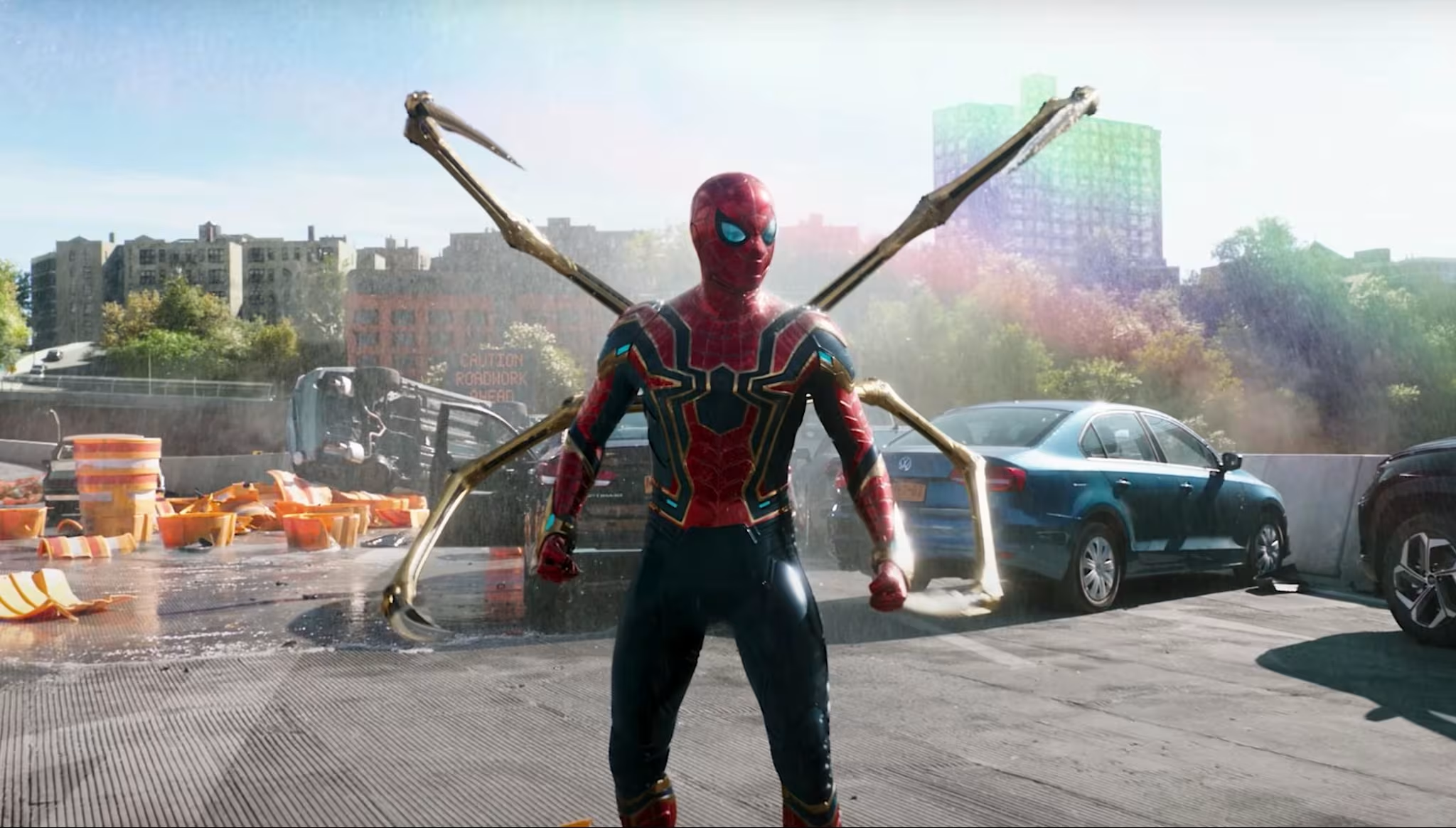
Image via Sony
Spider-Man: No Way Home—the most hyped Marvel movie since Avengers: Endgame—drops on Friday, Dec. 17. The early buzz has been universally positive. Critics are praising lead actor Tom Holland for his portrayal of Peter Parker. They are also praising Sony and Marvel Studios for doing what once seemed impossible: uniting all three Spider-Man movie franchises under a single title. It’s a two-and-a-half-hour movie that’s been germinating for over two decades.
According to the trailers and preview footage, Spider-Man: No Way Home embraces the concept of a Multiverse. Dr. Strange botches a spell intended to help Peter, and he inadvertently opens an interdimensional pathway, through which different universes can contact and interact with one another. This is a mistake that will reverberate for years to come; Dr. Strange in the Multiverse of Madness, the follow-up to this film, hits theaters in May.
But this is not a sudden plot twist; Marvel Studios has been building and foreshadowing the concept of a Multiverse for years. Here’s everything you need to know about the MCU Multiverse—what it is, how it started, and where it goes from here.
What is a Multiverse?
The Multiverse is a collection of scientific theories, positing that there are multiple universes beyond the observable one. This theory has different explanations and underlying justifications, but the one we hear most about, at least in popular culture, is the “many worlds” interpretation. It’s based on quantum mechanics—the study of how things work on an atomic and subatomic level, and thus constitute reality.
The “many worlds” theory posits that for every cause, every possible effect occurs simultaneously. We can only observe one of those outcomes, but each of the other outcomes also occurs and splits into its own universe.
So for example, there is one universe where a person goes to war and survives. There is another universe where the same person goes to war and dies. There is still another universe where the person goes to war and loses a leg. Infinite universes can stem from just those three possibilities.
This “branching” occurs ad infinitum, so long as the scenario is possible and obeys the laws of physics. Every eventuality occurs, no matter how improbable.
The reason a theory this insane exists and is a topic of serious discussion amongst theoretical physicists is because on a subatomic level, matter behaves in ways that are odd and counterintuitive:
“Before you look at an object, whether it’s an electron, or an atom or whatever, it’s not in any definite location,” says theoretical physicist Sean Carroll in an interview with NBC. “It might be more likely that you observe it in one place or another, but it’s not actually located at any particular place.”
The “many worlds” theory sprung from an attempt to explain this phenomenon—that particles seem to exist in multiple places and forms until they are measured. As crazy as it sounds, this is an explanation that does not create even more paradoxes and problems.
The Anti-Multiverse Arguments
Many theoretical physicists, including the late Stephen Hawking, object to the “many worlds’” theory because something infinite cannot be scientifically measured or tested. According to them, it is unscientific to claim something to be true without observing it directly. And since it cannot be proven true or false, the theory can never progress beyond mere speculation.
The Multiverse in Marvel Comics
This brings us back to Marvel Comics and its multiple superheroes and supervillains who bend reality and space-time as a matter of habit. The most recent, famous Multiverse arc was the 2015 Secret Wars storyline, which depicted multiple versions of the same characters struggling to co-exist on a single patchwork planet ruled by Dr. Doom.
Marvel canon also states that prior to the Big Bang, which created our current universe, there were older universes that predated it. Supervillain Galactus is a holdover from this earlier time.
First Mention of the Multiverse in the MCU
The MCU first mentioned the Multiverse in Dr. Strange (2016). The Ancient One, during one of her mind-melds with Stephen Strange, took him on a visual tour of the Multiverse, rhetorically asking him where his place in it was.
She also said, while lecturing him: “The language of the mystic arts is as old as civilization. The sorcerers of antiquity called the use of this language spells. But if that word offends your modern sensibilities, you can call it a program, the source code that shapes reality. We harness energy drawn from other dimensions of the Multiverse to cast spells to conjure shields and weapons to make magic.”
The MCU has also made mention of pocket universes, like the Mirror Realm and the Ant-Man’s Quantum Realm, which allowed the Avengers to travel through time in Avengers: Endgame.
Mysterio and Earth-833
The Spider-Man film Spider-Man: Far From Home hinged its big twist on the concept of a Multiverse. Mysterio claimed that he was from Earth-833, and that Spider-Man and the rest of the MCU were considered to be Earth-616. In the comics, the designation of the core comic universe is also Earth-616.
This whole story turned out to be a massive con on Mysterio’s part. But it was an excellent teaser for what (we assume) is now the real thing.
Into the Spider-Verse
The 2018 film Spider-Man: Into the Spider-Verse put the concept of a Multiverse front and center for a massive audience. It wasn’t connected to the MCU, but it served as an excellent standalone story, in which Peter Parker dies at the hands of Kingpin and a young Miles Morales has to fill his shoes—with the help of Peter B. Parker, Peni Parker, Spider-Woman, Peter Porker, and Spider-Man Noir. In that movie, Kingpin uses a massive collider to access parallel universes. In the MCU, it’s going to take a bit more effort than that.
'WandaVision' and the Rise of Scarlet Witch
Wandavision (2021) was the first official MCU television series. It was an exploration of grief and healing starring Wanda Maximoff, who created alternate realities based upon American sitcom tropes as a way of avoiding the death of Vision.
The series ends with Wanda reclaiming her chaos magic from sorceress Agatha Harkness, finally assuming the Scarlet Witch persona we know and love from the comics.
But does this relate to the MCU Multiverse? More on that in a bit.
'Loki' and the Destruction of the Sacred Timeline
In Loki, the titular character is arrested by the Time Variance Authority for creating a new timeline after escaping with the Space Stone. Over the course of six episodes, we learn that there is a “Sacred Timeline,” and the TVA is responsible for keeping it singular and eliminating its divergences.
In a massive exposition dump near the end of the episode, He Who Remains explains there used to be multiple, divergent timelines. But after a massive multiversal war, he took it upon himself to isolate his timeline and keep it from branching.
Unfortunately, Sylvie killed He Who Remains. And in the season’s closing minutes, we learn that the sacred timeline has sprouted infinite-seeming branches. In at least one branch, TVA has built a statue of He Who Remains, worshipping him as a deity.
Matching up the chronology
Let’s go back to Wandavision for a second. If you match the final episode of Wandavision with the final episode of Loki, Wanda’s ascension to becoming the Scarlet Witch matches perfectly with He Who Remains’ final speech and death. Sylvie may have complicated the MCU Multiverse with even more branches and realities, but it was Wanda who, through her powerful chaos magic, may have opened a portal to it.
'What If… ?' lays more groundwork
One of the more recent MCU television shows, What If…? (2021), explores some of the alternate futures of our favorite superheroes. In one episode, Peggy Carter is given the Super Soldier Serum instead of Steve Rogers. In another, Killmonger rescues Tony Stark in Afghanistan.
The Watcher, who ostensibly oversees the alternate timelines, brings together multiple heroes across multiple universes to stop an Infinity Stone-wielding Ultron.
Season 2 of What If…? is currently in development. And though it seems like the series might be self-contained stories within the Multiverse (that don’t relate to the bigger film story), we can expect to see some Easter Eggs in the years ahead.
Possible Venom Crossover
During the end credits sequence of Venom: Let There Be Carnage, we see Venom suddenly switch universes. His run-down motel room becomes a luxury suite, and on his television, he sees the MCU Peter Parker (Tom Holland) revealed as Spider-Man.
By that logic, all prior Marvel continuities—the prior X-Men films, the Raimi Spidey films, and even Lou Ferrigno’s The Incredible Hulk series from 1978–could be brought into the MCU, under the premise that they are alternate universes or realities to the ‘main’ storyline. It paves the way for massive crossover collaborations between studios; Fox’s X-Men movies are currently available on Disney+. They are accorded semi-canon status as “Marvel Legacy” movies. Where there’s billions to be made, there’s a way.
What's next in 'Spider-Man: No Way Home'?
Lastly, that brings us to Spider-Man: No Way Home. We’ve learned from the trailers that Dr. Strange attempts a memory spell to make the world forget that Peter Parker is Spider-Man. But after performing (and botching) the spell, supervillains from the MCU Multiverse start showing up in the MCU timeline.
The trailers have revealed the following villains: Green Goblin (Willem DaFoe from 2002’s Spider-Man), Dr. Octopus (Alfred Molina from Spider-Man 2), Sandman (Thomas Haden Church from Spider-Man 3), The Lizard (Rhys Ifans from The Amazing Spider-Man) and Electro (Jamie Foxx from The Amazing Spider-Man 2). Many fans speculate if we’ll see some iteration of the Sinister Six. If so, who is the sixth member? Is it Vulture? Or Venom? Or Hobgoblin? Or Rhino? Or someone else entirely?
There’s also rampant speculation that the other two actors who have played Spider-Man in the past 20 years—Tobey Maguire and Andrew Garfield—will also appear in this film as alternate Peter Parkers, to help Tom Holland’s Peter Parker fight all these threats. Andrew Garfield has repeatedly denied these rumors, but then again, what else can he do?
That said, there are currently spoilers floating around online, so be careful. Spider-Man: No Way Home debuts on Friday, Dec. 17, in theaters nationwide.




