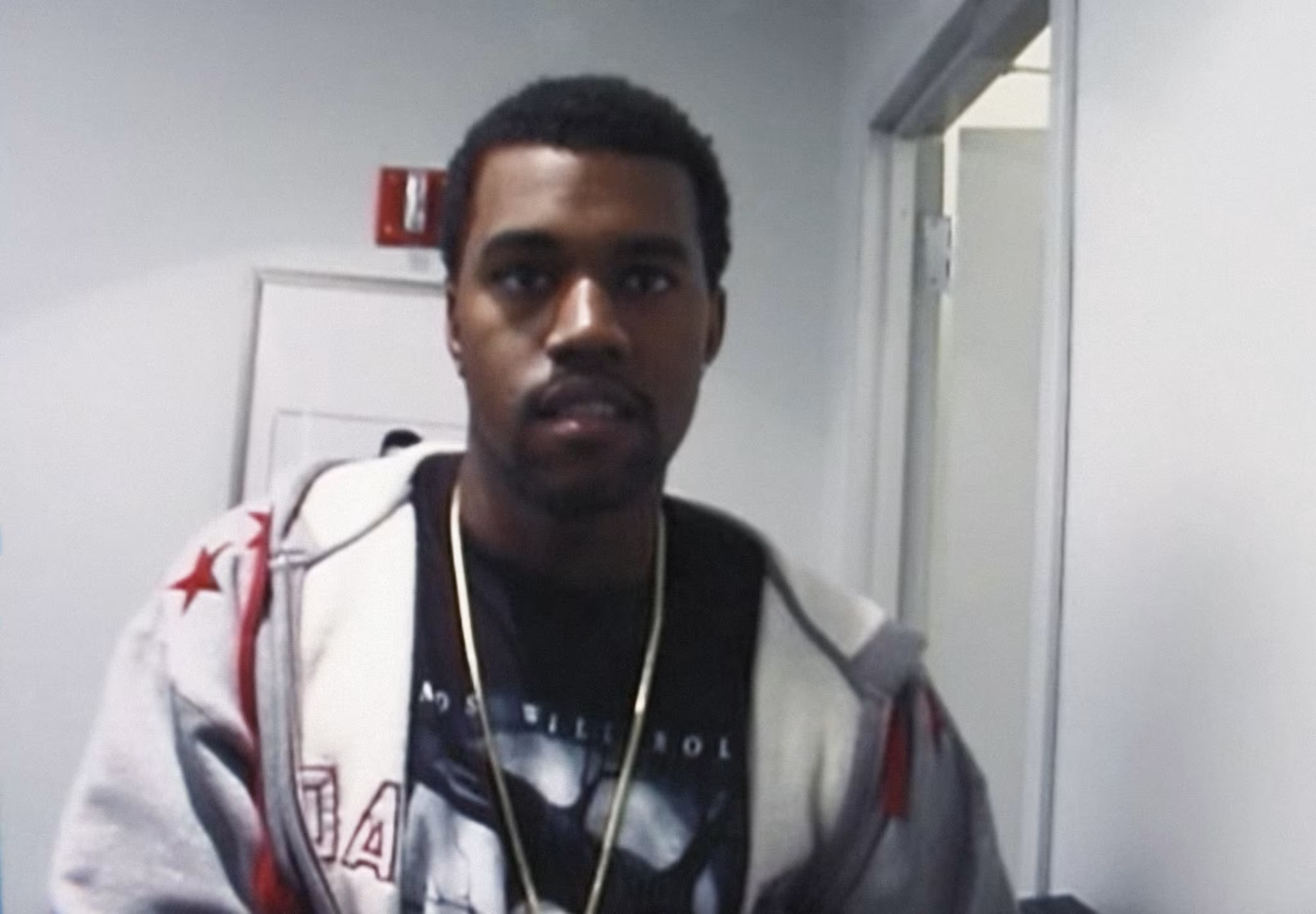
Image via Netflix
Some people have villain origin stories. Others have superhero origin stories. Kanye West has both—and they happened at the exact same time.
Lucky for us, the moment was captured on film, and 20 years later, it’s finally being shown to the public. The whole thing goes down around 17 minutes into the first film of jeen-yuhs: A Kanye Trilogy, which hit Netflix today.
One of the film’s directors, Coodie Simmons, sets the scene perfectly.
“If the world was ever going to hear Kanye’s music, he needed a record deal,” he says, as footage of Kanye in the lobby of a fancy New York City office building plays in the background. “After producing half of The Blueprint, his sights were set on getting signed with the number one rap label, Roc-A-Fella Records. He just needed to convince Jay-Z and his co-founders Dame Dash and Biggs that he deserved a spot on the Roc. So one day, we decided to bum-rush their office, and I kept my camera rolling.”
Sure enough, we see a young Kanye West knock on the front door of the Roc-A-Fella offices, and no one immediately opens it for him. He waits for a few seconds, then opens it himself and walks right in.
He gets a couple daps from A&Rs at first, but no one really notices him, so he takes matters into his own hands. Walking up to Chaka Pilgrim, who worked in the Roc-A-Fella marketing department at the time, he says, “Let me play you something.” Then he throws a demo CD into a stereo system on the wall and presses play.
Suddenly, “All Falls Down” starts blasting into the small room. Yes, that “All Falls Down.” The song that would eventually be released as the third single from The College Dropout, ultimately going two-times Platinum, earning a Grammy nomination, and becoming Kanye’s first solo Top 10 hit.
By all accounts, it’s a timeless classic. But back then, in that Roc-A-Fella office building, no one gave a shit. We see Kanye go from one room to the next, rapping along to a song that would end up selling millions of copies, and literally no one (but Kanye) cares. Meetings keep happening, phones keep ringing, and Roc-A-Fella employees chuckle as he plays a smash record that would peak at No. 7 on the Billboard Hot 100 chart.
Admittedly, Kanye didn’t go about this whole situation as well as he could have. Showing up unannounced, in the middle of the afternoon, he took everyone off guard. These Roc employees had work to do, and he presented himself as a nuisance. At one point, we even see an executive assistant put a phone call on hold as Kanye blasts the song on her stereo and raps into her face.
By the time this all went down, Kanye was getting desperate. He was walking around with classic songs like “All Falls Down” on a demo CD, but no one would take him seriously as a rapper. Because of his success producing records like Jay-Z’s “Izzo (H.O.V.A.),” everyone thought of him as “just a producer,” and nothing more. He had already tried the subtle approach, sending demos to collaborators and executives, but at a certain point, he had to start kicking down doors. He had to force the issue until others could see the vision he had for himself.
At the end of the scene, we see Kanye walking out of the Roc-A-Fella offices with a dejected look on his face. No one is taking him seriously, and it becomes painfully clear he’s still a long way away from a record deal—even with “All Falls Down” in his back pocket. Adding insult to injury, Kanye runs into an acquaintance, who looks into the camera and yells, “This boy is hot right here!” Then he turns to ’Ye and hollers, “Make sure I get my beats, man!” Once again, Kanye was being pigeonholed as just a producer.
In this moment, we see Kanye develop a chip on his shoulder that would follow him for the rest of his career. He had a vision for his own future that no one else could see yet, and he had to advocate for himself in order to actually make it happen. For the next 20 years, different versions of this would keep happening. He would try to break into the fashion world, and no one would take him seriously, discrediting him as “just a rapper.” He would try new styles of music and get bashed by fans and critics before ultimately proving to be ahead of his time. Over and over, he would find himself boxed in by the opinions of others, and then (loudly) advocate for himself until people took him seriously.
This would play out in inspirational ways, building on his superhero origin story. But other times, it would lead Kanye into controversial territory, playing into the villain character that some see him as today.
First, let’s get into the inspiring stuff. As jeen-yuhs chronicles, Kanye only made the transition from producer to rapper because of sheer willpower on his own part. After leaving the Roc-A-Fella offices that day, he kept hounding executives everywhere he went, until they finally gave him a shot. And even after he got signed, they didn’t provide enough funding for studio sessions and music videos, and kept pushing back his album release date. So Kanye went rogue and self-funded the music video for “Through the Wire,” which would make him a star and convince everyone (including executives at the Roc) to finally take him seriously as a rapper.
Throughout the documentary, we get a firsthand look at the vision that motivated Kanye to push through skepticism from others. In one scene, he goes on a rant full of self-fulfilling prophecies, explaining that he’s not satisfied with his success as a producer and has much bigger dreams than anyone realizes.
“I’m hungry, dog,” he says, while driving his car. “Motherfuckers always be talking about what I got, but they don’t realize I’m nowhere near where I want to be. I might be living your American dream, but I’m nowhere near where my dreams are. I’ve got aspirations. I’ve got big dreams, motherfucker. I’m a motherfucking rapper, dog. Man, before I had my car, I used to be walking to the train, practicing my Grammy speech.”
Later, while filming a segment for MTV’s You Hear It First, he dives head-on into his me-against-the-world philosophy. “I’m going to use everything that everybody says that I can’t do, and I’m going to flip it to the positive,” he says. “I look at everything as a glass half-full thing. I’m going to stand for everything that I’ve seen in my life, and I’m going to try to express that to y’all the best way that I can.” Then he adds, “I know that there’s more than one side to me. If I do what I’m supposed to do, people are going to look back, like, ‘Man, remember when dude used to just make beats for people?’”
When The College Dropout finally dropped, it became an immediate success, debuting at No. 2 on the Billboard 200 chart with over 440,000 first-week sales. Kanye was vindicated, at last. He had tangible proof that he was the only one who could really see his true potential in the Roc-A-Fella office building that day. And he’s carried this feeling with him ever since.
We saw it when he tried to break into the fashion industry, going on a now-iconic press run that included his “How Sway?!?!?” interview. Over and over, he explained that Nike and other brands didn’t see his vision. It turned out he was right, eventually turning Yeezy into a multi-billion dollar company.
We also saw it when he made wild stylistic left turns in his music, shifting from his signature chipmunk soul sound to the Auto-Tune-heavy 808s & Heartbreak. (And again when he swerved from the decadence of My Beautiful Dark Twisted Fantasy and Watch the Throne to the stark, industrial sound of Yeezus). Each time, he was met with criticism in the moment, before ultimately proving to be one of the most influential musicians of his time.
In examples like these, Kanye is a motivational figure; the human embodiment of clichés like “anything is possible if you believe in yourself.” It’s a big part of the reason why he’s become one of the most popular entertainers on Earth. But, of course, it doesn’t paint the full picture of Kanye Omari West. He’s an artist who contains multitudes, existing in contradictions and dualities. The same quality that makes him such an inspirational figure has also led him down much rockier paths.
Consider his infamous stage-crashing moment at the 2009 VMAs. When he grabbed the microphone and said, “I’mma let you finish, but Beyoncé had one of the best videos of all time,” he did so with the same mentality he had in the Roc-A-Fella office. He believed in something very strongly, and he wanted the rest of the world to see it from the same perspective. In some ways, he was right (the “Single Ladies” video is incredible) but the execution was awful, and the way he did it came across as very self-serving and callous. By that point in his career, he was so used to successfully proving people wrong that he got carried away and disrespected others in the process. It set him back, instead of propelling him forward.
You can even draw parallels to some of his more recent political controversies. After proving everyone wrong about becoming one of the most successful rappers on the planet (and then doing it again by becoming a billionaire in the fashion industry) he set the bar even higher and actually ran for president. Of course, this time it wasn’t nearly as well thought-out, and the whole campaign was an embarrassing mess.
The same frustration Kanye felt about being pigeonholed as “just a producer” in the Roc-A-Fella office 20 years ago is mirrored by his resentment of being boxed in by political ideals in his 40s. People expected him to align with Democrats, and as we all know by now, Kanye hates when he’s categorized into a specific box by others.
“I was told that if I voted on Trump my music career would be over,” he told Forbes in 2020. “I was threatened into being in one party. I was threatened as a celebrity into being in one party. I was threatened as a Black man into the Democratic party. And that’s what the Democrats are doing, emotionally, to my people. Threatening them to the point where this white man [Joe Biden] can tell a Black man if you don’t vote for me, you’re not Black.” Later in the interview, he added, “One of the main reasons I wore the red hat as a protest to the segregation of votes in the Black community.”
Unlike his attempts to avoid being pigeonholed as a producer in the Roc-A-Fella offices, though, these political gestures had more serious consequences. At this stage in his career, his hubris had grown so large that his drive to prove a point clouded his judgment, and he ended up aligning himself with the destructive policies of someone like Trump. He was so focused on his mission to break out of the preconceived notions of others that he stepped in his own way.
As Kim Kardashian said in 2018, Kanye overlooked Trump’s hateful qualities and stood beside him just to make a point. As she explained, Kanye “just happens to like Donald Trump’s personality, but doesn’t know about the politics.” She continued, “I think what my husband fights for—and again, he’s not the best communicator at explaining it—but what he fights for is the right to like what he wants to like, even if it’s different from what you like [...] I know it’s very confusing because, when you see someone wearing a red [MAGA] hat, you would think that they’re supporting that. But he’s just fighting for free thought, and for the freedom to like a person, even if it’s not the popular decision.”
This isn’t to make excuses for Kanye, of course. In an effort to avoid being put in a box, he dismissed the consequences of his own actions and pushed forward anyway. It was charming and inspiring when he took a stand about his own music career, but when the stakes grew higher, the same mentality had a more severe fallout. The very characteristic that made him a superhero to his fans turned him into a villain in many other people’s eyes
It’s unfair to explain the entirety of someone’s life decisions with a single anecdote, and that’s especially true for someone as complex as Kanye West. But watching him play a classic song like “All Falls Down” for an office building full of doubters, and then proving them all wrong, you get the sense a fire was lit under him that day. And it remains today. In many ways, it’s been a beautiful thing to witness, and Kanye has become a wildly inspirational force for millions. But it’s also pushed him into precarious situations with negative consequences that have detracted from his legacy. It all sits at the heart of the Kanye West story—a story of duality.
When I sat down to watch jeen-yuhs, I expected to glean insights into what makes Kanye tick. I expected to see footage that gave me a better understanding of the motivations behind his extremely polarizing decisions. But I didn’t expect to see it all happen in a single scene. Thank you, Coodie, for keeping your camera rolling when Kanye decided to “bum-rush the office” that day.




