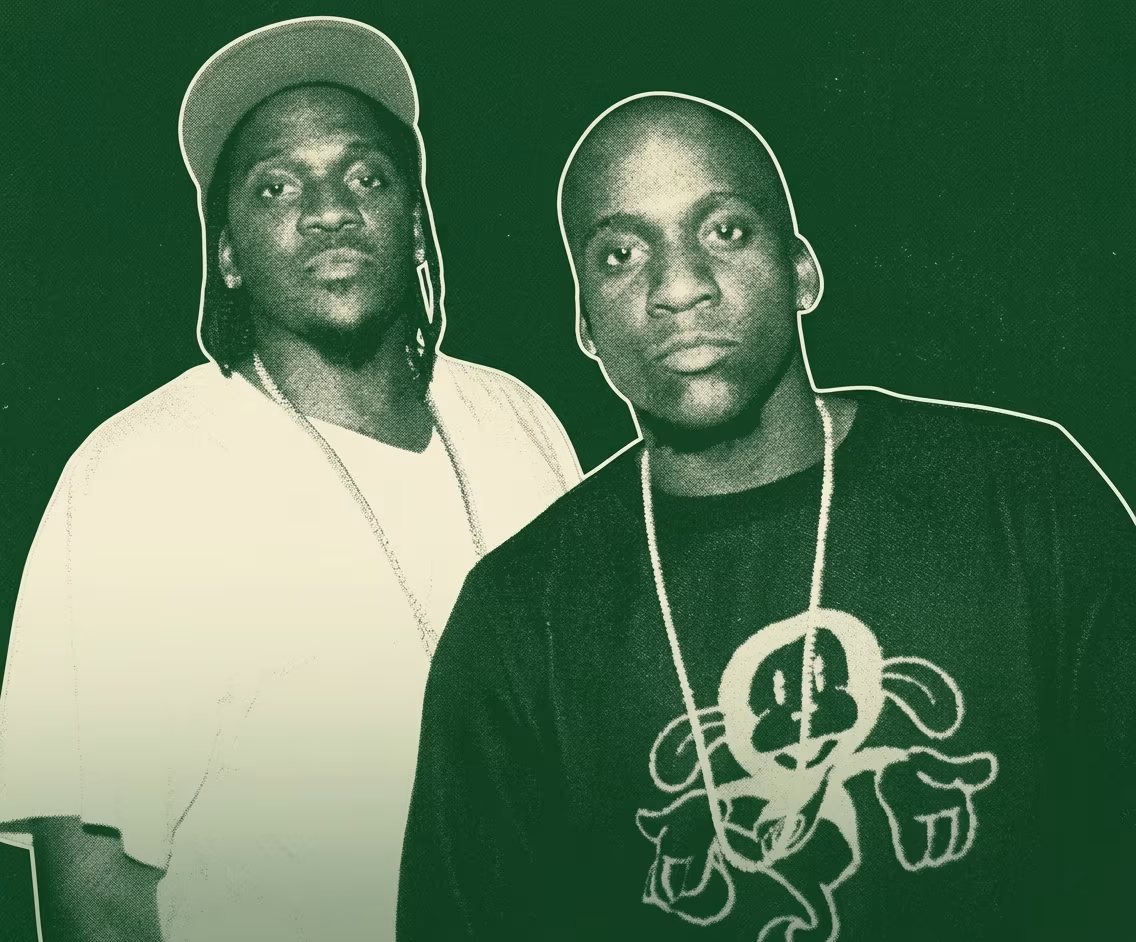
Image via Complex Original
The Tel-Aviv-based street artist made a name for himself painting a mysterious character on walls around the world. Here, he discusses 10 artists who inspire his work.
This Feature Appears in Complex's August/September 2014 Issue
Know Hope is an artist whose simple pieces—which alternately include one-line poems, a crouching figure, doves, red hearts, flags, brick walls, and tree stumps—should not be reduced to their subject matter alone. These spare works typically follow a singular, skinny character on a difficult journey (where a wall crushes him or his arms are crossed over his face), which ultimately end in the character offering up positivity, hope, and open arms. Know Hope's short poems, which at most reach three lines, more deeply explore human struggle, especially when paired with this character or photographs he's taken in his hometown of Tel Aviv. In this way, his works also enter a political space, questioning ideas of nationalism and privacy, as seen in the Others' Truth zine he released in 2012.
Often called "The Israeli Banksy," Know Hope has done impressive projects on the street and in galleries and museums, including a two-floor installation with Lazarides Gallery's "BRUTAL" exhibition, a window piece for Urban Nation's PROJECT M, and an installation at The Roskilde Museum Of Contemporary Art. We interviewed Know Hope about the 10 artists who influence his work for Complex's August/September 2014 "The Big Ten" feature.
Watch our interview with Know Hope from POW! WOW! Hawaii street art festival earlier this year:
“He’s one of the first artists I discovered on my own, initially through Black Flag album covers and the fliers he made for the band’s shows. Besides the overall cynicism, which feels accurate, his use of dark and familiar imagery paired with text, primarily in bold black-and-white lines, made sense to me.”
“My parents took me to a performance of hers at a young age. Years later, I realized what a privilege it was to see her. Her multi-media experimentation and conceptual sharpness elegantly communicate precision’s importance.”
“Universal truths in the everyday. Emotional logic corresponding with an overwhelming realization of ourselves as individuals in an immense, collective reality.”
“Swoon’s beautiful and graceful artistry is earnest, and the magnitude of her energy and ethos is everywhere in her heartfelt portraits. Her large-scale projects connect the communal and social, and naturally transmit how art and real life cannot be separated.”
“Holzer works in public spaces, utilizing familiar tools such as billboards, benches, and plaques, reappropriating their function by placing subversive phrases on them. It creates something profound in the mundane and overbearing.”
“Alÿs shows the inseparable nature of the emotional and the political. I’m interested in connections and symbiosis between the two, by perceiving political imagery, concepts, and notions as emotional mechanisms. Creating parallels between minor human conditions and larger, more complex human situations emphasizes the collective nature of the human struggle.”
“His work makes you realize that the people who live in a community are the community. Daily tribulations, misunderstandings, and communication typos are all made out of and for love; and love is a bare necessity.”
“Fekner utilizes public space to create messages that are deliberate yet suggestive. Sometimes the message is clearer when a situation is suggested as opposed to illustrated.”
“By converting iconography into patterns, McGee’s work is a metaphor for the impulsive being political. We’re surrounded by static and decay, though when one is attentive, patterns emerge and you recognize what’s buried underneath.”
“Silverstein was my first favorite artist. His children’s books created a longstanding moral foundation for everyone who read them. His ability to deal with existential matters in simple ways had a monumental influence on me, to the point where it feels like my work is a constant and humbled tribute to his.”