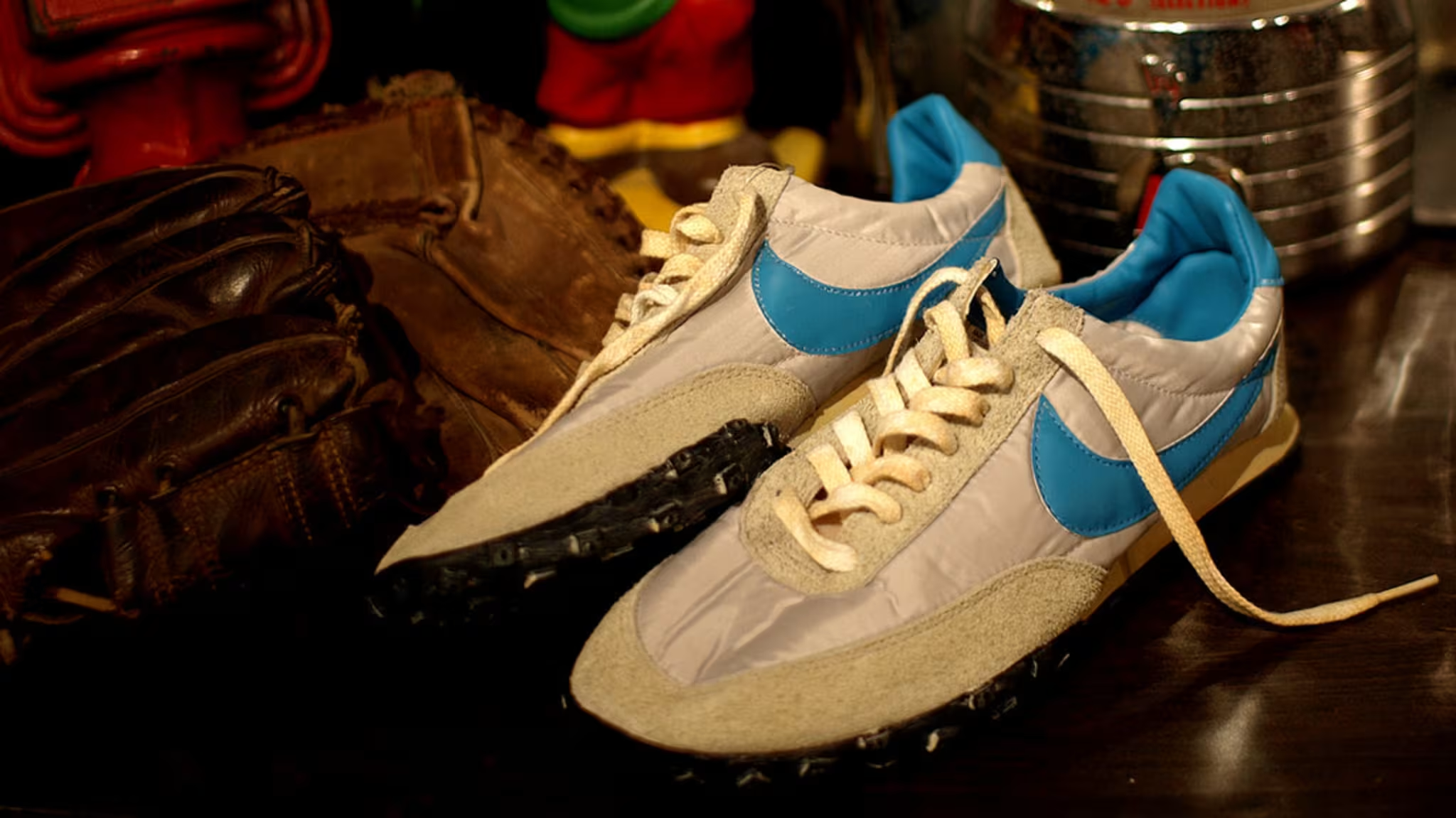
Phil Knight’s days as chairman at Nike may be coming to an end, but he’s left a legacy as the brand’s co-founder that will never be forgotten. As he prepares to step away from the company he helped create, he’s written a memoir that's a first-hand account of how he went from selling shoes out of the back of a station wagon to building one of the most recognizable brands in the world. We researched this just-published book, Shoe Dog, to learn more. Below are 18 interesting facts from Nike's history in Knight's own words.
Phil Knight’s days as chairman at Nike may be coming to an end, but he’s left a legacy as the brand’s co-founder that will never be forgotten. As he prepares to step away from the company he helped create, he’s written a memoir that's a first-hand account of how he went from selling shoes out of the back of a station wagon to building one of the most recognizable brands in the world. We researched this just-published book, Shoe Dog, to learn more. Below are 18 interesting facts from Nike's history in Knight's own words.
Why Nike boxes are orange.
In the '70s, sneaker boxes were either white or blue. When Phil Knight debuted the Nike brand at the National Sporting Goods Association Show in Chicago in 1972, he sought packaging that would catch the eye of prospective buyers and industry insiders: "I'd wanted something that would stand out, that would pop on the shelves of sporting goods stores. So I'd asked Nippon Rubber for boxes of bright neon orange, figuring it was the boldest color in the rainbow."
Signing Ilie Năstase was a hard bargain, even though he already wore Nike.
When Nike was just a fledgling brand, one of its earliest public supporters was tennis great Ilie Năstase. The athlete was the first that the company would sign and it cost Nike quite a bit at the time to have him wear the brand: "Now here was a top athlete already wearing Nike, and winning in it. How hard could it be to sign him? I found the number for Nastase's agent. I phoned and offered him a deal. I said I'd give him $5,000—I gagged as I said it—if his boy would wear our stuff. He countered with $15,000. How I hated negotiating. We settled on $10,000. I felt that I was being robbed." Năstase went on to sign with adidas a few years later.
Steve Prefontaine was such an ambassador for Nike, he would send products to his competitors.
"Though Pre's job title was intentionally imprecise, his role was real, and his belief in Nike was authentic as well. He wore Nike t-shirts everywhere he went, and he allowed his foot to be Bowerman's last for all shoe experiments. Pre preached Nike as gospel, and brought thousands of new people into our revival tent. He urged everyone to give this groovy new brand a try—even his competitors. He'd often send a pair of Nike flats or spikes to a fellow runner with a note: Try these. You'll love them."
Making the Waffle Trainer in blue was an epiphany for Nike.
Knight noticed that sneakers really started to have lifestyle appeal away from just sport activity in 1976, which gave him the idea to make one of its most popular styles—the Waffle Trainer— in blue so more people could wear it with jeans: "We couldn't make enough. Retailers and sales reps were on their knees, pleading for all the waffle trainers we could ship. The soaring pair counts were transforming our company, not to mention the industry."
Phil Knight was scared to take Nike public.
He feared that “going public would change Nike, ruin it, by turning over control to others.” That was until Knight learned they could issue two classes of stock: class A, which would go to the inner circle and founders, and class B, which would be available to the public. This allowed Knight to raise the money Nike needed for growth and retaining control.
Nike was the first U.S. shoemaker in 25 years to do business in China.
“The Chinese didn’t see why the nylon or canvas in a pair of shoes needed to be the same shade in the left shoe and the right. It was common practice for a left shoe to be light blue and a right shoe to be dark blue.” Despite this, Nike signed contracts with two factories, which at the time made Nike the first U.S. shoemaker in 25 years that was allowed to do business in China.
Phil Knight was obsessive about people not wearing Nike.
"I no longer simply made Nikes; Nikes were making me. If I saw an athlete choose another shoe, if I saw anyone choose another shoe, it wasn't a rejection of the brand alone, but of me. I told myself to be reasonable, not everyone in the world was going to wear Nike. And I won't say that I became upset every time I saw someone walking down the street in a running shoe that wasn't mine, but it definitely registered. And I didn't care for it."
Nike offices around the world have phone numbers ending in 6453.
The numbers spell out N-I-K-E on the keypad, but Knight has also noticed an interesting coincidence: “It also spells out Pre’s best time in the mile, to the tenth of a second: 3:54:6.”
LeBron James studied Nike history and gave Phil Knight a gift of appreciation for being signed.
During a private event in 2005, James pulled Knight aside and explained that he’d been studying up on the history of Nike. He then handed Knight a 1972 Rolex–from the year Nike was founded. It was engraved with the message, “With thanks for taking a chance on me.”
One exec was never forgiven for leaving Nike.
Knight didn't take kindly to Rob Strasser, who had been a key figure in Nike signing Michael Jordan, leaving the brand: “It might have been okay if he’d just quit. But he went to work for adidas. An intolerable betrayal. I never forgave him.” Ironically, Knight happily hired Strasser’s daughter, Avery, who now works at Nike.
Nike's original script lettering was confusing people.
"Aside from the Swoosh, we had a lowercase script name, nike, which was problematic—too many people thought it was like or mike...Denny Strickland, creative director at our advertising agency, had designed a block-lettered NIKE, all caps, and nested it inside a swoosh. We spent days considering it, debating it."
Nike shares innovations that have to do with environmental sustainability with the competition.
One of the most toxic parts of shoe production is bonding the uppers and soles: “We invented a water-based bonding agent that gives off no fumes, thereby eliminating 97 percent of the carcinogens in the air. Then we gave this invention to our competitors, handed it over to anyone who wanted it.” It's a practice that still continues today.
Knight was only interested in Air cushioning because adidas passed on it.
"'Air shoes sounded to me like jet packs or moving sidewalks. Comic book stuff," Knight wrote about being pitched air-infused soles in the late '70s. What really sold the co-founder on the technology when it was pitched to him by Frank M. Rudy and Bob Bogert. The design duo had originally presented it to adidas, who was also skeptical. "Abracadabra. That was all I needed to hear."
One of the inventors of Nike Air was a little creepy.
Frank M. Rudy, a former aerospace engineer, was part of the duo that pitched the concept of injecting air into a sneaker for cushioning in 1977. According Knight, Rudy kept a meticulous diary of his sex life and bowel movements.
Nike had a liason in Hollywood responsible for getting product seen on TV shows.
"We had a guy out there giving Nikes to stars, all kinds of stars, big, little, rising, fading. Every time I turned on the TV our shoes were on a character in some hit show—Starsky & Hutch, The Six Million Dollar Man, The Incredible Hulk. Somehow, our Hollywood liaison got a pair of Senorita Cortezes in the hands of Farrah Fawcett, who wore them in a 1977 episode of Charlie's Angels. That was all it took. One quick shot of Farrah in Nikes and every store in the nation was sold out of Senorita Cortezes by noon the next day."
A Korean factory knocked off Nike's Bruin sneaker so well that Knight ended up hiring them.
"Imitation is flattery, but knockoff is theft, and this theft was diabolical. The detail and workmanship, without any input from our people, was startlingly good. I wrote the president of the factory and demanded he cease and desist or I'd have him thrown in jail for 100 years. And by the way, I added, how would you like to work with us?"
Phil Knight doesn't believe in advertising.
It's hard to believe the founder of the company that's had some of the most memorable campaigns in history is not a believer in advertising, but it's true. Knight writes that only quality of product is what matters to him. He's even butted heads about his belief with Nike's agencies over the years: "Our advertising people, of course, told me I was wrong, wrong, a thousand percent wrong. But again and again I'd ask them: Can you say definitely that people are buying Nikes because of your ad? Can you show it to me in black-and-white numbers? Silence."
The first Nike Tailwind was a massive success, and a massive failure.
When Nike first launched the original Tailwind in 1978, it was packed with 12 new innovations for the company and was hyped heavily by the brand to launch at the Honolulu marathon. However, the early sales success was short-lived. After 10 days, bits of metal in the silver paint caused the shoes to fall apart and customers to return the products in droves. Nike ended up issuing a recall and giving full refunds. "We'd learned a valuable lesson. Don't put 12 innovations in one shoe...We reminded each other that there was honor in saying, 'Back to the drawing board.'" The Tailwind eventually went on to be one of the most successful lines for Nike.




