25 Classic Rap Albums and Their Sneaker Counterparts
Hip-hop and sneaker culture often feel like one and the same. Rappers love their sneakers, and a good portion of sneakerheads love to bump the rappers' booming tracks. More and more rappers are becoming the apple of the sneaker industry's eye, and the connection between sneakers and hip-hop is growing stronger and stronger every year. But instead of discussing which new rapper is going to sign a sneaker deal, let's step back for a moment: If a classic rap album was a sneaker, which one would it be?
There are many attributes of a classic rap album: Themes, the emcee's flow, the production value, and how it was perceived by the public. These ideas can also be related to sneakers. The design and reception of a sneaker can easily be linked to rap albums that heads rave about. Certain sneakers get slept on but are later appreciated by a niche audience, and some sneakers, like rap albums, have concepts that were misunderstood at the time of their release, but, through the years, were able to establish themselves as classics. So here's what everyone's dying to know: Which sneaker best represents Illmatic, Midnight Marauders, or Reasonable Doubt? This is the chance to find out. Here are 25 Classic Rap Albums and Their Sneaker Counterparts.
RELATED: The 50 Greatest Sneaker References in Rap History
RELATED: 25 Outdated Sneaker References in Rap
RELATED: The Best '80s Old School Rap
De La Soul "3 Feet High and Rising" and Nike Air Max 1
Album Release: 1989
Sneaker Release: 1987
It's tough to show listeners what actually is behind the beats that everyone nods their heads to. Samples can be so chopped that beats sometimes don't connect to the original music they take from. Prince Paul's production on De La Soul's 1989 debut album, 3 Feet High and Rising, was able to cut up the original breaks in a way that put people on to tracks from Otis Redding, Steely Dan, and even songs from Schoolhouse Rock. The idea of showing what's behind the scenes isn't only limited to music. Tinker Hatfield came up with the revolutionary idea of visible Air in 1987—after seeing the Paris museum Pompidou Centre's inside-out design, he came up with the Air Max 1. Both ideas, 3 Feet High and Rising and the Air Max 1, were misunderstood, too. Listeners liked to label De La Soul as "hip-hop hippies" because of their D.A.I.S.Y. imagery—it actually stands for Da Inner Sound Y'all—and Nike wasn't sold on the idea of the Air Max 1. Luckily, the album and the sneaker both received their proper praise.
Public Enemy "It Takes a Nation of Millions to Hold Us Back" And Nike Air Max2 CB 34
Album Release: 1989
Sneaker Release: 1994
Public Enemy scared the crap out of people. Sure, the group had hit the scene with their debut album, Yo! Bum Rush the Show, and even had a few hits. But their sophomore album, It Takes a Nation of Millions to Hold Us Back, felt like a burst of furious energy onto the rap scene. Chuck D's militant lyrics mixed with the abrasive production from The Bomb Squad was perfectly offset by Flavor Flav's adlibs to make the group lovable—although still intimidating. If the Nike Air Max2 CB 34 had been out in '89 when the album dropped, it would have been crazy to see the crew in the signature sneaker of Sir Charles Barkley. The sneaker was super abrasive. It was a legit hi-top, and had an elastic lacing system along with the sneaker's laces and a jagged, chunky midsole. Its design was inspired by a straitjacket. Of course, behind the sneakers was Barkley's likable personality. If the Air Max2 CB 34 had been made for someone not as appealing as Barkley, it might shooed off Nike consumers. Luckily, it didn't.
Beastie Boys "Paul's Boutique" and Air Jordan II
Album Release: 1989
Sneaker Release: 1987
The Air Jordan I was a huge success for Nike and Mike's career, the Air Jordan II? Not so much. It was a complete divergence from the I. It didn't even have a Swoosh, Nike's ubiquitous logo, on it. Still, it's a cult classic. It was expensive to produce, as it was made from premium leather in Italy. It could never be produced under Jordan and Nike's cost practices today. The Beastie Boys also had a certified classic with their first album, Licensed to Ill. But those expecting the fun-loving party jams such as "Fight for Your Right" and "Girls" were in for a shocker when the group dropped Paul's Boutique in 1989. It was abstract, different in sound, and featured tons of samples that a record label would never fork money over for now. But as years went on, the Air Jordan II and Paul's Boutique have been viewed through a new light. They weren't failures. They were revolutionary.
UGK "Ridin' Dirty" and Reebok Classic Leather
Album Release: 1996
Sneaker Release: 1979
UGK are legends in hip-hop, but the crew's Houston scene hadn't received the proper respect that it deserved. Until recently, that is. The re-discovery of the H-Town hip-hop has younger heads bumping the duo's classic album, Ridin' Dirty, and enjoying Bun B and Pimp C's simplistic but noteworthy concepts and narratives. The same can be said for the Reebok Classic Leather. For a long time, the sneaker had seen as something only worn by nurses or dudes from Staten Island, but a few knew its full potential. Thanks to revitalization and newfound interest in Reebok Classics, the Classic Leather has re-surfaced thanks to a ton of great collaborations and better packaging the sneaker to a new audience. Now, if Bun B can only get his own pair of Reebok Classic Leathers, all would be right in the world.
Kanye West "The College Dropout" and Nike Air Max 95
Album Release: 2004
Sneaker Release: 1995
It's crazy to think of Kanye West as the first conscious rapper, mostly because he's not. But The College Dropout brought his style of rap to a huge audience, and, effectively, changed their perception on what a "backpack" rapper could be. Kanye was also going through a personal struggle, having his jaw reconstructed after getting in an almost-fatal car accident. The Air Max 95 wasn't Nike's first insane-looking running sneaker. But it took its concept, reconstructing the human body, much like Kanye's jaw, through sneaker design elements: the midsole represented the spine, the laceloops were designed to look like ribs, etc. There's a segment of hip-hop listeners that wish Kanye would bring it back to his College Dropout days, but he's progressed past that point, and grown as an artist—but there are still flashes back to his days rhyming about his vulnerabilities and unshakable confidence. There are also people who wish the Air Max 95 hadn't been made into newer versions by Nike. But the sneaker hasn't strayed away from its ethos: being a groundbreaking running sneaker—both design and performance wise.
2Pac "All Eyez on Me" and Nike Air Tech Challenge II
Album Release: 1996
Sneaker Release: 1989
2Pac was a rebel voice to the rap world that was accepted by mainstream America. His double album, All Eyez on Me, touched on a plethora of topics: "California Love" was about repping the West Coast, "How Do U Want It?" had everyone popping bottles, and tracks like "I Ain't Mad at Cha" and "Life Goes On" showed Pac's more thoughtful side, but it was all done in a spirited nature. It's not a stretch to see the same passion and exuberance from an athlete, but Andre Agassi brought things up several levels in the '80s and '90s. His signature sneaker, the Air Tech Challenge II, was as outlandish as a tennis sneaker had ever been. It had a Visible Air unit, Hot Lava splashes along the upper, and came in a mid cut. But even as crazy as Agassi might have seemed, people loved his act—wig, bright sneakers, neon spandex, and all—just like they dug Pac's image.
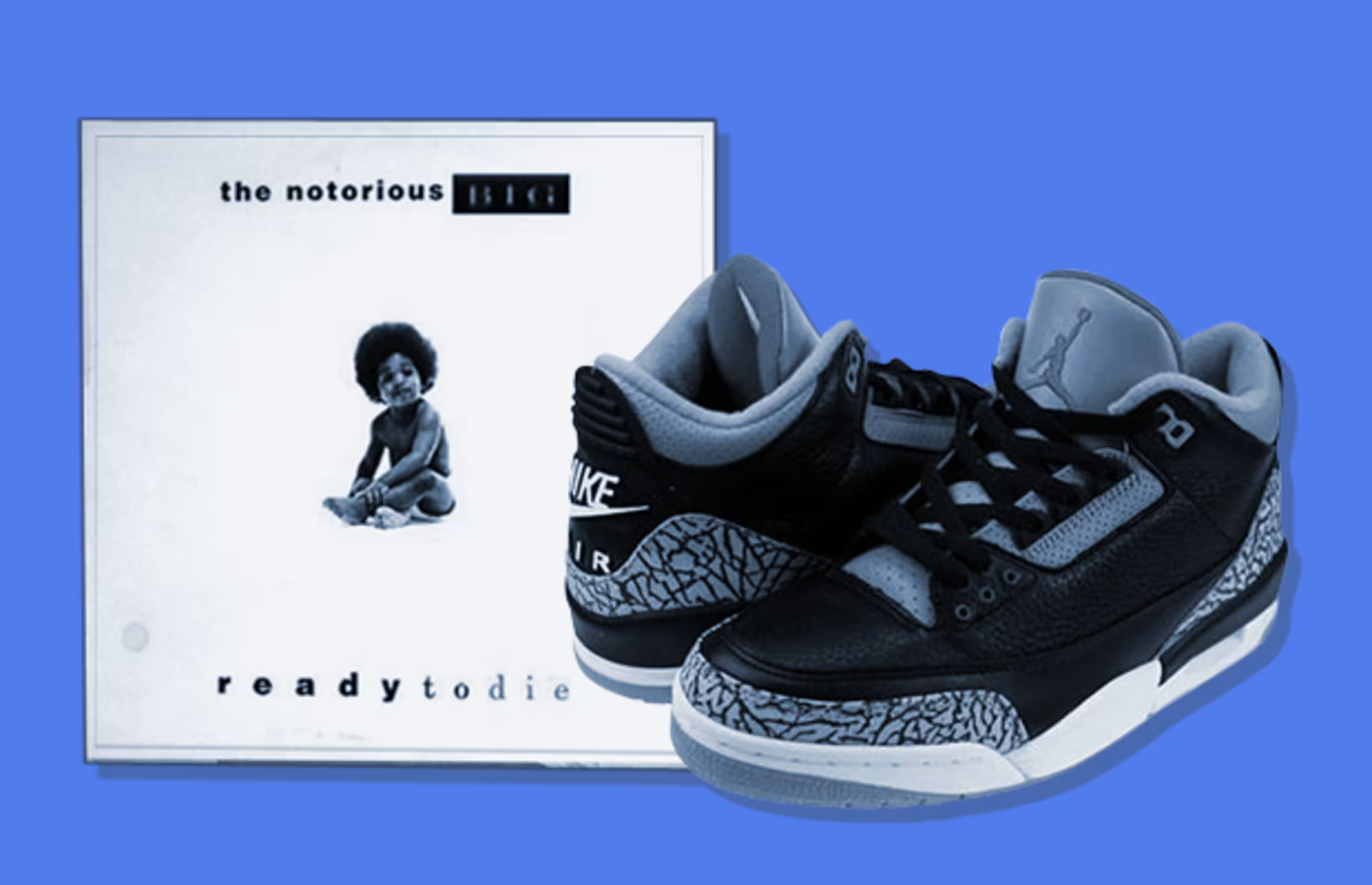
The Notorious B.I.G. "Ready to Die" and Air Jordan III
Album Release: 1994
Sneaker Release: 1988
The Notorious B.I.G.'s debut album, Ready to Die, was a new moment in New York City hip-hop. There hadn't been an emcee like Biggie before: His charisma, flow, and combination of self-deprecating humor and storytelling skills was a new plateau for emcees to step up to. His feel-good flows on "Juicy" and "Big Poppa" were just as resonating as the darkness felt on "Everyday Struggle" and "Machine Gun Funk." From that point on, rap just felt different. Emcees needed to be multi-dimensional. The Air Jordan III kept Michael Jordan with Nike. It was a complete re-think of the Air Jordan line, and looked at signature basketball sneakers through a new lens. It wasn't just a new basketball sneaker—it took visual inspiration from elephants, was a mid-cut sneaker, and ushered in the black and white commercials with Mars Blackmon, played by Spike Lee, and became a sneaker that was coveted for its on-court performance as much as its looks.
Kendrick Lamar "Good Kid, M.A.A.D. City" and Nike Roshe Run
Album Release: 2012
Sneaker Release: 2012
Kendrick Lamar's Good Kid, M.A.A.D City only released in 2012, but its impact has already propelled him into the "best rapper in the game" discussion. Not every classic album needs to be old. Kendrick's album displayed honed storytelling abilities, and he was was able to take inspiration from fellow Los Angeles OG emcees such as Ice Cube and Mikah 9. But was he was able to create something new and fresh. It didn't feel like a simple re-hash of old concepts and ideas. Although Kendrick pledged an already-broken allegiance to the Nike Cortez, his status in the rap world is more similar to the rise of the Nike Roshe Run. The Roshe Run became an instant classic—not because it was so futuristic, but it drew inspiration from Nike's running heritage and presented it in a new way. It was a plain sneaker that appealed to a wide swath of Nike consumers. Kendrick, with his wavering ties to the Cortez, could slip on a pair of Roshes just as easy. They'd be more comfortable, too.
Arrested Development "3 Years, 5 Months & 2 Days in the Life Of..." and adidas Mutombo
Album Release: 1991
Sneaker Release: 1993
Dikembe Mutombo's African heritage played a huge role in the design of his signature sneaker with adidas, the Mutombo. There were tribal prints and even a shield with spears on the sneaker's tongue. Meanwhile, '90s hip-hop was chock-full of Afrocentric clothing, rhymes, and ideas. Although Arrested Development rapped about going to Tennessee on its 1991 album, 3 Years, 5 Months & 2 Days in the Life Of... , the crew wore dashikis and kufis on the album cover, attire befitting of the House of Mutombo. But the connection between Mutombo, his sneaker with adidas, and Arrested Development goes deeper than just aesthetics. Mutombo is renowned for his humanitarian work in his home country, Democratic Republic of Congo, and with Arrested Development rapping themes of "Give a Man a Fish" and "Children Play With Earth," the album could have served as the soundtrack for Mutombo, as he swatted lay-ups and stomped in his sturdy hi-tops.
Run DMC "Raising Hell" and adidas Attitude
Album Release: 1986
Sneaker Release: 1986
The adidas Superstar wouldn't have became a hip-hop staple without Run D.M.C.'s co-sign on their 1985 track, "My Adidas." The album which it was featured on, Raising Hell, let New York influence the world through its music and the group's style. The image of hip-hop and New York in the mid-'80s was of a b-boy in a track suit and adidas sneakers without laces. Thanks to Run D.M.C.'s hard-hitting anthems of "It's Tricky" and "Walk This Way," Run D.M.C. convinced people that New York was the only place that hip-hop mattered. New York also has plenty of basketball icons. But in the '80s and '90s, Patrick Ewing put the city on his back. He eventually put out his own sneaker, but his wearing the adidas Attitude in the Knicks' white, orange, and blue allowed him to gain ground in a tough Eastern Conference.
The Fugees "The Score" and ASICS Gel Lyte III
Album Release: 1996
Sneaker Release: 1990
Some rap groups are built more eclectic than others. The Fugees, comprised of Lauryn Hill, Wyclef, and Pras, were a crew of worldly and well-travelled emcees who experimented with song structure and embodied their "refugee" philosophy on The Score. Even though The Fugees would rhyme (and sing) about developing-world injustices, and even employed militant-like flows, the group was wildly successful. Thanks to the vocals of Lauryn Hill and the crew's undeniable chemistry, The Fugees, although an oddball of a rap group, were able to sell a shit ton of records and even had parents singing "Ready or Not" and "Killing Me Softly." In sneakers, it's not common that a niche sneaker will succeed with mainstream consumers, but the ASICS Gel Lyte III, although it has a split tongue, has become one of the most sought-after sneakers. It's been collaborated on by sneaker shops around the globe: Stores from New York, Amsterdam, Melbourne, Chicago, Los Angeles, and Aberdeen have all worked on the '90s runner. But let's be real: They're ASICS. They could probably be purchased for someone's dad and they'd still wear them.
MF Doom "Operation: Doomsday" and Nike Footscape
Album Release: 1999
Sneaker Release: 1995
MF DOOM's 1999 debut album, Operation: Doomsday, isn't a classic to everyone, but to a certain niche crowd, DOOM's wordplay and use of raw, '90s beats was the sound they had been looking for. To others, DOOM seemed slightly off-kilter compared to his other contemporaries, but tracks such as "Doomsday," "Gas Drawls," and "?" proved that he wasn't just a weirdo in a mask, he was an iconoclast. And he grew into an underground rap hero. The Nike Air Footscape is just as niche, although it has enjoyed a wider audience in recent years. Nike designer Jesse Leyva told us, "It's funny because we re-do this shoe every once in a while, and I think there is a cult—maybe about a thousand of us around the world—that love that shoe. The rest of the people don't really get it." Case closed.
Slick Rick "The Great Adventures of Slick Rick" and Puma Clyde
Album Released: 1988
Sneaker Released: 1973
Everyone has wanted to go along on—or has at least visualized—one of Slick Rick's adventures. His 1988 album, The Great Adventures of Slick Rick, was a smooth trip through Rick's New York. The characters who populated it were all larger than life. Although the album took place in the '80s, it's easy to envision Walt "Clyde" Fraizer strutting around in one of Rick's rhymes, especially in smooth, suede Puma Clydes. Clyde wasn't decked out in gold like Rick, but their lifestyles were equally playboy. Clyde dressed like a pimp and Rick professed, "Treat her like a prostitute." Jokes aside, Slick Rick was a simple rapper who was able to master the element of storytelling, and brought it to life through his personality. Puma turned out a classic with how clean the Clyde looked, Clyde's over-the-top personality and skills on the court gave the sneaker the extra boost that non-endorsed sneaker wouldn't get.
Eminem's "The Slim Shady LP" and Reebok Pump
Album Release: 1999
Sneaker Release: 1989
When Eminem's The Slim Shady LP hit airwaves, rap hadn't seen something as in your face as Em's flows and witty references that touched on pop culture and his personal life. To some, who hadn't heard Em from his previous releases or battles at the Rap Olympics, he seemed like a gimmick—a rapper looking to make a splash off shock value. But that wasn't the case at all. His cadences and flows helped alter the direction of rap music and brought in a host of emcees who would try and mimic his formula. However, Em was able to build a long career off the back of The Slim Shady LP's success. For sneakers, there are tons of marketing gimmicks—just look at every sneaker that boasts a new technology. A lot of those gadgets are come and go, though. The Reebok Pump had people thinking, "What the fuck is this?" when it came out in 1989. It was clearly obtrusive from a design standpoint. But as time went on, the design stuck and was viewed as revolutionary. It was a next-level shoe for Reebok. One with staying power.
Wu-Tang "Enter the Wu-Tang (36 Chambers)" ad Nike Air Trainer 1
Album Release: 1993
Sneaker Release: 1986
There had never been as versatile and as large of a collective as when the Wu-Tang Clan dropped Enter the Wu-Tang (36 Chambers) in November of 1993. The crew from Shaolin were rough and rugged, but intellectual and armed with clever wordplay. With RZA manning the helm, the crew was able to distract the attention away from the West Coast and Death Row records. The Nike Air Trainer 1 established the "crosstraining" category. It was a sneaker built to tackle all sorts of activities: basketball, tennis, hitting the gym, and, even, a brief run. It was as versatile as the nine members of Wu-Tang, and could be used in just as many sports—maybe. Also, John McEnroe, undeniably, brought the motherfucking ruckus when he wore these on-court.
LL Cool J "Radio" and Converse All-Star Chuck Taylor
Album Release: 1985
Sneaker Release: 1917
Was LL Cool J the first rapper? No. But how many other rappers from his era are still around? Not that many. In 1985, he dropped Radio, and it oozed the '80s B-boy image that would go onto define early hip-hop. LL's tracks were simple and to the point. And that's what made him great. Now, it's crazy to think that the Converse All-Star Chuck Taylor wasn't the first sneaker. It sure feels like it. But it wasn't. However, it's the one sneaker from those days that's still popular today, and that's because Converse didn't try to do too much with the silhouette. It's a vulcanized sneaker with a canvas upper and a rubber cap-toe. The sneaker has attitude, though, as its been adopted by nearly every subculture and doesn't look to being going away. People can't survive without their radios, or Chucks.
Juvenile "400 Degreez" and Nike Air Zoom Flight '98 "The Glove"
Album Release: 1998
Sneaker Release: 1998
There's endearing qualities about Juvenile's 400 Degreez. Most remember it as a raucous slice of New Orleans life: Running through the Magnolia projects, watching women shake their assets, and, of course, being blinded by new cars, diamonds, and the spoils of success. But amongst Juvenile's tales on "Ha" and "Back That Azz Up," the whole record was accompanied by the smoothest of Manny Fresh beats. "Flossin' Season" and even the intro had masterfully produced beats with bounce and glide. This duality led to a balance on the album that makes its sound influential in 2014, and not just as a relic of 1998. It's tough to find sneakers that are actually two-in-one, but the Nike Air Zoom Flight '98, affectionately referred to as The Glove, was Gary Payton's signature sneaker and had a shroud on the upper which would un-zip to reveal a bright, high-tech upper that resembled flames. On top, the The Glove has a smooth, minimally designed silhouette, but underneath was where all the fun was. Gary Payton liked to talk shit. A lot of it, in fact. And although Juvenile was a Reebok-only guy, it would only be right if Payton told him why he needed to switch up his kicks. It would only be right if he wore The Gloves.
A Tribe Called Quest "Midnight Marauders" and Nike ACG Air Mowabb
Album Release: 1993
Sneaker Release: 1991
Someone could easily make the argument: "Q-Tip is the one of the top five rappers of all time," due to his work with A Tribe Called Quest, especially the group's third album, Midnight Marauders. But not too many people do. The combination of Tip and Phife was too funky, but they still made tracks that could bump. From "Midnight" to "Award Tour," the album had everything from introspection to certified anthems that make any hip-hopper lose their shit. Very few people are going to admit that the Nike ACG Air Mowabb is one of Nike's top five best sneakers. But it is, undeniably, the embodiment of the left-field thinking that was Nike's ACG program. Its color schemes have been copied and placed throughout Nike's history, but there's no replacement for the OG sneaker. And no matter how many rap groups try to duplicate Tip and Phife's back-and-forth chemistry on Midnight Marauders, it just can't happen.
Jay Z "Reasonable Doubt" and Air Jordan XI
Album Release: 1996
Sneaker Release: 1995
Take a look at the cover of Jay-Z's debut album, Reasonable Doubt. He's wearing a suit, scarf, fedora, and smoking a cigar. Pretty classy, right? It's surprising that a young Jay was so grown for his first solo venture into hip-hop. Even some of the tracks had a grown-up vibe with jazzy beats—reminiscent of kicking back in a quality lounge. But don't get it twisted, Jay still kept it street and showed off his rhyming ability. What basketball sneaker is more perfect to wear Jay's attire with than the Air Jordan XI? It has that patent-leather wrap, can legitimately used to play ball, and has ultimate respect with heads and on the street. Imagine if Jay had included a pair of black and gold Air Jordan XIs in his Barney's holiday collection? Safety would have been at an all-time low.
Raekwon "Only Built 4 Cuban Linx" and Jordan Jumpman Team Pro
Album Release: 1995
Sneaker Release: 1997
The Wu-Tang Clan is known for its unity, being "forever," and how dope the crew was together. But Wu-Tang was one of the few rap groups that could have its members break off and still make a product that rivaled the collective's group efforts. Raekwon's Only Built 4 Cuban Linx was such a solid album that there are people who would rather listen to it than 36 Chambers. Raekwon was able to turn out a consistent album that was definitively Wu-Tang, but proved that he was strong enough to stand on his own as an emcee. Team Jordans will never be compared to the original Air Jordan models, but the Jumpman Team Pro had some people thinking it could have been better than the Air Jordan XII. It looked similar to the XII, but was its own sneaker. The Jumpman Team Pro also had a rugged leather upper and would have been perfect to rock while listening to the bangers and knowledge Raekwon dropped.
Gangstarr "Step in the Arena" and New Balance 990
Album Release: 1991
Sneaker Release: 1983
There's something smooth and reassuring about Guru's voice over DJ Premier's beats. Their album Step in the Arena had just the right amount of jazz and appealed to hip-hop fans who wanted something with more substance behind the lyrics. Guru also called Boston home—the birthplace of sneaker brand New Balance. The brand's 990 was the first running sneaker that broke the $100 barrier because of how well it was made, not because it had a big-name athlete attached to it. The sneaker's buttery suede grey upper is smooth and monotone much like Guru's delivery—he is, after all, "The King of Monotone." While monotone deliveries and grey suede sneakers sound dull, New Balance and Gangstarr were able to captivate their audiences through quality and their messages. Plus, on the record, it was just Guru and Premier—no features. Simple, like a pair of New Balances.
Eric B. and Rakim "Paid in Full" and Nike Air Force 1
Album Release: 1987
Sneaker Release: 1982
There are few legitimate, street-credible rap albums that a son can listen to with his dad without offending him, but Eric B. and Rakim's masterpiece, Paid in Full, presents the issues of a street hustler through an accessible lens. Nike's Air Force 1 is also one of the few sneakers that a head's dad can cop, and it won't look like he's trying to wear his son's sneakers. The AF1 still gets its props with sneaker collectors, but has become a go-to sneaker for older guys that just want something that fits great. Throwing on "I Know You Got Soul" or "I Ain't No Joke" will please even the most fickle of hip-hop fans who don't want any bells and whistles, just a great product. Which the Air Force 1 and Paid in Full both are.
Dr. Dre "The Chronic" and Nike Cortez
Album Release: 1993
Sneaker Release: 1972
Dr. Dre's The Chronic is a certified West Coast classic. The album is able to resonate the mixture of palm trees, gang violence, and a laid back lifestyle that Los Angeles was known for in the early '90s. What better sneaker to represent the many moods of the city than the Nike Cortez? It's an athletic sneaker that has taken on a second life by the gang culture of L.A., but is also as simple as the G-funk rhythms that gave the backbone to Dre's masterpiece. His rhymes were never too complex, but to the point. The Chronic was able to become one of the formative albums for West Coast hip-hop to build its foundation off of, and with the Cortez being one of Nike's earliest sneakers, first released at the 1972 Summer Olympics, each played a large role in their respective fields.
Outkast "ATLiens" and Nike Air Foamposite One
Album Release: 1996
Sneaker Release: 1997
Outkast shouldn't have been a commercial success. The combination of Andre 3000 and Big Boi on 1996's ATLiens was so futuristic. Other artists could attempt to copy the duo's sound, but no one could actually do it. The Nike Air Foamposite One, which was released just one year later in 1997, was the first basketball sneaker of its kind. It wasn't just the latest technology, Nike custom molded an upper and had a pricepoint, $180, that wouldn't become common until years down the road. The sneakers, which were made for Penny Hardaway, were funkier than anything else on the market, much like Andre and Big Boi rhyming about tripped-out adventures in Cadillacs and fish, grits, and all that pimp shit.
Nas "Illmatic" and Air Jordan 1
Album Release: 1994
Sneaker Release: 1985
Hip-hop hadn't seen a complete album with a style like Nas' Illmatic. From "The Genesis" to the hard drums on "NY State of Mind," the album was the start a of new movement and feeling in East Coast rap. It was a paradigm-shifter, for sure. Of course, there were thoughtful emcees before Nas. But he was able to strip the meat off the bone, deliver an edited, thought-out selection of tracks, and create the perfect rap album that still feels fresh today. Michael Jordan wasn't the first basketball player to get a sneaker deal, but he, for all intents and purposes, could have been. Jordan and Nike were able to make all other sneaker deals irrelevant. The Air Jordan 1 was banned by the NBA and felt dangerous. But whenever it's released in its original form, people still go crazy over it. The same can be said for Illmatic. Just throw on "Represent," and real heads will lose their shit in any predicament.




