undefined
----
Unapproved Source: Publicist
----
Depending on your age, you might have fond memories of putting endless coins into Street Fighter or Time Crisis arcade machines, usually on some boring seaside family holiday. Or maybe you’re young enough that the idea of actually having to go to a physical location to play videogames against other people seems insane, instead of just logging into Xbox Live.
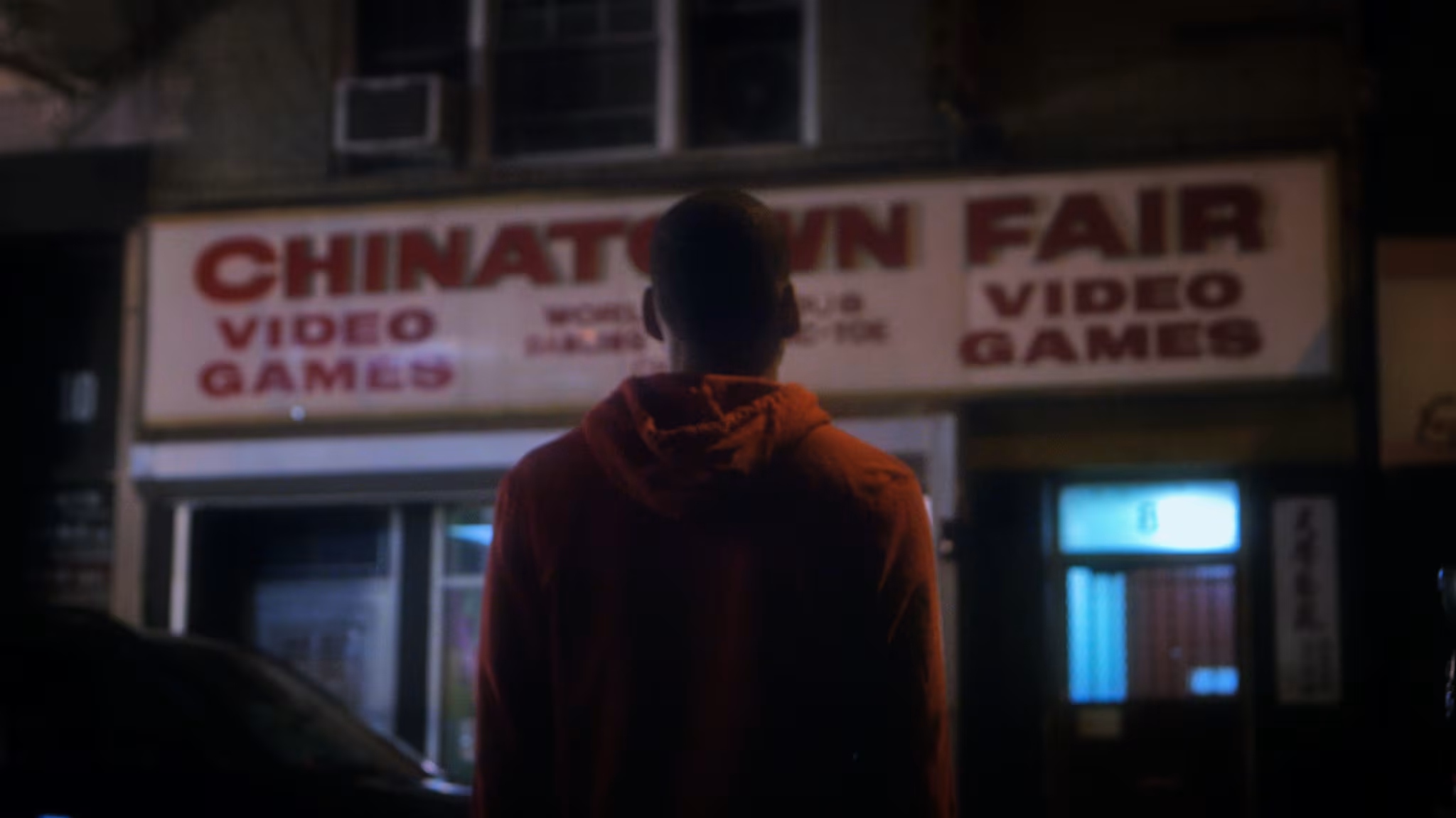
Videogame arcades have all but disappeared from malls and high streets in the West these days, as modern games consoles can offer everything a high end coin-op cabinet can, and online play gives you and endless stream of new opponents without leaving your house. But something they can’t replicate is the experience of hanging out, in person with other humans. A new documentary called The Lost Arcade captures the undefinable magic of these dusty old meeting points. It tells the story of ‘Chinatown Fair’, one of the last remaining arcade in New York’s Chinatown, as it faces closure. Chinatown Fair had become a mythical location, a hangout and safe space for a diverse young crowd, attracting both god-level Street Fighter and Dance Dance Revolution players, and kids trying to escape the world. The film serves as both a social history of NY and a chronicle of the human stories of its owners and patrons, including runaway kids who ended sleeping and eventually working at the arcade, and its eccentric elderly owner who became a surrogate parent to some of them (and also knew nothing about videogames). It’s also a great looking documentary — old footage of New York always looks cool, but this captures the neon of the cabinets like a Michael Mann film, accompanied by an appropriate electro score.
We spoke to director Kurt Vincent and producer Irene Chin chat about making the film, the growing acceptance of games in the mainstream, and how Chinatown Fair is holding out today.
So how did you come across Chinatown Fair?
Irene: We were actually out meeting friends our Chinatown, and I realised I didn’t have my ID, so we weren’t able to get into the bar we wanted to. But I’d just read about this arcade, ‘Chinatown Fair’ that’s been there forever, so we checked it out. It was January, a really cold night and it there was no one on the street apart from this wild place. All these teenagers were hanging out outside. It was like “What’s this all about? This is crazy.” So we step inside and it was like being transported into another dimension. It was something special.
It had a pretty diverse crowd, right?
Kurt: Yeah, there was a lot of different types of people there. Black kids from Harlem, Hispanic kids from the Lower East Side, Chinese kids from Chinatown. It also meant a lot of LGBT kids came to Chinatown Fair because it was like [safe] space, it was like a refuge or shelter.They didn’t come for the games originally, they went maybe because their friends knew the place, and they could hang out and not get bothered. And then from seeing people playing games there, they became gamers.
The film doesn’t consciously explain what Street Fighter or DDR are — you just see people playing them and it makes sense — did you ever have primers on the games in there?
K: We definitely went down that route, and we had a Street Fighter section because I was outsider being educated about this subculture. And then when we’d watch it didn’t feel right, and that the movie was really about people and their stories. And Street Fighter is pretty easy to understand.
There seems to be a new wave of great documentaries about games, with films like The King of Kong, Indie Game and Atari: Game Over. Have you experienced any older critics or film festival programmers being snooty about games, or not understanding why people should care about arcades?
I: I would say no, actually. The film community actually relates to in the way that cinemas are going. They related to this underground community trying to keep film alive, showing actual film prints and things like that. And we had a film programmer talk about that, how it relates to what he’s doing, trying to keep film alive. And we though that was a really interesting parallel.
K: I think I was expecting a lot more people to be wary of the movie but videogame culture is so much larger than people realise, and it dates back to the early 70s. So the people that are programming festivals and theatres, and writers, grew up in the age of videogames. It’s hard to find one who doesn’t have some relation to videogames. I don’t consider myself a ‘gamer’, but I love videogames.
I think some people expect it to be a real niche videogame film that will connect to people who only play games. And that’s strange to me. And I think that’s because videogames still have this stigma that’s slowly being shaken off. If you told somebody you made a documentary about boxing, I don’t think people would say you have to like boxing to appreciate the movie. But with videogames it’s weird. When people hear that I’m not a gamer [they’re shocked], but you don’t have to be a gamer to appreciate games and the stories around them. Maybe we’re slightly ahead. You listed a string of videogame movies, and that’s just the beginning.
What’s been the reaction from the fighting game community?
K: Really good. A few people are like they wanted to see very specific things close to them, because when you’re an expert at something, your understanding of it is so finely tuned… You’re not going to please everyone. I was worried about that. But the friendship with people we made in the community, those were in our minds the entire time making it. When we showed it to them the first time we were pretty nervous, but they loved it. They were screaming and laughing, and afterward we got some really touching hugs. I think people are pretty appreciative that we were able to capture with such a sincerity a subculture and story that hasn’t really been told yet.
I wanted to ask you about some of the characters in the film — in particular former foster/homeless kid Akuma Hokura, who ended up working at Chinatown Town. He seemed like quite a character…
I: Akuma is just at the arcade, all the time. We were just hanging out at the arcade, trying to get to know people. We did meet him pretty late. We were probably like a couple of years deep into filming. He was just really open, and just this really sweet person, and we just really wanted to share his story. And it ended up being one of the most poignant stories in the whole film. But I think it was us hanging out and him seeing us every day, because he’s a really guarded person. He’s shy and afraid to put himself out there, but he trusted us and was able to open up. That was really powerful.
Akuma is also the name of a Street Fighter character…
K: It is his chosen nickname. Only a few long time friends call him by his first name, which I won’t reveal here. He really loves going by his chosen name. This was actually a subtly that we weren’t able to go into fully in the film, because it is a part of the story that I think is interesting. A lot of people in that community don’t go by their first name, they go by their chosen nickname. To me it was very symbolic, because inside this arcade you can be whoever you want to be. A lot of these people are using the arcade as a refuge to escape from a lot of things, and if you are able to shed your identity and take on a new one in the arcade is a freeing experience for a lot of people.
Another big character is Sam Palmer, the elderly Pakistani owner. Was he as lovely as he comes across in the film?
K: Sam was amazing. Sam passed away last year. Sam was as caring and loving as he came off. Once we started talking to the different people, we started realising at the heart of Chinatown Fair was this owner and we realised Sam had to be in this movie because everyone was referencing him. It took many months of weekly phone calls to convince him to sit for an interview, because he is also a very private person, and didn’t really see any value in it — he’s old school, you know. But when we did it was just so good. And Sam loved us, we hit it off right away, he could tell we understood what the arcade was about.
The film looks great, it really stands out from standard talking-head documentaries…
K: Thank you, so glad that you think so. That was important for us. Chinatown in New York is a pretty awesome experience, just walking around at night. We just wanted to the movie to transport you. We weren’t interested in making something that was just a piece of journalism telling the facts — we wanted to bring people into this place, this setting, and I guess we chose to push the visual medium a little bit. It’s our first film, so there was a lot of trail and error, but I think we really had fun doing it, and using what was around us to take the viewer into another place.
I grew up watching The Warriors and Scorsese films like After Hours, that night time New York. And that was before I moves to New York, so I had that impression of the city shaped by my movies I’d watch. I definitely looked at this as an opportunity to do that. We love that stylised approach.
I felt a bit of a Michael Mann vibe…
K: Michael Mann is definitely an influence. He’s one of my favourite filmmakers, especially his visual style, shooting in low light, the neon vibe. You were pretty spot on with that.
Can you tell me about the score?
K: It’s by Gil Talmi. He got really inspired by the content, he grew up in the 80s. He recognised the authenticity of the film, like how we didn’t just film computer screens, we’d find the real arcade machines and film them. And he said this film needs the real synthesisers, not software. So he started going on eBay and Craiglist and finding them. Ones he grew up with, and ones he wanted to play. And he basically amassed this whole orchestra of synths and drums and started composing on those.
There seems like there’s a lot of angry gamers on the internet these days, but the film shows people being brought together IRL by games, and building relationships. Do you think that the arcade have something that’s missing from online gaming?
I: Definitely. That’s something that predates videogames. It’s really important for just social relationships, and people coming together, face to face, challenging each other. That’s something that’s built relationships since the beginning of humanity.
K: Respect has always been a part of losing and winning. Being a good sport. But online people don’t necessarily understand or feel that, and act in ways they never would in person. It’s a part of gaming that I consider vital. There are definitely good things about the online culture, but if that’s not part of the online culture, that that is something that needs to be address. The guys that play in the fighting game scene, playing online is such a joke that there’s no respect, and people just quit if they start loosing. It’s something that’s lost, and it needs to be found.
Finally, minor spoilers, but the film finishes with former employee Henry opening a new venue called Next Level, and Chinatown Fair being re-opened by a new owner. How are the two locations doing?
K: Next Level opened in Brooklyn, and it’s actually in a Chinese neighbourhood. Henry chose it because it’s where his family now live, and the rent was affordable in 2012 - but in that four years since, a some very nice hipster coffee shops have opened up nearby, and restaurants and boutiques. His lease was up this year and he chose to find a new location. It’s not lucrative, but it’s working and he’s making enough money and keeping the community alive. It’s growing, for instance there’s a really big Super Smash Bros community there, and Magic The Gathering community. And then the re-opened Chinatown Fair is doing well, I checked in last Friday to see how they were doing actually. It’s full of rhythm games, some Japanese ones I’ve never heard of. It was just full of couples and young teenagers, and was super-diverse. It’s so different from the old one, but the spirit is there.
The Last Arcade is opening in NYC at the Metrograph and VOD next month. Find out more here.