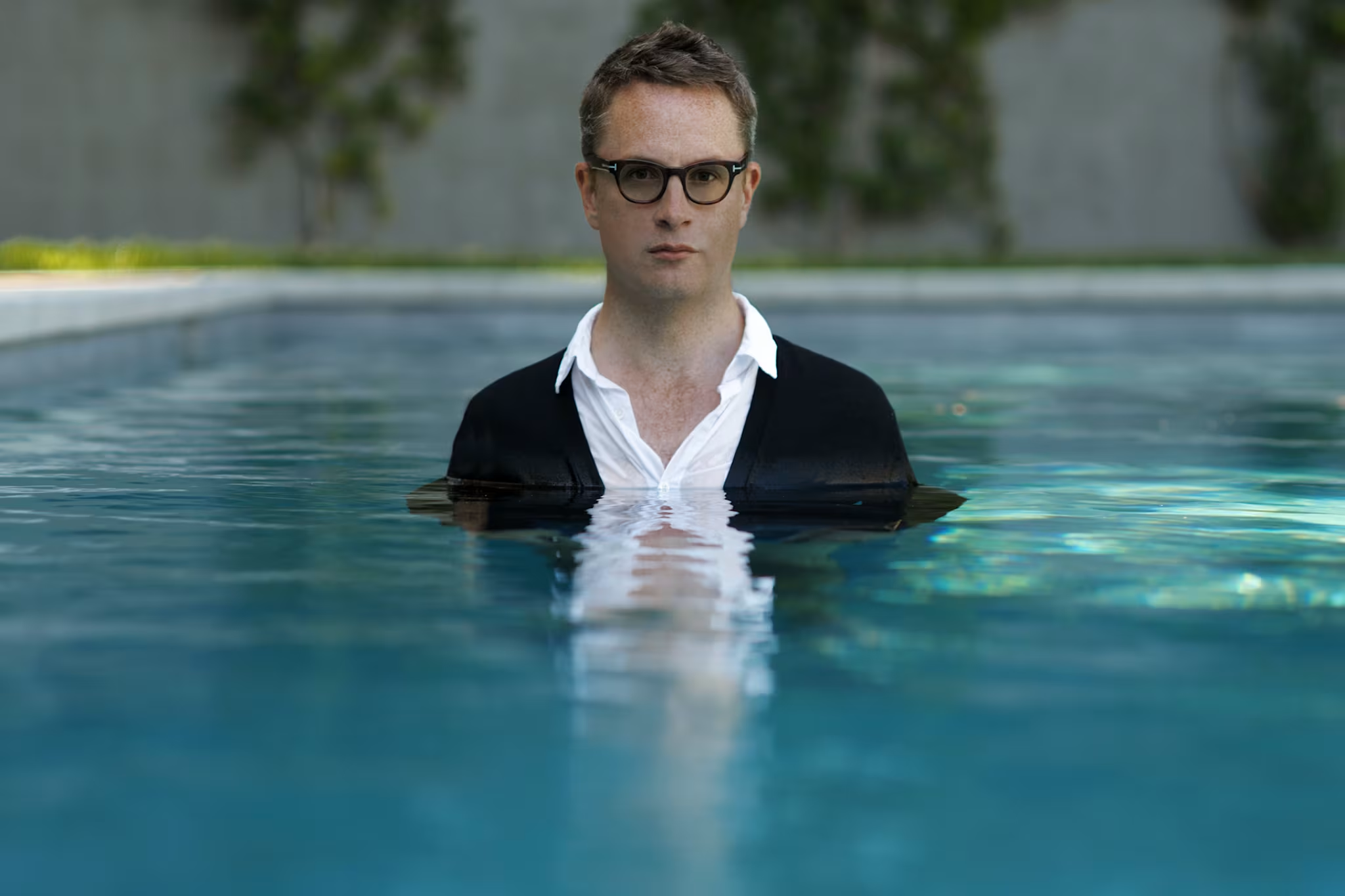
Danish filmmaker Nicolas Winding Refn is a mad, crazy, genius. He gave Tom Hardy his big break in Bronson. He then made Ryan Gosling the coolest guy in the world in Drive. And then with the world at their feet, he and Gosling followed that up with Only God Forgives, a mindfuck of a Thai kickboxing movie that gleefully alienated all their new mainstream fans.
But it’s not a film he’s promoting at the moment. Several years ago he purchased a large collection of film posters, not really knowing what they were. They turned out to all be sleazy exploitation posters, the type that would hang in the lobbies of the notorious Times Square grindhouse cinemas before New York was cleaned up in the early 90s. They advertised gory horrors and soft porn, with lurid artwork promising levels of violence and sex that no film could ever deliver on. Now he’s put them together in a book, called The Act Of Seeing, and we spoke to him about it when he was in London, as well as working with Ryan Gosling and collecting Japanese toy robots.
Danish filmmaker Nicolas Winding Refn is a mad, crazy, genius. He gave Tom Hardy his big break in Bronson. He then made Ryan Gosling the coolest guy in the world in Drive. And then with the world at their feet, he and Gosling followed that up with Only God Forgives, a mindfuck of a Thai kickboxing movie that gleefully alienated all their new mainstream fans.
But it’s not a film he’s promoting at the moment. Several years ago he purchased a large collection of film posters, not really knowing what they were. They turned out to all be sleazy exploitation posters, the type that would hang in the lobbies of the notorious Times Square grindhouse cinemas before New York was cleaned up in the early 90s. They advertised gory horrors and soft porn, with lurid artwork promising levels of violence and sex that no film could ever deliver on. Now he’s put them together in a book, called The Act Of Seeing, and we spoke to him about it when he was in London, as well as working with Ryan Gosling and collecting Japanese toy robots.
Why did you decide to put all the posters together in a book?
I found them and I was like “Oh my goodness”. I’d purchased this collection by accident. What was I going to do with them? It was like a bit of a time machine, and there were so many obscurities, so it thought would make a great book.
How many of the films have you actually seen?
Probably only about 15 of the 300 movies in the book. The rest I have no idea what they are. {Co-author} Alan Jones had to do research on them. It took him two years just figuring out all the information about them.
What are your favourite posters in the book?
There’s one called Nest Of The Cuckoo Birds—it’s so unique, it looks like a Jean-Michel Basquiat painting. And it’s a lost film, so that’s all we know about it. There’s crazy sci-fi ones. But mostly it’s all sex. Selling sex.
A lot of these posters completely mis-sell the films, making them look like they’re full of sex and violence, even if the filmmakers had been trying to make something else. As a director yourself, you have any sympathy with them having their work misrepresented like that?
No. I think what’s interesting is that a lot of these films were purely made for financial reasons. It’s a down and out way of approaching it. I invest $5,000 in something and show it in Time Square, and I’ll make $20,000. It was very crudely put together. I think that how cinema has been promoted over the years, it’s very interesting to preserve that part of the industry. Not just making films, but selling them as well, which is equally an art form. Some of these posters are very artistic, even if they are very crude.
Did you go to the sleazy grindhouse cinemas where these films played when you were growing up in New York {Winding Refn moved to NY from Denmark when he was eight}?
No, I was too young for that world. I wasn’t allowed to go to Times Square, and by the time I was, it had gone away. So I am one of those people that romanticises that period because I didn’t live through it.
Talking about the selling of films, most of your work could broadly fit into an easily marketable genre—Bronson is true crime, Valhalla Rising is like Conan, Drive is a car chase movie, Only God Forgives is a kickboxing film. Is that something you consciously think about when making them?
Yes. I’m very involved, and I very much think about it even at script level. You have to understand the finances of entertainment to survive. If you don’t you very quickly get dissolved into nothingness. But if you don’t lose money, people will always be willing to support you.
There was a story that a woman tried to take legal action because Drive wasn’t the action film she was expecting…
Oh that’s true. She sued actually. I think I was going to have to go to some local court. It was very ridiculous. But it was pretty groovy also! It’s a great compliment.
Looking at how the posters in the book mis-sell some films, did you have any sympathy for her? She was told she was going to get something like The Fast and The Furious…
That’s interesting, I never thought of it like that! I don’t know if I have sympathy for her. I have great amusement because it’s so insane. What’s great about entertainment is that it can be sold in so many different ways, to people’s fantasies. Like most of these posters promise so much, but it’s going to be impossible to deliver.
Only God Forgives really feels like a Jean Claude Van Damme movie from the 80s, like Kickboxer or Bloodsport—were they an influence on it?
I sold Only God Forgives as a kickboxing movie, a Muay Thai movie. And I had some very good financiers that trust and support me. And then I decided to make it into something else… And they were like “Er, yeah, ok. We’re behind you.” I shoot everything in chronological order, so I don’t really know what it is until the finished film.
We expect Ryan Gosling to be a badass in the film, because he’s the movie star we recognise, but when he eventually has to fight he gets the crap beaten out of him. Was that intended as a satire or a parody at all?
It wasn’t so much intended like that. For the storyline he needed to lose. And what was great about Ryan he was like “Let’s go all the way. Destroy me”. That’s why we work so well together, because we’re very much in sync. He’s the greatest alter ego I can have.
Does being mates with Ryan Gosling help get your films made?
The bigger stars you have, the more chance you have of it getting made, but its not a given any more. But it has to be the right actor for the role, that’s the first rule of law. Me and Ryan will work together again, very soon. He’s one of my best friends.
Was Drive intended to be a crossover movie at all?
It doesn’t work like that. It’s not different to any of my other movies. It just took everything I did to a higher level.
Your films, Only God Forgives especially, seem to capture a sort of nightmarish vision that would actually live up to some of these posters…
It’s not conscious. Before Bronson then I had done the Pusher trilogy that was all about capturing reality. I decided with Bronson to do things about a heightened reality. Approach it as a pin-up magazine, and completely make it fetishized.
How did you cast Tom Hardy in Bronson?
I was interested in Jason Statham, but he turned me down. Then I went to Guy Pearce with it, and he never got back. And then there were lots of young actors, but the best out of everyone was Tom Hardy.
What do you do when you’re not making films?
I have two kids and a wife, so I don’t have much time to do anything else when I’m not working. I’m a big toy collector, I collect Japanese toys. Usually, I start collecting a certain type of thing and then I lose interest—and then I’ve bought a lot of them and I don’t know what to do with them.
What toys are you into—are you after anything specific like Transformers, or Gundam Wing?
Whatever interests me. I’m purely based on what I like. Some of them are based on TV shows I’d watch when I was younger. And some I just love the design of. A lot of it is from my childhood. I have an interested in re-collecting everything I had as a child in New York. All those Japanese robots. I’m a big supporter of eBay!
You’ve made films in Denmark, America, Canada, the UK and Thailand. Do you think of yourself as an international filmmaker?
I just like to travel. For me it’s not just the film, it’s the experience of traveling. It’s where I’m going to have dinner, where I’m gonna sleep. What works for my family, which is now an important thing. I like not just the filmmaking process, but the whole identity of being away. You live in bubble, an unreality. And then you go back home, and everything is very real and boring.
Do you ever see yourself making a big blockbuster, like a superhero movie?
I would love to make a superhero movie. I enjoy watching them. I just have to find something that would work. But I very much enjoy my creative freedom. It has to be a worthy trade-off. Life is short, so you really have to decide how many battles you want. Doing what you do, the way you want to do it, still outweighs any about of money they can give you, or what people call ‘success’ later on. The act of creativity I find more interesting than all that.
You directed some ITV dramas, right? What was that like?
Doing Miss Marple was purely a job for hire. I needed the money, and I milked ITV for as much as I possibly could! I enjoyed it, but it’s not particularly engaging.
What can you tell us about your new film, The Neon Demon?
We’re in post production. I don’t what it’ll be; it’s not done yet! In another six months I’ll tell you.
“The Act Of Seeing” by Nicolas Winding Refn and Alan Jones is published by FAB press. Visit www.fabpress.com.