Key Takeaways
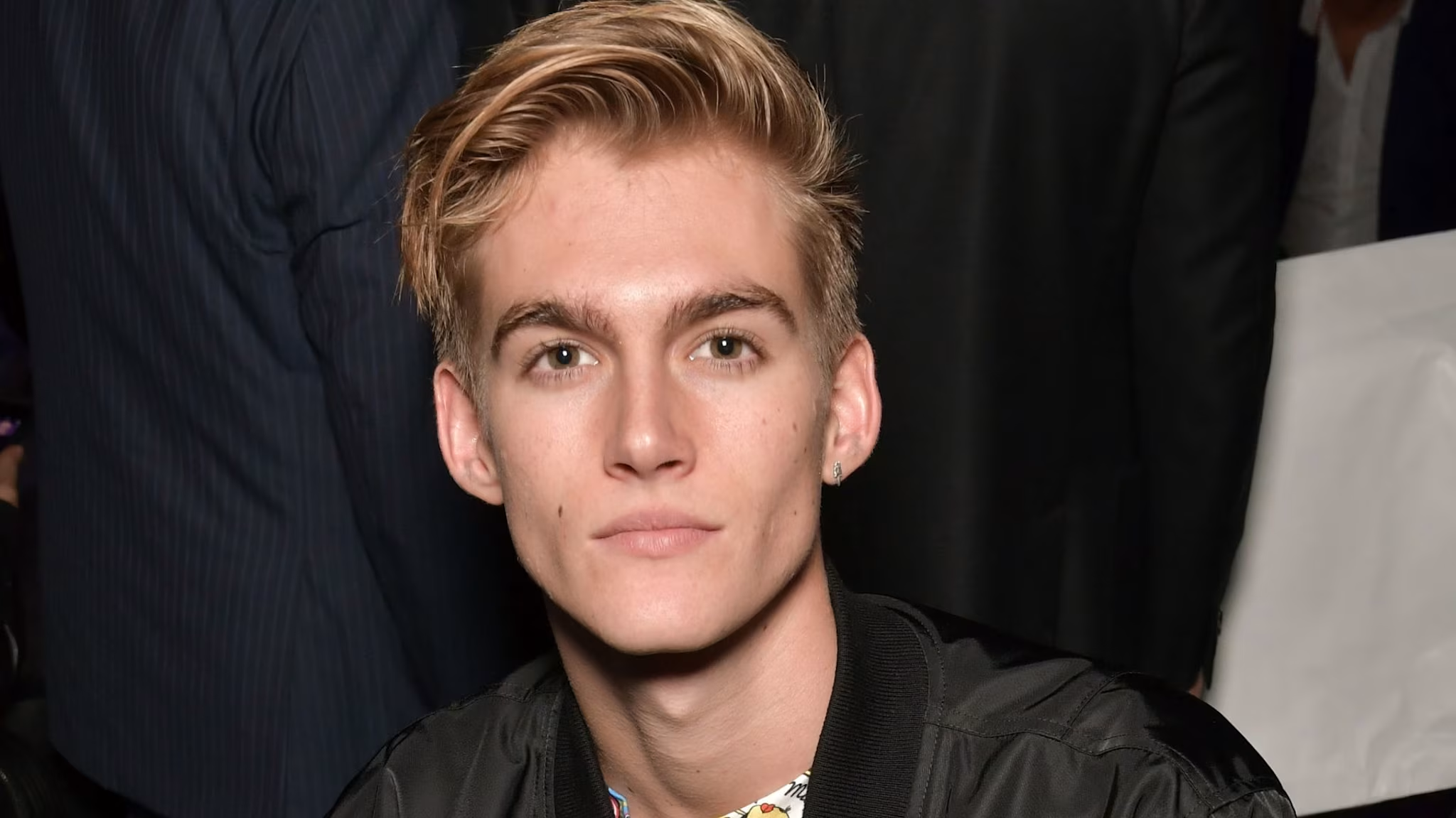
- Los Angeles authorities are investigating the death of Presley Gerber, the 27-year-old son of Cindy Crawford and Rande Gerber, after paramedics pronounced him dead at a rehabilitation facility.
- The medical examiner scheduled an examination for September 21 but has not released a cause of death or said whether investigators suspect an overdose, accident, or foul play.
- Gerber had publicly documented his struggles with addiction and depression, including ibogaine treatment and a “Mental Health Mondays” series, while his family asked for privacy following his death.
The death of Presley Gerber remains under investigation as authorities work to determine what happened to the 27-year-old son of Cindy Crawford and Rande Gerber. The Los Angeles County Medical Examiner said an examination was scheduled for Monday, September 21, one day after Gerber died while at a rehabilitation facility. No cause of death has been released, and officials cautioned that information remains limited.
Responding paramedics pronounced Gerber dead at 9:45 a.m. on Sunday, Sept. 20, according to the medical examiner’s office. The Santa Monica Police Department is handling the investigation.
“The investigation is still ongoing, and there is limited information available,” the office said in a statement made to People. Authorities have not announced whether they suspect an overdose, an accident, or foul play.
A representative for Crawford, Rande and their daughter, Kaia Gerber, confirmed the family’s loss while requesting space to grieve. “The family is asking for privacy during this very difficult and painful time,” the representative said. Gerber was the couple’s only son and Kaia’s older brother.
The investigation has drawn additional attention to Gerber’s public discussions of addiction, depression and treatment in the months before his death. In one of his final Instagram posts, shared in March, he documented preparing to undergo what he called an “ibogaine flood dose.”
Ibogaine is a naturally occurring psychedelic derived from the root bark of the Central West African shrub Tabernanthe iboga. Although it has been studied as a possible addiction treatment, it is not approved for medical use in the United States.
“Quiet moment before everything changed,” Gerber wrote beneath a video recorded ahead of the treatment. He admitted that he was “absolutely terrified” but said he had reached a point where he was ready to confront what he had been avoiding.
“I knew why I was there,” he wrote. “I faced what I had been running from, and somewhere in all of it, I started finding my way back to myself.”
He closed the reflection by saying he was “praying it’s the last time I have to come back.”
His family publicly encouraged him beneath the post. Crawford called her son a “warrior” and wrote that she was proud of him for walking “through the fire” to find himself. Kaia responded, “That’s my brother. I am so damn proud.”
Gerber later created a recurring “Mental Health Mondays” series on social media, describing mental health as a constant responsibility rather than a problem solved by one treatment or breakthrough.
In a since-deleted Instagram video posted in December 2025, Gerber also discussed taking medications that included buprenorphine, Xanax, and Valium while dealing with panic attacks and other mental-health challenges.
“Unfortunately, I’ve had a lot of loss in many different forms recently,” he said at the time. He explained that the losses were not an excuse for his condition but helped explain how he reached that point. Crawford responded publicly, telling him, “We love you, and you are not alone.”
Before his struggles became such a visible part of his story, Gerber had followed his mother and sister into fashion. He signed with IMG Models at 15 and made his runway debut for Moschino at 16. He later walked for Burberry, Dolce & Gabbana, Bottega Veneta, Tommy Hilfiger and Ralph Lauren, while appearing in campaigns for Calvin Klein, Celine, Omega and Pepsi.
He also modeled alongside Crawford in a 2018 Super Bowl commercial that revisited her famous connection to the brand.
Kaia addressed her brother’s decade-long struggle with addiction in Vogue shortly before his death, describing its effect on the entire family. “When something like that happens in a family, it kind of levels everyone,” she said. She also praised Presley for refusing to hide what he was experiencing, calling him a “teacher” who chose to be human in public despite the family’s longtime instinct toward privacy.
If you or someone you know is struggling with substance use, help is available. Contact SAMHSA’s free, confidential National Helpline at 1-800-662-HELP (4357) or visit FindTreatment.gov. Call or text 988 for immediate mental health or crisis support.