There was a time when Ayra Starr felt like she had something to prove.
At 19, she was fighting for freedom. By 21, she was navigating what it meant to grow up while millions of people watched. Now, with her third album, Starrgirl, the Nigerian hit-maker has arrived somewhere that sounds simple enough: she wants to just be.
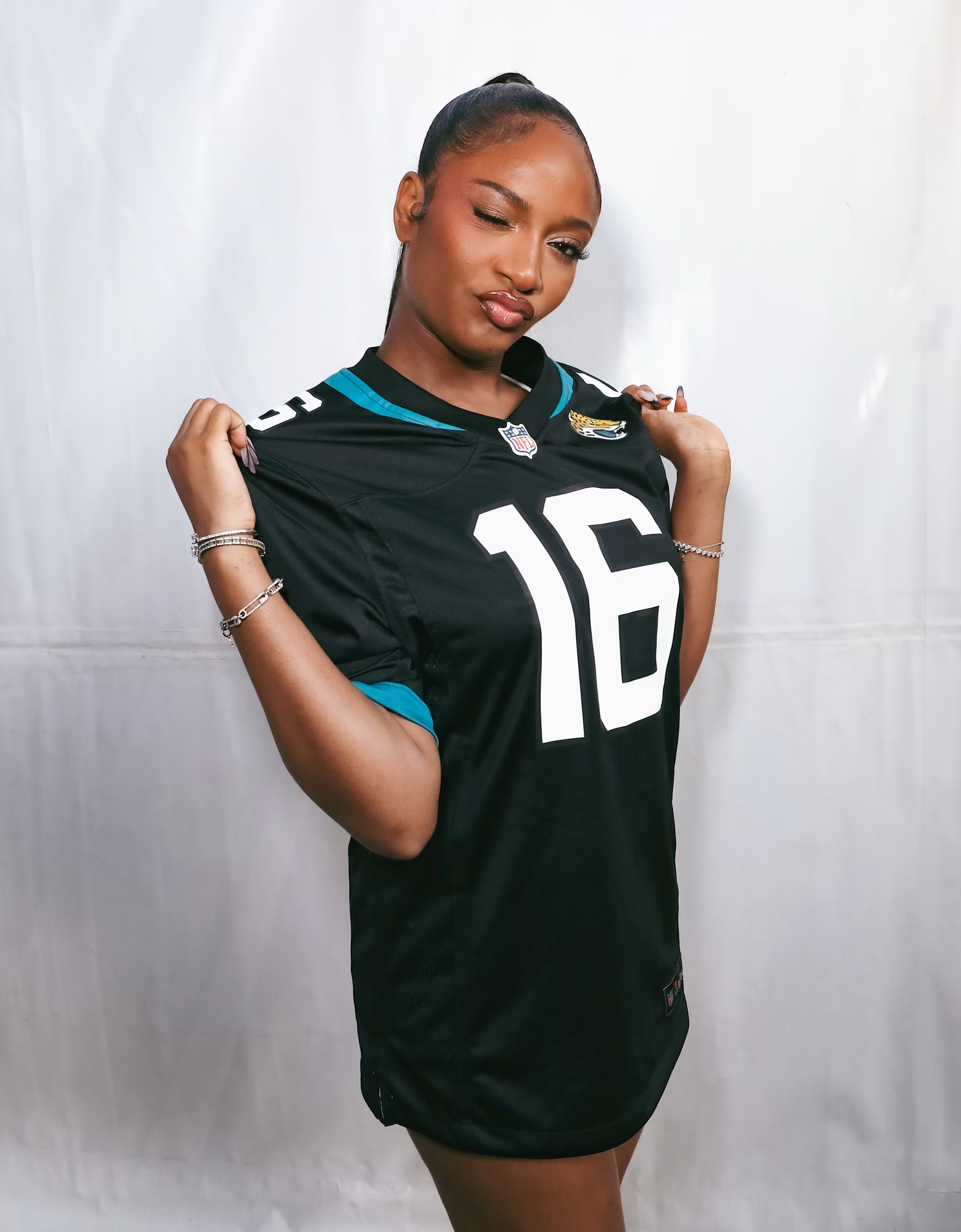
Since breaking through with “Away” in 2021, Ayra has gone on to become one of African pop’s biggest global stars. “Rush” accelerated that journey, taking her from rising star to international force seemingly overnight. Since then, there have been billions of streams, a MOBO Award win, and still-talked-about performances on Glastonbury’s Pyramid Stage and stadium shows alongside indie-pop outfit Coldplay. Next comes another unlikely stage for an Afropop artist: the NFL London halftime show.
Yet it seems the bigger Ayra’s star becomes, the more interested she appears in the person underneath it all. Starrgirl is her most revealing record because, for the first time, she had enough lived experience to write almost entirely from herself, which was a freeing process. “Midnight In New York” is her. “Amazing” is her. “Ms. Paper” is her. Where her previous songs drew on emotional references from films or other people’s experiences, this LP documents a woman who has lived enough life to let the songs tell on her.
That honesty didn’t come easily, though. Following the success of “Rush”, Ayra says she experienced imposter syndrome and retreated into herself. Moving to New York eventually gave her enough distance to look at what she had built, reconnect with the girl who once dreamt about this life, and question whose expectations she was carrying. The result is an album full of contradictions. Ayra is ambitious, a woman of faith, confident, heartbroken and occasionally unsure. On “Misunderstood”, those contradictions become the point: she no longer needs everyone to understand her.
Ahead of her NFL London halftime show performance at the Tottenham Hotspur Stadium on Sunday 11th October, Complex UK caught up with Ayra Starr to talk about growing up in public and learning to ignore unsolicited advice, rediscovering herself through writing, being a music nerd and finally learning that she doesn’t always have to be something—sometimes, she can just be!
COMPLEX: Hi Ayra! First of all, congratulations on landing the NFL London halftime show! When you got the call, what was your immediate reaction to knowing you’d be taking your Starrgirl album to such a huge global stage?
Ayra Starr: To be honest, when I found out, I was like, “Oh my God! What am I going to sing? What song? How can I pick?” I actually found out before the album dropped, so I already had nerves because I hadn’t performed in a while. It was a lot of nerves finding out that I was going to be performing at the NFL London halftime show, but at the same time, I was very excited because it’s London. I was like, “Yes!”
London has been part of your journey from very early on, and it has played an important role in putting African music at the centre of a global conversation. What does it mean to you to headline this particular game, in this particular city?
I’m doing it for my people, to be honest. I’m doing it for all the Nigerian and African girls. Even with the album itself, that’s one of my biggest inspirations: the Nigerian and African girlies. I know who I’m doing it for. I’m showing out. I’m going all the way and I’m going to do my best for my people. It’s nerve-racking, but at the same time it’s exciting. I’m like, “Okay! What do we do? Let me see.”
You’ve already performed on Glastonbury’s Pyramid Stage, reached billions of streams and experienced stadium crowds with Coldplay. Where does this NFL moment sit within what feels like another huge chapter for you?
It definitely feels like the stars were aligning. There are things I’ve wanted to do for a long time; something like this was one of them. I think I said it one time and didn’t even think much about it afterwards. Then my manager told me with a smirk on her face, “By the way, guess where you’ve been asked to perform?” I was like, “What?” It felt like things were aligning for the album. I was like, “Okay, this is going to be big! It’s going to be huge for the album and for my fans.” Just being able to be on that stage and be part of that world is crazy.
When people watch the halftime show, what do you want them to understand about who Ayra Starr is now?
I feel like I’ve passed the stage in my career where I have to explain myself… I’m very comfortable in who I am right now. You’re going to see Ayra Starr being Ayra Starr. I can’t tell you to expect grandiose—just expect Ayra Starr because that’s who I’m going to be on that stage. I’m going to give my best. I’m going to put on the best show I possibly can, have fun, and make sure the audience is having fun too. That’s really important to me—everybody has to have fun.
I saw that you read what I wrote about Starrgirl on my Substack. My biggest takeaway was that we’re finally getting to meet more of the person behind Ayra Starr. When you read it, was there anything that made you think, “Mimi, how did you clock that?”
It was a lot! From the beginning, I was like, “Was she in the studio with me?” [Laughs] My manager sent it to me and was like, “Did you read this?” I said, “Let me lock in.” I went on Substack and read it and I was like, “How does she know that?” There were so many things that were so on point. I was like, “Girl! I want to repost this, but my mum is going to see it. She doesn’t have to know certain things you were writing, Mimi!” [Laughs]
Well, thanks for reading, and… Hi mum! [Laughs] People will probably call Starrgirl your “grown” album, but I actually think you sound more decided. What changed between your last album, 2024’s The Year I Turned 21, and making this album?
For me, it was about pushing myself while making sure everything still felt authentic. I can’t lie about something I don’t know or can’t relate to. Before, I had written a lot of songs from other people’s experiences. I would take experiences from movies or work with people who had lived certain things because I didn’t have enough lived experiences myself to make certain songs. But with this album, I wanted to make songs that were me and what I was experiencing. “Midnight In New York” was me. Everybody knows I’m outside. I. am. outside! You see me everywhere—I’m going to be there. “Amazing” is my experience. “Ms. Paper” is me… I can perform the songs and sing the songs because it’s me.
You mentioned New York. How important was physically taking yourself out of everything familiar to becoming the person we hear on Starrgirl?
After my first album [2021’s 19 & Dangerous] and “Rush”, I had a lot of imposter syndrome because it just went from zero to one hundred. The thing I’d been saying I wanted to do, happened. Then I didn’t know what to do from there. I started going back into my shell. I didn’t want people to see me. I felt like people knew too much about me, and I didn’t really like that. Then I came to New York and moved myself away from everything I had ever known. It put me in a different perspective—I could see myself from the outside and see what I had built from an outside point of view. I was like, “Wow, girl! Wake up!” I started removing those shells and allowing myself to be seen. For me, being seen was understanding that if I can just be myself, I don’t have to be anybody else. I have nothing to hide because this is who I am—take it or leave it.
You’ve also started writing more on Substack. You clearly want to let people into your world, but you also value your privacy. Why has writing become the way you do that?
I’m not the best at talking on camera and doing vlogs. My team wants me to do more vlogs and show more personality. They’re like, “You’re hilarious!” And I’m like, “I don’t know how to show my personality.” The camera comes and I’m like, “Hey…” But I can write. I’ve been writing since I was 13. I used to write romantic fan-fiction and all of that. So I thought, “Let me go into that space again. I might not be able to talk about how I feel, but I can write about how I feel. I might not be able to say it, but I can write it.” I felt like that could bring people into my head a little bit so they could see how I was thinking and understand my thought process. I can post a picture and do all of that, but writing is more intimate. It’s like I’m inviting you into my mind, like: this is my brain, this is how I think and this is how I see life.
Hold on—you were writing romantic fan-fiction at 13 years old? We need to discuss this. Is any of it still online?
No! There was one that kind of went viral at the time, but nobody knew it was me. Also, I wasn’t supposed to have a phone, by the way. I was writing fan-fiction that I should not have been writing at the age of 13 [laughs], but let’s move to the next question!
Growing up in front of the world must make that balance even harder. How do you decide what people get access to and what remains yours?
It’s really a discernment thing. There are some things where I know nobody needs to know. There are things you might experience about my personality when you meet me in person and speak to me, but certain things I feel people don’t need access to. I keep that side protected. That’s just who I am. If the camera is there and catches me on a good day, you get that personality. But if not, I’m not going to force myself to give that. That’s why I was writing, because vlogs couldn’t do that for me; taking and posting pictures couldn’t do that for me either. Writing is my most intimate part because I’m inviting you into my mind.
To me, “Misunderstood” feels like the thesis of the entire album. You present this girl as both unbothered and heartbroken, confident and vulnerable. What do you think people misunderstand about you the most?
I think people misunderstand my mission and my dreams. I don’t feel like I have to tell people exactly what my dreams are, but I do feel like people tend to project their own agendas onto me—what they think I should be doing, what my life should look like or what my career should look like. That’s probably the most misunderstood thing because I don’t feel like I’m unaligned. I feel very aligned with who I am as a person, and what my journey is as an artist. “Misunderstood” came from a place where I was digesting a lot of information telling me what I should be and who I should be. When you digest and eat—and eat, and eat, and eat—that information, you start to lose track of your own person. Starrgirl comes from a centre where I had to go deep within and find that little girl who grew up to be who I am now, who is still growing, and follow that journey. I had to understand that everything is going exactly the way I want it and how it’s meant to be.
Was there a moment when you realised you had to stop absorbing everyone’s advice about what Ayra Starr should do next?
There was just so much advice being given to me. At one point, I had to tell myself, “I’m not taking advice from anybody I don’t want to be like, or anybody who hasn’t done something that inspires me.” It’s something I have to remind myself because you go on the internet and social media and digest all these things. Eventually, you start thinking, “Well, maybe it’s true.” But why is it true? Why is Tunde telling me this? What does Tunde know about me? What does Tunde know about where I came from? What does Tunde know about how I grew up? What does Tunde know about my dreams, my mission and what I’m doing? I’m fine being misunderstood because I know who I am. That’s the “little miss unbothered” part. But at the same time, I live and learn and grow. Sometimes I’m heartbroken, sometimes I’m sad. Sometimes things don’t go the way I wanted them to and it breaks my heart. Then I get up again. She ain’t nobody’s fool, little misunderstood. I’ve always been who I am. I’ve always been different. The miniskirt I’m wearing now? I was shortening my skirt in secondary school and getting into trouble for it. Everything people are saying now, they were saying when I was a child too.
Would that younger girl be proud of the person you are now?
Definitely. Younger me would be very, very proud. Not just because of everything I’ve done or everything I’m doing—of course, she’d be proud of those things—but because I know who I am. I still know her, and I haven’t forgotten her. She’s still such a big part of me. Growing up, I would spend a lot of my days daydreaming about who I am now. I was writing stories and having these huge dreams. Now, I’m living that life. Sometimes I’ll sit down and think, “I said this when I was 10 years old and I’ve done it now.” It’s very healing to connect the dots and see how God’s mercy and grace have been in my life. So, younger me is definitely proud of who I am, but I’m even more proud of younger me because she wasn’t afraid to dream. Nothing seemed too far. Nothing was delusional. Her way of escaping the hard life she was living was dreaming big and trying. That’s what I’m doing now.
Let’s get into the actual making of Starrgirl—the creative process, the people you chose to bring into the world of the album, and how those collaborations came together. Zayn was one that really surprised me. How did that relationship and collaboration come about, and what did it mean to hear him bring his voice to a song like “Heaven Baby”?
Zayn… Until now, I’m still shocked. We weren’t physically in a session together, but we could connect emotionally through the music. I understood who he is as an artist because I listened to him growing up. There was something about “Heaven Baby” that connected with him emotionally, and he said that was the song he wanted to do. He sent me the verse while I was in Lagos, and I remember hearing it in my room while my mum was in the other room shouting. African mothers! [Laughs] I listened and cried because I couldn’t believe what the song had become. I was also scared of it, because it felt so vulnerable and intimate. I became fearful, like, “Am I ready for this? Am I ready for the sound?” Every person I featured on this album is somebody I genuinely love listening to.
It sounds like you approach collaborations as a fan before you approach them as Ayra Starr. Is that fair to say?
Definitely. I was listening to Leon Thomas back-to-back. I went to his show before I even sent him anything. I watched him perform and I was like, “He’s crazy live. What? He is a genius! He’s a beast!” Then I told him I had a song for him. I sent it before I left London and he sent it back the next day. It was the same with kwn. I had been listening to her for a long time and I went to her concert before sending her any music. That was important to me because I’m a fan of these people, first. I respect them as artists. I’m the type of artist where, if I love you, I’m going to gag. I’m going to be in the DMs like, “Why did you write this? You’re crazy for that!” I’m very passionate about music. I’m quite nerdy about it. I’m not too shy to ask, either. I’ll be like, “I have this idea—let’s do this.”
You mentioned that Starrgirl was also the first album where you had more women physically around you in the studio. Did that change anything creatively?
Yes, this was the first album where I had girls in the studio with me, female songwriters, female engineers sometimes—all of that. There’s something about seeing another female artist in the same space: we’re going through similar things, so there’s so much respect. You see another woman being herself and being who she is as an artist and I’m just enamoured by it. It’s almost like a work crush.
That brings us to “Ms. Paper” featuring Theodora. You sounded like you had a lot of fun making that song with her—what was that session like?
That was probably the most fun session I’ve ever had. I had a whole different song for her before she came into the studio and she recorded it. Then I was like, “You know what? I want something more fun.” I got a Congolese chef to come through that day because I knew she was coming to the house. We had Congolese food cooking while we were making the beat; the AC wasn’t working, so everywhere was hot. I went to one of the pianos and pressed something, and it made sense in the beat so I was like, “Hey! I’m a producer. Add me. Add me to the beat!” Then she started writing the chorus and I was like, “Whatever you’re writing right now, I’m singing that too. We’re going band for band. Let’s go!” It was so fun.
If 19 & Dangerous was you stepping into the world and The Year I Turned 21 was you growing up inside it, who is the woman we meet on Starrgirl?
With 19 & Dangerous, it was very much an angsty teenager. There was almost an anger towards the world. On some songs, I was speaking to my older self, asking, “Do you really want the things you say you want?” and “When you have it all, remember God.” Then, on other songs, I was basically like, fuck society! Fuck you wannabes! I was fighting for freedom. With The Year I Turned 21, it was almost the same thing where I was growing and I felt like I had to prove it. When you’re an African girl, the mindset is always being something: you have to be this person, you have to be the sister, you have to be the respectful girl, you have to be the friend... It’s just a lot of being something and not just being. There doesn’t always have to be an action—you can just be! And I feel like that’s what Starrgirl is. I took myself out of my world, came to a completely different place and saw myself from an outside point of view. I could just be! I could just be, and I made the album from that standpoint.