Image via Complex Original
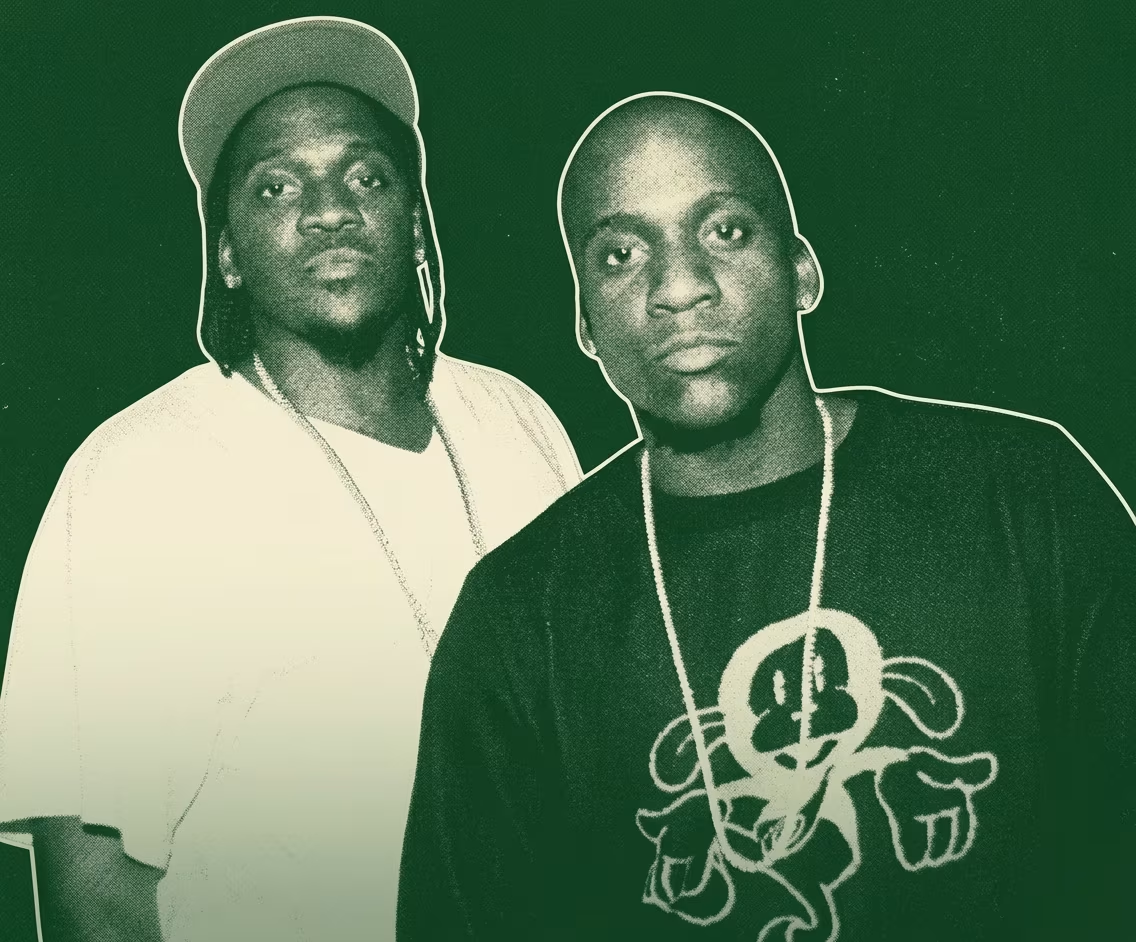
With his impossibly cool delivery, complex metaphors, previously unheard of internal rhyme schemes and Five Percent Nation of Gods and Earths–informed knowledge, Rakim instantly changed the game for MCs with Paid in Full, his 1987 debut album with Eric B, released 25 years ago today.
The emergence of The God MC was remarkable, at the time at least, for another reason: He didn’t claim Brooklyn (where he had deep family roots), or Eric B.’s home borough of Queens, but Wyandanch, a small town 30 miles east of the city, in Long Island’s Suffolk County. People still generally don’t associate the suburbs with hip-hop credibility but starting with Paid In Full and Public Enemy’s aptly titled Yo! Bumrush The Show (also released in ‘87),
Long Island’s “Black Belt” became, for several years, hip-hop’s center of creativity. Embracing their outsider status, acts like De La Soul, EPMD, Leaders of the New School and KMD issued a wave of innovative albums in the late ‘80s and early ‘90s, ushering in sounds and sensibilities that invigorated hip-hop’s core audience while evincing a universality rappers from the city couldn’t always muster.
Though not as vital as it once was, Long Island’s rap scene still produces the occasional gem—see Roc Marciano’s Marcberg, for one recent example. What better was to celebrate the 25th anniversary of Paid In Full than to take a look at 25 of the greatest albums to come from Strong Island? Recognize.
Written by Jesse Serwer (@JesseSerwer)
Follow @ComplexMusic
25. JVC Force, Doin' Damage (1988)
Label: B-Boy Records
JVC Force gave “Strong Island” its anthem with their underground classic by that name in ‘88. And, quiet as it’s kept, the trio of B-Luv, AJ Rok and Curt Cazal dropped a pretty dope album that year, too. With its offbeat samples, put-on accents and a general air of playfulness, Doin’ Damage had the sort of loose, bugged-out aesthetic that another Suffolk Country trio, De La Soul, would take to greater heights a year later, with 3 Feet High and Rising.
24. Grand Daddy IU, Smooth Assassin (1990)
Label: Cold Chllin'/Reprise/Warner Brothers
Golden Era rap label Cold Chillin’ Records was generally associated with Queens and the Juice Crew but Tyrone “Fly Ty” Williams’ imprint had other acts, too. A product of gritty Hempstead (hometown of Prodigy, and the birthplace of Method Man), the dapper, baritone-voiced Grand Daddy I.U. had a pair of minor, R&B-flavored hits with “Something New” and “Sugar Free" but Smooth Assassin tracks like "Nobody Move" and "Behind Bars" showed that Strong Island MCs could get just as gully as their city peers. And to think, this project almost never happened! When album producer Biz Markie initially called I.U., the rapper thought he was bluffing and brought baseball bats to their meeting before wising up.
23. The UN, UN or U Out (2004)
Label: 456 Entertainment/WORLD Records
Carson Daly has proven to be more successful at championing new music on late-night TV than he was as a record label exec but the Last Call host’s short-lived 456 Entertainment imprint was responsible for at least one brilliant—if little known—rap album, in The U.N.’s U.N. Or U Out. On their lone LP, the Uniondale, L.I.-based crew (which also included former Flip Mode member Roc Marciano, of nearby Hempstead) came off sounding like a Long Island version of Wu-Tang, while rocking over some of the best—and darkest—Pete Rock and Large Professor beats you’ve probably never heard. If only Carson went all in on this record label thing, more people might have.
22. EPMD, Business As Usual (1990)
Label: Fresh/Sleeping Bag Records/Priority Records
EPMD never tried to one-up or reinvent themselves after their breakthrough success with Strictly Business. The Brothers from Brentwood, L.I., have been content to retrace that album’s blueprint (funky, whip-friendly beats and rhymes about snappin’ necks and gold-digging chicks named Jane) over and over throughout their career. If it ain't broke, don't fix it.
Case in point: '91's Business As Usual isn't necessarily superior to their next best albums, ‘89’s Unfinished Business and ‘92’s Business Never Personal—they're all pretty much the same in terms of overall quality—but it was the first EPMD release to showcase Erick and Parrish's ability for spotting talent, introducing the Hit Squad to the world via Redman's cameo on “Hardcore.”
21. Freddie Foxxx, Industry Shakedown (2000)
Label: Landspeed Records
Though his connections to Brooklyn’s Gang Starr Foundation and the Bronx's BDP—not to mention his tough-as-nails demeanor—might lead you to think otherwise, Freddie Foxxx was raised in solidly suburban North Babylon, L.I. Released 11 years after his first and only major-label release, Freddie Foxxx Is Here (MCA), Foxxx’s Industry Shakedown put phony rappers and disingenuous corporate execs on blast with bold threats ("I remember when I first stepped to Lyor, I should have blown him/Cause that cracker been a crook since I first known him" went one particularly direct line) and gruff, cut-the-bullshit lyricism. Produced by an all-star committee of DJ Premier, Pete Rock, Large Professor, Diamond D. and the Alchemist, Industry Shakedown was the best-selling independent album of 2000, ensuring that Bumpy Knuckles had the last, diabolical laugh.
20. Son of Bazerk, Bazerk Bazerk Bazerk (1991)
Label: MCA/Sound of Urban Listeners
Long Island produced a lot of colorful acts in the early ‘90s, but none more unique than Son of Bazerk or, as they were known in full, Son of Bazerk featuring No Self Control and the Band. Looking more like a vintage Motown act than a rap group, the co-ed unit (whose members were childhood friends of Flavor Flav's) put a soulful, reggae-accented spin on some of Public Enemy producers the Bomb Squad’s most experimental beats.
While Bazerk Bazerk Bazerk flew over the heads of most rap fans in ‘91, leading to the group’s dissolution shortly thereafter, those who “got it” successfully urged the group to reform in 2010 via the comments section of hip-hop blog Unkut. The surprisingly taut result, Well Thawed Out, showed the foursome hadn't lost a step, even after 20 years of inactivity.
19. Eric B. & Rakim, Let the Rhythm Hit 'Em (1990)
Label: MCA Records
Eric B. and Rakim's third LP isn’t as celebrated as its predecessors, Paid In Full and Follow the Leader, but tracks like “In The Ghetto,” “Untouchables” and “Mahogany” were among The God MC's most advanced lyrical demonstrations, and hold up as well as anything in his catalog. Let the Rhythm Hit 'Em was equally impressive on the production side, thanks to the involvement of the late SP-1200 wizard Paul “Paul C.” McKasty and his then-unknown protégé, Large Professor. The beats on this LP really were as bangin' as its title suggests, though it would be the last time Ra, or anyone, would work with Paul C.: he was killed while the LP was in production.
18. Roc Marciano, Marcberg (2010)
Label: Fat Beats
Not just cul-de-sacs and strip malls, Long Island has some hardscrabble hoods too, and Hempstead is definitely one of them. Blue-collar noir-rap specialist Roc Marciano mined his gritty upbringing there for Marcberg, an evocative, almost gothic masterstroke that updated the best elements of mid ‘90s East Coast street rap to fit 2010. The former Flip Mode Squad soldier produced the whole album himself, with just one guest verse (by Brooklyn’s Ka) across the whole thing, making his achievement all the more remarkable.
17. Busta Rhymes, The Coming (1996)
Label: Elektra Records
Busta Rhymes had five years after his breakout performance on A Tribe Called Quest’s “Scenario,” and three years after the demise of his group Leaders of the New School, to prepare a classic debut. He certainly made good on his promise with The Coming.
While the debut single "Woo Hah!! (Got You All In Check)" offered Bussa Buss as a zany character suitable for mainstream consumption, the album itself took a much darker tone, introducing the apocalyptic themes that would color nearly all of his successive LPs. Busta's Y2K fearmongering proved to be unfounded but, from an artistic standpoint it was a win.
16. Leaders of the New School, A Future Without A Past (1991)
Label: Elektra Records
Leaders of the New School are remembered today primarily as the group that launched Busta Rhymes, but their debut effort hinged on the collective chemistry and rambunctious energy shared by all three Uniondale High School classmates: Busta, Charlie Brown and Dinco D (along with cutmaster Milo of course). A concept album structured around one day of school, A Future Without A Past addressed topics any young listener could relate to—cutting classes, brushes with bullies, that damn P.T.A.—while reviving the barbershop quartet-style group dynamics of early hip-hop crews like the Treacherous 3 and the Cold Crush Brothers. A clash of egos eventually led LONS to self-destruct, but not before they dropped their highly slept-on '93 follow-up, TIME: The Inner Mind’s Eye.
15. Prince Paul, A Prince Among Thieves (1999)
Label: Tommy Boy/Warner Bros.
The mad genius behind De La Soul’s first three albums and the Gravediggaz (not to mention classic records by 3rd Bass, among others) producer Prince Paul crafted a masterpiece he could call his own in Prince Among Thieves. No rapper himself, the "Dew Doo Man" tapped Breezly Brewin of the Bronx’s Juggaknots as his muse/spokeman and recruited a cast of MC all-stars like Biz Markie, Big Daddy Kane and Kool Keith for supporting roles on this melodramatic concept album about a rapper's hustle gone horribly, horribly wrong. A Prince Among Thieves, the movie never materialized as planned but it didn't matter: the LP played out like one—the first true "hip-hop opera."
14. De La Soul, 3 Feet High and Rising (1989)
Label: Tommy Boy
3 Feet High and Rising was so strange and different from any other hip-hop album before it that it had to have come from outer space. (In fact the original concept for the album involved music being transmitted from Mars by three microphone plugs). Things made a little more sense (at least to New Yorkers, at the time) when you learned that De La—Posdnous, Trugoy the Dove and Pasemaster Mase, aka Plug One, Plug Two and Plug Three—were from Amityville, the racially mixed town on Long Island’s South Shore known for its infamous “Horror House.”
Together with producer Prince Paul, a high school classmate who’d already gained hip-hop fame as the DJ for Brooklyn’s Stetsasonic, De La made it cool to be weird in hip-hop—so long as the artistry and cultural credibility were on point, too. With its sublimely random samples (The Turtles, Johnny Cash, French library records), the original hip-hop skits (involving a not-quite-explainable gameshow whose host asked questions like “How many times did the Batmobile catch a flat?”) and the special sort of rambunctious energy you only get from young friends who spend all their time hanging out and making music together, 3 Feet High and Rising elevated bugging out to the level of high art.
13. KMD, Bl_ck B_st_rds (1994)
Label: ReadyRock/Subverse Music
For years the sophomore LP by brothers Daniel and Dingilizwe Dumile, aka Zevlove X and Subroc (Onyx, KMD’s third, non blood-related, member left the group after ‘91’s Mr. Hood) is one of hip-hop’s most storied lost albums. Shelved by Elektra Records due, in part, to provocative cover art depicting a Sambo figure being lynched, Bl_ck B_st_rds wouldn’t be released in its entirety until 2000, six years after Subroc was killed in a car accident and two years after Zevlove's re-emergence as the masked supervillain MF DOOM. The sound quality on the version of the album assembled by ReadyRock Records in 2000 was muddy in patches but, if anything, these deficiencies actually add to the dark LP’s eerie, haunted armosphere. It's a shame it took the world so long to hear KMD's masterpiece, but it was worth the wait.
12. Eric B. & Rakim, Follow The Leader (1988)
Label: Uni/MCA Records
The R's second microphone clinic with Eric B. in the cut may not have shattered hip-hop’s rulebook in quite the same way that its predecessor, Paid in Full, had just a year earlier. But it actually was more commercially successful—and good enough to be considered one of the best albums in a year (1988) that produced some of rap’s greatest LPs (PE’s It Takes a Nation of Millions...; NWA’s Straight Outta Compton; the Ultramagnetic MC’s Critical Beatdown; The Great Adventures Of Slick Rick, and the list goes on).
Anyone who questions how ahead of the game lyrically Rakim truly was should listen to the first verse of “Microphone Fiend” ASAP. The Suffolk County native invented hashtag rap two whole decades before Twitter even launched: “I was a fiend before I became a teen/Melting microphones instead of cones of ice cream/Music orientated so when hip-hop was originated/Fitted like pieces of puzzles... #Complicated.”
11. Public Enemy, Yo! Bum Rush The Show (1987)
Label: Def Jam/Columbia
Buying an album based on the cover art might be unheard of to those whose music consumption has come primarily in the iTunes era, but when you saw what Public Enemy looked like on the front of Yo! Bum Rush the Show back in ‘87, you knew their album had to be the shit.
The dimly lit image of Chuck D., Flav, Professor Griff, Terminator X and the S1Ws in paramilitary attire told you that these guys were on some next-level seriousness, and the album delivered with some of the most aggressive and provocative raps ever laid to wax, from the bourgie-broad–baiting “Sophisticated Bitch” to the menacing “Miuzi Weights A Ton.”
But the best track on the whole album was already three years old by the time Def Jam put it in stores: “Public Enemy No. 1,” a battle rap over the JB’s “Blow Your Head” that Chuck had originally recorded as a promo for the Adelphi University radio station, was so good that Rick Rubin literally called Chuck’s house for years trying to get him to sign a record deal. The reluctant MC finally gave in, PE was born, and the rest is history.
10. Busta Rhymes, When Disaster Strikes... (1997)
Label: Flipmode/Elektra Records
Nowadays Busta Rhymes plays up his early life in Brooklyn more than his time in Uniondale, L.I. (where he attended high school and began his rap career as a member of Leaders of the New School) but he has, on occasion, acknowledged how his move to the suburbs gave him the space to embrace his creativity and become the character we know today.
Credit Uniondale then for the rapper’s sophomore LP, When Disaster Strikes..., which saw Busta at his creative peak. From the blockbuster singles “Put Your Hands Where My Eyes Can See” and “Dangerous” to darker fare like “Survival Hungry” and “Things We Be Doin’ For Money, Pt. 2,” and the collaboration with Erykah Badu ("One"), the whole album felt huge—for Busta, for hip-hop, and for Strong Island.
9. De La Soul, De La Soul Is Dead (1991)
Label: Tommy Boy
De La Soul’s sophomore release showed that a hip-hop group could completely distance themselves from their signature release without compromising their integrity in the least. In an effort to kill the group's reputation as soft hippies, the former Amityville High Schol classmates Posdnuos, Trugoy and Maseo crafted an album that was just as idiosyncratic and enjoyable as 3 Feet High and Rising, giving mettle-testing hoodlums, basehead brothers, demo-hawking jackals, bitties in the BK lounge and other foes—not to mention their own selves—the gasface with attitude-heavy, hilarious takedowns like “Peas Porridge Hot” and “Ring Ring Ring (Ha Ha Hey).” Self deprecation never sounded this good.
8. Biz Markie, Goin' Off (1988)
Label: Cold Chillin'/Warner Bros. Records
Back in 86 Biz Markie had to go to Queens to get on in the record industry but, as acknowledged on “Make The Music With Your Mouth, Biz,” Long Island is where he honed his craft as a beatboxer and MC. “Now it's time to put Long Island on the map,” the Brentwood, L.I. product pledged on “Biz Dance, Pt. 1,” and on his album Goin’ Off he did just that, dropping classic after classic like “Pickin’ Boogers,” “Nobody Beats the Biz” and “Vapors," bringing fellow Strong Islander TJ Swann—the original hip-hop hookmeister—along for the ride. Though he never released a truly worthy follow-up to his seminal debut (89's The Biz Never Sleeps came closest) he's remained one of hip-hop's staple fixtures ever since.
7. Public Enemy, Fear of a Black Planet (1990)
Label: Def Jam/Columbia
Released at the height of the Strong Island representer's fame and influence in 1990—and against the backdrop of heightened racial tensions in New York and Professor Griff’s dismissal from the group over alleged anti-Semitic remarks—Public Enemy’s third album played off of current events in a way that no other rap album had before.
The three songs for which PE is best known—“911 Is a Joke,” “Fight The Power” (originally featured on the soundtrack to Do the Right Thing) and “Welcome to the Terrordome,” are all contained on Fear of a Black Planet, not to mention Chuck D.’s most oft-quoted lyrics, from that infamous line about Elvis to "hear the drummer get wicked!"
6. LL Cool J, Radio (1985)
Label: Def Jam
LL Cool J famously represented Queens on “Doin It Well,” among other hits, but James Todd Smith has lived practically his whole life east of the New York city line in Long Island. Having spent his early years in Suffolk County before making his way to Hollis, Queens as a teen, the rapper-turned-actor has more recently called the upscale Nassau County enclave of Manhasset his home.
Even if L.I. allows the Q Borough credit for Ladies Love Cool James’ other signature releases (‘90’s Mama Said Knock You Out, ‘95’s Mr. Smith) it would still have to claim Radio, though: Def Jam’s first LP release not only gave the world its introduction to LL’s “hard as hell” rhymes but also to the abrasive, bell-rocking production style of another Long Island native: Rick Rubin.
5. MF DOOM, Operation: Doomsday (1998)
Label: Fondle 'Em Records
Lots of rappers have reinvented themselves with new personalities, but none ever re-emerged in a fashion quite like Daniel "MF DOOM" Dumile. The artist formerly known as Zevlove X had been MIA for five years after the death of his brother Subroc (and the resulting demise of their group, KMD) when he returned with his omnipresent metal mask (few photos exist of the rapper without it) and a new, comic book–inspired persona.
Dumile reportedly wound up drug addled and homeless during his hiatus. Operation: Doomsday, the Long Beach, L.I. native’s only full-length as DOOM before relocating to Atlanta in the early 2000s, addressed his descent and recovery in the most creative ways imaginable. DOOM would gain much wider acclaim five years later for his collaboration with L.A.’s MadLlb, Madvillainy, but Operation: Doomsday remains his definitive work.
4. EPMD, Strictly Business (1988)
Label: Fresh/Sleeping Bag Records
There were rumblings of a rivalry between Rakim and EPMD after Strictly Business dropped in '88 but, really? Rakim was the God MC. Erick Sermon and Parrish Smith were two regular guys who used their government names to rap about things like which six pack to buy, Miller or Stroh’s. And therein lay the appeal of Strictly Business, an album that perfected the art of rhyming about nothing, two decades before Wale decided to make a mixtape with that theme.
What they lacked in lyrical depth, Erick and Parrish made up for with sonic foresight. Strictly Business’ deeply funky, hard-hitting beats helped steer hip-hop away from an over-reliance on James Brown breaks and into the car.
On 231, the popular Long Island drag racing strip separating Rakim's hometown of Wyandanch from EPMD's Brentwood turf, you couldn't miss the subwoofer-friendly sounds of "You Gots To Chill" (the first rap song of note to use Zapp's supreme "More Bounce to the Ounce" groove) and "It's My Thing" booming out of custom Camaros and Jeeps, foreshadowing developments soon to occur in L.A. and the South.
3. De La Soul, Buhloone Mindstate (1993)
Label: Tommy Boy
De La Soul’s last album with Prince Paul in the producer’s chair is probably the least celebrated of their early LPs but it stands as the most expansive album in their catalog and, arguably, the most complete.
Aesthetically, Buhloone Mindstate tempered some of the grumpiness of De La Soul is Dead (though their continued frustration with the state of hip-hop was addressed on “Ego Trippin’ [Part Two],” the video that instigated a brief and little-known feud with 2Pac) with more of the fun, free-wheeling randomness of 3 Feet High and Rising (see the misleadingly titled “Long Island Wildin,’” a showcase for Japanese rappers Scha Dara Parr).
Prince Paul’s sample-heavy production meanwhile grew to take on organic elements from legendary James Brown players Maceo Parker, Fred Wesley and Pee Wee Ellis. Hip-hop grew in all sorts of new directions after De La dropped 3 Feet High and Rising in '89. Four years later, they were still leading its expansion.
2. Public Enemy, It Takes A Nation of Millions To Hold Us Back (1988)
Label: Def Jam/Columbia
Is there anything to say about It Takes A Nation of Millions To Hold Us Back that hasn’t already been said? Critics and scholars have devoted more space to analyzing PE’s second album than almost every other rap record put together. And with good reason: from the onslaught of sociopoltical facts and observations with which Chuck D. armed listeners to the obscene number of samples the Bomb Squad crammed into each track, It Takes A Nation packed more data into 70 minutes than almost any other album in history.
But no know-it-all talking head can ever convey the stop-you-in-your tracks, what-the-fuck-is-this? sensation of hearing the sublime cacophony of “Rebel Without A Pause” and “Night of the Living Baseheads” for the first time in '88. Fewer still know about the group's origins as Spectrum City sound system and their show on Long Island's WBAU FM the Adelphi University radio station.
1. Eric B. & Rakim, Paid in Full (1987)
Label: 4th & B'way/Island Records
From the Dapper Dan custom suits, massive gold medallions and stacks of bills Eric B. and Rakim rocked on the cover to the subtle, ingenius way the "God MC" indoctrinated his listeners to Five Percent Nation philosophy, Paid In Full captured the streets in a way no rap album had before.
Collectively, songs like "Eric B. Is President," "My Melody" and "I Ain't No Joke" elevated MCing from a lighthearted pursuit into something dead serious, worthy of scholarly precision and study. Even “I Know You Got Soul,” Rakim’s call to dancers to get hype, was deeply lyrical, leading with one of his most unforgettable and oft-quoted lines: “It’s been a long time/I shouldn’t have left you/Without a strong rhyme to step to.”
Amidst all of Ra’s verbal innovations, the album’s production (a joint effort between Eric and Ra, with Marley Marl, engineer Patrick Adams and Ra’s brother Stevie Griffin also deserving some credit) sometimes gets short shrift, but it shouldn’t: From Marley's innovative sampling techniques on “Eric B. is President” to the title track’s DJ-friendly use of the Soul Searchers’ “Ashley’s Roachclip” (a break since used on everything from Milli Vanilli’s “Girl You Know It’s True” to Lil Wayne’s “Girls Around the World”), its impact was greater than any other rap album of the era. Not bad for a rapper from a small, Long Island town—Wyandanch—which few people had ever heard of before, and still haven't really.