Image via Getty/Allen J. Schaben/Los Angeles Times
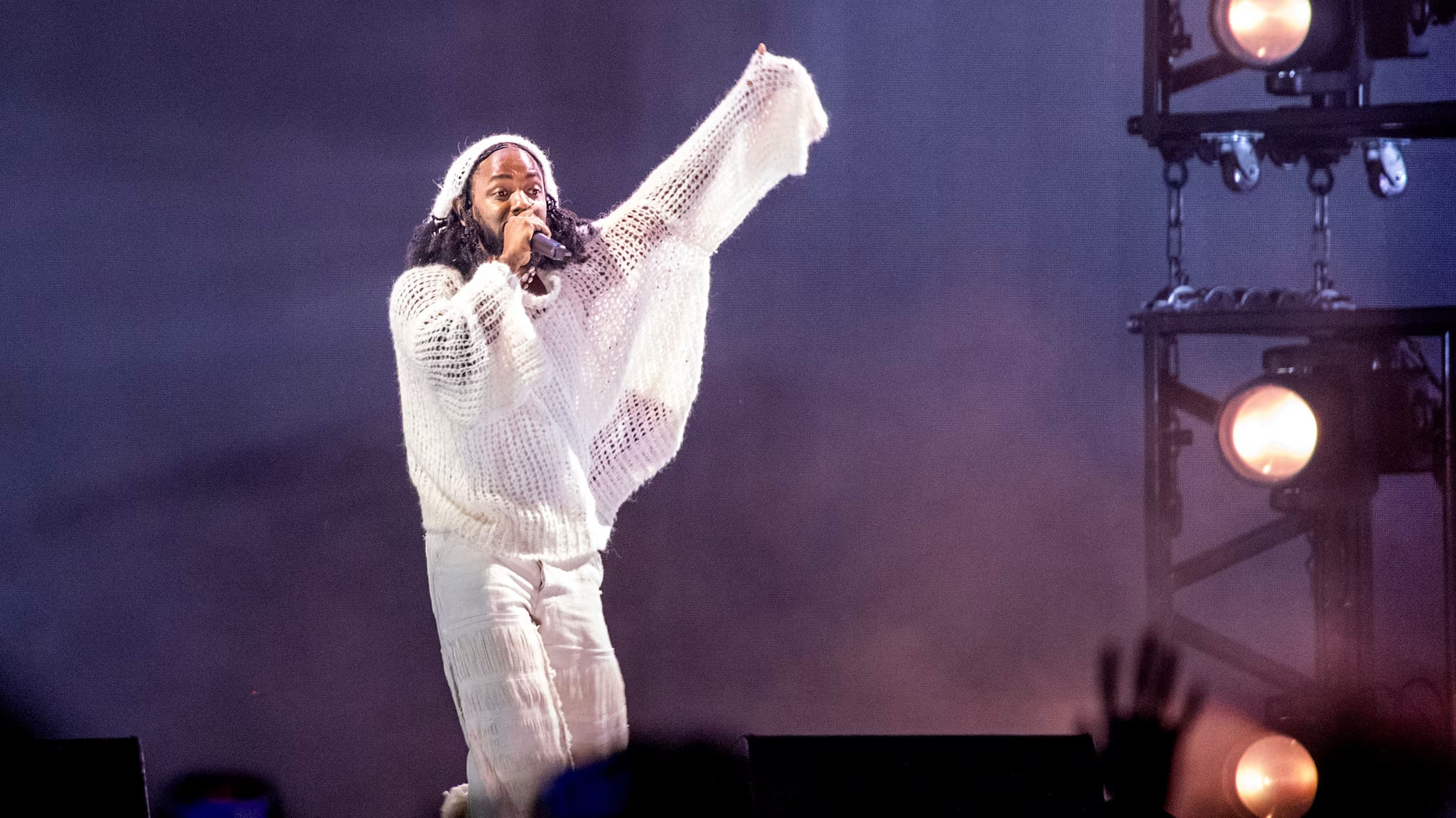
Back in November 2021, Kendrick Lamar made his long-awaited return to the stage as the headliner at the Day N Vegas music festival in Las Vegas. Lamar ran through all of his projects from Section.80 to DAMN. Post-show clips that were peppered across social media timelines show Lamar zombie walking amongst a sea of stagemates in a flowy cream sweater, matching distressed double-knee pants, and a knit beanie drooping off the back of his head. It was a grand re-emergence for Lamar that called for a statement-making outfit. The ensemble wasn’t designed by a big fashion house or a prominent costume designer, though. The entire outfit was constructed by Drew Curry, the 29-year-old behind the fashion line Airei.
The pieces are from the first two collections that Curry ever produced. He was friendly with Taylor Mcneill, who styled Lamar that night, which is how his pieces got to the artist. While he didn’t get a chance to meet Lamar, he is confident they will work together again in the future. “For me, Kendrick Lamar is one of the greatest artists of our time. He’s always been like a superhero,” he says. “It was a completely surreal experience.”
Lamar isn’t the only big name that’s supported Airei in its infancy. Fellow TDE labelmate SZA has worn the brand. Gunna rocked a puffer vest onstage at the BET Awards back in 2021. Bad Bunny wore a full Airei look in his “Lo Siento BB:/” music video. NBA star and tunnel standout Shai Gilgeous-Alexander has repped Airei during his pre-game tunnel walks. And in December, Billie Eilish performed on SNL outfitted in items from Airei’s yet-to-be-released third collection that he just debuted in Paris. He was connected to the pop star through her stylist Amanda Merten, someone he met while working as a salesperson at a Nordstrom in LA a few years prior. Curry says, in most cases, he finds out that someone wears his clothes the same way everyone else does. For instance, he recalls a friend telling him about Gunna wearing the puffer vest he designed as he was watching the performance on television. Most of the time, Airei ends up in the hands of these celebrities just because stylists or celebrities take a liking to the clothing on the sales floor at Dover Street Market, not because Curry is sending it to them.
“It’s cool when somebody we know about buys it, but it’s also great when an art student buys one of the hoodies from Dover,” he says. “I want to create something people enjoy. I just want to give them the best possible thing I can make right now.”
Airei’s latest milestone has nothing to do with a celebrity co-sign, though. This past weekend, Curry presented his Fall/Winter 2022 collection, “Plight,” at Dover Street Market Paris’ 3537 cultural hub during Paris Fashion Week, his first PFW presentation ever. The space has been home to installations including Gucci and Balenciaga’s “Hacker Project” and L’Art de L’Automobile’s Porsche 968 collaboration in the past.
“Paris Fashion Week is always that platform I hoped I would get to,” says Curry. “I definitely did not think that we would do that in our third season.”
Rather than a traditional runway show, Curry opted for a performance art piece titled, “The Case for a Tragic Optimism.” Dressed in a matching cream wool jacket and shorts with a red balaclava covering his face, the designer sat on a wooden bench. Throughout the 30-minute performance soundtracked by his close friend and musician Cashmere Cat, he periodically stood up to cut strings away from a cube-shaped sculpture that housed three mannequins, one of which had red threads pouring from its chest and arms that resembled blood. He also performed a live two-hourlong rendition on Saturday afternoon. The performance was meant to symbolize the development of compassion by going through a difficult experience with others.
“I wanted something to be available for the whole week where people didn’t feel like they had to make it for a certain period of time to be put into a room for eight minutes with a lot of other people. It’s something that people can come and experience and if they wanna stay for two hours, they can. If they wanna be there for five minutes, that’s cool too,” says Curry. “So I wanted to do something that was really creative and new, but also something that kind of took in the reality of our world right now.”
“Plight” is the latest output of what has been a steady progression throughout Airei’s first three collections. Its DNA, an experimental take on items like puffer coats and deconstructed workwear, was established with Airei’s Fall/Winter 2021 collection, “Fulfillment of Cherished Dreams.” The entire range was produced using undyed Khadi, a traditional hand-spun fabric found in India. It also introduced some of the signature elements of Curry’s designs. Raw hems, distressing, and loose threads are meant to nod to human individuality and fragility. Hoodies and jackets feature clusters of threads that form bouquets of flowers or words like “glory.” Curry calls this practice his “ghost stitching.”
The Spring/Summer 2022 collection, “I like America and America Likes Me,” introduced more tailored items like trousers and jackets, crudely knit balaclavas, and hand-knit sweaters that took 23 hours each to complete into the fold. It also broadened the color palette to include more earth tones like brown and grey. With “Plight,” Curry introduces another new layer. Lengthy skirts and jackets that extend above the head are made to represent human restriction. Some pieces will require the wearer to cut away threads from the openings before they can even wear them, adding yet another element of personal connection to each garment. Color is introduced for the first time. Bright red is used on vests and button-ups, while deeper red threading creates a sweater or hangs loose from other garments.
“We included the color red this season, in a really strong way,” says Curry. “The collection is about going into or coming out of this dangerous situation. Red is such a strong color. It’s a color of passion and danger as well.”
Curry’s attention to detail also shines through via the quality of materials he uses to make his garments such as Japanese wool, natural Khadi cotton, recycled Italian cashmere, and Merino wool. Working with high-grade materials like these means his prices may be a bit high for some, $1,250 for a button-up for instance, but Curry is more interested in creating his true vision than sacrificing quality.
“I would much rather make the things I want to make and have to work full time then sacrifice the quality or the creativity just so that I can make money,” says Curry. He says the mindset is something he learned from Rei Kawakubo.
While it may seem like fashion has always been in his life, Curry admits that it wasn’t a big hobby throughout his upbringing in Tacoma, Washington, aside from wearing bright Ice Cream sneakers with his private school uniform to stand out or admiring Lil Wayne and Pharrell’s Bape outfits. Like many, his initial intrigue in fashion came through streetwear. As he got older, he would study Japanese designers like Rei Kawakubo and Yohji Yamamoto. His upbringing still does impact his designs in some ways, though. The workwear influence is a nod to the blue-collar mentality of his hometown and time he spent woodworking with his grandpa while he was growing up.
He didn’t always want to design clothing. After dropping out of the Arizona State University business school, he wanted to pursue another design medium, architecture. He credits a trip to Kolkata, India in 2013 with formulating his approach to design and encouraging him to channel that with his own creative ventures. He was 14 and saw firsthand how resourceful and joyful the people were despite their tough living situations. “It’s very much about using what you have, mixing the elements together,” says Curry. “Aesthetically, that was kind of influential to how I think about design.” He first experimented with cut and sew pieces by making his own versions of kurtas, the traditional men’s attire in India. His job at Dover Street Market LA, where he still works as a manager to help fund his brand, really opened his eyes to the creative opportunities you can have as a fashion designer.
“Dover Street Market unlocked something in me that I didn’t know was possible,” says Curry. “I realized how creative you can be and how you can really have a business from it. I feel like that was the missing element. From then on, I just decided I was going to go for it.”
DSM is currently the exclusive stockist of Airei. He got a spot on the salesfloor when DSM America vice president James Gilchrist saw an early sample of Airei’s first collection that Curry had posted on Instagram. This led to Curry showing the collection to Gilchrist and Dover Street Market CEO Adrian Joffe. Two weeks later, he got word they would be buying it to stock in the New York and Los Angeles locations. The DSM Ginza team liked the collection so much that they agreed to carry it in their location as well.
“I was working at Dover, but I definitely wasn’t pursuing it,” says Curry. “It was only in my wildest dreams that I would be carried there. It was literally a dream come true.”
SSENSE and H.Lorenzo will start carrying the brand later this year. While Curry doesn’t work on the floor of DSM Los Angeles where Airei is displayed, he told his co-workers not to mention that someone who works there designs it. He describes the excitement of seeing shoppers genuinely intrigued by his designs: “When I do walk by and I see a group of friends geeking out over it, that’s an amazing experience,” says Curry. “I can explain it to them without telling them it’s by me and seeing their real reactions.”
He is OK with taking things slow, though. Although accomplishments are mounting for Curry’s Airei in such a short amount of time, he says that his goal, at least right now, isn’t related to money or instant success. He considers his pieces art. He just wants to bring his vision to the world and let Airei grow organically.
“So many brands do ‘perfect’ really well. I just don’t want to do that. I don’t find that as interesting,” says Curry. “There’s something about fashion that maybe masks our experience. And I kind of want to highlight those experiences as opposed to hiding them.”




