Image via Supreme
Yes, it’s that time of the year again. Last week, Supreme unveiled its preview and lookbook for its Fall/Winter 2022 season. As always, a peek at what Supreme has in store in the coming months has already created a frenzy amongst hypebeasts and fans of the beloved New York City clothing label. Resellers were working overtime and peeling off André 3000 posters to flip on Grailed before Supreme officially opened its doors last Thursday. Others are more excited to see the very first offerings from Supreme’s new creative director Tremaine Emory, whose first pieces for the brand arrive this season before his first full collection next spring.
As always, Supreme has delivered more of what it’s usually known for. There are odd accessories, bizarre food collaborations, commissioned graphics by rising underground artists, surprising brand collaborations, and the return of more sought after box logos. Season after season, Supreme proves their formula works and it never gets stale. But after taking a look at the brand’s newest offering this season, there’s certainly a lot to unpack here. Here are some of our initial takeaways from Supreme’s Fall/Winter 2022 collection.
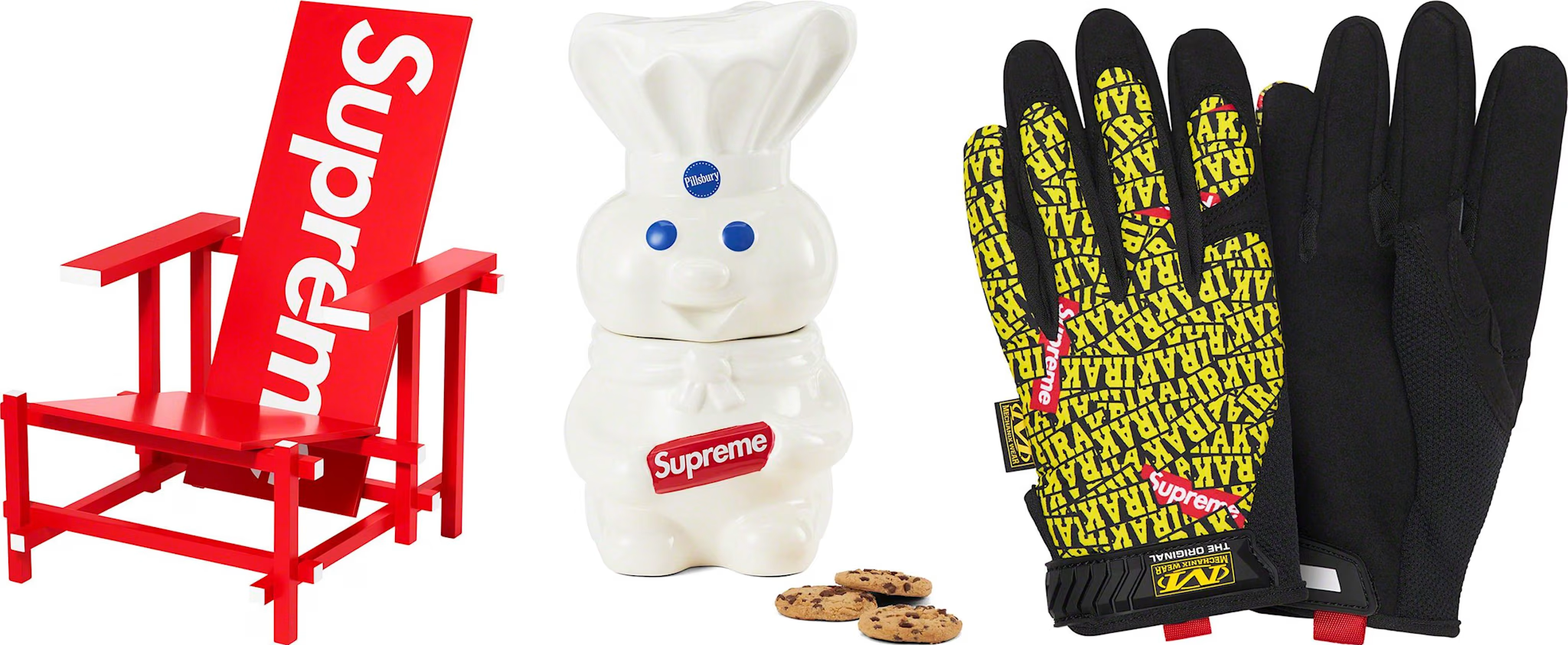
Supreme Figured Out a Food Collaboration That Makes Sense With Pillsbury
Budweiser, White Castle, Oreos, Skittles, Wheaties, and Kraft Macaroni & Cheese, are just some of the major food brands that have teamed up with Supreme in the past. While many of these Supreme collaborations have managed to make headlines—never forget the ridiculous news stories about the high resale value of Supreme Oreos—none of these collaborations ever felt in step with the rest of the brand’s collection. Aside from their collaboration with Skittles, which referenced the candy brand’s NASCAR sponsorships for collaborative racing-inspired apparel, the garments that come out of some of these collaborative food ventures usually fall flat. But there’s something about Supreme’s collaboration with Poppin’ Fresh, the mascot that’s more widely known as the Pillsbury Doughboy, that feels apt for Supreme’s reinterpretation.
Simply put, Poppin’ Fresh is one of the hardest mascots ever conceived by an advertising company. That’s why your mom has a Doughboy shaped cookie jar in her kitchen and why French Montana rocks an iced out Doughboy chain. Streetwear parodies of the past have shown us some rugged interpretations of this classic American mascot, which likely informed Supreme’s own collaborative apparel.
Poppin Fresh’ even has some historic significance within skateboarding. When skateboarder Alphonzo Rawls was first sponsored by H-Street in the ‘80s, one of the very first graphics he ever drew was a Pillsbury Doughboy for his own personal pro board. Naturally, skate decks featuring the Doughboy are a part of Supreme’s collaboration with Pillsbury. While we’ll never exactly know why Supreme pursues these collaborations with food brands (is it some form of streetwear native advertising or just Supreme trying to put their name on anything out there?), this Pillsbury collaboration will definitely be remembered in years to come.
The Cassina Gerrit T. Rietveld Chair Shows Supreme’s Great Taste In Furniture
One of the most striking accessories from Supreme’s latest season is a bold and abstract red chair by Cassina that utilizes Supreme’s box logo as a backrest. High-end furniture collaborations are nothing new for Supreme. In the past, the label has released Aalto stools and Wassily chairs with Knoll, Panton chairs with Vitra, and Pila chairs with Anonima Castelli.
This season, Supreme teamed up with Cassina to produce a special version of Gerrit T. Rietveld’s iconic “Red and Blue” chair. The chair was originally designed by the Dutch furniture designer and architect in 1918. According to the Museum of Modern Art, the name is derived from a 1923 iteration of the chair that applied the primary colors associated with the Dutch de Stijl art and architecture movement that Piet Mondrian founded. Rietveld’s simple yet abstract construction for the chair came from a desire to see it be mass-produced rather than handcrafted. Today, professionally made Red and Blue chairs cost thousands and vintage ones have sold for over $10,000 at auction. It’s a true statement piece and shows Supreme’s commitment to highlighting great furniture. For those looking for a cheaper option though, it’s possible to make your own by following blueprints or buying a kit. Yes, you can paint it red and just screenprint that Supreme logo as well if you’re so inclined.
Supreme Digs Into New York City History With Their “Trash” T-shirt and Skate Deck
One of the oddest items to appear in Supreme’s latest collection is a T-shirt and skate deck that features a photo of the Statue of Liberty overlooking a giant mound of trash with a plastic Supreme bag sitting in it. While haters will say that this is an apt metaphor for what the brand has become today, there’s more to this photo that meets the eye.
This “trash” photo was taken by a photographer named Louie Psihoyos, an award-winning photographer whose images graced National Geographic throughout the ‘80s and ‘90s. In recent years, he’s directed critically acclaimed documentaries such as The Cove, which won an Academy Award for Best Documentary Feature in 2010.
The photo Supreme used came from an series of photos Psihoyos took for National Geographic of the infamous Fresh Kills Landfill in Staten Island, where New York City’s trash was collected from 1948 to 2001. According to New York City’s Parks Department, it was considered the largest landfill in the world by 1955. In a caption Psihoyos wrote on his website, he said he shot the photo while he was on one of the barges that used to transport 20,000 tons of garbage out of New York City every day.
“Getting the pile of trash with the city in the background would be a powerful juxtaposition,” Psihoyos wrote on his website. “When I noticed the plastic American flag banner just as we were drifting by the Statue of Liberty, I quickly climbed onto the revolting refuse and snapped about 10 pictures before we sailed out of range.” Psihoyos also noted that after these photos were published, barges had to be covered with giant nets so that trash wouldn’t blow into the water. Since Fresh Kills closed two decades ago, it has been redesigned to become a 2,200 acre park that’s envisioned to be three times the size of Manhattan’s Central Park. It’s set to be the largest park developed in New York City in over a century and is still under construction today. While we’ll never know why Supreme was drawn to this specific photo, they certainly selected a visually striking image that uncovers an interesting tidbit about New York City’s past.
Supreme Co-signs “Anti-Style” Graffiti With a Wombat ICBM T-shirt
Supreme has always supported rising underground artists. In recent years they’ve frequently tapped into the psychedelic aesthetic of Shaun Crawford, commissioned the New York City-based artist Shana Sadeghi-Ray to make T-shirt graphics, and forefronted the work of Arvid Logan’s label Bugsex for a Junya Watanabe collaboration. Never forget that long before Chito became Matthew M. Williams’ graffiti muse at Givenchy, he lent his aerosol art skills to Supreme for some of their best pieces in recent years. While this season was filled with great art collaborations, the most striking one was a T-shirt made by an artist who goes by the name of Wombat.
Anyone who’s interested in New York City graffiti is aware of Wombat and the ICBM crew. In recent months, Wombat has managed to completely blanket New York City’s rooftops with their uniquely messy graffiti. The “Wombat” T-shirt Supreme released this Thursday is emblematic of their work, which features Supreme written in a punk-inspired style that defies nearly all the conventions of traditional graffiti. Wombat’s work has become the subject of many recent conversations online regarding the growth of what’s dubbed as “Anti-Style,” a subgenre of graffiti that garnered controversy amongst graffiti enthusiasts. The schism is split between two camps. One side of purists believes Anti-Style is the absolute worst of graffiti because it completely dismisses the basic elements of what’s traditionally been considered good graffiti. This side of the debate believes that Anti-Style writers do not uphold any sense of uniformity, proportion, or tradition associated with long-established regional graffiti styles. Others embrace Anti-Style writers for giving a fresh new take on graffiti that doesn’t fall on cliche tropes or lean too heavily on nostalgic graffiti styles of the past. Although it looks bad and completely disgraceful to some hardcore graffiti heads, others find the output of writers like Wombat to be compelling and intriguing. As highlighted in a recent Baffler piece on Dimes Square, it’s undeniable that Wombat is “getting up” in trendier parts of New York City right now.
Wombat admitted in a recent interview for Tattoo Punk Fanzine that they are indeed bad at graffiti and never really identified with traditional graffiti. “I mean I love rap, and I like hip-hop graffiti now that I am kind of older and can appreciate it more, but I was a dirty, ugly punk kid and I wanted to do graff that reflected that, you know?” they told the zine. “I never wanted to be good at graffiti or tried to be. So it just looks how it looks and I like it. And, some people like it and some people hate it, and that shit’s tight too.”
While Complex is going to remain neutral on deciding whether Wombat’s graffiti is good or not, Wombat’s collaborative T-shirt with the brand shows Supreme is still paying close attention to what’s going on in the streets of New York City today. It’s also a surprising co-sign to see when considering that most of Supreme’s past graffiti collaborations have highlighted artists with more history in the game. Graffiti is an ephemeral artform and no one stays on top forever. So only time will tell how this T-shirt with Wombat will age.
The Great Photographer Behind The André 3000 Photo T-shirt
The photographer behind the already iconic André 3000 photo T-shirt is the acclaimed Black imagemaker Deana Lawson, who recently became the first photographer to ever win the Guggenheim Museum’s prestigious Hugo Boss Prize in 2020. Lawson is currently a photography professor at Princeton whose work has also been exhibited at museums like the Modern Museum of Art and the Art Institute of Chicago. A good and popular representation of her work is the cover of Blood Orange’s Freetown Sound, which featured Lawson’s 2009 work “Binky and Tony Forever.” Lawson is known for compelling intimate portraiture centered around Black life and culture. “A lot of my work is about what I don’t see in popular media culture, and to me I felt like I needed to make an image that was about embracing and intimacy and support, physically, between young people, particularly young black people,” Lawson told Fader about the photograph Dev Hynes used for Freetown Sound. Alongside Lawson, Emory also revealed that Will Perkins, Eric McNeal, Atiba Jefferson, and Issac “West” Rubenstein were also behind the shoot.
Photographers like Kenneth Cappello and Shaniqwa Jarvis, have been frequently commissioned to shoot some of the most memorable photo Supreme T-shirts. Lawson being commissioned as a new photographer for Supreme doesn’t just deliver a fresh new perspective, but also introduces her incredible artwork to a new audience, which is why this photo T-shirt is one of major highlights this season. Those located in New York City still have a couple days to stop by her first museum survey at MoMa PS1 in Queens, which runs until Sept. 5 this year.
They’ve Stepped Their Denim Up This Season
Hardcore fans of Supreme will always emphasize that there’s more to the label than graphic T-shirts and hoodies. Since its earliest years, Supreme has always tried to go above and beyond when it comes to cut and sew apparel. This season, they came correct with mohair knit sweaters featuring rockets, moleskin work jackets, cowichan box logo sweaters handknit in Canada, and more. But in regards to cut and sew, what really stands out this season is their denim range. This season includes one of Supreme’s best Vanson collaborations yet, which is centered on denim reinterpretations of their classic motorcycle jackets. Meanwhile an upcoming collaboration with the British label Griffin employs their blade cut construction to pairs of Supreme’s five-pocket jeans for an eye-catching distressed look. Two-tone paneled denim jackets and pants, double-knee painter pants with script logo embroidery, and layered jeans reminiscent of ones made by Japan’s Hysteric Glamor are also a part of Supreme’s impressive denim ensemble this season. Yes, there’s even another collaboration with True Religion coming this season. This is definitely the season to pick a pair of Supreme jeans up if you haven’t already.
Supreme’s Collab With The Great China Wall Leans Heavily Into 2000s Nostalgia
Supreme is known for its left field collaborations and their partnership with a label called The Great China Wall’ is certainly one of them. For clarity, The Great China Wall has absolutely nothing to do with Chinese culture, but it has everything to do with 2000s fashion trends that would have likely been forgotten about forever if Supreme didn’t revisit them. According to California Apparel News, The Great China Wall was a California-based label founded by Alfredo Settimio in 2000. The brand’s motifs included Chinese characters, hand-painted graphics inspired by 1940s warbirds, and Swarovski crystals placed on garments inspired by vintage Vietnam War-era military fatigues. During its heyday, the price point for The Great China Wall ranged from $500 for a hoodie to up to $3,000 for a jacket. It was reportedly stocked in 160 boutiques across the world and grew to $7 million in sales by 2006. Celebrities such as Jessica Simpson and Juelz Santana heavily co-signed the label, with Santana even saying on an old song with Lil Wayne: “Swarovski crystals, Great China Wall,/And my money run longer than the Great China Wall.”
According to one boutique owner quoted in the article, many imitated the style of The Great China Wall during its heyday and the brand was supposedly one of the first labels to make cargo pants embroidered with skulls. Supreme wasn’t the only label to tap into this forgotten 2000s label for nostalgic play. Earlier this year, Mike Amiri teamed up with Settimio—whose label is now officially named Great City Workshop—for a special capsule collection of upcycled goods.
Irak Finally Got a Proper Supreme Collaboration
Fans of Supreme are likely familiar with three artists the label has collaborated with many times over the years. The late Dash Snow, Kunle Martins, and Ben Solomon, who are all members of the prolific New York City graffiti crew Irak. In 2016, Supreme collaborated with Snow’s estate to release a set of skateboard decks and a T-shirt that referenced one piece within a collection of 20 tabloid newspaper cutouts of Saddam Hussein. In 2021, Supreme’s collaboration with Dan Colen included the release of apparel that featured Colen’s own re-creation of Snow’s apartment wall.
And last season, they even released a special printed top that featured a photo of the rebellious Downtown New York artist taken by Alain Levitt. Martins’ “Earsnot” tags have become a permanent part of the interior design of Supreme’s retail stores across the world and his impeccable handstyle has also graced major collaborations such as the apparel for their Fall/Winter 2018 partnership with Comme des Garçons Shirt.
Solomon has directed a number of Supreme’s most memorable video campaigns since 2011, which includes videos featuring Prodigy of Mobb Deep and their recent commercial with Slick Rick. Despite Supreme’s long relationship with various members of this prolific New York City graffiti crew, there’s never been a proper Supreme Irak collaboration until this season. While that’s likely due to the Irak clothing brand originally being stocked in Alife during the 2000s, it’s refreshing to see that the crew finally teamed up with Supreme on a great range of products, which includes a trucker hat with an silver Irak tag written across the front alongside hoodies, gloves, and balaclava decked out in Irak and Supreme box logos. Fingers crossed that there are more products to come with this collaboration. However, it’s clear that Irak has already made their mark on Supreme long before this official partnership.
The Rare Teal Box Logo Finally Returns As a Crewneck
Yes, it’s still quite funny to think that one of Supreme’s simplest pieces of apparel will always be its most coveted every season. We don’t have to spell out what a Supreme box logo is and there’s nothing that unique about the new box logo crewneck sweatshirts arriving this season. However, the preview did reveal one interesting colorway hidden within the rack, which is a red on teal box logo. Many of the most-coveted Supreme box logos that sell for over $1,000 on secondhand marketplaces like Grailed are typically rarer ones that haven’t been released in years, such as Supreme’s collaborative box logo with A Bathing Ape or the 1999 “Jackson Pollack” box logo. But some of the most highly coveted box logos are just colorways that were worn by Tyler, The Creator, who popularized many of these specific pieces during his early years of stardom as a member of the rap crew Odd Future. This specific box logo colorway was originally released as a hoodie in 2009 and prominently worn by Tyler in the 2011 music video for “She.” In recent years, the hoodie has been sold for as much as $3,910 on Grailed and the cheapest one currently listed is asking for $1,312. While it’s obviously not the exact box logo piece Tyler wore, it’s close enough. Many Odd Future stans will likely have to scoop this up just to restore the feeling.
The Irony of Supreme’s Ty Beanie Babies
Last Thursday, Supreme dropped Supreme Ty Beanie Babies for $18 that were decked out in an American flag pattern reminiscent of Supreme’s coveted flag box logo hoodie from their Fall/Winter 2014 collection. It naturally became one of the most hyped products to drop on the first week of the season and sold out instantly. In less than a day, over 30 listings for this Beanie Baby popped up on Grailed and 160 of them were resold on StockX for an average price of $45 each. It doesn’t take much math to realize that the profit early resellers made off these could barely buy dinner for two at Chipotle after shipping and taxes. But that’s what makes the Supreme Beanie Baby one of the most clever accessories released by the brand this season, especially if you’re aware of Ty Beanie Babies’ own history as a coveted collector’s item.
Like Supreme, Ty Beanie Babies were ravenously collected by enthusiasts because of its scarcity. During the toy’s most popular years in the ‘90s, collectors paid as much as $5,000 for rare plushies like Peanut the Elephant. Ty Warner, the creator of Beanie Babies designed the toys to be limited by retiring certain plushies after they were released. Once they disappeared from stores, collectors chased them down and were willing to pay high resale prices for them. According to a report from The New York Times, the thirst for Beanie Babies led to mass counterfeiting and scams where unsuspecting collectors lost thousands of dollars during the toy’s heyday. As reported by Vox, while there are plenty of avid Beanie Baby collectors out there today, the hype bubble it had eventually burst and their resale value is questionable today.
Supreme’s hyped releases aren’t too different from Ty Beanie Babies especially amongst prospective entrepreneurs. While some items definitely do stand the test of time and become worthy investments that fetch high resale prices, a good number of the brand’s recent sold-out releases don’t exactly garner much profit. For example, a “Bling” box logo hoodie that sold out instantly last season can be purchased on StockX for a little over $20-$30 above retail. The release of a Ty Beanie Baby as an accessory this season almost feels like a subtle snub from Supreme to resellers, who hoard and flip scarce Supreme items that may not be as valuable as they seem to believe.




