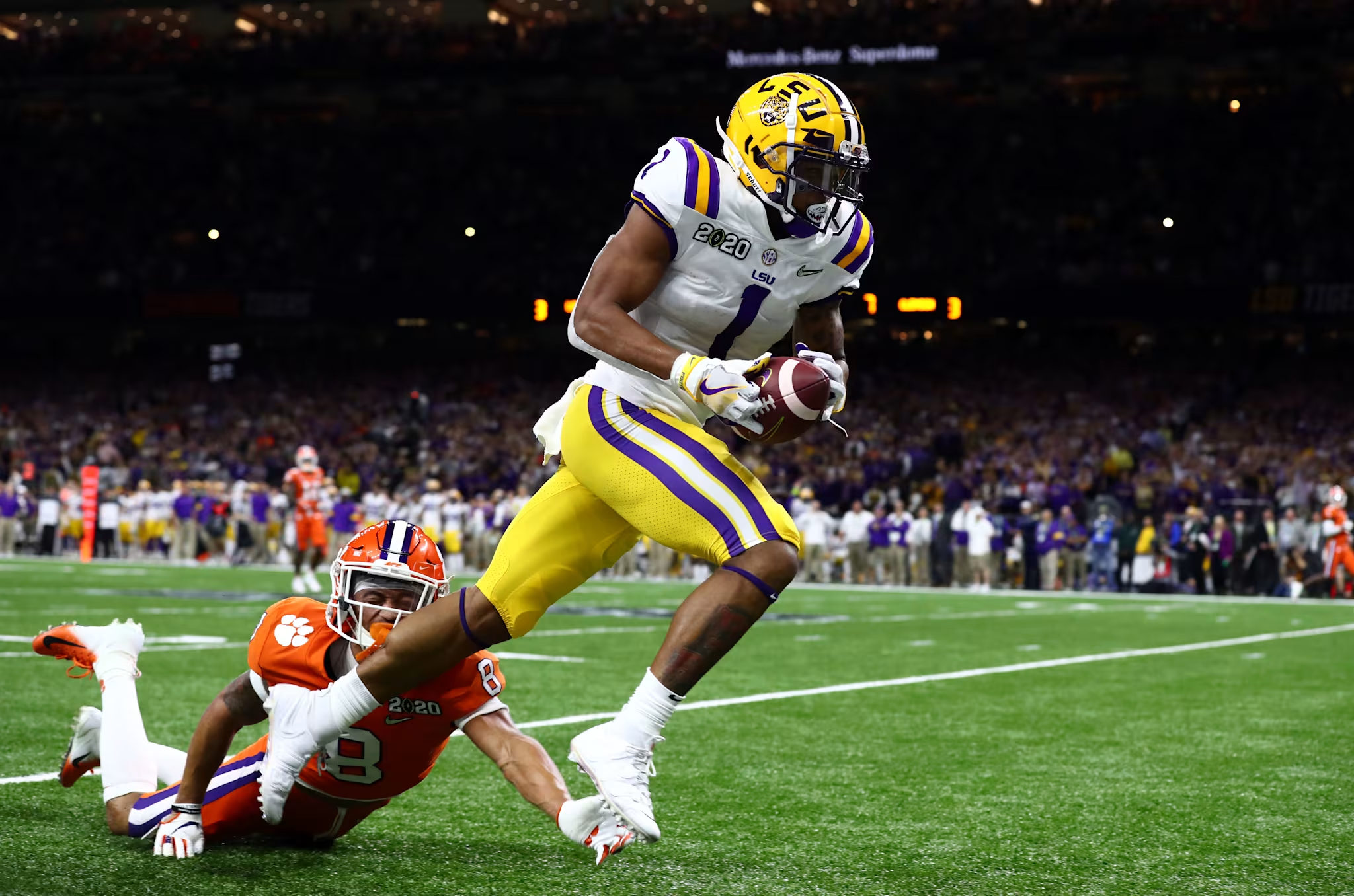
Jan 13, 2020; New Orleans, Louisiana, USA; LSU Tigers wide receiver Ja'Marr Chase (1) scores a touchdown past defender Clemson Tigers cornerback A.J. Terrell (8) during the first half in the College Football Playoff national championship game at Mercedes-Benz Superdome. Mandatory Credit: Matthew Emmons-USA TODAY Sports
The prospects atop our NFL mock drafts have been household names for months, and will be picked apart to death before the end of April when the draft finally arrives. But these players can ball, and feature special traits that allowed them to dominate at the collegiate level. The difficulty in evaluating them is whether those traits are strong enough to elevate above their competition in the NFL.
Comparisons are hard because usage is affected by many outside factors. We’ve already covered the best comparisons for the top prospects but now we’ll look at the worst case. Where a player is drafted matters, and there’s a slew of factors that lead to letdown careers.
Trevor Lawrence, Clemson
Worst case comparison: Ryan Tannehill
Crowned as a generational talent before he even played for Clemson, Lawrence is used to feeling the pressure of expectation. He delivered for the Tigers—three playoff appearances and one national championship. His illustrious career has slated him to be Urban Meyer’s top overall pick to Jacksonville and for good reason.
For all of Lawrence’s immense physical tools and accuracy, there’s a worst-case for how his career will turn out. He needs good weapons around him, and isn’t used to playing with a porous offensive line and mediocre receivers. Jacksonville has some good pieces but it’s not as if they’re loaded with bonafide stars that’ll keep Lawrence clean in the pocket and amazing receivers who get open in two seconds.
The worst case is new offensive coordinator Darrell Bevell under-utilizing Lawrence like he did Russell Wilson, and the offense not highlighting receiver DJ Chark enough. As well as Tannehill has played for the Titans, his career didn’t fully blossom in Miami because he rarely had decent protection or quality receivers. Lawrence is a great talent, but an inefficient scheme and mediocre surrounding cast can easily limit his output if he’s not a destined Hall-of-Fame player.
Zach Wilson, BYU
Worst case comparison: Drew Lock
The BYU breakout star is a difficult projection and comparison. While he dominated his competition this year, the only team that played Wilson physically was the team that stifled him. Coastal Carolina may have exposed Wilson’s bad habits of breaking clean pockets, struggles reading beyond his first read, and his inconsistent mechanics.
Spread quarterbacks are more common now and the NFL helps ease their transition better than ever, but there’s still a point in the developmental curve that requires a big jump. Wilson has all of the physical tools, but if his mental processing doesn’t improve and his footwork remains shoddy, he will be more of a tease than a consistent producer.
Denver’s Lock has quickly gone from potential star to being replaced because his arc for growth was stifled as complex defenses gave him nightmares in 2020. Wilson will be given more leash because he’ll be drafted higher, but he has as much potential downside as upside.
Justin Fields, Ohio State
Worst case comparison: mobile Jared Goff
There’s no question that the limited number of games this past season made evaluating certain players more difficult. While some players had more than 10 to work out issues and improve, others like Fields didn’t benefit from the extra time with new teammates. Fields suffered from the lack of chemistry and time with young receivers and his stock has suffered a bit.
While Fields has immense physical talent and excellent accuracy to all levels, there are some concerning traits that he shares with average NFL pocket passers. Fields doesn’t have tremendous feel in the pocket and will stand inside too long while waiting for routes to develop. This has led to drive-ending sacks and frustrating missed opportunities.
Having to create out of the system and out of rhythm has been difficult for many NFL quarterbacks, and Fields must be able to perform well in both situations. We saw flashes of it at Ohio State but we also saw it from Goff while at Cal. Goff thus far hasn’t been efficient against pressure, and is purely a rhythmic passer, which limits what his offenses can achieve.
Trey Lance, North Dakota State
Worst case comparison: early career Josh Allen
Trying to find a comparison for such a unique quarterback is difficult. Lance was supremely productive at North Dakota State and has immense physical traits. He’s a powerful and fast runner, with a strong arm and thick frame that projects to have a limitless upside.
However, Lance’s film is littered with easy misses, sloppy footwork, and few instances of playmaking with his arm outside of the scheme. He had it easy with the Bison, and the jump in competition will be sharp. His small sample size of film is extraordinarily risky for any team that expects him to play before 2022 at the earliest.
The best case might be a transformative face of the franchise, but the worst-case is terrifying too. We saw Allen take a big leap in 2020 from a very poor first two seasons and that arc is the expected road for the team that lands Lance. How Lance recovers and adjusts from those bumps in the road will be the critical fork in his career path.
Mac Jones, Alabama
Worst case comparison: Mason Rudolph
Another quarterback with less than two years of starting experience, Alabama’s Jones looks like the big winner from getting hot at the right time. Jones was incredibly productive for the Crimson Tide and contributed to one of the most dominant offenses we’ve ever seen. However, teams must overlook some of the numbers to see a flawed physical skill set and concerning upside.
Jones often relied upon his incredible supporting cast to do the heavy-lifting and it’s hard to be a long-term starter in the NFL with that tendency. His arm is mediocre compared to peers, and his receivers often had to adjust to passes behind them or lower than what would’ve maximized their yards after the catch.
Everything in Jones’s process must speed up for him to avoid being relegated to a backup. His post-snap adjustments are lacking and he has to be great at reading defender’s leverage to avoid cumbersome interception numbers that come with a lacking arm. If he can’t, his role will quickly be settled on as a backup-caliber option.
DeVonta Smith, Alabama
Worst case comparison: Tyler Lockett
Sometimes a player comes around that’s built to become the exception to the rule, and Smith is trying to overcome one of the slightest frames we’ve seen enter the NFL at the position. Smith blossomed over his last two seasons at Alabama to win the Heisman Trophy and figures to be a top 10 pick. However, his thin build pits him among few NFL successes when it comes to Body Mass Index.
It’s hard to imagine Smith not being a quality receiver despite his physical comparisons rivaling former Eagles first-round bust Freddie Mitchell more than any Pro Bowl receiver. His speed and quickness devastated almost every opponent he played in college, and he showed special playmaking with the ball in his hands. The worst-case can’t be that he’s an outright bad player at the next level.
One of the smaller receivers who’s produced consecutive 1,000-yard seasons and 37 career touchdowns is a good comparison. Lockett is a quality No. 2 receiver in Seattle, and is capable of game-changing plays at any moment. Smith has the same size limitation as Lockett, but also the ability to overtake a game with his skill set.
Jaylen Waddle, Alabama
Worst case comparison: Cordarrelle Patterson
The receiver with the highest upside in the class is Waddle. Waddle has more than a few executives and high-level scouts in his corner as the best receiver in the class despite missing time at Alabama and his teammate winning the Heisman. Waddle looks eerily similar to Stefon Diggs.
But Waddle is a lean speedster and there’s been plenty of explosive talents who couldn’t consistently make an offensive impact in the NFL. Waddle has better route-running than his worst-case scenario of Patterson, but Patterson was a similarly-dynamic and dominant presence in college. Eventually his lack of physicality as a receiver led him to be a special teamer and tease at receiver.
Waddle’s toughness, route-running and ability to win one-on-one will make or break his enormous upside more than anything else. He can become an All-Pro or a footnote in history as a top 12 pick this April depending on where his development takes him.
Ja'Marr Chase, LSU
Worst case comparison: Kenny Stills
Some of the most productive offensive playmakers have good size, speed and quickness but weren’t the freakiest athletes at the combine. The right blend of the football skill and those traits make the best players, but sometimes the gap between collegiate and NFL competition is too much for average athletes.
Few would say that LSU’s Chase is an average athlete, but he’s also not Julio Jones. His size and speed fall into a large bucket of good or lesser players, meaning he has to win in the margins at the next level to be a star. Worst-case, he’ll be another solid but unspectacular talent because he’s not the fastest, quickest or biggest receiver.
Chase has shown the ability to win over the top as a deep threat and also as a creative runner with the ball in his hands. Sometimes he has to be schemed open, though, making his upside dependent on usage and fit with an accurate quarterback. Going to the wrong situation and offense will stifle Chase’s impact more than some of the other top receivers in the class.
Kyle Pitts, Florida
Worst case comparison: David Njoku
The runaway winner of the John Mackey Award for being the best tight end in the country, Pitts has an argument for being the best overall playmaking prospect in this class. His blend of size, speed, hand strength, and route-running is already comparable to standout receivers and tight ends at the next level. He can be a Pro Bowl-caliber or better talent in the NFL.
Tight ends are rarely a sure thing, though. The position is a slow-developing one since few offenses really utilize the athletes they have available, and nuance is extremely important for the bigger-bodied receivers. We’ve seen numerous standout pass catchers at tight end take more time than expected to become consistent contributors.
Njoku is a good player when healthy, but hasn’t been an impactful player for Cleveland outside of his sophomore season. Pitts has more wiggle than Njoku in his route-running, but being reliant on winning jump balls doesn’t always translate. If Pitts can’t win at the catch point as often as he did in college, he could become a tantalizing player who hasn’t fully maximize the physical promise he has like Njoku.
Micah Parsons, LB
Worst case comparison: Myles Jack
Being a versatile player can be a negative if a coaching staff doesn’t properly identify the most valuable usage of a skill set. The Penn State defender has spent time as an off-ball linebacker and edge rusher, and his best value in the NFL is off the edge. His speed, strength, and size projects well as a well-balanced force.
However, he needs time to improve his hand usage and get more experienced at handling talented blockers. It’ll take experience and rough patches. And in the meantime, a coaching staff can’t panic and move him to middle linebacker to get production out of him.
We saw the Jaguars do this with Jack. Jack is a great athlete but plays better with a defined role over the freedom that middle linebacker calls for. Parsons must be in his most comfortable spot, which is coming off the edge and not in the middle of a defense trying to read keys that he’s unfamiliar with.




