Image via Getty/Rocky Widner
Spoiler: The Knicks only made this list once.
It seems as though the easiest route to becoming a multi-millionaire in America today is to have one halfway-decent season in the NBA ahead of free agency. Or at least that’s how things have gone over the last two seasons, which have seen lackluster guys in the game like George Hill, Ian Mahinmi, and Evan Turner get paid like stars. These contracts could have made them the highest-paid players in the Association back in the ’90s, despite the fact that they are only marginally impactful players at best.
And those kinds of NBA player salaries are only going to grow more common in the coming years. With the new CBA kicking in this season, player salaries are going to rise along with a salary cap that’s shot up exponentially over the last 20 years. The cap is at $99 million this season — up from a mere $34 million in 1999-00 and $57.7 million in 2009-10. That’s a pretty sharp increase over a relatively short period of time.
Having a cap that allows these kinds of contracts means that the NBA has a high percentage of players who most would consider “overpaid,” undeserving of the dollars they're receiving—far more than the NFL or MLB. Since revenue is divided into two pools, the players’ pool and the owners’ pool, and since the NBA has fewer players in the league than any other sport, they are naturally going to get a bigger share of the cash.
But some guys are just plain overpaid — not by virtue of a CBA that benefits so-so players, but by the ineptitude of teams (usually the Lakers) or simply by virtue of injuries and age catching up to a once-great star. It was unsightly to see Kobe Bryant play as poorly as he did his last two seasons, and the Lakers probably weren’t thrilled by the fact that they had to pay him over $48 million total for that time, either.
With that in mind, let’s take a look at the most overpaid players in the NBA.
Tim Duncan
Team: Spurs
2017-18 stats: N/A
Salary: $1.8 million
Imagine making $1.8 million a year by doing literally nothing.
That’s what Tim Duncan did last season, it’s what he’s doing this season, and it’s what he’ll be doing again next season. Duncan retired with one year and $6.3 million left on his final contract, so a buyout agreement between him and the Spurs calls for him to make $1.8 million a year through 2019. Given what the Spurs got out of Duncan for 20 seasons, it’s hard to say that he didn’t earn a couple extra million as a “thank you” from the team. The same can’t be said of other buyout structures in other sports. Take Bobby Bonilla’s deal with the Mets, for example: He’s getting paid $1.1 million a year through 2035, and hasn’t played for them since 1999.
Paul Millsap
Team: Nuggets
2017-18 stats: 15.3 PPG, 6.3 RPG, 3.0 APG
Salary: $30.7 million
There are only three players in the NBA making over $30 million this season: Steph Curry, LeBron James and Paul Millsap.
One of these things is not like the others.
Unlike most players on this list, Millsap is a solid player. He was averaging 15.3 points and 6.3 rebounds this year for the Nuggets, before suffering a wrist injury in November. His acquisition made Denver a much more formidable team. But it’s impossible to make the case that he’s in the same league as Steph and LeBron, and the fact that he’s receiving a similar payday is just absurd.
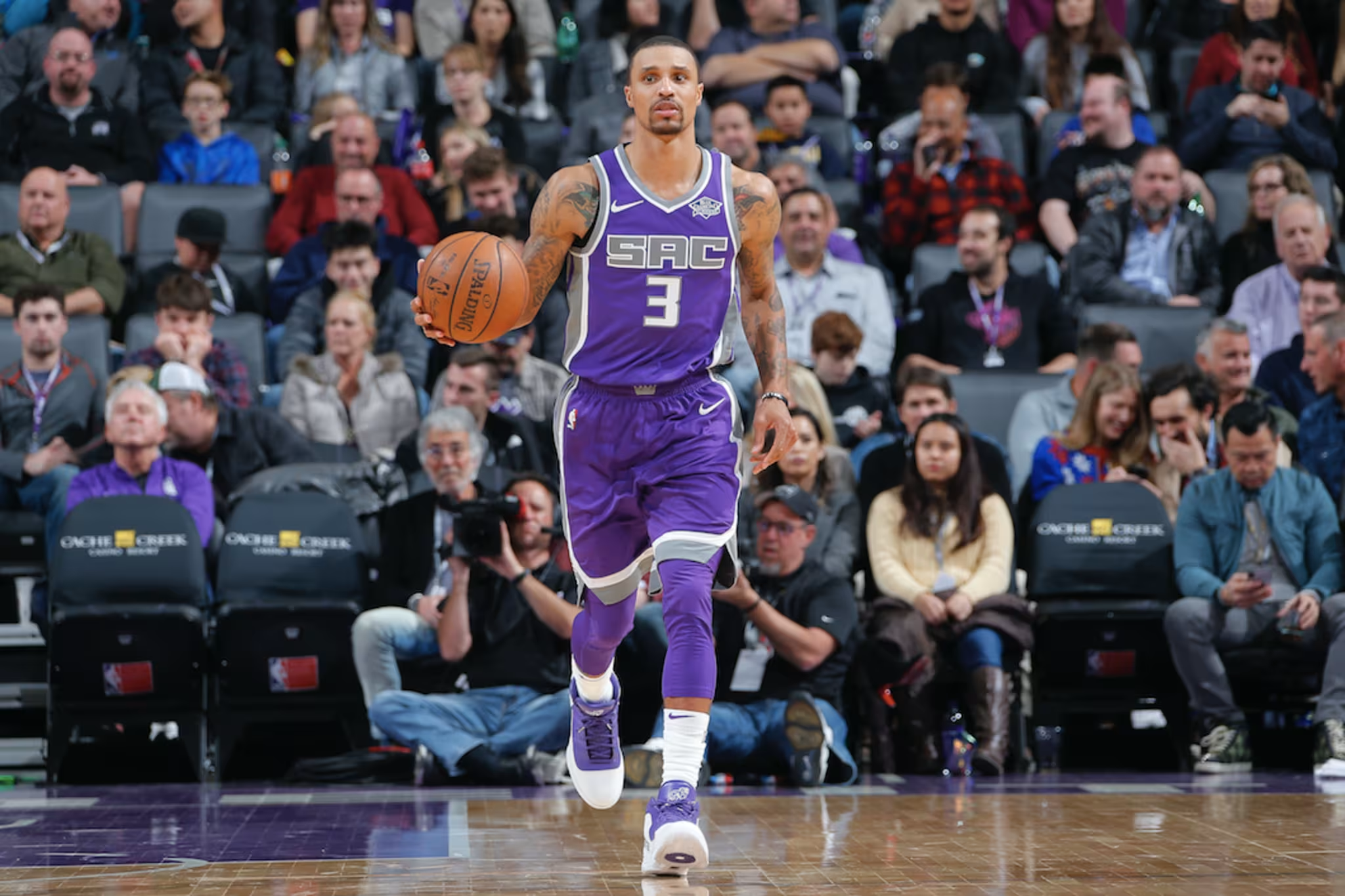
George Hill
Team: Kings
2017-18 stats: 10.1 PPG, 3.0 RPG, 2.7 APG
Salary: $20 million
Hill has been a solid player for the better part of a decade. He’s consistently averaged double figures and plays solid defense. His lifetime averages of 11.7 points, 3.2 rebounds and 3.3 assists would indicate how solid he has been, especially during successful playoff runs in San Antonio, Indiana and Utah.
In no world, however, is Hill worth $20 million a year. But that’s what he’s making this year to play with the Kings. The ten-year vet inked a three-year, $57 million deal last offseason to take his talents to Sacramento. And now that he’s with the Kings, he’s starting to play like one too: Hill is averaging under double figures for the first time since the 2011-12 season.
Allen Crabbe
Team: Nets
2017-18 stats: 11.6 PPG, 3.8 RPG, 4.3 APG
Salary: $19.3 million
Crabbe is a solid role player. A solid role player who makes more than superstars Kyrie Irving, Jimmy Butler, Kawhi Leonard and John Wall. After barely playing during his first two seasons, Crabbe had a breakout 2016 season in which he shot .459 from the field and .393 from three-point range, as he became a restricted free agent. The Nets—in their eternal wisdom—offered him a four-year, $75 million offer sheet.
It’s reasonable to see the Nets making a deal like this, since they have no high draft picks until 2019 and a roster chock full of what Stephen A. Smith would call “bonafide scrubs.” But the Blazers shockingly matched this deal—and then traded him to the Nets this season, where Crabbe actually starts.
Evan Turner
Team: Trail Blazers
2017-18 stats: 8.4 PPG, 3.8 RPG, 2.4 APG
Salary: $17.1 million
The former No. 2 overall pick never lived up to the hype of his selection as a Sixer. But Turner established himself as a stellar option off the Celtics’ bench in 2016, averaging 10.5 points per game on a whopping .456 from the field. He was able to turn this into a four-year, $70 million contract, one that earns him $17.1 million this season.
But Turner’s play has tapered off quite a bit since inking his deal in just about every major category: He’s averaging just 8.4 points, 3.8 rebounds and 2.4 assists. Turner is a far cry from the player he was with the Celtics in 2016.
Timofey Mozgov
Team: Nets
2017-18 stats: 4.4 PPG, 3.5 RPG, 0.4 BPG
Salary: $15.3 million
Despite the fact that he had never averaged double figures in points, and the fact that he averaged more than five rebounds in a season just twice, and the fact that he’s, well, Timofey Mozgov, the Lakers signed the Russian big man to a jaw-dropping four-year, $64 million contract. After a mediocre season in L.A., Mozgov was shipped to the Nets, where he continues to play like Timofey Mozgov.
Ian Mahinmi
Team: Wizards
2017-18 stats: 3.8 PPG, 3.6 RPG, 0.4 BPG
Salary: $16.6 million
Mahinmi had a lifetime average of 4.3 points per game in seven seasons leading up to 2015-16, and never averaged more than 18 minutes per game. Then, the departure of Roy Hibbert thrusted Mahinmi into the starting center position with the Pacers, in which he did a pretty solid job. Mahinmi started 71 games for the Pacers that year, averaging 9.3 points per game, 7.7 rebounds per game and 1.1 blocks per game. But despite him not having any real track record beyond that, the Wizards signed Mahinmi to a four-year, $64 million contract before last season.
This move has had little impact on the Wizards on the court. Mahinmi has not started a single game since inking the deal, and is averaging just 3.8 points and 3.6 rebounds in 14.9 minutes per game. This could be a prohibitive contract if the team wants to add players around John Wall and Bradley Beal.
Bismack Biyombo
Team: Magic
2017-18 stats: 4.7 PPG, 5.3 RPG, 1.2 BPG
Salary: $17 million
The Congolese bigman inked a four-year, $72 million deal with the Magic ahead of last season, after Biyombo had a career year with the Magic — he averaged 8.0 rebounds per game coming off the bench. Since signing that deal, his defensive output has fallen sharply: His defensive rating per 100 possessions has risen from 101 with the Raptors in 2016 up to 108 last year and 107 this year. His time on the court has fallen sharply too: Biyombo averages just about 15 minutes per game this season.
Joakim Noah
Team: Knicks
2017-18 stats: 1.7 PPG, 2.2 RPG, 0.7 APG
Salary: $17.7 million
Noah was great with the Bulls.
Then he went to the Knicks.
You can thank Phil Jackson for that one, Knicks fans.
Luol Deng
Team: Lakers
2017-18 stats: 2.0 PPG, 0.0 RPG, 1.0 APG
Salary: $17.2 million
The four-year, $72 million contract the Lakers gave Deng before last season has been nothing short of an unmitigated disaster so far. Deng posted career lows in points, assists and field-goal percentage last season, and has played in just one game this season as the Lakers prioritize giving younger players court time.
Deng is making $17.2 million this year, and is owed $36.8 million over the next two seasons. All for a guy who has been a healthy scratch virtually all season.
Chris Bosh
Team: None (Still paid via his Heat contract)
2017-18 stats: N/A
Salary: $25.2 million
Bosh and the Heat reached a deal in the offseason to part ways, meaning that the $52.1 million he’s owed between this year and next doesn’t count towards the salary cap, and most of that sum is covered by insurance. Since it’s mostly covered by insurance, Bosh narrowly misses out on being the most overpaid player in the league.
Still, Bosh is being paid quite a bit for someone who hasn’t played in over a year, and who will likely never play again. His career is likely over due to a heart issue, which is unfortunate because of how truly great he was in his 13 years on the court.
The $25.2 million Bosh will make this season makes him the 14th-highest-paid player in the league, more than guys like Kevin Durant and Chris Paul. And he’ll be among the highest paid next season as well.
An 11-time All-Star, Bosh was perhaps the most underrated and underappreciated player of his generation. He played much of his early career in obscurity with bad Raptors teams, and was known mostly as “That Third Guy” on the Heat Big Three teams. He may have never received the fanfare or media attention that he deserved, but at least he’ll be leaving the NBA with quite the payday
Chandler Parsons
Team: Grizzlies
2017-18 stats: 8.8 PPG, 2.8 RPG, 2.0 APG
Salary: $23.1 million
Memphis isn’t exactly a marquee destination for free agents. So if the Grizzlies want to get any quasi-relevant player to sign with them, they’re going to have to overpay. And that’s just what they did: Chandler Parsons, who averaged a respectable 15.4 points per game from 2012-13 through 2015-16, inked a four-year, $94 million contract with Memphis. This makes him the 24th-highest paid player in the NBA this season, which is not bad for someone who has never been a superstar—or even made an All-Star team, for that matter. The contract still would have represented a gross overcompensation if Parsons had played at his 2013-2016 pace, but the Grizzlies haven’t even gotten that out of him. He played in just 34 games last season, and is averaging just TKTKTK points per game, mostly coming off the bench. $23 million is a lot of money to be giving a bench player—and they’ll be paying $24 million next season and $25 million the season after that.