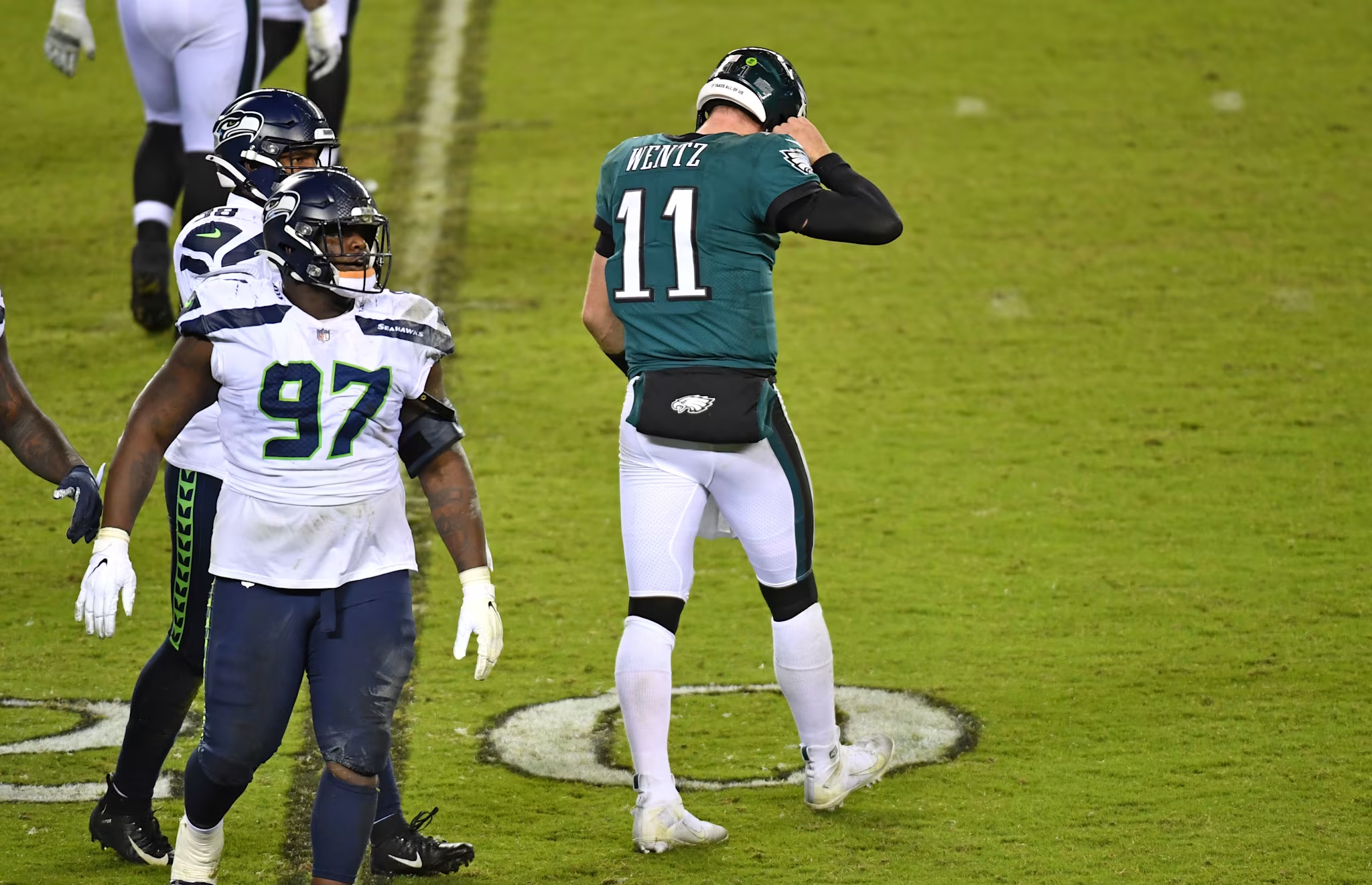
Nov 30, 2020; Philadelphia, Pennsylvania, USA; Philadelphia Eagles quarterback Carson Wentz (11) unsnaps his helmet after turning the ball over on downs during the fourth against the Seattle Seahawks quarter at Lincoln Financial Field. Mandatory Credit: Eric Hartline-USA TODAY Sports
Success in modern pro sports often comes down to shrewd salary cap management. In recent years, we’ve seen NFL teams execute victories in free agency that helped fuel Super Bowl runs—like the Patriots inking Stephon Gilmore in 2017 and Chiefs getting Tyrann Mathieu in 2019.
But for every Gilmore and Mathieu, there are just as many signings that don’t go according to plan. Think of the Jets giving Le’Veon Bell a four-year, $52 million deal in 2019 (he now makes $1 million on a one-year deal with the Chiefs), or the Jaguars giving Nick Foles a four-year, $88 million contract that same summer.
It’s no coincidence those two franchises are languishing at the bottom of the league.
The takeaway is simple: when you’re going to back up the Brink’s truck, you’d better make sure it’s for the right player. A number of teams, unfortunately, recently made miscalculations and are now regretting the massive paydays they handed out to key players. These are deals that could hamstring a franchises for years.
Below, we run through the five worst contracts in the NFL right now.
Ezekiel Elliott
Contract: 6 years, $90 million, signed in 2019
Elliott has had a tough lot this year. His offensive line has been decimated by injuries, and Dak Prescott is no longer under center to open up the passing attack (Prescott suffered a season-ending ankle injury in Week 5). Andy Dalton just doesn’t strike the same type of fear in opponents.
That said, Elliott also clearly hasn’t been himself. His YPG has declined each year he’s been in the league, and this year it’s plummeted to a career-worst 64.0. He hasn’t had the same burst of explosiveness, and he’s also gone down easier after getting hit; the former Buckeye is averaging 1.9 yards after contact per rush, compared to Tony Pollard’s 2.3. (Because we know you’re wondering: Pollard is making a little over $800,000 this season. Yikes.)
Though Elliott is only 25, it’s understandable for a running back with such a heavy workload to experience regression—but what’s troubling for Cowboys fans is just how much he’s getting paid, and just how long he’ll be collecting those checks. He’s the second-highest-paid RB this year (behind Christian McCaffrey), his deal includes $50.1 million guaranteed, and it doesn’t expire until 2027. Ouch.
Sadly, Elliott seems to already be past his prime, yet he’ll be eating big helpings of cereal from Dallas’ bowl for the next six years.
Carson Wentz
Contract: 4 years, $128 million, signed in 2019
Much like the situation with Elliott, the Wentz contract hurts because it includes a ton of guaranteed cash and won’t expire anytime soon. In Wentz’s case, he got $108 million guaranteed with his extension, which expires in 2025.
In fairness, this looked like a good deal at the time it was signed. Wentz was playing on his rookie contract (which significantly undervalues top performers), he had at times played like an MVP, and the Eagles wanted to lock him up for his prime. They were still basking in their 2018 Super Bowl win and were hungry to continue capitalizing on their window.
Wentz is the eighth highest-paid QB in the league this year, but he clearly hasn’t been the eighth-best signal-caller. In fact, with Philly down in the third quarter in Week 13, Wentz got benched for rookie Jalen Hurts, who was then named the starter the following week. Hurts looked good in the Eagles’ surprising win against the Saints this past weekend and it looks like the Eagles will roll with the rookie for the time being.
Again, let’s be fair—Wentz has been hampered by an already-weak supporting cast that’s gotten hit with body blow after body blow of injuries. Yet Wentz’s performance has also been lacking. He’s already tossed a career-high 15 picks this season (to 16 TDs), and his completion percentage is a career-low 57.4 percent. His passer rating and YPG are also at career-low marks, and he’s taken a league-leading 50 (!!!) sacks.
This doesn’t seem like the end of the road for Wentz. It sure feels like the pride of #Bisonation will get another shot in the league, either with Philly or another team. I mean, the 2016 No. 2 overall pick is only 27. But he’s currently the most overpaid backup QB in the NFL.
Robert Quinn
Contract: 5 years, $70 million, signed in 2020
This deal seemed questionable from the start. Quinn is a decorated DE and outstanding athlete, but he’s 30. Did the Bears really expect him to be productive enough to warrant this money as he approaches his mid-30s? Maybe they were banking on front-end production that would justify the cost in the back-half of the deal.
Unfortunately, it hasn’t been there—signed in March, this deal is already looking regrettable. It’s been far from a banner year for Quinn. He has only one sack, three QB hits, and zero tackles for loss.
These numbers are easily the worst of his career—he had 11.5 sacks last season with Dallas—and his performance has been especially disappointing because he’s playing down the line from Khalil Mack. Understatement: Mack is a bad man. Teams game plan specifically to stop him, so there should be plenty of opportunities for Quinn to flourish, but he just hasn’t played like his All-Pro self.
You have to wonder if he’s still hampered by the ankle injury that kept him out for the season opener. Even if he’s banged up, though, there’s no reason Quinn’s performance should be inferior to that of Barkevious Mingo, who has 2.5 sacks and is getting $1.2 million this year.
CJ Mosley
Contract: 5 years, $85 million, signed in 2019
Pop quiz: who are the two highest-paid inside linebackers in the NFL? The first in Seattle’s Bobby Wagner. Second: Mosley.
Jets fans won’t be surprised to see his name on this list. The team’s spending spree in 2019, with Bell and Mosley inked in hopes of resurrecting the franchise, looked iffy at the time and has since been proven downright foolhardy.
Like some of the other guys on this list, Mosley has had tough luck since signing his career-defining deal. He was only able to play two games in Year 1 due to injury, then he opted out of this season due to COVID concerns.
Nonetheless, you know the Jets are kicking themselves for giving the former Baltimore Raven such a big contract since he’s rarely seen the field. This deal, like Wentz’s, won’t expire until 2025.
Further, Mosley’s dead-cap number is significant. Getting out of the agreement would cost New York $19.9 million in 2021 or $12.5 million in 2022. Even if he returns to his prime form, Mosley won’t be able to justify $85 million.
Kirk Cousins
Contract: 2 years, $66 million, signed in 2020
The Vikings are still in the NFC playoff hunt; as they fight for a wild-card spot, they’d currently be the first team out of the postseason. It’s been a weird season for the purple and yellow. They started 1-5 but have rebounded to win five of their past seven.
Even if Minnesota claws into the playoffs, you can’t feel great about their chances. With Cousins at the helm, this team hasn’t been a real contender. They did win a playoff game a season ago, but the Niners handled them with relative ease in the divisional round. Minnesota’s best team in recent years was its 2017 squad, quarterbacked by Case Keenum. (Remember that pass to Stefon Diggs? What a moment.)
Cousins signed a fully guaranteed three-year deal worth $84 million in 2018 to hypothetically put this squad over the hump, but it hasn’t happened. That deal made some sense given the Vikings’ title window, but here’s what doesn’t: after an up and down two years, Cousins signed a two-year extension in March 2020—again, fully guaranteed. His current contract won’t expire until 2023.
Cousins is getting paid like Aaron Rodgers. His completion percentage has dropped to 67.5 percent, and he’s tossed 12 picks. He was much better in his first two seasons in Minnesota.
The Vikings have two legit stars in Dalvin Cook and Justin Jefferson. The front office probably wishes they had a promising young QB to build around as well, but—for better or worse—Cousins is this team’s future for the next few years.
Adam Humphries
Contract: 4 years, $36 million, signed in 2019
Humphries got his big payday after a breakout 2018 season with Tampa Bay in which he caught 76 balls for 816 yards and five TDs. That season now looks like an aberration, as his performance in the Music City hasn’t justified the big money he’s receiving.
In his first year with Tennessee, he caught 37 passes for 374 yards and two touchdowns. His role was relatively small, as his targets were more than cut in half (105 in Tampa, 47 in Tennessee).
We’d be surprised if Humphries has been on a roster in your fantasy league for much of this season. He missed four games with a head injury, returning last week versus Cleveland with one catch for 9 yards, and hasn’t been much of a factor.
Tennessee can’t feel too bad about this deal, as the Titans have had a great season and have two standout WRs in A.J. Brown and Corey Davis, but it’s still one they wish they’d avoided.
Needless to say, Tennessee and the other teams featured on this list will think long and hard before they grab those keys for the Brink’s again.




