None
Are you already knitting the Stark's direwolf emblem onto your favourite jumper in anticipation of the next series of Game of Thrones? Nothing better than showing your Westeros family allegiance by donning a poorly tailored garment, after all.
Unfortunately, the premiere of season five isn't due until April 2015. Nearly five, long, cold months to endure without Bran, Arya, Khaleesi and co.
While dry turkey, awkwardly wrapped presents and dodgy dance moves from your parents will consume a week or so of your life over Christmas, there remains many weeks to kill before Game of Thrones' alluring blend of violence, sex and political turmoil makes its way back into our lives.
Out this week, Dragon Age: Inquisition might just represent the comfort to ease such absence. The third game in a series that has historically taken a very mature approach to all things fantasy, dragons and, ahem, helmets, could this be the game to fill the Jon Snow void?
We delve into Inquisition to determine whether or not it holds the right kind of appeal to satisfy Game of Thrones fans.
*Warning: Some spoilers exist for those not up-to-date with Game of Thrones Season 4.
Is it as approachable?
One of the reasons Game of Thrones has been so successful is that it's extremely easy to get involved in. You don't need to have a PhD in goblin lexicon and literature to understand what's going on.
To a large degree, the same is true of Inquisition. You don't need any pre-existing fantasy genre knowledge or experience to appreciate the story and allow yourself to be drawn into it. What is useful, however, is a basic understanding of how videogame role-playing works. While you don't need to be expert—and tutorials are functional—you will save yourself some time and frustration if you have experience with this kind of thing.
Whatever the case though, an appreciation of the likes of Game of Thrones will make any transition into Inquisition that bit easier and more natural.
"I think somewhere around the release of the Lord of the Rings movies fantasy hit a point where it became acceptable for the mainstream," Inquisition creative director Mike Laidlaw says when asked about how the likes of Game of Thrones have impacted the fantasy genre.
"Also, I think cable TV has done a good job in presenting characters and ideas that have made people more willing to accept and explore different genres. So, yeah, I think there's been a degree of rubbing off there that means people are more willing to get involved in fantasy and that has benefitted us.
"It's not just fantasy, though. Superheroes have taken off in a big way, too, and it wasn't so long ago that they weren't accepted by the mainstream."
How engaging is the plot?
You might be one of those people that claim to watch Game of Thrones only for the fights and the nudity, but deep down you know you enjoy the narrative just as much as the next closet geek. Betrayal, backstabbing, sinisterly-motivated seduction, the heroic plight of orphaned siblings... that's really why you've watched it for four years.
Dragon Age Inquisition, while much, much slower to get going, does feature a significant degree of exactly this sort of thing. Most certainly, what's on offer here is far closer to Game of Thrones than it is Lords of the Rings on the maturity scale—although there are a few too many predictably wise elves for our liking.
The narrative is centred on banishing evil from the world, with you taking centre stage as the leader of an Inquisition that has taken it upon itself to lead the charge. That sounds simplistic, but not all of the involved fractions of humans, dwarfs, elves, mages et al are happy with your power and that leads to some significant underhanded acts of treachery and corruption.
How you deal with such things massively alters how your character perceives different alliances and how your closest advisors react to you. In turn, that can make the narrative seem more or less sinister depending on how selfishly you want to exercise the authority granted you by your position at the top.
When the loin cloth hits the deck, is it as engaging as Game of Thrones from a narrative perspective? No, but it's not far off and many of the same themes permeate both.
Does the world have the same level of detail?
In a word, yes. It's the level of detail in Inquisition that is arguably it's most impressive achievement. Not a character, place or incident seems to exist without it in some way influencing or altering something else in the world and the story.
The sheer amount of back-story that has been built up over the course of the first two Dragon Age games resulted in creators BioWare hiring a crime reporter with the specific job of cataloguing and classifying all of that information into an easily digestible internal Wiki.
Impressive is the way that this detail only presents itself if you want it to, the more you delve into a certain subject or person the more you will find out about it/them. Alternatively, if you'd rather get through the plot more quickly you can ignore this kind of thing.
What this does is prevent people that haven't played the previous two games from feeling bogged down by past events. The story here more than works in isolation for those that would prefer it to.
Part of this depth comes from the fact that the writing team is planning two games ahead each time, giving Inquisition's characters a sense of place that goes well beyond the boundaries of this story.
Laidlaw explains to us that "within the Dragon Age world there's a ton of stuff we haven't done. There are whole nations we haven't visited, empires we haven't explored, organisations that have deep backgrounds but we've only shown glimpses of.
"Generally we maintain a two game horizon. If someone came to me and said 'you must tell me what the next two games are about, or else', I could do that."
Is it as violent?
In terms of the bigger picture, yes, Inquisition is as violent as Game of Thrones. Huge swathes of people are battling each other, demonic beasts do their thing and kill pretty much anything they see and dragons aren't too friendly, either.
There's plenty of destruction and pain, no need to worry about that.
Inquisition doesn't, however, reach the same levels of intimate gore and bloodshed as HBO's show. There's nothing quite as unnerving as The Red Wedding for sheer surprise or barbaric execution, nothing as coolly sinister as Arya slowly puncturing a chest with Needle and nothing as grotesque as Joffrey's poisoning.
This is a game that has you personally indulge in many a death and sees you get plenty of blood on your hands, but the nature of it is less indulgent and varied. Primarily, this is a result of deaths usually coming from actually engaging people in combat with your sword, axe, magical staff or whatever else you've chosen to wield.
Therefore, the camera angles are designed to make sure you can see what you're doing at all times. They're not designed to make each individual death as gruesome as possible.
Does it have the same level of sex appeal?
How sexy you want Inquisition to get is down to you. The level of control you're given over your character's decisions means that it's your actions that dictate how much sex you have and with who.
No matter whether you're playing as a female or male you can play at being gay, straight or bisexual—no limits are present that attempt to funnel you into who you 'should' be and how you 'should' act.
In terms of pure aesthetic eye-candy, there are plenty of examples from both sexes of individuals that prefer the skimpy over the conservative. A general theme of the fantasy genre—videogames and otherwise—is that there are those people that dress like nuns and monks, while almost everyone else wears the medieval equivalent of a bikini or pair of Speedos... even when they're halfway up an ice capped mountain.
Nothing to worry about, then. There's plenty of flesh on show and plenty of opportunity to bed that special someone that has caught your lustful eye.
The only difference here is that you've got to put in the legwork to convince others that you're worth getting naked for. In Game of Thrones you watch others do that kind of convincing for you
Is it as beautiful to look at?
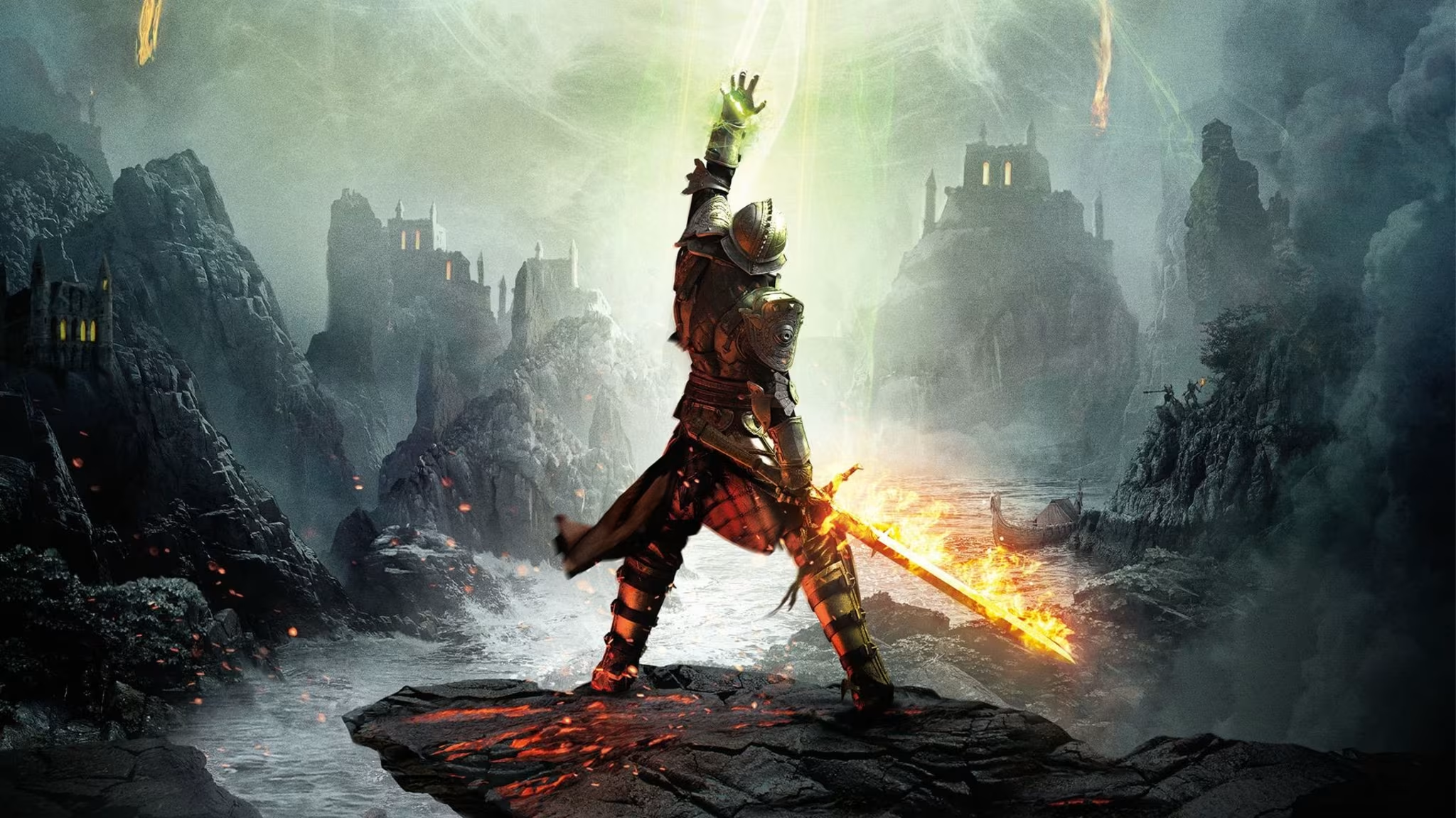
To dredge up an old cliché, beauty is in the eye of the beholder. To be more specific, Inquisition and Game of Thrones can at times look like carbon-copies of each other. Therefore, the amount of time you spend pondering the game's environment will likely determine how attractive you think it is.
What isn't up for debate is that there are beautiful things to see if you take the time to do so. Buildings, certainly the bigger and grander examples, are quite brilliant in their design and rival anything in Game of Thrones for sheer scale—except perhaps The Wall.
"Our art director is very keen on having his artists think about the game's architecture in terms of it being built by a race of people capable of using their minds to lift huge rocks," Laidlaw tells to us. "That gives a lot of the buildings a much more epic, fantastical look than many other games."
Where Inquisition is perhaps less involving aesthetically is in its aforementioned provision of overtly stereotypically fantasy elements, the kinds of things we've many seen times over and again in the past across games, films, comics and novels.
"Dragon Age works well when it includes familiar elements, which is why we have elves and dwarves," explains Laidlow when we ask whether he tries to steer away from clichéd elements. "That provides a degree of acceptability to people that are interested in fantasy and want to experience it in a videogame.
"However, Dragon Age also works when you start from a 'character first' slate. That makes things feel interesting and more human and we try to work that idea through in everything we do to make sure it feels unique."
Are the characters as good?
It's in the characters that Game of Thrones does feel more robust and well-rounded than Inquisition. Certainly, there's nothing wrong or disappointing with the game's cast, but the variety of motivation and action just isn't quite there.
This may well be a result of giving the player so much choice; the fact that you're free to make so many of your own decisions forcing the writing team to accommodate many different outcomes, making each character feel less impactful and more accepting than they otherwise might.
Yes, characters become irritated at you depending on how you act but their response is never so blunt or poignant as those in Game of Thrones.
Once you've finished Inquisition it's the world and the way it changes from the start to the finish that you remember, it's not necessarily the individual players within it. Where Game of Thrones has the luxury of being able to finely tune each of its characters to represent a certain ideal or obstruct a specific plot point, Inquisition must make sure almost everyone is open to being influenced by you—for better or worse.
That doesn't make the characters here bad or weak, but it does make them seem a little diluted by comparison.




