None
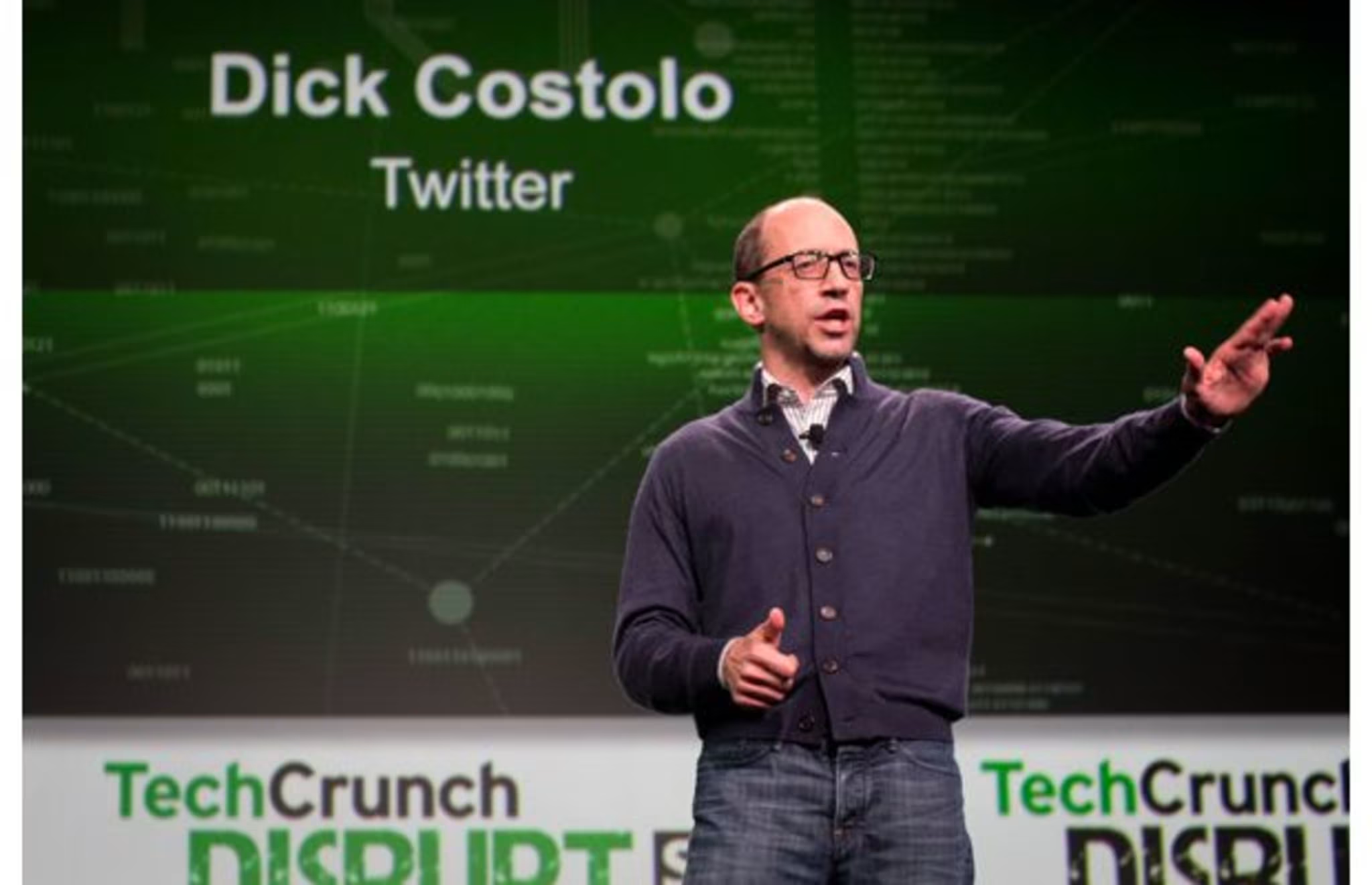
It isn't easy starting from the bottom: a number tech CEOs and founders spoke on stage in San Francisco this past week for Disrupt SF 2013, one of the biggest tech conferences of the year. From Yahoo CEO Marissa Mayer, to Twitter CEO Dick Costolo, many of them gave some insight into their beginnings, the challenges they faced, and how they battled through them. Some started a company from the bottom up, and some took over a company while it was in trouble, but all of them understand that it's a new world out there, and it's going to take some tough decisions in order to change it. Now that Disrupt SF 2013 is officially over, here is the best advice given by CEOs and founders at the conference.
Evan Spiegel, Co-Founder of Snapchat
On bringing things from the real world and making them digital:
"[We hired a sociologist after] he created this term called 'digital dualism,' which explains a way of thinking about the digital and analog worlds, that they're kind of separate. So, traditionally, a lot of product development in the technology sphere has tried to take experiences in the analog world and bring them into the digital. We're looking at a future where people acknowledge the hybridization of the digital and analog, and appreciate and understand that they both effect each other."
Don Valentine, Founder of Sequoia Capital
On building products:
"What is important is to have the ability and willingness to be different. Great companies are built with different products by different people."
Eric Migicovsky, Founder of Pebble
On trying to raise money through Kickstarter, the same method he used for Pebble:
"Kickstarter is not a single touch point where you touch it and it explodes. Kickstarter, in a lot of ways, is similar to Craigslist. It's a page on the Internet that people can browse to. The real value of Kickstarter, in my mind, is the fact that it's simplified, it's a single landing page... If you can tell a story, if you can explain why someone should back your project, there's a single green button on the right that people can hit, and there's only one action that you can do. So, if you can tell your story in two to three minutes and explain to people what you're working on well enough for them to click a button, then you've completed the path. It all boils back to the point that you have to explain what you're working on in a very concise manner."
Nicholas Woodman, Founder of GoPro
On inspiration and failing after his first project:
"I had no inspiration for what to do next, so I decided to go surfing, to pursue what I'm most passionate about. I believe that when you're indulging yourself in your passions, hopefully your healthy passions, you're turned on and you're most creative and ideas come to you. Ideas don't come to you sitting in a room thinking of a great idea, it never happens. They come to you out on the road bumping into people, living your life passionately and you find inspiration."
Drew Houston, Founder of Dropbox
On building a team:
"Most great people want the same things, they want to work on interesting problems with poeple that they respect, and they want to do things that they think are important. I think we offer an interesting mix of being small enough where you can make a difference [in the company], but big enough that you can still make a difference [in the world]."
Sebastian Thrun, Co-Founder of Udacity
On the future of technology and online education:
"We can't really afford to have a single-study education these days - we have to stay up to date... We have to change the mindset that 'you get a degree, and then you're set for life.'"
"It's really important to be creative about this, to reinvent education today. Right now we force every student in the classroom to go at exactly the same pace, think exactly the same thought, at the same time. It's almost like an industry of drones, the way we educate today... from K-12, it's been shown that a C student can go to an A by going at their own speed of progress."
"There are a lot of old-fashioned things we perpetuate that come from a world that's not digital, not interactive and not online, and we try to retain it. I think we need to be creative."
Logan Green and John Zimmer, Founders of Lyft
On moving on from their first project, Zimride, to Lyft:
"Lyft came out of a hackathon project where we were trying to figure out what Zimride looks like on mobile."
"It was a tough switch, but Logan and I were pretty decisive about it... About a month or two after [launching Lyft], after feeling the weight of trying to do two things really well, we said 'Let's focus.'"
Mark Zuckerberg, Founder and CEO of Facebook
On fighting for success:
"Building things is about seeing things through and sticking to it."
Marissa Mayer, CEO of Yahoo!
On having a team:
"I don't think I have [superpower]. [But] I think maybe it's my ability to empathize. When I came on, the company had been through such turbulence. I had to understand the state of the company, get there with the team, to find a path for growth. It couldn't happen if I didn't understand them."
Dick Costolo, CEO of Twitter
On success:
"There are many different ways to be successful, and you need to find your own way to be successful."
"As a leader, you need to care deeply about your people, while not worrying, or even caring, about what they think about you. Managing by trying to be liked is the path to ruin."




