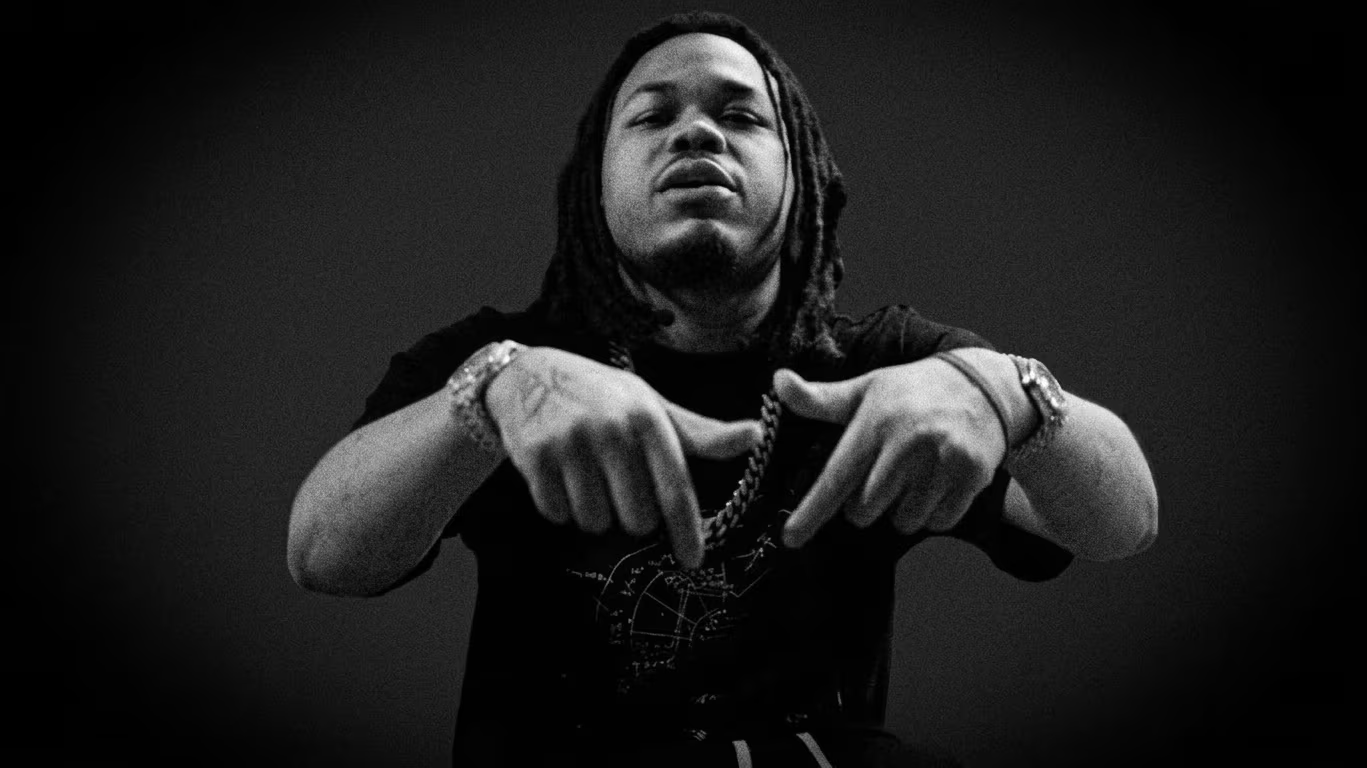
Image via Complex Original
Once upon a time many years ago, three friends from Atlanta, Georgia decided to form a music production trio. Their goal wasn't to be the next big industry hitmakers, nor was it to gain local popularity—it was simply to play backup for a collective of several young rappers they had taken under their wings. The three young men were named Rico Wade, Ray Murray, and Patrick "Sleepy" Brown. They called themselves Organized Noize.
Starting out in the basement of Rico's mom's house—a.k.a. "The Dungeon"—Organized Noize cooked up sounds for their collective, which came to be known as The Dungeon Family. On any given night, future supergroups like OutKast and Goodie Mob would be down in the basement, making the music that would make them hip-hop legends.
Though no one knew it then, it's now become starkly obvious how groundbreaking Organized Noize's sound was. To say they were ahead of their time would be an understatement. Besides creating their own stars, Organized Noize has been credited with resuscitating En Vogue's career, giving Ludacris his most memorable party anthem, and handing TLC their biggest hit ever on a silver platter.
In this Complex exclusive, Dungeon Family founder Rico Wade, fellow Organized Noize producer Ray Murray, and associate producer Mr. DJ, tiptoe down memory lane to discuss the hits that put their crew on the map, and the juicy behind-the-scenes stories you've never heard before... until now.
Written by Linda Hobbs (@LinnyLovesLin)
Follow @ComplexMusic
1. OutKast “Players Ball” (1993)
Album: A LaFace Family Christmas / Southernplayalisticadillacmuzik
Label: LaFace
Rico Wade (Producer, Organized Noize / Founder, Dungeon Family): "'Players Ball' was for a Christmas album, so when [LaFace Records co-founder] L.A. Reid called me he was like, 'I need y'all to do a Christmas song.' And we had just kind of got the LaFace deal with OutKast, and this was the first thing he called and asked for.
"Thing is, we don't really fuck with Christmas like that. That's where we were at the time, we were on some, 'Christmas is not one day out the year, it's every day.' For us, it was just about being realistic. People get caught up in the excitement of, 'I got to buy this, I got to do this and that” and they lose they mind.
"Our thing was, why wait till a certain time of the year? Every day you need to do something. And if it was Jesus birthday, of course it would be cool, but since we know it's not, whatever.
"But anyway, I told OutKast, 'We gotta do a Christmas, song but we'll just talk about what we don't do on Christmas, or what it means to us.' And while we were in the studio working on it, I had to go meet Ray at another session, cause he was working on a song for this group called The Drip Drop.
"I went over to the studio and I heard the beat he was doing. We took that beat and took it to the studio and turned it up. We ended up using that for 'Players Ball.' There were samples at the beginning, and we were like, 'We know we can't clear these samples' so that's when we got Big Rube to talk on the beginning. But that song ended up jumping off OutKast's career."
Xscape “Tonight” (1993)
Album: Hummin' Comin' at 'Cha
Label: Columbia
Rico Wade: "'Tonight' was originally a U-Boyz song. The U-Boyz was a group that had me, Marqueze [Ethridge] (who wrote TLC's 'Waterfalls'), and Sleepy in it. It was a singing group. We used to do little acapella things, and Xscape heard one of our songs and they wanted to use it. 'Tonight' was the song that made them fuck with us. We had already knew Xscape growing up because they were trying to be a female version of our singing group, cause we were like street dudes singing. Our style was like Jodeci before they came out. Ian Burke was managing Xscape at the time, and he came to us and was like, 'I want Xscape to do "Tonight" over' and that's how it wound up on their album."
TLC "Waterfalls" (1994)
Album: CrazySexyCool
Label: LaFace
Rico Wade: “'Waterfalls' was written by my childhood friend Marqueze Ethridge. We got T-Boz to come demo the song before we even told LaFace Records about it, before we even told them we had a song for TLC. We were just working on it and was like, 'Yo, this would be perfect for TLC.' Cause Tionne [T-Boz] was somebody we knew already, we just called her and told her, 'We got this song for you, T. Come up here.' We wrote that song while working on an OutKast record—I can't remember which one. But Marqueze was hanging out in the studio with us while we were working on the OutKast song, and he came into the studio like, 'I got this melody for something.' He sung it and I was like, 'Yo, that's hot.' Ray was working on beats, and I told Ray about what Marqueze had and we started working on that idea. We just did it on the side while we were doing other stuff. And then we called Tionne and was like, 'Come sing this.'
"The horns in the song was live. Our engineer, Neal Pogue, is the one who put the horns on there. He just sat there with us in the studio because he was so into it. As you can tell, the horns were very pop. But we were at that point in our career where we wanted to bring everything back that was analog, and live horns and whatnot. I was there when TLC recorded their vocals, but I don't really like sitting on the vocal sessions cause I'm not a singer. It's boring to me. That's not what I do. Plus, you don't want to mess up the singer's vibe or anything and you can't say, 'That's fucked up,' you got to say it nicely like, 'Do that again, that was nice. One more time, that wasn't really it, one more time…' I don't want to sit through all that. So we bring in somebody to sit there and do that. We hire people to hold their hand. When L.A. [Reid] heard the song, he went crazy."
Goodie Mob “Dirty South” (1995)
Album: Soul Food
Label: LaFace
Rico Wade: "Big Gipp came to me one day and was like, 'Yo, you got to check out this song [Cool] Breeze got.' I heard it and we wound up putting it on Goodie Mob's album. Gipp is the one who made it happen. We were already working with OutKast, and Goodie and I knew Cool Breeze from the Eastpointe Chain Gang, but I never really talked to him. But Gipp was like, 'You need to go talk to him, you need to hear this song.' And just so happen it was 'Dirty South.'
"As far as the term go, we never got paid for none of that shit. But as far as the way it's been capitalized, now everybody got 'dirty south' records, and 'dirty south' movies, and… 'Dirty South' was Cool Breeze's shit. He came up with that shit and he didn't make nothing from it, and he will forever be bitter about that. And he deserve to be. I didn't know we should trademark that shit."
Goodie Mob “Goodie Bag” (1995)
Album: Soul Food
Label: LaFace
Rico Wade: "I was making the beat in my mother's bedroom and my cousin DJ [who went on to produce 'Ms. Jackson' and 'Bombs Over Baghdad' for OutKast, and a lot of stuff for Common] was there. To be honest, there's only a couple of beats that I've allowed him to work on, and that was one of them."
Mr. DJ: (former Associate Producer, Organized Noize / Co-Founder, Earthtone III / Cousin of Rico Wade): "That first Goodie Mob album was recorded right there at the Dungeon, at Ric's house in the studio downstairs. Rico had the sample going and I came in there and put some drums on it. That was kind of like my job at first, as being an associate producer for Organized Noise. That was my thing: make sense of stuff. Everybody was so busy doing other stuff. Ray of course, was always making beats. And Ric was in and out. Ric would be making beats and then Ric would be on the phone handling the business, getting the money. At the Dungeon, everybody would always just drop by all the time, so we would have beats cooking."
Rico: "We put that out on the album Soul Food of course. Soul Food totally meant a family, totally meant more than fucking food. But overall, 'Goodie Bag' was my idea, it was my melody, but DJ added extras to it. People might not know that DJ was a part of that, because he didn't get credit. But I got him [paid] for the production work he did on Goodie Mob's 'Black Ice' and 'They Don't Dance No Mo.'”
DJ: "There's a lot of things I may not have gotten credit for, but I was always financially taken care of. I was always straight. Between my cousin and them being fair, and my attorney, I've never been jipped out of any money. Believe that. I've always got what was due to me. Even though there was a time where Interscope stopped giving us money, we never had any fallouts over money."
Society of Soul “Peaches N' Erb” (1995)
Album: Brainchild
Label: LaFace
Rico Wade: "This was one of Pimp C's favorite songs. He later remade it and called it, 'Swishas & Erb.' He did it for UGK's last album. Me, Sleepy and Ray were and are fans and friends of UGK. They wanted us to help them a lot but we were busy working with OutKast.
OutKast “Benz or Beemer” (1995)
Album: New Jersey Drive, Vol. 1 [soundtrack]
Label: Tommy Boy
Mr. DJ: "I used to be a car thief. In Atlanta, we had a lot of car thiefs. I had a chop shop, and Ric was the wholesaler. We used to steal cars, car parts and sell them. Everybody was in the studio one day just talking about what kind of cars they would steal. Like, 'You either want a Benz or a Beemer.' I was the first one in the crew to get a Beemer, so that was my Beemer in the music video. Dre had a Cadillac, Big had the LexusGS when it first came out, and I got a BMW. Ric's first car was an Acura, Sleepy's first car was a Benz, and Ray bought a Trooper and a Jeep. I did all the scratches on that record."
Rico Wade: There was only two hit records on that New Jersey Drive soundtrack: Outkast 'Benz or Beemer' and that Total record ['Can't You See']. That's what sold the soundtrack. It was a good look for us—it helped us because we were between the Southernplayalistisic album and ATLiens. The song's concept was something we had before OutKast even had a deal. And the beat was real relaxed. We didn't overthink it, we didn't worry about having no singing hook, we dind't worry about that. We just knew that where we were in our career, people would respect us doing some straight hip-hop shit, and it worked out cause Atlanta loved it. 'Benz or Beemer' became an anthem for Bankhead rappers."
OutKast “Two Dope Boyz (In A Cadillac)” (1996)
Album: ATLiens
Label: LaFace
Rico Wade: "There's nothing special about that session. The only thing special about 'Two Dope Boyz in a Cadillac' is the fact that them dudes got a blog called, '2 Dope Boyz' and they got it from our shit—another one of our ideas that we came up with. But we not mad though, those bloggers support us."
OutKast "Elevators (Me & You)" (1996)
Album: ATLiens
Label: LaFace
Mr. DJ: "Andre 3000 actually did all of that. Me, Dre and Big all learned how to produce from Rico, Ray, and Pat [Organized Noize]. Cause when we first started doing the first album, we all used to just hang around the Dungeon at Rico's mom's house and watch them. They use to always be on the beat machines making the beats that OutKast eventually rapped to to make that first album Southernplayalistic. And we would just mimic ON.
"It was always cool to watch Organized Noize working on beats because they might have a blunt hanging out with the ashes falling on the beat machine and Ray would be turning them buttons and you'd just hear the 808s and the samples, all the different melodies and stuff, and that was, like, intriguing. That was how we learned how to produce. So when we finally got a little money, everybody bought music equipment and just started emulating Organized Noize.
"I started as the DJ for OutKast, and that's what I did for the first album. Towards the end of the first album, me, Dre and Big had a situation, and I stopped being the DJ and decided I was going to go and produce. And that's when I became an associate producer for Organized Noize. Later on, Big and Dre were like, 'Ay man, even though you're not DJing anymore, let's start a production company together.' Because at that point I had already produced that whole 8Ball & MJG album, In Our Lifetime Vol. 1, and some other stuff. So Big was just like, 'Man, we should just form a production company.' So me and OutKast formed a production company going into that second album, while we were still on the road. We called the company Earthtone III.
“'Elevators' was one of our songs produced for Earthtone III. I can remember Dre doing that beat, and we were actually on tour when he was working on it. The tour we were on was the Quad City Bass Tour, with the 69 Boyz and This & That. It was a summer tour. We had equipment hooked up on the tour bus, and Dre had his stuff hooked up in the back of the bus and we rode around with 'Elevators' for a long time—it was like a lot of little versions of it Dre kept playing on the bus. And when we got back to Atlanta, that was the first song that Earthtone III recorded ourselves, produced ourselves, and that was the start of us producing the rest of the albums. We kind of knew that 'Elevators' was going to be something special. It's not a super complicated beat, but it resonates. Sometimes less is more."
Rico Wade: "That's one thing I'll give Andre 3000 credit for: he was very very excited about pleasing us [Organized Noize] with his production. I expected everyone around us to know how to make beats. I was encouraging them, too. Sitting around watching Ray do that shit, you can't help but be inspired and motivated. Now how good you gon' be is the key. It never really mattered who was gon' do it, because I never really thought any of them was going to be better than Ray, and they still not. They just copied our style, and they got bigger hits than we got—well actually, they don't cause they ain't produced no 'Waterfalls.' They ain't produced no En Vogue 'What's It's Gonna Be.' The shit they did, though, helped out—because I probably would have never did a 'Ms. Jackson' for them.
"But I didn't feel no kind of way when they formed their own production group. If anything, with OutKast, I made them [Big and Dre] be partners [when I created OutKast], but I really saved them from where they are now, because Big and Dre had a little deep-down resentment towards each other, cause they had been working together for so long, like, 'I spent 20 years of my life with you.' I mean, Keith Richards talks about Mick Jagger the same way. It's like having brothers, like, 'Damn, everywhere we go, we together all the time.' Eventually, that's going to get a little boring. You just don't want to see muthafuckas every day. So they got separate lives now. Andre got his own equipment, Big Boi got his own equipment, and DJ got his own equipment."
OutKast “13th Floor/Growing Old” (1996)
Album: ATLiens
Label: LaFace
Rico Wade: "We had just done 'Waterfalls' for TLC, so in our mind we were like, 'We want to do something big for OutKast.' So we rented this condo in downtown Atlanta, the Biltmore, and we just kind of worked on some of the songs for that album, and that was one of them that we worked on down there. We got out of the Dungeon and rented that condo because we wanted it to be different when we made that beat. We were listening to a bunch of Sade and stuff at the time. We had Marqueze write the hook for it. But the original hook was the end of 'Growing Old' where it's fading out and we have Andre doing, 'See all them leaves must fall down, growing old…' That was the hook that they originally wrote to it, and we changed it. We wanted that to be a special song."
Mr. DJ: "During the making of that whole second album, we just knew… We kind of knew that we were on to something, and that song just made you feel that. So the cut that I was cutting at the end, I was saying, '96 gon' be that year,' cause that was confirmation that it was going down. No one had to tell me to add scratches to it. Everybody had a role in the camp. And it was an unsaid role, you just knew what you did best and what you had to offer—and that was just what it was. It wasn't nobody questioning it, it was no problem with it. When it came to OutKast laying verses in the studio, I was probably like the only person there with them. Most of the time we did verses at Stankonia Studios. In the early days, I stayed in the studio most of the time, even when OutKast were on the road doing something.
"Lyrically, Big's a faster writer than Dre. When Big goes in to do his verses, he takes off all his jewelry. He takes everything off before he goes into the booth, and that's his little ritual before he lays his verses. My assumption was, he did that before making music because it's, 'as you were when you started.' You know? To have that feeling of pureness. You standing there in a booth with all your jewelry on, you kind of lose touch.
"Dre and Big both write everything. Matter of fact, Dre don't even believe in freestyling, and I don't even think Big believe in freestyling. Cause I think the explanation was, it's a little bit better to think about what you gon' say before you say it rather than just blabbing off anything. It makes more sense to think about what you saying. Cause I remember when we used to be on the road and people used to always want them to freestlye, especially over in the Bay area. They were on the Sway & Tech Wake Up Show show once in California, and everybody would have to freestyle on their show, and Dre and Big explained that they wasn't gon' freestyle cause that's just not what they do.
"Overall, they both understood the power of words. And The Dungeon is just now starting to understand what our music meant to people. Because we were just having fun making music, I don't think we realized how it touched people until later. Now we get to really hear how much people appreciate the songs."
OutKast "Wheelz Of Steel" (1996)
Album: ATLiens
Label: LaFace
Mr. DJ: "I grew up listening to Magic Mike. Magic Mike is this Miami deejay, and he was the king of cutting. Down south, our DJing consisted of mostly difficult cutting or scratches. That's what we were known for. So I used to watch Magic Mike, and I was like, 'This gon' be the song where I emulate Magic Mike and cut it up.' “'Wheelz of Steel' was dedicated to the DJs. Dre came up with the drums on that beat, Big came up with hook, and all the scratches and stuff, I did. I had like 17 records.
"If you actually listen to the song, everything that I'm cutting, I'm actually saying a sentence with the different scratches on that song. Like at the end of each scratch, I'm actually scratching a word. So each one of those words, if you actually put it all together, are sentences. It's a different scratch for each word, so you have to really listen to it. Like, one particular cut that might come off a Public Enemy record where somebody is saying the word 'feel.' And the next word that might come off an OutKast record, that says, 'so.' For example, say I cut the 'so' from 'So Fresh, So Clean,' and then the other record might be a cut from somebody else saying the word 'good'— I'd cut them all together and in order, and it all ends up saying sentences, like, 'This feel so good.' So I say different sentences with the cuts.
"Me and OutKast might have done that one live only once or twice. It was off the chain. It was a good show song. While DJing, I would do all the behind-the-back stuff, and show performance things. We were kind of like the modern-day Run-DMC. We didn't do the song that much, but it was a live song when we did do it. I mean, I was a good show DJ, a good DJ period, and I kind of really would like to get back to DJing, because I enjoy the power that it has."
Organized Noize “Set It Off” (1996)
Album: Set It Off [soundtrack]
Label: Elektra
Rico Wade: "This was a remake we did, with Andrea Martin singing. The song was basically Sylvia Rhone making us be a group, like, 'I want to make it y'all song and I want Andrea on it' cause I guess she had promised Andrea that she was going to put a song out on her. So we went and bought the rights to Set it Off and just did it. We were also able to put the Goodie Mob song 'Angelic Wars' on the soundtrack."
Curtis Mayfield “Ms. Martha” (1996)
Album: New World Order
Label: Warner Bros.
Rico Wade: "We had rented Curtis's house one time—it has a studio in it, and we were working with Curtis's son and his engineer. One day they both were like, 'Curtis called and said he wants you to do something for him.' Curtis had told them, 'Ask [Organized Noize] if they wouldn't mind giving me a couple of songs.' This song was Sleepy's opportunity. It was something he personally wrote, and I was proud of him. I've met Curtis too, but he was in the wheelchair. I met him a couple of times. It was a relief when I did meet him, because he liked the song. I'm glad I got his blessing. After [OutKast's] 'Players Ball' everybody would tell us, 'Y'all got the Curtis vibe,' even though we knew that wasn't what we were totally on, but it still felt good that people felt like our music was good like Curtis Mayfield. Working on that song [“Ms. Martha”] was awesome."
En Vogue “Don't Let Go (Love)” (1997)
Album: EV3 / Set It Off [soundtrack]
Label: EastWest
Rico Wade: "Originally, we were writing that song for Mick Jagger and Andrea Martin. Sylvia Rhone sent Andrea to Atlanta to work with us. She's a songwriter [known for writing songs like 'Better In Time' for Leona Lewis and 'I Love Me Some Him' for Toni Braxton]. Because 'Don't Let Go' was supposed to have been for Mick Jagger, that's why the vibe was like that—real rock sounding. But since we needed a record for En Vogue [for the Set It Off soundtrack], Sylvia just made it an En Vogue record. We were in a situation where we were working on the whole Set it Off soundtrack ourselves, so we were in the studio just writing for everybody. Andrea Martin's lyrics, though, is what made the record pop."
Goodie Mob “They Don't Dance No Mo'” (1998)
Album: Still Standing
Label: LaFace
Rico Wade: "That song came from the concept of Khujo and myself. Goodie Mob needed a single."
Mr. DJ: "Ric had the beat playing down in the Dungeon and it didn't have a beat on it, it just had this Aerosmith sample in it at first—a little part from the Aerosmith song, 'Dream On.' We sent it off and they didn't clear the sample, so we had to take all that stuff off and kind of do our own little thing. I had my drum machine, 'cause when I first started out producing, I would be with Organized in the studio. At the time I was about 17 or 18 years old. I would just go and start making beats with whatever equipment Ric had. I started making the drum pattern for 'They Don't Dance No Mo' and Ric came downstairs and was like, 'Man, that's the shit right there, that's it!' So that was how we ended up with the complete, 'They Don't Dance No Mo.' And then Ric and Khujo got together on the vocals."
Rico: "Me and 'Jo just sat down at the board one day and came up with something, where he would say something and I would imitate him. Everything Khujo would say, I would try to remember what he was saying and repeat it, cause he was freestying. So he'd be like, 'People don't dance no mo, all they do is this' and I'd repeat him. The rest is history. It only took one day to make the beat. We had a daytime vibe going."
Mr. DJ: "I stopped going to school in 11th grade because the music started getting serious and I was always with Ric, my big cousin. So we really had jobs and were really trying to pursue the music thing. So I kind of left school right when it started jumping off in '94. it might've took about 30 minutes to make the beat, sitting there playing with different sounds. But the actual recording process back then definitely took way longer because of technology. About five or six hours to actually track it out because that was back when they had two-inch, when we were using tape. Khujo was the first Goodie Mob member to come by the Dungeon to hear it."
Goodie Mob "Black Ice" (1998)
Album: Still Standing
Label: LaFace
Mr. DJ: "That song was originally supposed to be a Mista song. They had that song out then called 'Blackberry Molasses' that Organized Noize produced, and I was dong a remix to the song, so I made that beat to the acapella down in the Dungeon at Ric's house one day, cause that's where we did a lot of the Mista stuff. Bernasky Wall was the engineer at the time, and had the acapella up on the two-inch reel and I just started playing it. I just put it on loop, and eventually I started making a beat to it. One day Gipp came by the studio and was like, 'Man, what is that playing right there?!' and I was like, 'That's the remix for Mista.' And he was like, 'Naw, not really, that ain't it…that's something else right there.' And he started writing to it and he actually came up with part of the verse for 'Black Ice.'”
OutKast f/ Raekwon “Skew It On The Bar-B” (1998)
Album: Aquemini
Label: BMG
Rico Wade: "One thing really stood out about that song. I remember we had to meet with OutKast to play them some beats for the new album. When Dre showed up, he had Erykah Badu with him because they were dating at the time."
Mr. DJ: "I can remember the times where Erykah was around. She was just like one of the boys. I mean, she was Erykah Badu—but to us she was just family. Even though she didn't dictate the songs, she might've been the influence for some of the lyrics. Her part that she sang on 'Humble Mumble' was all her idea, but she wasn't giving advice to OutKast for like hooks or anything."
Rico: "When Dre and Erykah walked into the studio, Ray turned on the beat and Erykah flipped out… she went crazy. We were all digging the song, but she had to [have] been the loudest one up in there. That's something I'll always remember. That was fly to me."
18. Cool Breeze “Cre-A-Tine (I Got People)” (1999)
Album: East Point's Greatest Hit
Label: Interscope
Rico Wade: "Cool Breeze was supposed to be our first artist. For whatever reason, we didn't pull the trigger. I was trying so hard not to be Puffy, holding niggas' hands. Like Witchdoctor with 'Holiday'—he brought me that single. He wasn't just taking. Some niggas were actually giving back."
Ray Murray: (Producer, Organized Noize): "The first deal that we did with [Interscope] was sign Cool Breeze. Cool Breeze, it just so happened, is the kind of an artist—and all the artists have the issue sometimes—but the worst of them who have the writer blocks are Cool Breeze and Mr. Benjamin. We were hard on Dre and Big Boi, but we were harder on them than we were anybody else simply because they were the first ones."
Rico: "We already had 'Watch For The Hook,' but this was the song where I had to tell Cool Breeze, 'You got to write some better words.' On this song, I made him sit there and go in. I told him, 'You're gonna have to get into some street, this is what they want from you.' And he responded. I've always wanted him to just do what he wanted, but that's when I was like, 'We can't fuck this one up.' The beat was spaced out. And I challenged him. People want pressure."
Kurupt “I Call Shots” (1999)
Album: Tha Streetz Iz a Mutha
Label: Antra
Rico Wade: "I did this song for Kurupt because of what he had done on the Cool Breeze album 'We Get It Crunk.' Kurupt just came through and didn't charge us any money—he just showed up. So I was like, 'I'm gonna do this beat for you for free; you can come and stay at my house.' I was just trying to show him some love. He had already had a hotel room he was staying at with Foxy Brown downtown, but I allowed him to stay at my house.
"We went to the Dungeon and I'm blending that shit hard, he writing to it, it's like 3 or 4 in morning, and I'm like, 'Shit, I'm gon' go ahead and go to sleep so I can get up early and we can get back on it.' But Kurupt was like, 'You don't mind if I keep on working?' and I was like, 'Cool.' The engineer was there, so I just went upstairs and went to bed. I remember waking up the next morning and I heard the beat still playing and I walked downstairs and Kurupt was still up smoking cigerrettes, the door was open, and the song was done—first verse, second verse, the hook. And he was looking at me like, 'Check it out.' I realized that people go as hard as you go. I knew I went in, I knew I worked all night, I knew I deserved to lay down… but he knew too. And he didn't go to sleep. And when I got up that shit was done. That shit was stupid. Kurupt is awesome.
"After he did that stuff with me, that's when Daz started fucking back with him, and Dr. Dre started messing with him. Kurupt told me it was almost as if they weren't taking him seriously anymore. So his whole way of getting away was coming to Atlanta. He ended up taking that shit and getting me paid for it. Have gave me $100,000 out of pocket for like three songs. He a real nigga, and that's why we got a great relationship. I later produced his little brother Roscoe's first single, and I worked with Snoop as well. That's family."
OutKast “So Fresh, So Clean” (2000)
Album: Stankonia
Label: LaFace
Rico Wade: "Sleepy came by the house one day and sang me a melody. The next morning I was in the shower and came up with a beat for it. 3000 is raw; that's why we fuck with him. But Big, he's tangible…he's touchable. Like Dre, you can't touch him, you can't get to him. With Big, it's almost like he's the people's champ. But what's raw about Dre is, he can turn down a $10 million tour—where Big Boi can't. Him and Dre stand side-by-side. Tide wanted to do a commercial using the song, and then Dre didn't want to be on the song. And I actually respect Dre for not falling for the money. I mean, Big had money, so it wasn't like he was tripping."
Ludacris “Saturday (Oooh Oooh)” (2001)
Album: Word of Mouf
Label: DTP/Def Jam South
Rico Wade: "We had gave Ludacris a record on his first album that he didn't pay for, we just got publishing money instead. So on the second album he came to us and was like, 'I want to make sure y'all on this album.' He then told us, 'I want you to take, "She say she never done it, she say she'd never try"… I want you to do something with that for me and I want to do a song called "Saturday" and I want Sleepy to sing [the hook].' And just so happen that day I had got some new sounds from Ray. So I just immediately hit the beat and he loved it, took it, wrote to it, brought it back, and it was done."
Dungeon Family “6 Minutes” (2001)
Album: Even In Darkness
Label: Arista
Rico Wade: "My first time hearing this song was when Big Boi was already on it. Big Boi came up with the idea for Dungeoneze. He jumped that album off."
Ray Murray: "Dungeoneze is like the movement. It's not a group, but it's a continuation of that [Dungeon] mindset and creativity. It's creative expressionism in the 21st century, consisting of film, music, etc."
Rico: "Ray did the beat. They got it done in one night. But everybody fell in line. Bad thing was, L.A. didn't put it out until Andre was on it…that was wack."
Ray: "We all just had good energy that night in the studio. We did the beat and everybody just sat up in the studio kicking it for a minute, like, 'What's going on with you, what's going on in your life?' None of us had seen each other for a minute. And then that nigga Dre just gets up and raps. He told me he was just going in to test the mic real quick. He went in and bullshitted for a half a second. We thought he was bullshitting, and out of nowhere he laid down the whole hook and the first verse."
Nivea “Don't Mess With the Radio” (2001)
Album: Nivea
Label: Jive International
Rico Wade: "Organized Noize is the reason why Nivea got a deal. We did her first single, 'Radio'—we actually did her whole album. But the label only used one or two of our songs. Either way, we set Nivea off, but her manager at the time fucked up. She had a manager who had brought her to us but the song that got her a deal was when we was working with her. She did background vocals on this song we did for Kurupt called 'Tequila.' She was also on one of Cool Breeze songs—she was on a lot of stuff. This is all before she was with Lil Wayne. Lil Wayne loved her because she had money already. He was staying at her house in Atlanta after she got her deal. One of the reasons why he liked her is because she was used to being around niggas. She worked with us when she was between 17 or 18. When she first went to her prom she came by the studio to take pictures. She's like a little sister to us."
Joi “Lick” (2002)
Album: Star Kitty's Revenge / XXX [soundtrack]
Label: Universal Distribution
Rico Wade: “'Lick' was on the XXX soundtrack, and Gucci Mane stole it for this song he had out with the Rick James [beat], talking about, 'She's such a freaky girl…' He stole our stuff. I ain't got no problem with it, but Joi ain't like it. She hit me up on Facebook like, 'Gucci stole that.' I haven't brought it up to him but I need to."
Killer Mike "A.D.I.D.A.S." (2003)
Album: Monster
Label: Purple Ribbon/Virgin
Mr. DJ: "Big wanted this song at first for himself. Me and Big were in the studio working on Killer Mike's album at the time, and I had this beat. Big didn't take it, though, cause Killer Mike really needed it for his album. The concept for the song came from Big Boi. I had just went through a fresh stack of records, and came up with some good drums and some good sounds. This was after Earthtone III dismantled. It was one of my first songs after Earthtone III. Big Boi did the hook—he was always a genius on hooks. That was sort of Big's thing, whereas Dre was good at concepts. The song wasn't necessarily meant to be funny, though. It was just the truth. It took me about 30 or 45 minutes to make the beat."
Cee-Lo f/ Ludacris “Childz Play” (2004)
Album: Cee-Lo Green... Is the Soul Machine
Label: Arista
Rico Wade: "This was one of the beats that I did where Ludacris got off—he killed it. The beat itself was just where we was at at the time, stylewise. It's sort of like that song we did for Luda called 'Blueberry Yum Yum.' We just try to manipulate melodies; that's how we come up with that stuff. Plus, we never did and never do use samples in our music. That's the challenge. This song was a circus vibe, like 'Cell Therapy.' It was just one of our random weird vibes, like OutKast's 'Mighty O.' What the kids are doing right now is not what we're doing really. But I love what they're doing. And I'm inspired by it. Like, I like Pharrell because I met him. I like Dr. Dre because I met him. But the ones who really inspire me are those right here with me, like Ray. We motivate each other every day."
Cee-Lo “Scrap Metal” (2004)
Album: Cee-Lo Green... Is the Soul Machine
Label: Arista
Rico Wade: "This beat was originally for our early Dungeon group Society of Soul, but we gave it to Cee-Lo. The song itself was Cee-Lo's way of dissing Goodie Mob without beefing, because that was when Goodie Mob had did 'One Monkey Don't Stop No Show.' This was Cee-Lo's way of having a response record for Goodie Mob without saying something that would fuck up something for real. I could tell by the raps what he was talking about, because I knew what was going on at the time."
Brandy “Necessary” (2004)
Album: Afrodisiac
Label: Atlantic
Rico Wade: "This was a song that Cee-Lo had wrote. Then this executive from Atlantic heard it and he was like, 'I want to use this for Brandy.' So he made it happen—he got Brandy on the track. But what he did was, he had this other girl demo it so Brandy could want to do it. Cee-Lo had demo'd it himself, but Michael took the song and had another girl to do it so Brandy wouldn't be intimidated hearing Cee-Lo's vocals. The way Cee-Lo originally sung it, it was so good, so hard, that they didn't want Brandy to be like, 'I can't sing like him.' So they had this other girl sing it to make it sound lighter. Overall, I was just happy to do a song with Brandy. I loved the outcome."
Big Boi “Hold On” (2005)
Album: Big Boi Presents...Got Purp?, Vol. 2
Label: Purple Ribbon/Virgin
Rico Wade: "This was an old Goodie Mob song that we did for the first Goodie Mob album, Soul Food. It was a song that was never used. That song was a part of the first five songs we made for Goodie Mob that didn't make the album. Big had requested the song; he asked what we were doing with it. The other unused songs were 'Hold On,' 'Holla At You,' 'Snappin,' and 'Lay Back.' We wound up keeping 'Cell Therapy,' and we used 'Blood' for a performance. Goodie rapped 'Blood' over the Society of Soul 'Embrace' beat when they opened up for Biggie Smalls once. But 'Hold On' was just long and didn't fit the commercial format, so we had to scrap it. Labels always want everything commercial."
OutKast “Mighty O” (1996)
Album: Idlewild
Label: LaFace/Zomba
Rico Wade: "We hadn't spoken to OutKast in a minute, but [Jive Records CEO] Barry Weiss called us one day and was like, 'I really need OutKast to rap.' So we called up Andre while he was in New York doing something with Nile Rogers. When he answered, we were like, 'Yo, they really want y'all to do a rap song for Idlewild.' And he said, 'Soon as I get back, just send me some beats and I'm going to get it done.'
"So when he got back, we came up with some beats, and went to the studio. First beat we played was 'Mighty O' and he sat there and just wrote. Him and Big couldn't come together for the video though. But the good news is, we got a good relationship with Barry Weiss now. As far as Big and Dre dissing each other in the song, that was a rumor. I heard it too, but I didn't really think that. Big kind of thought that, but I didn't think Dre was doing that."
Ray Murray: "I think that after Idlewild, they both were humbled, in the sense of like, 'People don't like us? People don't feel we're dope?'"
Bubba Sparxxx “Claremont Lounge” (2006)
Album: The Charm
Label: Virgin
Rico Wade: "Bubba Sparxxx called me one day and was like, 'I got to meet this girl Ric, man, but I don't really have a bunch of money to spend tonight. I don't have no cash on me, so I really don't want to go up there too early. So I'm coming by the Dungeon to chill with you.' So he came over and while he was down [there] I turned this beat on and that's when he wrote the rap. He was like, 'I'm fittin' to meet this bitch up at the Claremont Lounge / The money's low, but I dare not scrounge / Cause I'll be right back / And the money'll follow / It's cloudy today, it'll be sunny tomorrow.' He killed it."
Cee-Lo “Ophidiophobia” (2006)
Album: Snakes On A Plane [soundtrack]
Label: Watertower Music
Rico Wade: "Me and Ray was out in L.A. working on the Miami Vice soundtrack the same time Cee-Lo was blowing up with that Gnarls Barkley song 'Crazy.'"
Ray Murray: "I really wanted to do movies and stuff. So we went out there and did Ali, went back out there and scored Miami Vice 2, and TV stuff, like, Being Bobby Brown—we did the music for that."
Rico: "While out there on the West Coast, Ray and me met up with the people for Snakes On A Plane and they were like, 'We want y'all to do a song for the movie, but what y'all think about that Gnarls Barkley?' We were like, 'We love them. That's our friend. That's our artist Cee-Lo.' We called him right there. When we got back to the hotel, we came up with a beat, sent it to Cee-Lo through the computer, he wrote Barry, sent it back to us after putting something on it, and we all got paid. They might have gave us $150,000 for that song. We all split it."
Sleepy Brown f/ Outkast “I Can't Wait” (2006)
Album: Mr. Brown / Barbershop 2: Back in Business [soundtrack]
Label: Toshiba EMI / Interscope
Rico Wade: "This was on Sleepy's album for Dreamworks. It had got bought by Interscope. Jimmy Iovine wanted the song, and 'Kast got on it on they own without being asked—they just wanted to get on it. OutKast was already on it when Jimmy took it. They rapped on it for free. But when Jimmy wanted to use it for the soundtrack and shoot the video, we made them pay OutKast. I mean, it was a hit. But I was more happy for Sleepy. That was his record. It's something to be proud of."
Wiz Khalifa "ATL Freestyle"
Album: N/A
Label: N/A
Mr. DJ: "The 'ATL Freestyle' is a famous unreleased song I did with Wiz Khalifa. I got the track here, but it never came out. It's something I'm thinking about using— like, just make a record or something. My Snoop Dogg song never came out, 8ball & MJG song never came out, Talib Kweli song never came out. I got Andre 3000 stuff…that's not garbage songs. I'm thinking about doing something with them. To be honest, I think the people would be appreciative of that if I do it the right way."But Wiz Khalifa was this guy name Tick's artist. [Kenny "Tick" Salcido] worked as an A&R at Warner Bros. with another A&R named Orlando McGhee. I knew Tick back at DreamWorks. Wiz met me through his record company. The label briefed him, like, 'This the dude that produced OutKast.'
"Orlando and Tick brought Wiz by the studio one day and was like, 'Ric, can you work on a couple of songs with him while he's in town?' That was the first beat that we did. I wasn't in the picture on the YouTube video, but it was my beat playing in the background. I was making that beat for Wiz only. His manager, Benjy, might have been the one recording. At that time, Wiz was really into recording himself wherever he went—he was always that kind of dude, marketing-wise. That's how he caught fire.
"When I first met him, he was exactly what he is now: a hippie. This was before 'Black and Yellow.' You already know I smoke weed, and he love the weed—so that's what made the vibe between us so great, honestly. That's why he was freestyling so good, because he was on that kush. He came in with some purp. He's a connoisseur. And he offered me some, and I was like, 'Nah, I don't really like purp cause it get you down. I got this kush and it's kind of loud, like, it's gon' keep you going, excited.' And then he rapped about it. That's how I know that what he was saying wasn't written, cause he was like, 'And I like purp / I fuck with kush more.' He was really freestyling.
"The beat was playing while he was writing to it, so even though he was freestyling, he was writing as he was going along, like remembering stuff. He just kept freestyling and adding stuff to it. So his verses wasn't written. And I see a lot of people do that nowadays, like, instead of writing something down they'd find they little melody, and then they'd just keep rapping it until the right words pop up. I got him recorded doing that, but it ain't the same though. He finished it, and [the actual song] is a little bit better.
"I put Wiz on that ghetto hop. The beat was pure hip-hop. It had strings in it, but it was bouncy though. I always thought he reminded me of like a DJ Quik or Snoop Dogg and stuff. That was his whole vibe… skateboard vibe, whatever that vibe is. He had his hat all flipped up and he was really cool. I remember his manager texting me afterwards like, 'Thank you man, that shit hot.'
"I remember the label really liking the beat too, but all of a sudden they just dropped him. He went on and did his own thing and blew up. What broke him was 'Black and Yellow,' a ghetto kind of song.
"I haven't spoken to him since he blew up. And I'm going to be very honest and say that I haven't even heard or bought his album. But I love 'Black and Yellow.' I thought that shit was incredible. It was stupid. He has an incredible fanbase. That's apart of his demand, people really do fuck with him. But that was a great record we did, I loved that record, and I feel that record kind of turned him up."