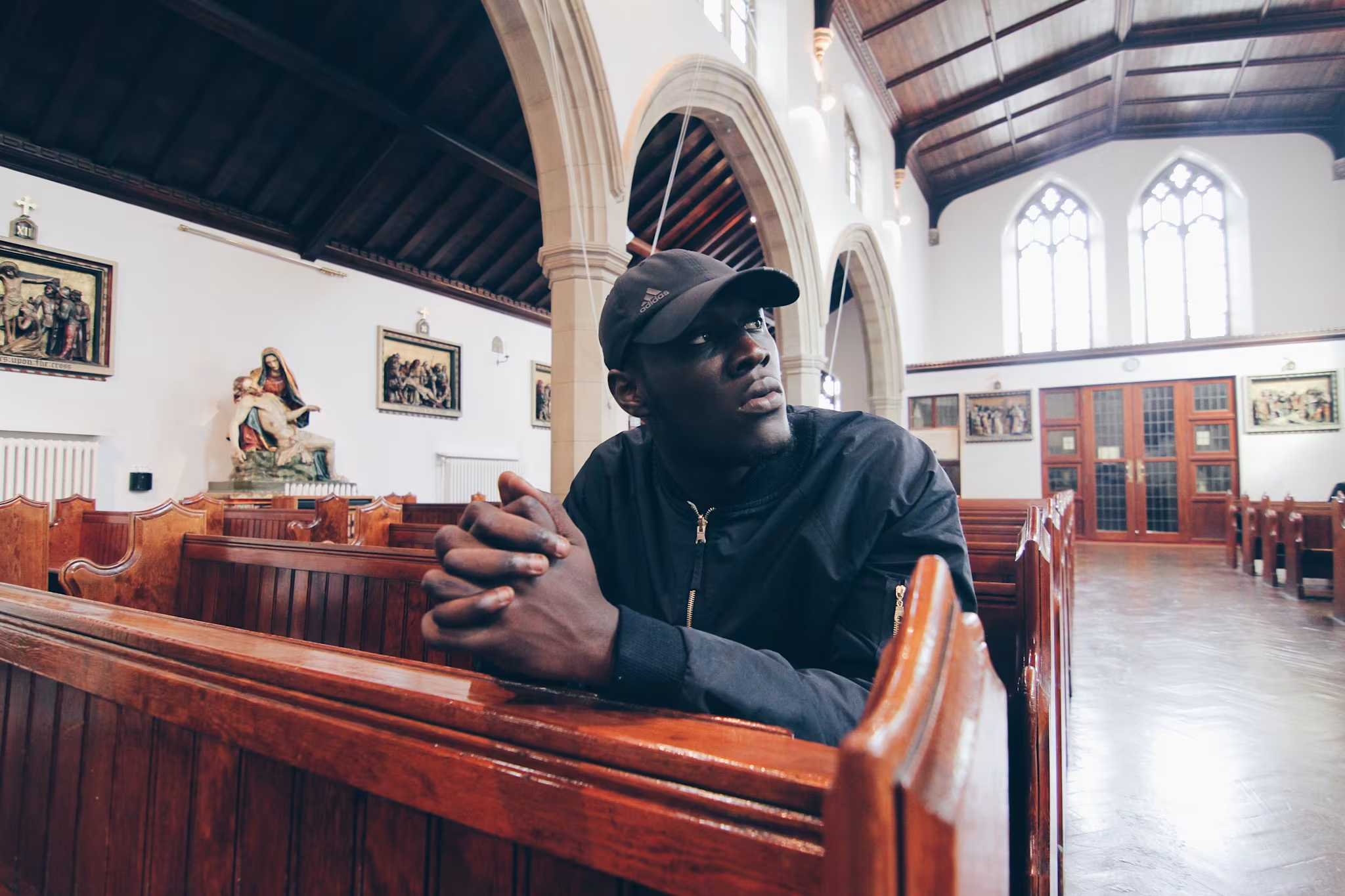
Stormzy is no longer knocking at grime’s door—he’s halfway through the frame.
Born Michael Omari and raised in South London’s Croydon, the 21-year-old MC has one of those voices you don’t forget once you’ve heard it: deep, heavy, but agile enough to switch gears without losing control. He first started putting music out around 2010, moving through road rap circles where his talent showed early, even if the direction wasn’t fully locked in yet. Still, it was obvious grime was always going to be the natural fit.
If you’ve been paying attention, Big Mikey’s rise hasn’t been loud or forced. For a long time, the buzz stayed low-key—industry whispers, word of mouth, that kind of thing. Then Wicked Skengman happened: a run of quick, no-frills freestyles that felt less like a campaign and more like Stormzy reminding people where his heart was at. Jumping on classic riddims like S-X’s “Wooo Riddim” and Ruff Sqwad’s “Pied Piper”, he sounded fully at ease—like someone reconnecting with the sound he grew up on, even if he’d felt a bit distant from the scene before. It didn’t take long for the right people to notice either, with Wiley and Skepta giving him the nod. And while Skengman got everyone listening, it was the release of Dreamers Disease in July 2014 that really changed how he was being talked about.
From there, things moved fast. October saw Stormzy win Best Grime Act at the MOBO Awards, and in the same month he became the first unsigned MC to hit Later… with Jools Holland, tearing through “Not That Deep” like he belonged there—because he did. At that point, calling him “one to watch” almost felt lazy. Stormzy was here now. But with that comes expectation. Grime’s history is full of artists who have buckled once the spotlight got too bright, and whether he asked for it or not, Stormzy’s now one of the genre’s flag-bearers.
So the real question isn’t about talent anymore—it’s about pressure. Can Big Mikey carry the weight without losing what made people believe in him in the first place? We caught up with him to find out.
COMPLEX: Your life, I’m guessing, has seen a complete 360 turnaround over the past year or so. How have you handled the transition from 9-5 worker to full-time musician?
Stormzy: I’ve just been getting on with it, to be honest. I haven’t really been getting involved with the kind of things that perhaps I should be: the raves, the girls, the glitz and glamour. I don’t really entertain it. There’s still so much work to be done and I see it as my life is still the same; I can’t afford to get caught up in that right now. But I’m not ruling it out forever. I’m just saying not for now.
When did you notice things were on the verge of blowing up?
I think it was around this time last year, when I dropped “Wicked Skengman [Freestyle] Part III”. It was causing a big stir online. Everyone was talking about it, everyone was tweeting about it, and it was from that I first started getting bookings. People wanted me to perform this freestyle at live events and uni raves. It was mad! Things were starting to really pick up. That was actually the first time Skepta clocked me, then a few other grime artists clocked me after that; everyone was just talking about it. That was the first moment I thought, “I could run with this.” I have to say: winning a MOBO helped the process, too. It’s weird, because some people said I’d done a lot before that, but others were saying that was the first time they’d heard of me. A lot of people could see that as you’re proven—you’ve got your MOBO, you’ve done your thing—but, in reality, there’s still a lot of room to show people I deserve this and that I’m here to stay.
In a recent interview you did with GRM Daily, you stated that even you thought everything was happening too fast. With that being said, do you feel like you’ve earned all of these accolades?
I’m a strong believer that if you deserve it, you will get it. I don’t think anyone is just given things, especially in music. You see Sam Smith swiping up four Grammys? He deserved that. Sometimes you might not understand it, you might have your own opinions about it, but there’s a reason why that happened. I’ve learnt to just think that I’m here for a reason. Don’t dwell on it—just take it, run with it.
Have you encountered any ignorance claiming that you “jumped” on grime’s hype?
I’ve heard a few things! But no one can really say I jumped on the grime thing. When the Skeng freestyles started, grime was still like… Grime had this resurgence late last year, and I was doing grime early 2013. And I think people are starting to understand that now. When I started, everyone was a grime spitter. There were no rappers on the ends. There was none of that! Everyone was just spitting grime, and then this UK rap scene came about. For a long time, though, I didn’t get the whole road rap thing. I thought it was too slow, and sounded too American. But I felt like I needed to adapt to it and I needed to jump on it because that’s what was happening. I’ll be honest about that. There were grime MCs, but there was no one really popping off, and UK rap was heavily popping around those times. So I started rapping. It took me a bit to get into it; I couldn’t slow it down as much because I was a proper grime kid.
UK rap came and I started with that and then I made the Wicked Skengman series. I don’t wanna sound selfish but they weren’t really for the audience; it was purely for my enjoyment. I loved grime, and I still wanted to do it—I was still sick on it. I remember talking to my camera man one time, saying: “This could be a thing where even if I have to carry on rapping, I could still have that bit of grime in me.” I just wanted to express myself on grime instrumentals.
Eventually, everyone started going nuts for it. Then grime had its resurgence. For me, I think it was like them saying, “This is where you belong.” I couldn’t neglect that. Even me putting on them freestyles was like, “Yeah, you’ve got this in you but you can’t really do it right now so do a little freestyle instead.” But the responses I’d get from people around me would be like, “Nah! You’ve got to make this a little series that you do every now and again. You can do grime. People still respect grime.” For a long time, honestly, I thought the reason people didn’t like grime was because it wasn’t that exciting to listen to or good anymore. I was listening to grime and then I stopped; something was just missing for me at one point. But then I started doing it again and now everything’s back in fashion. But that’s a whole other debate.
Of all of the grime MCs you listened to on your way up, whose lyrical style and persona behind the mic did you gravitate to the most?
Skepta. One hundred, thousand per cent. I never even try to hide that, because there’s no point. 100 percent Skepta! He was my favourite from the get-go. He was the one man I always felt that, every time you hear him spit, he reps.
What’s Stormzy’s style, flow, and energy like—in his own words?
I’m just hard-hitting with it. My energy’s always aggy, South London aggy, and I always try to keep that aggression when I’m spitting.
So we won’t be hearing any “softer” tunes from you, then.
See that’s the thing—I’m on all of that, too. For me, it’s quite difficult though, in terms of how to express that and how the public will accept it. It’s not even about the sound, it’s more that people are a bit resistant to it because they don’t respect it. It’s an art I definitely need to master, just how to execute different sides and different topics. But you’ll always respect it when it comes, simply because it’s good. I don’t think it should be a thing of, “I don’t wanna hear Stormzy doing that because it’s not grime.” If it’s good music, then it’s good music. On Blacklisted, Skeppy’s got “Somebody’s Everything”, but no one dismisses it because it’s a great song.
How has it been having all these legends, such as Wiley, supporting your every move?
It’s humbling, man. It’s mad humbling. I’m a huge fan of that scene and those people. All the people bigging me up, I’m a fan of them all. From a childhood point of view, that’s just gassed [laughs]. On one level, I want to call up my friends and family and be like, “You seen what man’s saying about me?”. But on another level, it’s just super-humbling. I feel like I’ve been passed a torch and told to rep. So that’s even more of a reason to rep; it’s not a time to kick back. At the end of the day, these are like figureheads saying it. Now, it’s about proving what everyone said was right. When an artist comes out and everyone picks them and says they’re good, more often than not, they don’t even prove themselves. It’s all air, at the end of the day. It can turn from sick things to air! It doesn’t mean anything unless you’re actually doing stuff, so you’ve got to be reppin’ all the time.
How much influence does South London have on you, and what sets that side of London apart from the rest?
I try and keep it South London at all times. Us South boys, we’ve got a certain aura about us. When we’re in the building, it’s not even a cocky thing, we’re just confident. Everywhere I go, my heart and soul is still in South London. We’ve had bare man doing their thing but we’ve never had frontrunners. In North, it’s Skeppy, Chip, and East’s been having frontrunners, from Wiley all the way to the new stock coming through. For a long time, South didn’t have much. Obviously, we’ve got Giggs and Krept & Konan—who have been badding up the game for years—but I don’t think we’ve had anyone do it big on a grime level. We’ve got [Big] Narstie, though. I always give my props to Narstie.
You’ve always made it a point to say that you’re a man of God. What do the people in your congregation think of your newfound fame?
You know how it is, JP: you just get to church and you’re humble. Nobody’s famous in the sight of God—you’ve come to repent of your sins. With my church, I don’t go every Sunday, but there’s no glitz and glamour. There’s no Stormzy in there, I’m not headlining nothing. I’m just there as a humble human being and I can’t ever forget that.
Could you see yourself ever releasing a gospel grime tune?
[Laughs] I don’t see why not. It’s not washed-up to have that emotion and to praise God; it’s actually G’d up to do that. I always try and make it known that I’m a child of God. It’s important, man.
Dreamers Disease, your debut project, was released last year summer. Tell me a bit about the meaning behind that strong title.
I started making it around this time last year and I had just quit my job. For me, it was like a leap of faith. I was hungry for it, and something needed to happen fast! Not even in an impatient way, more in terms of financially, mentally… Something needs to happen. I was in a space where I’d just left my 9-5 job and I could’ve went back to the things I did when I was younger, but I made a conscious decision not to do that; if I’m going to do music properly, I need to do it properly. I was so wrapped up in making this happen that it almost felt like a disease—it was all I could think about. It was the only thing that was on my mind. I was hell-bent on making it happen, so that’s where the name and artwork came from. But I wasn’t that surprised with the reaction. I was very content and very happy. It was another achievement for me.
You independently released “Know Me From” earlier this month, and it was close to going Top 40—were you disappointed?
It was a little disappointing. But not in a completely gutting and heartbreaking way, more in the sense that we were so close, yet so far kinda thing. Throughout impact week of the single, it was on its way to being a top 40, and then it wasn’t. It was a sick learning experience for me, though; it was my first campaign, and I had to buck up my ideas. In the grand scheme of things, all it did was put more fire in me, making me more determined and motivated.
You must have plenty offers from all the major labels right now…
There’s this whole culture of signing and being secretive with it, and that’s not me. There was an article recently saying “Stormzy’s lined up for a major deal,” but if I was looking to sign a deal people would know. I’m good with the team I’ve got right now. I’ve got my brothers around me, so I’m genuinely good and a lot of people don’t really get that. When people can’t really understand why something’s happening, they think there has to be a bigger picture. It’s like they can’t take it for what it is, but it genuinely is what it is. If I had a deal, my fans would be the first to know. Right now, I’m just not ready for it. I’m not in that space. But if I ever am in that space, I will sign a deal. But if I’m never in that space, then I won’t. If I don’t feel like I need a deal, then I won’t sign one. You know better than anyone; when you’re on this side of the industry, you understand it doesn’t mean anything. Whether you’re signed or not, you can still be the biggest artist in the world. It doesn’t matter.
Say we have a follow-up interview three years from now, in 2018—where will you be in your career?
I’ll be the most prominent figure from our scene. And in terms of everything: success, music—everything! I think you’re selling yourself short if you try and be anything less than that. If I said to you in the next three years I want a Top 40 album and a sold-out show in Camden, it makes sense to say that—I’m trying to break all the heights. Skepta, Tinie, Dizzee… I’m trying to go past all of them. I want my name to be at the top! I wanna break all that ground for the right reasons, and that’s the end goal. I don’t know how that could be measured; in album sales or the amount of shows I’ve done or the artists I’ve worked with. I don’t know how it’s measured, but I just know when I get there I want it to be so evident. I want there to be a thing where you can’t not respect it. Even if you don’t like it, you have to respect it. And that’s why I always give it to Tinie because a lot of people in our scene can look at someone like Tinie, despite the music he makes—and that’s a whole other debate—but his success is universal. This is why people rate acts like Linkin Park and Coldplay; you don’t need to understand their music or like it, but you understand that they’re the dons in their scenes. And that’s what I want to be.




