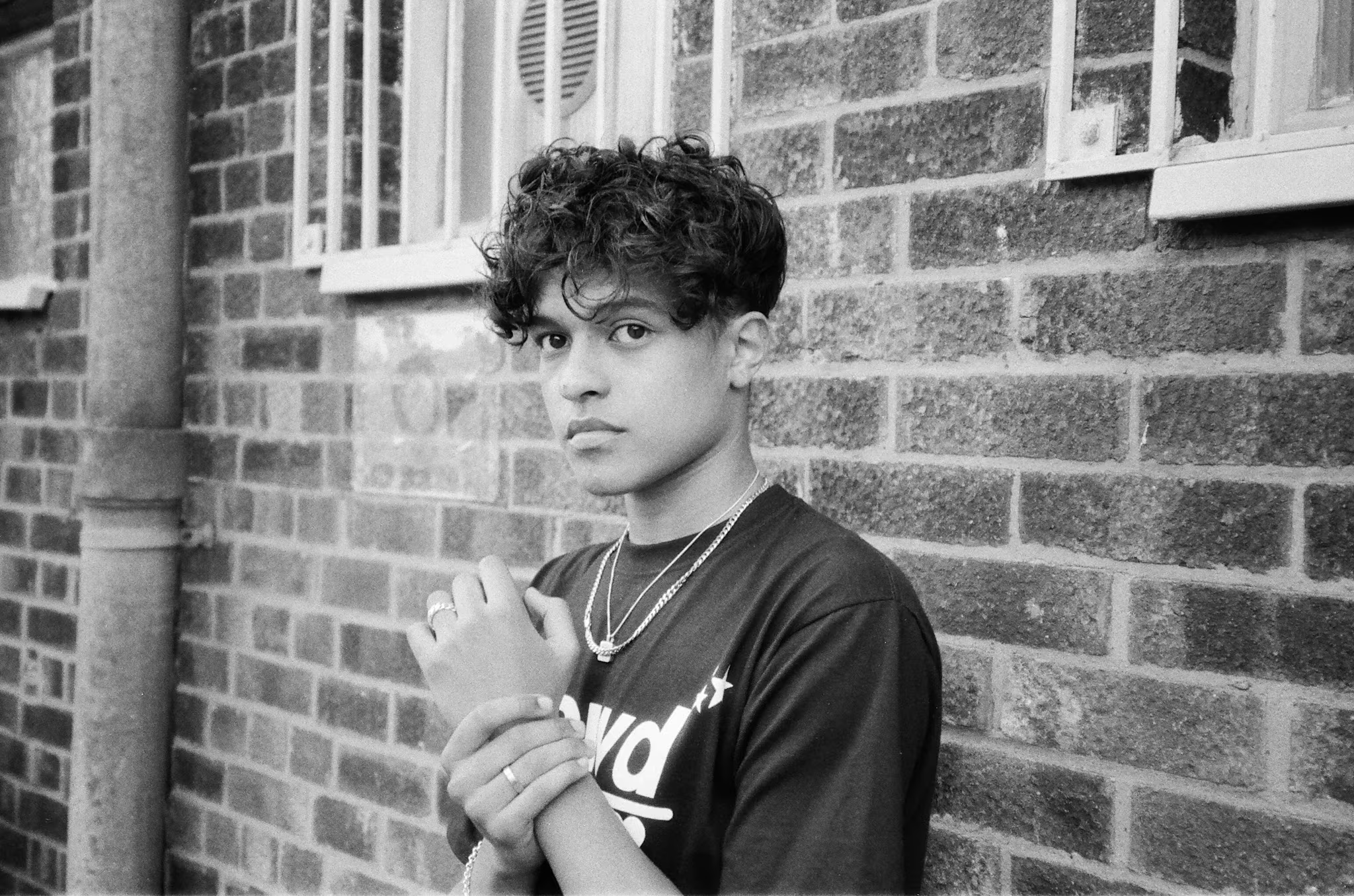
Getting your start in music during lockdown could be seen as less than ideal. You can livestream a performance, but you can’t tour, and all of your fan interactions have to go through social media. Obviously, it’s not impossible—lots of new artists enjoyed enormous success during lockdown—but it can be an odd, often isolating experience.
Fortunately for pop-R&B newcomer Kamal., he got to experience both sides of the coin. Prior to lockdown, the North-West London native played some small pub gigs in a band, and he even went to BRIT School. Then lockdown happened and he was left to his own devices. With that newfound isolation, he found a renewed focus and that solitude, he says, gave his music a “cosy” feel. But his story is much more than that and he’s far from a “lockdown” artist—in fact, his biggest successes came once he was able to go outside, collaborate, and work side-by-side with producers in studios. Best of all, that he was able to cut his teeth on the live circuit prior to lockdown, however briefly, has given him an edge in the game that cannot be substituted.
You’ll no doubt know Kamal. from his arrestingly tender contributions to Dave’s “Mercury” (one half of a two-tracker he dropped pre-We’re All Alone In This Together), which he describes as a “magical” experience. He’s also had kudos from the likes of Billie Eilish. On top of all that, early releases like “Blue”, “Homebody”, and the War Outside EP had a veil of loneliness, but he’s far from a “sad-boy”. The truth is tracks like “Better”, wrapped up in a heady infatuation, couldn’t be more optimistic. He’s not completely switching his sound, but the latest single offers a streak of hopefulness—or, at least, a contrast against that young sadness—that shows a songwriter on the cusp of something quite major.
We sat down with 19-year-old Kamal. to discuss his come-up, his creative processes, and how he’s shaping a more upbeat future for himself.
COMPLEX: Descriptors like ‘bedroom music’ have been attached to you, but how do you feel about that term?
Kamal.: I feel like it can be a bit limiting, but at the same time, it’s describing a sound that’s more cosy and more comforting than other music. So I understand why it’s used, but I feel like I don’t want to be limited to it. It’s not that other artists who come under that umbrella or that label are in a box themselves, but I feel like as I develop as an artist and as the music that I’m releasing develops, that will end up being more of a stage rather than the be-all-end-all of what I’m making. But yeah, I’m not mad at it. I listen to music that’s described as bedroom music, so I can take it as a compliment.
Well, that’s what I was going to ask: is it even accurate anymore? Do you even make music in your bedroom these days?
Lots of ideas start in my bedroom. I’ve got my keyboard to the left of me and I draft ideas on Logic quite a lot, and then I take those ideas into the studio to develop them with a producer that I’m working with. That’s the process for some of the songs that I’ve made in my bedroom, but a lot of my more recent songs started in the studio—just feeling out the room, coming up with a chord progression, and working from there. So it’s a mix, really. It’s definitely not solely confined to the four walls that I sleep in.
How did you feel when things were starting to open up again after lockdown?
I think I was very ready for it. As much as I do have a part of me that is that homebody who enjoys staying indoors and enjoys my own company, I feel like I was very much ready to be spending most of my time with my friends again. It’s something I cherish a lot.
How was lockdown for you, generally?
It wasn’t the best, but it wasn’t the worst. I mean, in some ways, it allowed me to just properly recollect myself, but it also gave me too much time to overthink and I became quite anxious, and was in my own head a bit more than I wanted to be. I was definitely grateful to be back outside once it was available.
Do you think that down time influenced your songwriting at all?
Yeah, I think the EP I dropped, War Outside, almost exclusively reflects how I felt during that period. When I listen back to those songs, they feel very periodical and I feel like you can directly relate it to that time. I think it’s a cool thing to have out as a sort of marker of that whole period.
Now that we’re out of lockdown, what effect has that had on your music? Has it changed the kind of things that you’re writing about?
I’ve just dropped one of my first ever happy songs—which is a good sign. It just allowed me to bounce off other people, other producers, other writers, in a way where I feel like a more of a developed artist now. I feel like my abilities have improved quite a lot and I’m just more comfortable with making music in general.
Were you getting concerned that you were going to be labelled like a “sad boy”?
There was this thing of, “I hope I’m not known as a ‘lockdown singer,’” but even if it was something like that, because I was able to connect with some specific people through that music, it was never going to be a mad issue because it’s like if people are feeling the sounds that I’m making, then they’re feeling the sounds that I’m making. I don’t think I need to read into it any deeper.




