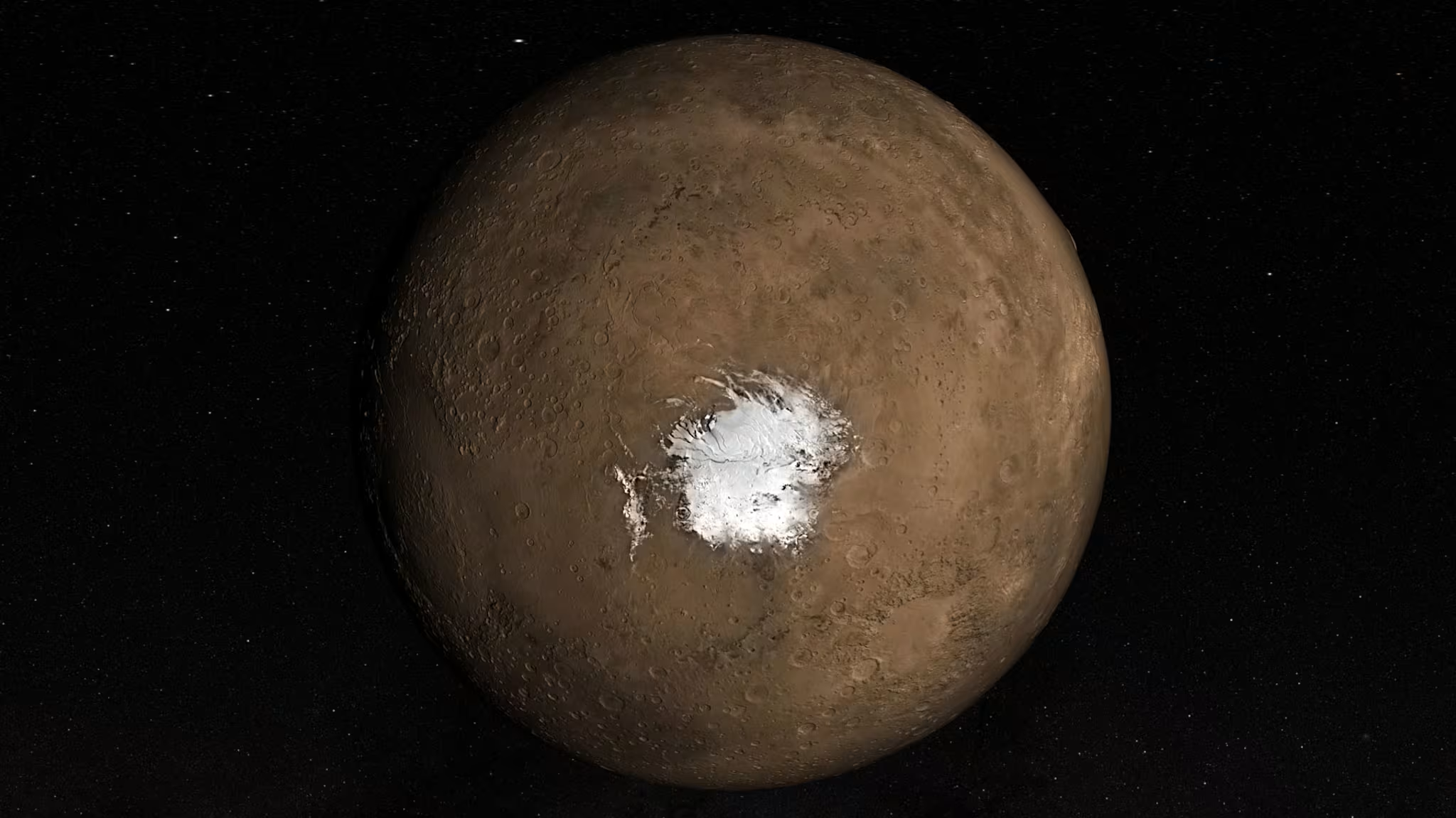
New research spearheaded by a team from Italy's Roma Tre University has bolstered an argument that there's a lake hiding under Mars' southern ice cap. This research, published on Monday in the journal Nature Astronomy, takes things further by proposing that several ponds surround the main reservoir.
In order to come to this conclusion, the researchers utilized the European Space Agency's Mars Express orbiter radar data to expand their findings around water that was initially detected back in 2018.
"Now, taking into account more data and analyzing it in a different way, three new ponds have been discovered," the ESA said via a statement on Monday.
If it exists, the largest lake would be roughly 19 miles across, and would stretch out to cover an area of about 230 square miles. Researchers believe that the water would have to be extremely salty in order to remain a liquid at the low temperatures present in the area. A previous paper (from last year) proposed that volcanic activity might be what's keeping the water from freezing, but this newest paper is going with the theory that it's because it has tons of salt.
"While it is not possible for water to remain stable on the surface today the new result opens the possibility that an entire system of ancient lakes might exist underground, perhaps millions or even billions of years old," is how the ESA put it.
Similar techniques used by researchers have helped to map subglacial lakes in Earth's arctic and in Greenland, but this find remains unclear because it's kind of hard to prove when it's on another planet with current technology.
The find could be an exciting one for anyone rooting for the discovery of life on Mars (even if it would look more like bacteria than a fully formed extra terrestrial). Unfortunately the future search will be complicated by the fact that there's more than a mile of ice between Mars' surface and the waters below.
"This area is the closest thing to ‘habitable’ on Mars that has been found so far,” says planetary scientist Roberto Orosei. Note that Orosei headed up the 2018 report.
“We don’t know exactly what is in this water,” he added. “We don’t know the concentration of salts, which could be deadly to life.”
Related Stories

Visiting Mars Just Became More Realistic With Discovery of 'Rather' Clean Ice Water
Researchers have discovered seemingly pure water ice deposits close to Mars' surface.

Astronomers Find Massive Underground Reservoir of Liquid Water on Mars
As a byproduct of the discovery of water on Mars, which is kind of a huge deal, we can only hope that Jared Leto will finally retire 'Thirty Seconds to Mars' for good.

NASA Finds Definitive Evidence of Water on Mars
This is great promotion for the new Matt Damon movie 'The Martian.'




