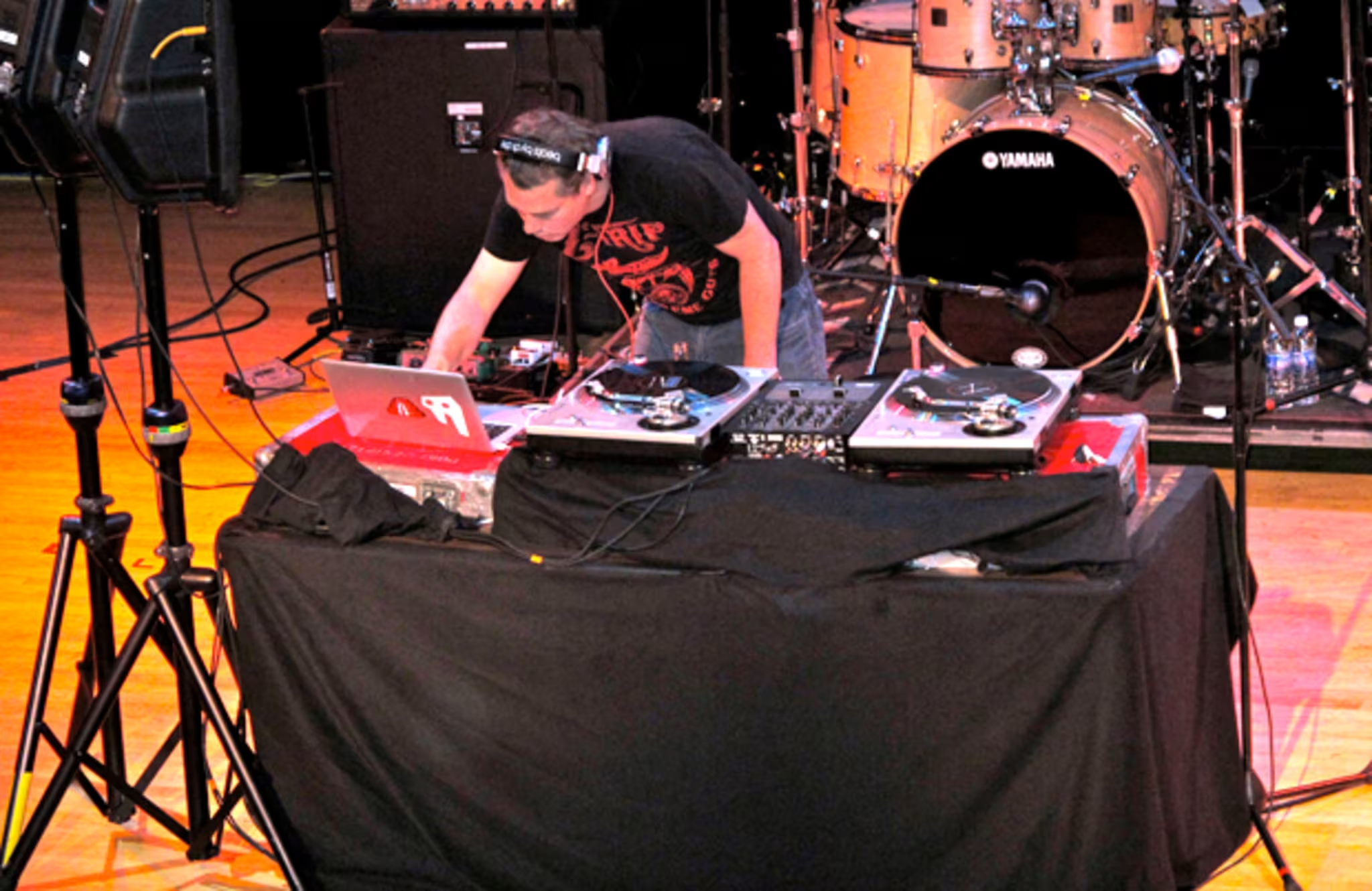
Last Thursday, MoveOn.org’s Rebuild the Dream movement held an event in New York, where green economy activist and human rights pioneer Van Jones gave a speech to launch his platform. The Roots rocked the stage, and Shepard Fairey spun a set to warm the audience up. It was an opportunity for us to catch up with Shepard, so we sat down with him to talk about the way he responds to negative media attention, his political engagement, the tumblr generation, and whether he'll do a 2012 version of "HOPE". Click through to read our interview with the OBEY artist.
What's your relationship with MoveOn.org?
”I work on a lot of different initiatives with MoveOn. Some of the issues are more substantial, like Clean Energy for America, who I did a poster for and created a logo. And I have a lot of friends that are friends with Van Jones, so I’ve just been following what he’s been doing. His premise is something I firmly believe in--a lot of Americans have either been manipulated into thinking that the good ol’ days are over, or they’re acting against their own best interest; people saying that health care reform is a bad thing, etc.--anything I can do for something like this, I’m excited to do it."
How did growing up during the Reagan era, when politics and the corporate climate really shifted, influence your art?
“I grew up in South Carolina, which was really conservative. But I got into skateboarding and punk rock, and when I was about 14, I got into the Dead Kennedys. They talked about Reagan’s foreign policy, oil interests, and the use of the communist threat as a way to further American financial interests around the globe. As an optimist I always thought, ‘Well, the U.S. is the U.S., we’re the good guys, and the government always does the right thing, and corporations want you to live the American dream.’ But I realized that’s not always the case. Punk rock has a critical side and rebellious side to it that has fostered some of my provocative work.”
Young people are exposed to art in an extremely different way now than even 5 years ago. How do you think kids now are going to approach art differently? Is tumblr the new street art?
“I think that any way people experience something powerful is legitimate. But from the safety of your bedroom, sitting in front of a computer, is probably not going to be the most arresting experience. It’s very safe, and a lot of people like it because it’s safe. You can take risks because you’re not taking them face to face. But I’m always going to respond to street art because it’s taking a risk. It’s an act of defiance. There’s an implicit political statement, even if the content of the message isn’t political, when you encounter it on the street. The person had to be courageous enough to break the rules to do it. I’m inspired by that, and I respond to that."
newslide
How is street art changing? Will street art ever go away?
"I don’t think that’s ever going to go away, but I do think that the way people comment on it is changing. And I think that the way that a street artist used to be able to incubate in anonymity, strengthen, and then get the attention of galleries or magazines, and then the person could, more fully formed, engage in a way that made them more vulnerable, has changed. Now, you’re vulnerable from the moment you do anything that exists in public. I’ve been doing my thing now for 22 years, I should have really thick skin by now, but I don’t. It still really hurts my feelings every time I see stuff about ‘How whack I am’, or ‘How paid’, or ‘How much of a sellout I am’.
"It takes a lot more courage to stand for something. Punk rock and hip hop have this sort of rebelliousness that made me scrutinize things instead of being prone to just swallowing every piece of information that came my way. Eventually it made me realize how important it is, when you sift through the bullshit, to stand behind the things that aren’t bullshit. It leaves you very vulnerable to attack when you choose to stand for something.”
Will you do a new version of the HOPE poster for 2012?
“Well 2008 was a fairly unique circumstance in that things had gotten really really bad under Bush. I had a lot of motivation to change the culture away from the Bush direction as much as I could. And to support someone that I thought was symbolic of that culture changing in the right direction. Now I think Obama is more of a known quantity; the economy, even though it’s not Obama’s fault, is in shambles, and people just have the ‘throw the bums out’ mentality, and just throw whoever is in office out of office. He has a new set of challenges. Now he won’t be seen as a person you can say will work miracles.
“If I made a poster supporting his candidacy, it certainly wouldn’t be a portrait glorifying him, that strategy wouldn’t work. The way the media breaks it down, you’re either a brainwashed, ‘Drink the Kool Aid’ disciple, or you’re a traitor. One article said, ‘Obama HOPE Artist Loses Hope.’ It’s insulting. It’s a lot more complicated than that. I would do something for Obama’s candidacy, but it would probably be around an important issue. Ultimately, I supported Obama because of his stance on issues I cared about, not because he was someone I supported unconditionally as a person.”
I read that you got into music because you had an expansive record collection and that your DJ friends told you that you should be a DJ. When and how did you start collecting music in the first place?
“Where I grew up in South Carolina was pretty conservative, so music was an escapist outlet for me. The amazing thing about music, just like art, is it can be really a visceral enjoyable experience. I loved classic rock, the Beatles the Rolling Stones, Cars, Joan Jet. But then I got into the Clash, the Sex Pistols, the Dead Kennedys, Bad Brains, Black Flag. And that was something that I related to because it was something that questioned things, it energized me because it was aggressive and it went well with skateboarding. And then I got into Run DMC, and the Beastie Boys and then Eric B and Rakim and Public Enemy and a Tribe Called Quest. And hip hop as an underground culture with a lot of the same DIY ethics that punk rock has.
"I always loved music so becoming a DJ as a hobby is a way for me to be able to share my loves sonically and philosophically since a lot of the music has a message in it that I like.”




