Image via Complex Original
The 1990s were one of the great stretches in NBA history, with some of the game’s greatest players plying their trade during this all-important decade. It was also a period of huge transition for the league, as guys like Larry Bird and Magic Johnson retired and Michael Jordan (and a slew of others) took their place as the faces of the league. It was, likewise, a glorious time to be a fan; the explosion of the sport’s popularity meant numerous national TV games, ubiquitous stars, and ample merchandising opportunities.
It was truly a great time to be a fan. You had distinct players on almost every team, many ways to rep your favorite squad, and could watch the game’s best play on TV almost every week in the featured national games. You also could be the envy of all your friends if you latched onto the coolest fashion trends, which thanks in part to ample TV advertising began to sweep the nation. While there are surely many more, here are 20 Ways to Tell If You Were an NBA Fan in the '90s.
RELATED: 20 Reasons Why the NBA Was Better in the '90s
RELATED: Go Back to 1996 on Space Jam Website
The Slam Dunk Contest was must-watch TV.
While there were a couple snoozers that made fans long for the Michael Jordan-Dominique Wilkins battles of the 1980s (I mean seriously, Brent Barry?), the Slam Dunk Contest was appointment television during All-Star weekend. The decade began with two of the best, as Wilkins and Dee Brown both captured the title with nearly perfect scores and unleashed several dunks that have become all-time highlights. We even got to see rising star Kobe Bryant do his thing, with his title-winning between the legs/windmill dunk putting everyone in the NBA on notice that this 18-year-old wasn't going anywhere.
You collected trading cards religiously.
The internet has rendered trading cards pretty much obsolete, but if you loved the NBA in the 1990s you know that there was nothing better than taking that hard-earned allowance down to the local card shop and picking up a pack of Fleer, Skybox, or any other kind of cards. You were always hoping to be lucky enough to snag that precious rookie card, the one that would instantly make you rich and make your collection the envy of all your friends. But, like most of us, you now probably have huge stacks of cards dumped into shoeboxes gathering dust somewhere in your parents' closets or attic.
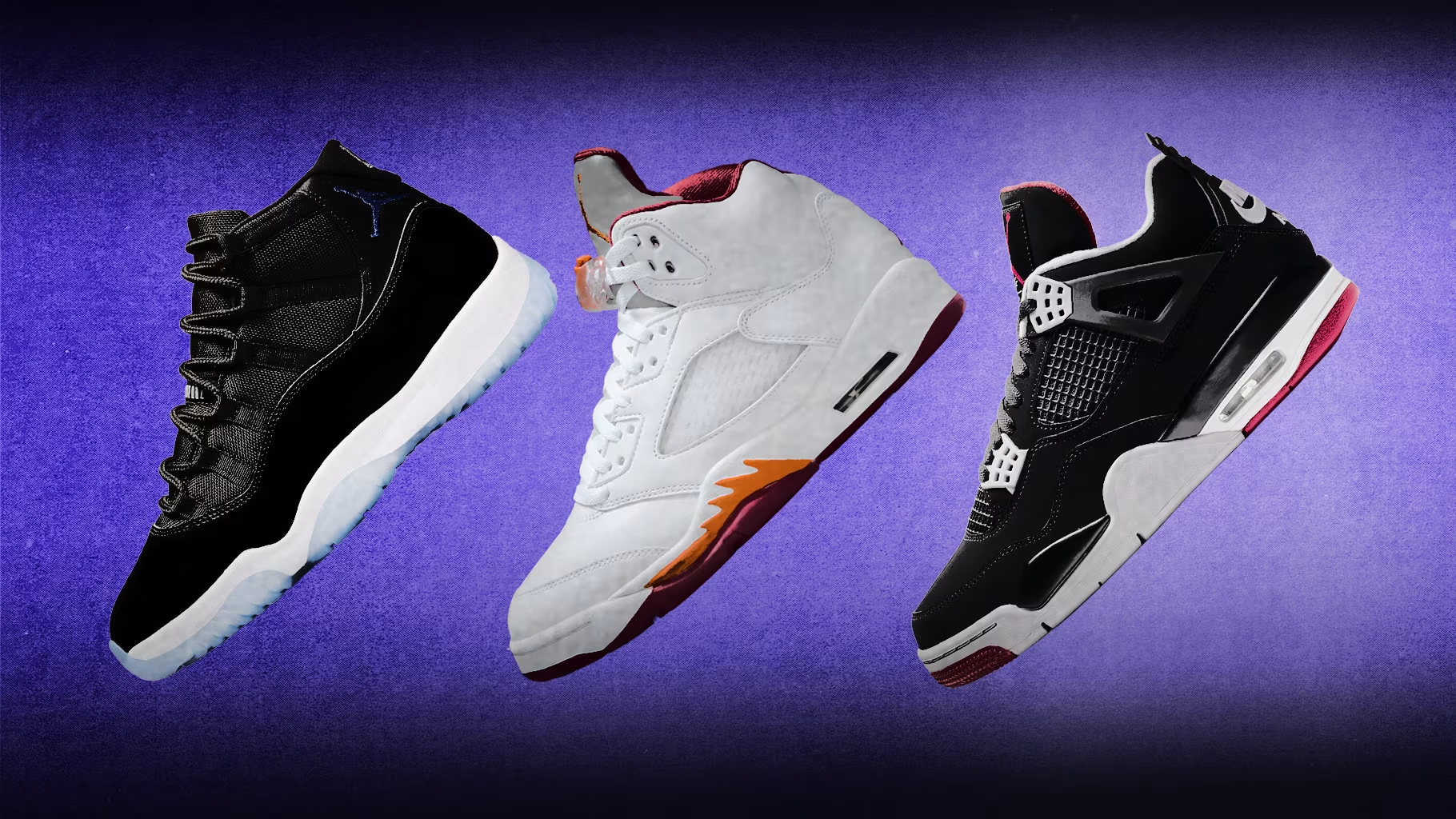
You prefer Reebok Pumps or Air Jordan XIs over any sneakers today's players wear.
Kobes, LeBrons, KDs, D-Roses, these are all fine sneakers and worthy choices for your balling or fashion adventures. However, if you really want to make a statement, there is still no better pair of shoes to put on your feet than any one of a number of Air Jordans. There's a reason that guys like Ray Allen still rock the 1990s Air Jordans; the XIs and XIIIs were, basically, the pinnacle of sneaker technology, and continue to be superior to the majority of the shoes players wear today. Other shoes of the 1990s such as Reebok Pumps and Nike Foamposites continue to be huge sellers today as well, and are always a fan favorite when spotted on the court.
You can still name every member of the original Dream Team.
Not only is this one of your favorite teams of all time, but if anyone asks, you will probably argue passionately that this is the greatest basketball team ever assembled. And you would certainly have a good case; the team is in the Hall of Fame, as are 11 of its 12 members (sorry, Christian Laettner), and they won every game by an average of 43.8 points, and players from opposing teams would line up to get their autographs before the games had even started. They were a global phenomenon, and if you have any doubt about their influence just wear one of their jerseys out in public and listen to the reaction you get. Plus, the Dream Team (and Charles Barkley) gave us this unforgettable quote: "I don't know anything about Angola, but Angola's in trouble."
You knew who everyone in the draft was.
Before Kevin Garnett truly got the prep-to-pro movement underway in 1995, the NBA Draft was made up almost entirely of the college stars you had just finished watching mere weeks before. Not only that, but oftentimes these players were juniors or seniors, guys you had seen play for multiple years before they put on an NBA uniform. A "one and done" was so rare that players who did it were incredibly well-known, and furthermore the dearth of international players in the league meant that if one happened to be in the draft, he'd be such an oddity that everyone would know who he was too. Today, with so many foreigners and "one and done" guys from every school, it's virtually impossible to know (and argue about) each drafted player.
You still call the Wizards "the Bullets."
Maybe it's force of habit, or maybe it's because you think the warlock logo and theme is incredibly stupid, but the Washington NBA team will always be the Bullets. We get the philosophy behind the 1997 name change; nobody wants to be a mascot for gun violence. However, let's be honest here: Who really thinks that naming a team the Bullets associates you with crime? It really says something that the Wizards are now actually trying to get back to their roots, changing their colors back to red, white, and blue and dropping hints that a name change isn't far behind. So stay strong, people, pretty soon everyone will be back to calling them by their proper name.
You had these sheets on your bed.
Especially when you're younger, when you get into something you really eat, sleep, and breathe it. If you loved the NBA, you had no choice but to watch every game you could, play basketball in your spare time, and when you needed to rest, you made sure your bed showed your allegiance to anyone who entered your room. It didn't matter who your favorite team was, it was most important that you represented the league you loved even when you weren't conscious. However, it certainly got mom or dad bonus points if they put your team's logo front and center when they put the sheets on.
You wore your favorite team's Starter jacket almost year-round.
There was no greater sign of allegiance on the playgrounds than a Starter jacket. With its bright colors, incredible warmth, and multiple team logos, this jacket gave the '90s NBA fan everything one could ever ask for in the winter months. And, really, you probably loved your Starter jacket so much that you wore it even at less appropriate times. With word dropping this summer that they're coming back to store shelves soon, Starter jackets are poised to make a huge comeback and bring joy to all 1990s NBA fans.
You know who the Czar of the Telestrator is.
Mike Fratello enjoyed a brief period of unemployment from the coaching ranks in the early 1990s, and in that time it allowed him to partner up with Marv Albert and earn a moniker that will likely be his most lasting legacy. The "Czar of the Telestrator" as Albert called him was a whiz at diagramming plays for viewers and immediately making sense of what we all had just seen on the court. The term is now largely ceremonial, as while Fratello and Albert continue to work together on occasion, the telestrator has evolved such that Fratello no longer has to show off his artistic skills when rehashing an on-court sequence.
You loved the commercials with 'Lil Penny.
You may think that Team America: World Police was the moment society came to except marionettes as a legitimate comedy vehicle, but you would be wrong. That distinction belongs to Lil' Penny (voiced by Chris Rock), who not only introduced the world to whatever Penny Hardaway's newest shoes were, but also provided the kind of wiseass trash-talking most often heard on the playground. He was always hilarious, right down to his "1/2" jersey and miniaturized Nikes, and anytime a new ad debuted it was always big news.
You could actually afford to go to a game.
If your local team sucks, you can probably still afford to go to a game. But with the new model for pricing tickets, it's virtually impossible to watch your team play against anyone halfway decent in today's NBA. Not so in the 1990s, though. With the exception of teams like the Bulls, tickets in all sections for almost any game were readily available and affordable. Not only that, but the arena food (while obviously terrible tasting and unhealthy) wouldn't bankrupt you once you finally could afford to get inside. While the experience may have been a little less posh, it was a hell of a lot cheaper.
You fondly remember the ugly jerseys worn by the Nets, Hawks, Raptors, and others.
If there was one thing the 1990s was good for, it was bright colors everywhere. It didn't matter what aspect of popular culture it was; loud colors dominated the landscape, nearly blinding you at every turn. The NBA, thinking the NFL didn't take things far enough in the 1980s with Zubaz pants, kicked it up a notch by breaking out some of the most ridiculous jerseys in the history of sports. Almost every team was subjected to some kind of tank top horror, and yet as fans we never batted an eyelash in consenting to this madness. It's fun to look back on them now and wear these jerseys just for laughs, but let's be real: these are some of the ugliest clothes ever made.
You remember what Dennis Rodman looked like with black hair and one tattoo.
The "Bad Boy" Pistons were given their edge not just by Hall of Famers Isiah Thomas and Joe Dumars. No, it took the nasty interior combination of Bill Laimbeer, John Salley, and Dennis Rodman to really solidify their reputation as one of the toughest (and dirtiest) teams ever to play. While his behavior was certainly bizarre during this period, Rodman never exhibited some of the traits (like kicking a cameraman in the groin) that would later get him suspended from the league and labeled as a possible psychopath. No, he was just another run-of-the-mill tough guy who occasionally took things too far. Ah, the good old days.
Muggsy Bogues made you think you could be in the NBA.
Everyone who has picked up a basketball has dreamed of playing in the NBA. Somehwere along the line, though, reality sets in. You realize that you aren't going to be 6'8" and you don't have a 40" vertical. However, for those who grew up watching 1990s hoops there was hope, and his name was Tyrone "Muggsy" Bogues. Muggsy was just 5'3" and couldn't even palm a basketball. The fact that he played for 14 seasons made it seem possible that anyone could play in the league. The problem was that he had several significantly above average traits: his vertical leap was 44", he was an astonishingly good passer, played superb defense and he could get up and down the court faster than anyone in the NBA. Sorry, short guys; Muggsy is proof that your dream just it isn't going to happen.
You wanted to be "Like Mike."
What kid who played basketball didn't idolize Michael Jordan? Some of this wasn't entirely our own doing; Jordan was everywhere, and in the days before YouTube and non-stop NBA coverage on TV you basically had the guys on your local team and MJ to choose from in the race to be your favorite player. And for anyone who didn't live in Chicago, your home team was always eventually losing to the Bulls anyway. So, really, what choice did you have? The ubiquitous Jordan was an icon in every sense, hawking all manner of products and serving as the face of the NBA for the entire decade (even after both of his retirements).
Your favorite video game is NBA Jam.
This one almost doesn't even need explanation. For most basketball gamers, NBA Jam is still the hands-down best game ever created. Mixing and matching the two-man teams, heating up, going on fire, shoving your opponents, capturing the ever-elusive "team fire," these were all just some of the features that made this game a smash hit across multiple video game platforms and led to more fights between friends and siblings than almost any sports game in history. It was all about strategy; did you want to go with a big and a shooter? A high-flyer and crafty point guard? Double big men for brute force inside? Double guards for crazy speed? With so many possibilities, you could (and some of us still do) play NBA Jam for hours on end without getting sick of it.
Space Jam, Kazaam, and My Giant are some of your favorite movies.
For whatever reason, the 1990s were a decade where movie executives collectively decided that all basketball players were capable of being in movies. The transcendental Space Jam set the gold standard, with not just Michael Jordan but also Shawn Bradley, Patrick Ewing, Charles Barkley, Larry Johnson, and Muggsy Bogues all turning in Oscar-worthy performances. (As a side note, what kind of team were the Monstars trying to assemble, exactly? Who was playing shooting guard? They had two true centers and two power forwards, with nobody who could play the wing spots. Bad general managing by them). Kazaam (Shaq) and My Giant (Gheorge Muresan) were two other instant classics that turned basketball players into film actors, although shockingly none of these really led to a second career in Hollywood for their hooping stars. And we're kidding about the classic part.
You watched NBA Inside Stuff with Ahmad Rashad and Summer Sanders.
After you got up and crushed some Frosted Flakes, was there anything better than flipping on NBC, kicking back, and watching Ahmad and Summer do their thing on NBA Inside Stuff? Before NBA TV or 24-hour SportsCenter existed, this is where you had to go to catch up on the week of NBA highlights. The "Jam Session" segment was always the highlight; you got to see whatever sick posterization Dominique Wilkins, Shawn Kemp, or someone else had unleashed that week, with of course the classic blooper reel or player interview mixed in.
You remember when hard fouls, taunting, and fights weren't a big deal.
While it may be a good thing that some of the shenanigans from 1990s basketball have found their way out of the game, you have to admit that it's kind of a bummer not to have some of the general roughhousing that used to go on during NBA games. All the flagrants and double technicals are boring; I'll take Charles Oakley throwing elbows, Jeff Van Gundy grabbing legs, and Dikembe Mutombo wagging his finger in everybody's face. On defense, we had the Jordan Rules; now we have the "blow on Kobe Bryant and he goes to the foul line" (the same thing happened with Jordan, too) rules. We will say, though, that it's nice to not have to worry about another Malice at the Palace happening.
You still love the "NBA on NBC" theme song.
The jam known as "Roundall Rock" by syndicated radio DJ John Tesh is, undeniably, the theme song to the 1990s NBA as a whole. It's a song that even now immediately summons feelings of nostalgia and takes us all back to some of the signature moments of that incredible decade of basketball. NBC really nailed that whole introduction; not only do they have the great song, but they also masterfully interspersed video highlights that were absolutely perfect at getting you fired up for whatever game happened to be on. Quite simply, with the exception of possibly Monday Night Football, no sports program on TV has ever had a better opening song.