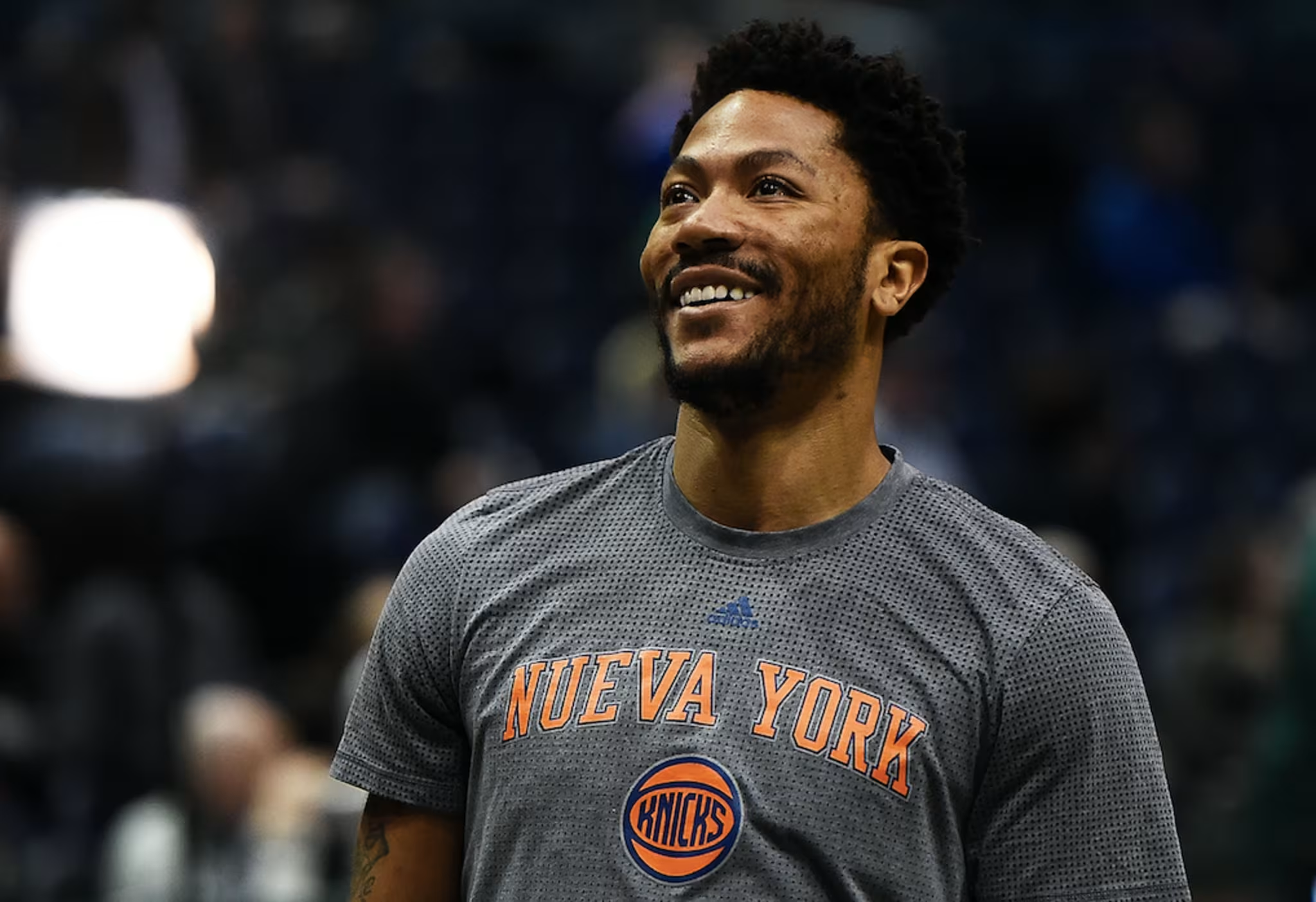
Image via Getty/Stacy Revere
It seems as though the easiest route to becoming a multi-millionaire in America today is to have one halfway-decent season in the NBA ahead of free agency. Or at least that’s how it seemed last offseason, which was notable for lackluster athletes receiving substantial sums of cash for their services. Guys like Timofey Mozgov, Ian Mahinmi, and Evan Turner make contracts that could have made them the highest-paid players in The Association back in the ‘90s, despite the fact that they were only marginally-impactful players at best.
And those kinds of NBA salaries are only going to grow more common this season. With a new collective bargaining agreement that’s going to kick in, professional athlete salaries are going to rise along with a salary cap that’s shot up exponentially over the last 20 years. The cap is projected to rise to $121 million next season, up from $113 million this season. It was a mere $34 million in 1999-00 and $57.7 million in 2009-10, so that’s a pretty, pretty, pretty big jump.
Having a cap that allows these kinds of contracts means that the NBA has a high percentage of players who most would consider “overpaid”, and don't deserve the dollars they're receiving—far more than the NFL or MLB. Since revenue is divided into two pools, the players’ pool and the owners’ pool, and since the NBA has fewer players in the league than any other sport, they are naturally going to get a bigger share of the cash. But some guys are just plain overpaid, not by virtue of a CBA that benefits so-so players, but by the ineptitude of teams (usually the Knicks) or simply by virtue of injuries and age catching up to a once-great star. It was unsightly to see Kobe Bryant play as poorly as he did his last two seasons, and the Lakers probably weren’t thrilled by the fact that they had to pay him over $48 million total for that time, either.
With that in mind, let’s take a look at the most overpaid players in the NBA.
Dwight Howard
Team: Hawks
2016-17 stats: 74 G, 13.5 PPG, 12.7 RPG, 1.2 BPG
Salary: $22.3 million
Howard is a far cry from the player who carried the Magic to the 2009 NBA Finals, as evidenced by his sharp decline in scoring. But this decline hasn’t stopped Howard from commanding the 13th-highest salary in the NBA, or being the highest-paid player on the Hawks. Despite what’s usually seen as a decline—and for good reason—this year represented a marked improvement for Howard nonetheless, especially in the advanced analytics department. His 8.3 win shares was his highest mark since 2011 with the Magic, and his player efficiency rating topped 20 for just the second time since he left Orlando. So the Hawks should be satisfied with Howard’s season as they continue to shell out big bucks.
Tim Duncan
Team: Spurs
2016-17 stats: None
Salary: $1.8 million
Imagine making $1.8 million a year by doing literally nothing. That’s what Tim Duncan did this season, and that’s going to be the case again next season. Duncan retired with one year and $6.3 million left on his final contract, so a buyout agreement between him and the Spurs calls for him to make $1.8 million a year through 2019.
Given what the Spurs got out of Duncan for 20 seasons, it’s hard to say that he didn’t earn a couple extra million as a “thank you” from the team. The same can’t be said of other buyout structures in other sports—take Bobby Bonilla’s deal with the Mets as an example. He’s getting paid $1.1 million a year through 2035, and he hasn’t played for them since 1999.
Kevin Garnett
Team: Timberwolves
2016-17 stats: None
Salary: $8 million
Area 21 on TNT seems to have been a success this season, meaning Turner was probably justified in bringing Garnett onto its pregame show. But Garnett didn’t do much this year to justify his $8 million salary for the Timberwolves. In fact, he didn’t do anything to justify it. Garnett retired with a year and $8 million left on his contract, which apparently was paid in full. According to Basketball Reference, Garnett’s salary was the third-highest on the Timberwolves this year, behind just Ricky Rubio and Nikola Pekovic.
But this $8 million is just pennies to KG, who, with over $325 million in career earnings, is the highest-paid player in NBA history. Garnett still reportedly has $35 million to be made after his retirement, on contract extensions he had with the Timberwolves and Celtics. That adds up to about $350 million total, and that’s not even counting what he’s making at TNT.
Evan Turner
Team: Trail Blazers
2016-17 stats: 65 G, 9.0 PPG, 3.8 RPG, 3.2 APG
Salary: $16.3 million
The former No. 2 overall pick never lived up to the hype of his selection as a Sixer. But Turner established himself as a stellar option off the Celtics’ bench last season, averaging 10.5 points per game on a whopping .456 from the field. He was able to turn this into a four-year, $70 million contract, one that earned him $16.3 million this season.
Turner’s play tapered off quite a bit from this season compared to last in most conventional statistics, but particularly in the advanced analytics. He recorded 1.2 win shares this season, down from 4.0 last season, and his value over replacement players fell to -0.3—almost a full point less than his 0.8 mark in 2016.
Allen Crabbe
Team: Trail Blazers
2016-17 stats: 79 G, 10.7 PPG, 2.8 RPG, 1.2 APG
Salary: $18.5 million
Crabbe is a solid role player. A solid role player who makes more than superstars Paul George, Kyrie Irving, Jimmy Butler, and John Wall. After barely playing during his first two seasons, Crabbe had a breakout 2016 season in which he shot .459 from the field and .393 from three-point range, as he became a restricted free agent. The Nets—in their eternal wisdom—offered him a four-year, $75 million offer sheet. It’s reasonable to see the Nets making a deal like this, since they have no high draft picks until 2019 and a roster chock full of what Stephen A. Smith would call “bonafide scrubs.” But the Blazers shocked the basketball world by matching the offer sheet, making Crabbe the 31st-highest paid player in the NBA this season.
Derrick Rose
Team: Knicks
2016-17 stats: 64 G, 18.8 PPG, 3.8 RPG, 4.4 APG
Salary: $21.3 million
Rose cashed in after his MVP season in 2011, with a five-year, $94 million contract. So he’s still able to get paid like an MVP, despite not playing like one in five years. It’s not that D-Rose is a terrible player; when he’s healthy, he’s still one of the better point guards in the NBA. But injuries have clearly taken a toll on his career, which is unfortunate, given how great he was just a few years ago. Rose will be a free agent this offseason, so it’s safe to say he’ll be making less than $21.3 million next season.
Luol Deng
Team: Lakers
2016-17 stats: 56 G, 7.6 PPG, 5.3 RPG, 1.3 APG
Salary: $18 million
Deng’s four-year, $72 million contract with the Lakers looks to be a disaster for several reasons, primarily how poorly he played last season: Deng posted career lows in points, assists, and field-goal percentage. And that’s just the first year of a four-year deal—one that pays Deng $18 million annually, and one that won’t end until Deng is 35 years old. It’s hard to imagine Deng gaining his 2012-2013 All-Star form in his mid-30s.
Good job, Lakers.
Joakim Noah
Team: Knicks
2016-17 stats: 46 G, 5.0 PPG, 8.7 RPG, 0.8 BPG
Salary: $17 million
Noah, like Rose, was great with the Bulls. Then he went to the Knicks. Things have gone downhill fast for Noah since he was named Defensive Player of the Year in 2014. For illustration, here’s a side-by-side comparison of his 2013-14 statline and his line from this season:
2013-14: 12.6 PPG, 11.3 RPG, 5.4 APG, 5.4 SPG, 1.5 BPG
2016-17: 5.0 PPG, 8.7 RPG, 2.2 APG, 0.7 SPG, 0.8 BPG
Noah’s defensive rating, which measures an estimated points allowed by a player per 100 possessions, has also declined sharply, from a league-best 96 in 2014 to a career-worst 108 last season. However, he’ll be making big bucks for years to come, as his four-year, $72 million contract runs through 2020. You can thank Phil Jackson for that one, Knicks fans. Oh, and Noah also failed a drug test and received a 20-game suspension.
Timofey Mozgov
Team: Lakers
2016-17 stats: 54 G, 7.4 PPG, 4.9 RPG, 0.6 BPG
Salary: $16 million
There used to be a time where playing for the Lakers served as the pinnacle of any player’s career. This is not one of those times.
Despite the fact that he had never aveaged double figures in points, and the fact that he averaged more than five rebounds in a season just twice, and the fact that he’s, well, Timofey Mozgov, Timofey Mozgov inked a four-year, $64 million contract with the Lakers. The center became the posterchild for mediocre players cashing in on huge paydays last offseason when he signed this contract and became one of the first players of the offseason to sign. These aren’t your father’s Lakers.
Ian Mahinmi
Team: Wizards
2016-17 stats: 31 G, 5.6 PPG, 4.8 RPG, 1.1 SPG
Salary: $16 million
Mahinmi had a lifetime average of 4.3 points per game in seven seasons leading up to 2015-16, and never averaged more than 18 minutes per game. Then, the departure of Roy Hibbert thrusted Mahinmi into the starting center position, in which he did a pretty solid job. Mahinmi started 71 games for the Pacers that year, averaging 9.3 points per game, 7.7 rebounds per game, and 1.1 blocks per game. And despite not having any real track record outside to back that up, the Wizards signed him to a four-year, $64 million contract last season.
This move had little impact on the Wizards this season. Mahinmi played in just 31 games this year thanks to lingering knee injuries, and his averages fell in every major category. Even if he plays like he did with the Pacers last season, you’re still paying $16 million a year to a backup center. This could also be a prohibitive contract if the team wants to add players to supplement John Wall and Bradley Beal.
Chandler Parsons
Team: Grizzlies
2016-17 stats: 34 G, 6.2 PPG, 2.5 RPG, 1.6 APG
Salary: $22.1 million
Memphis isn’t exactly a marquee destination for free agents; you’ll never hear LeBron say he’s taking his talents to Tennessee. So, if the Grizzlies want to get any quasi-relevant player to sign with them, they’re going to have to overpay. And that’s just what they did with Chandler Parsons last season. Parsons, who averaged a respectable 15.4 points per game from 2012-13 through 2015-16, inked a four-year, $94 million contract with Memphis. This made him the 18th-highest paid player in the NBA, a pretty good deal for someone who has never been a superstar—or even made an All-Star team, for that matter.
The contract still would have represented a gross overcompensation if Parsons had played at his 2013-2016 pace, but the Grizzlies didn’t even get that out of him this season. He played in just 34 games due to a myriad of knee injuries, which can’t bode well for his future in the NBA, and averaged a career-low 6.2 points per game.
Chris Bosh
Team: Heat
2016-17 stats: None
Salary: $23.7 million
Bosh’s career is likely over due to a heart issue, which is unfortunate because of how truly great he was in his 13-years playing. This situation has also led to quite the conflict between Bosh and the Heat. Despite the fact that Bosh failed a physical this season and was unable to play all year, he is still not officially retired and hopes to make a comeback. The Heat feel, as do several NBA doctors who have examined Bosh, that his heart ailment is a career-ender. While this complicated confrontation has taken place, Bosh’s $23.7 million contract has continued to count against the team’s salary cap.
Miami is working on a deal with Bosh and the Players’ Association to get his salary off the books, but any official deal would still likely allow Bosh to collect the $52 million still owed to him over the next two seasons. Bosh was the 11th-highest-paid player in the league this season, despite not playing a single game, and he’ll be among the highest the next two seasons, as well. All the while, playing again remains unlikely.
An 11-time All-Star, Bosh was perhaps the most underrated and underappreciated player of his generation. He played much of his early career in obscurity with bad Raptors teams, and was known mostly as “That Third Guy” on the Heat Big Three teams. He may have never received the fanfare or media attention that he deserved, but at least he’ll be leaving the NBA with quite the payday.




