None
The distance between Allyson Felix and history didn’t amount to much in the end. It was ultimately measured in meters—two batches of 400—at this year’s Olympics in Tokyo. She, a sprinter of inexhaustible talent and speed, had been slicing it away in chunks of track every four years.
She started at the Olympics in Athens in 2004, picking up a silver in the 200-meter. In Beijing, in 2008, she earned another silver in the same event and her first gold, in the 4x400-meter relay. Felix added three more golds to her tally in London in 2012, then two more and another silver in Rio de Janeiro in 2016. She was on her way toward becoming the most decorated American athlete in Olympic track and field history.
Then, in 2018, for the first time, she slowed down. Felix was pregnant, so she started racing less, granting herself a rare break in a long career that had not offered many. In November of that year, she gave birth via an emergency C-section to her daughter, Camryn.
The next year, she called out her longtime footwear sponsor, Nike, for how it handled her pregnancy. In a New York Times op-ed, she accused the brand of trying to cut her pay by 70 percent and said Nike was unwilling to give her contractual protections that wouldn’t punish her if her race times flagged in the months around her childbirth. She left the brand after the parties couldn’t agree to a new contract, but her exposure helped push Nike to change its maternity policy for athletes. Then, without a footwear sponsor, she started to work on her own woman-focused sneaker brand in the middle of the pandemic in 2020. Then she came back for more medals.
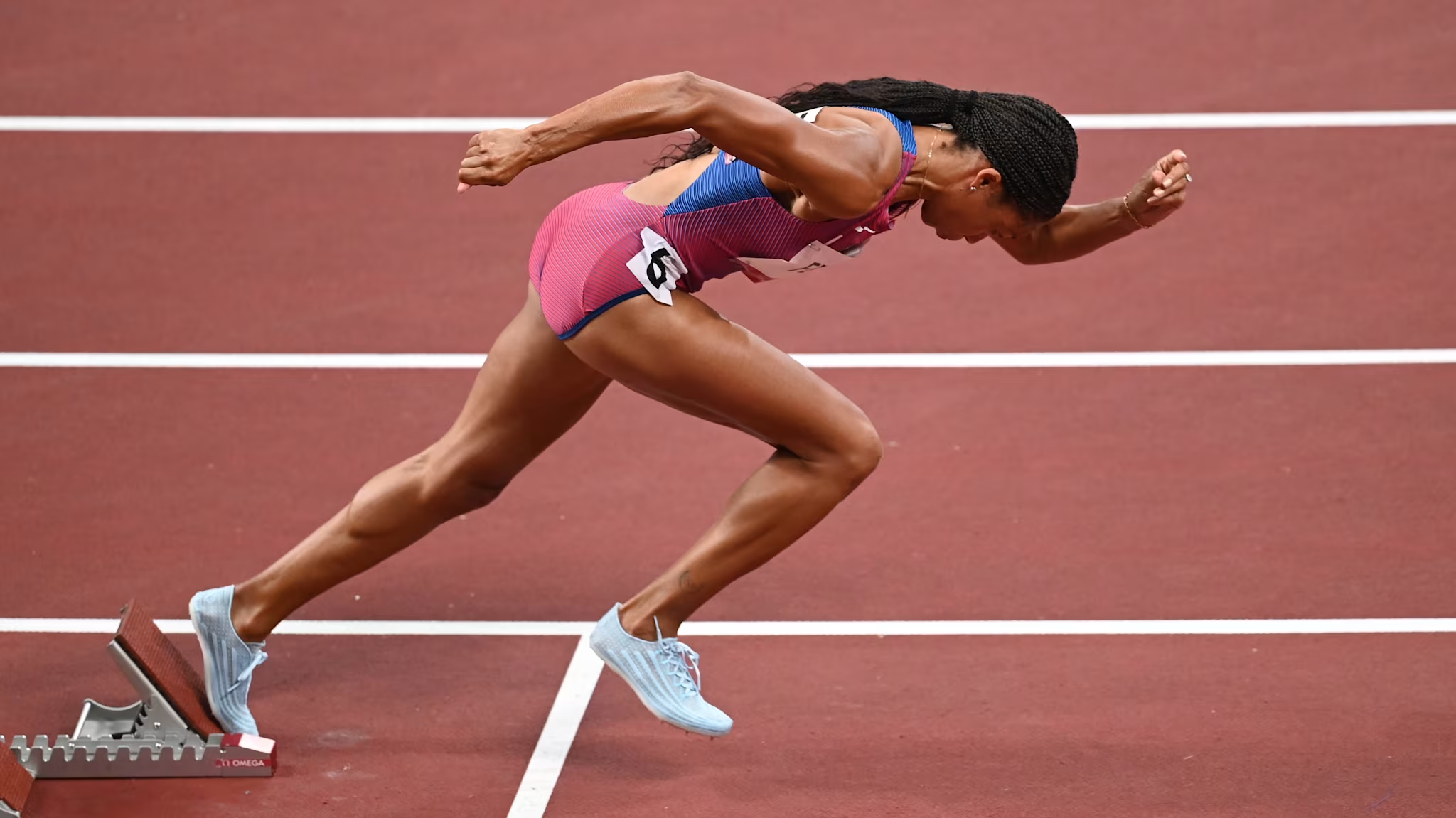
Felix sprinted toward history in Tokyo this summer, running there in spikes from Saysh, the brand she started after breaking with Nike. She, at age 35 and participating in her fifth Olympics, claimed bronze in the 400-meter and gold in the 4x400-meter relay to become the most decorated woman in Olympic track and field history and the most decorated American athlete in Olympic track and field history. (All this is to say nothing of her collection of finishes from the World Athletics Championships, where her 18 medals—13 of them gold—have made her the most decorated athlete in that competition’s history.) Her performance was significant for track and field’s record books, yes, but also for the sneaker industry.
Allyson Felix wore spikes from her brand Saysh at the Tokyo Olympics. Image via Getty
Elite runners like Felix usually wear product from billion-dollar brands. From a footwear perspective, track races at the Olympics are monopolized by a handful of companies. In Tokyo, Felix’s footsteps, a cycle of light blue blur, were her own. Here was a Black woman who’d created her own business and her own spikes, using them on the sport’s biggest stage.
“I do understand the significance of it,” she says, speaking from her home in California after returning from Tokyo. The remnants of jet lag in her system may be the first instance of time ever being ahead of Allyson Felix, a woman used to victory in any battle against a clock. “And also just understanding more of this industry through the amazing women that I’ve been able to work with, and kind of understanding the hardships that they face, as engineers, and as designers, and wanting to have more opportunity there.”
She’s focused now on growing that opportunity through Saysh, which will ship its first sneakers in September. The company has recruited top women from the sneaker world, like former Nike engineer Tiffany Beers, to help develop its shoes. Here, Felix talks about how she started her own brand, prepping for the Olympics in her own spikes, and what the wins in them mean to the sportswear industry. The conversation has been lightly edited for length and clarity.
How long have you been working on Saysh?
So it’s about a year and a half now. It actually all came together during the pandemic, and we were able to kind of build everything remotely. So it’s kind of crazy just how fast everything happened, that we were able to put the whole team together and have it come to life.
I feel like that’s probably one of the most exciting aspects, putting that team together. Because you’ve been in this industry for so long that you know who all the brilliant minds are at different brands, or who’s worked where, and how they can kind of put these pieces together.
Exactly. I mean, it wouldn’t have happened without that. And it’s such a purpose-driven kind of mission that I really felt like it was important that people connected over that, and that it made sense, and that everyone was really passionate about that. And so, yeah, it totally was being able to connect with the right people, obviously, because I had no idea how to make shoes or build shoes. But I felt like I learned so much. But yeah, we have an incredible team that came together.
How far into that decision did you decide that you were going to wear the spikes at the Olympics? Was that always the goal?
It kind of came about naturally. The footwear aspect was the reason that we decided to bring Saysh to life, just because I didn’t have a footwear sponsor. And it was crazy to me that at this point in my career, for whatever reason, maybe because I was so strongly branded as a Nike athlete, or whatever, the interest wasn’t there. And so it was like, “OK, can we do this ourselves?”
You’re saying that there was not any opportunity for you to even have another sponsor, aside from Nike.
Yeah. I am partnered with Athleta for apparel, but there wasn’t anything that made sense to do on footwear. And I think that could have come from just the consequences of speaking out—or for whatever reason it was, it just wasn’t there.
And so that was the thought of like, “OK, well, what am I going to do around footwear? Can we do something ourselves?” And then once we connected with Tiffany and started down this line, then it was the question of, “OK, would we be able to build an actual performance spike?” And so, yeah, it was somewhere kind of in the middle of putting all this together that we really wanted to be able to bring the brand on the biggest stage.
You mentioned that you felt like maybe some of your past efforts, in terms of equality and equity for women in this space, have affected your marketability for certain brands. Do you feel like the public doesn’t necessarily see that? Because I feel like at this point, your narrative is very celebrated, and it’s seen as a positive thing for the public. But we may not understand the extent to which taking those steps were real sacrifices for the amount of money you can make, or the amount of support you can get.
Yeah, for sure. I think you’re absolutely right. Of course, everyone’s not on the journey with you, and so they don’t understand kind of the realness of not getting paid for two years, going through this struggle, this back-and-forth. And then, just not even knowing if I was going to have another sponsor, and the whole footwear issue. So all of the things that happened. And I feel grateful now to kind of be at this place, and kind of understanding like, OK, I feel like I’m absolutely where I’m supposed to be. But it definitely came at a cost.
So, for the spikes, how much testing were you able to do? And then when did you start running in them in the lead up to the Olympics?
So we did a ton of just back-and-forth testing. I guess it was probably about a year, a little bit under a year of testing. I had a member of the team who made Michael Johnson’s gold spikes, who was just a true shoe craftsman, working on the spike and leading that up. And so it’s very minimalistic, and very light—it’s only 3.7 ounces. But yeah, a lot of back and forth with just testing everything out.
And was that a process you were familiar with from being signed to Nike, or had you never been this close to it before? In terms of getting samples and really making those small tweaks.
I was familiar with some of it, but I had no idea the in-depth things, because all of my spikes were made by hand. And so just seeing that process coming to life and kind of what goes into that. So I would say I had an idea, but no clue, because I felt like also in this process, when you’re working with a big brand like Nike, you might have three or four meetings on your footwear. Whereas this is something: every week we’re meeting multiple times, we’re going in depth, and I’m brought in on that process and having my input in all of that. So it was much more in-depth.
Was there any pushback from anybody around you? Or any fear that you might be sacrificing some advantage by not running in a shoe from a brand like Adidas or Nike that has just way more resources in terms of production?
I think there were questions. Obviously, with footwear now, with the carbon fiber plates, and I think just where it’s going, we didn’t feel like we had the time and the ability to do something like that. So I think initially, it was like, “Well, do I need that? Is that something that I’m interested in?” And for me, I didn’t really feel like I had to do that. I felt like what we could do would still be amazing, and I felt like there were still a lot of questions around that as well. So I think, if anything, that would be the one point that we had to make a decision on.
Do you feel vindicated, in a way? Because there’s this symbolic aspect of this moment, where it shows that you don’t have to bow to the whims of a billion-dollar sneaker brand in order to be successful in track and field.
I feel, I guess, proud, more than anything, that I was able to feel like I knew my worth and I stood by it. And I think being able to compete in my own brand at the Olympic Games was just the biggest moment of that. I knew that my story wasn’t done, and I knew that I still have more left to give. And I guess the realization of that, and being able to see it play out, felt really good. But I think I knew it all along. It was just seeing it come to light.
I have to wonder, too, if there’s some psychological advantage. It’s more than a signature shoe—it’s your own brand. NBA players, or WNBA players, will talk about wearing a shoe that is their own, but this is really your own brand. So I even wonder how much further that propelled you in your races.
Yeah, for sure. It was definitely a huge motivation to get it out there. Also, just the focus on women, and, really, that message coming across. And also just not to do things the traditional way, like you’re saying. I think I was in such a unique position that a lot of athletes never have the opportunity to be in, because obviously we’re usually sponsored by some big company. And so yeah, you can have a signature shoe, but to actually own the company is something that’s so rare. So I really loved being able to also put it out there that you can go this non-traditional route, as an option.
Is there a phase of this where you’re starting to recruit other runners to compete in Saysh spikes? You obviously know a number of talented women in the running world.
Not at the moment. We really see it more as a lifestyle brand, as far as the sneakers. Just, performance spikes, it’s a hard world. It’s extremely expensive to make these spikes. Like I said, they’re all handmade—we haven’t mass-produced or anything. So right now that’s not really kind of the focus. It’s just really on the lifestyle sneaker. I feel like it’s more about meeting women where they are. The everyday woman doesn’t need a running spike, but I do feel like they need a sneaker that is for them, and made by them. And so that’s where all the attention is.
So you have the spikes, and you have the lifestyle shoe as well. Are you at the point now where you’re only wearing your own shoes?
[Laughs.] Yeah. I have been the last, I guess, six months or so. Which is so different, having so many sneakers, but it’s a really cool thing.
And then, what’s the plan with the spikes that you ran in at the Olympics? What becomes of those now?
We’re actually auctioning a pair off that will go to Power of She Fund, which is a fund to help female athletes who are mothers to be able to compete and have childcare. It’s just the true embodiment of what the brand is. It stands for speaking out and knowing your worth and your value. And so I think that will always be at the core of who we are as a brand.
Is it hard to let go of them? Because this really is a piece of history.
I mean, as long as I continue to run, I’ll be in them. This was my last Olympics, not sure what I’m going to do next year. We have World Championships that is in the U.S., and so that’s a possibility, but yeah, they won’t be far.
The history you were confronting with respect to the medal count is very obvious, but were you actively thinking about what this moment meant in footwear history? In terms of being a Black woman who started her own brand and very quickly took it all the way to the Olympic medal stand. Are you thinking about that, in terms of footwear?
Completely. I think even in starting this brand, I think there were so many moments where I felt like, “Well, can I do this? I’m this girl from the heart of L.A. Am I capable?” And I hope, more than anything, it’s a representation that we can do this, that women can do this, that women of color can do this. And I just feel grateful for all of the support that I’ve received through it, throughout the whole process.
But yeah, I do understand the significance of it. And also just understanding more of this industry through the amazing women that I’ve been able to work with, and kind of understanding the hardships that they face, as engineers, and as designers, and wanting to have more opportunity there. I think that’s something that we thought about a lot as a brand, that we want this to be a place that women can come in to grow their careers. And so, constantly working to do that.