back-to-the-future
If a picture is worth a thousand words, a movie poster is worth a thousand pictures. It’s responsible for encapsulating the tone, story, and visual style of a film in one large image—and in doing so, it can become just as iconic and influential as the movie it’s advertising. The movie poster has come a long way from its humble, hand-drawn beginnings in the days of silent film, evolving into a veritable art form during the golden age of cinema and the early blockbuster era. But you wouldn’t know that from a stroll down the hallways of your local multiplex. While some modern poster companies like Mondo and movie distributors like A24 dedicate the necessary time and imagination to creating a unique poster, the vast majority of movie marketing consultants today just lazily slap together pictures of the stars in Photoshop, color it teal and orange, and call it a day.
So what happened? How did movie posters lose their way? As Michael Barnett, print editor of Marketing Week puts it, “Most of the time, marketers will choose the low-risk option, which is to pick the one that market research tells you will appeal to the people most likely to watch your film.” As anybody who complains about the endless Hollywood onslaught of reboots and sequels or the rise in Chinese product placement will tell you, mainline Hollywood seems to have prioritized the need to make money over creativity and originality, leaving the craft of movie poster creation behind.
While we wait eagerly for the format’s renaissance, we can sustain ourselves with Hollywood’s greatest movie poster achievements of the past, those that have become as ingrained in the zeitgeist as any other work of art. Here are the 10 most iconic movie posters of all time.
10. Metropolis (1927)
The only poster on this list not from the latter half of the 20th century, and for good reason. Fritz Lang’s seminal silent classic jump-started the modern science fiction genre with its elaborate sets, fantastical cityscapes, and deep-rooted themes of social criticism. Heinz Schulz-Neudamm used the matte paintings of the city seen in the film as a touchstone for the vertical, Art Deco-inspired background, and the robotic Maria in the foreground was unlike anything audiences had ever seen. Coupled with the bizarre, sporadically geometric font of the title, Metropolis’ poster was and continues to be a unique achievement for poster design, inspiring countless filmmakers and visual artists to this day.
9. Titanic (1999)
Say what you will about his consistency—or his insane plan to make four Avatar sequels in a row—but James Cameron is a true visionary, birthing The Terminator, The Abyss, and, yes, Avatar, and forever changing the film industry with each. However, his biggest contribution to the field of movie posters is for his Oscar-winningest, highest-grossing movie, Titanic. The image of the titular ocean liner splitting the screen keeps the imminent danger of the disaster ever-present against the seminal romance between Jack and Rose, whose floating heads in the upper third of the poster spawned an entire subgenre of romantic posters.
8. Pulp Fiction (1994)
The genius of the poster for Pulp Fiction is that it’s not really a poster for Pulp Fiction. James Verdesoto’s poster has little in common with the film other than Uma Thurman’s Mia Wallace, which is exactly what a film inspired by pulp novels needed to be. The beat-up design, 10 cent sticker, and poorly shopped-in props recall the novels from which Tarantino drew inspiration and add a nostalgic air of mystery around what you’re going to discover as soon as you turn the page. Add to it a stacked cast list and a distinct title font and you’ve got a poster that echoes the shocks Pulp Fiction sent through the film industry when it came out.
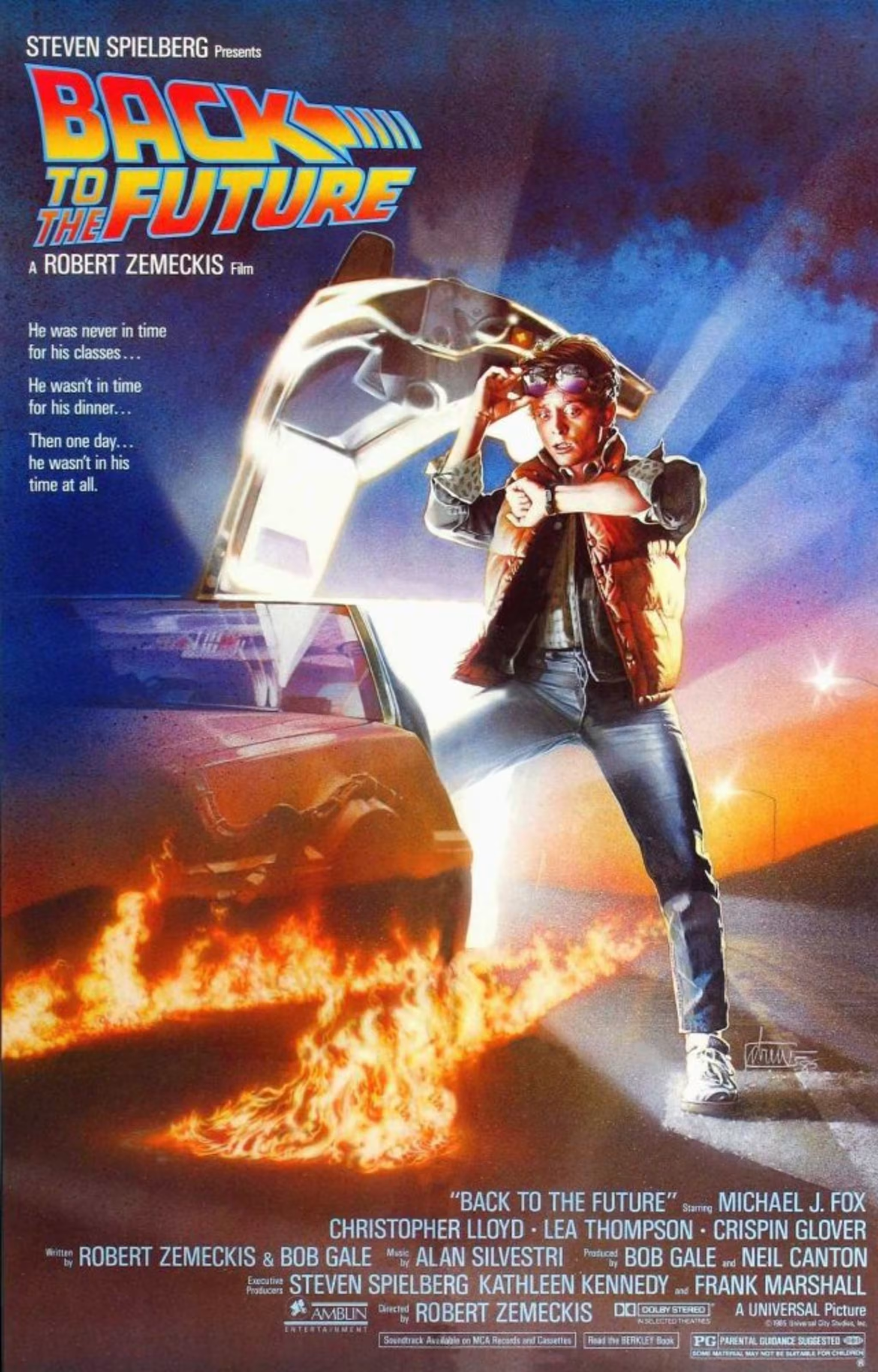
7. Back to the Future (1985)
For a slacker who skips class and spends all his time hanging around with an old man, Marty McFly is really, really cool, and the incredibly prolific and influential Drew Struzan’s poster captures that in spades. Marty’s 80s streetwear, the DeLorean’s gullwing door, and the two trails of fire get equal share and sum up the incredible style of Robert Zemeckis’ film in gorgeous fashion while leaving just enough mystery as to the contents of the time-traveling plot: “He was never in time for his classes...he wasn’t in time for his dinner...then one day...he wasn’t in his time at all.”
6. The Exorcist (1973)
Promoting what is arguably the greatest horror film of all time, Bill Gold’s poster for The Exorcist just oozes dread in every inch, from its single image of Max von Sydow’s Father Merrin arriving at the MacNeil house to the purple font and lower third, to the two-sentence-long plot synopsis: “Something almost beyond comprehension is happening to a girl on this street, in this house...and a man has been sent for as a last resort. This man is The Exorcist.” You can practically hear the piano begin to play.
5. Scarface (1983)
In his designs of the poster for Brian de Palma’s ode to 1980s Miami drug-money opulence, art director Ed Richardson opted for minimalism to make perhaps the single most ubiquitous dorm-room movie poster. The contrast between the black and white halves splitting Tony Montana in two not only pays homage to Howard Hawks’ seminal 1932 original, demonstrates Tony’s internal moral struggles, and creates a strikingly unique image—it also looks, for lack of a more eloquent adjective, really badass, summing up the intense intentions behind seminal lines such as “You cockroaches wanna play rough? Okay, I’m reloaded!” and “Don’t fuck me, Tony. Don’t you ever try to fuck me” with only two colors.
4. Vertigo (1958)
While its status as the greatest Hitchcock film is somewhat debatable, Saul Bass’ striking poster for Vertigo is, without a doubt, the greatest Hitchcock poster. Bass, who also designed many of Hitchcock’s title sequences, was known for his offbeat minimalism in his designs, and the Vertigo poster is no exception. Utilizing a deep orange background and a spirograph that calls to mind a descent into madness, Bass nearly puts the audience in the perspective of the man dressed in black at the center of the frame, chasing after a ghastly female figure. The poster promotes the fact that the film is Alfred Hitchcock’s masterpiece, but it’s plain to see that it is itself a masterwork.
3. Alien (1979)
Comparing this poster to those of the Alien sequels, particularly 2017’s misguided Alien Covenant, shows just how effective Frankfurt Gips Balkind’s Xenomorph-less poster is. Consistently ranking at the top of the greatest movie taglines of all time, “In space, no one can hear you scream” is all you need to know about what this movie is going into it: a terrifying experience set on a space station with some kind of monster. If that wasn’t enough to get butts into seats in 1979, when audiences were being inundated with a cavalcade of family-friendly Star Wars rip-offs, the sight of the horrifying alien egg just beginning to crack certainly was, making Alien a hit and essentially kicking off an entire genre of sci-fi horror.
By all accounts, Star Wars should have been a colossal failure on all accounts. The special effects artists were winging it, George Lucas was winging it, Harrison Ford was especially winging it. Obviously, the film became the biggest deal in the history of anything, which is why we’ll keep getting Star Wars films until the inevitable heat death of the universe, but part of that is due to the winging it of Tom Jung, whose poster for the film, despite Luke’s generously rendered abs and Leia’s skimpy outfit, pulls together the themes of good and evil in such a brilliant way that it’s no wonder the movie became an instant mega-blockbuster. Like the film itself, the poster has been copied, recycled, and retooled again and again, but nothing will top the classic original.
1. Jaws (1975)
The depth of Steven Spielberg’s filmography is only rivaled by the sheer number of iconic posters his films have spawned: the nostalgic portraiture of Indiana Jones and the Raiders of the Lost Ark, the wonder and hope of E.T., the mystique of Jurassic Park, but not even these can come close to the poster for Jaws. Eschewing any pictures of the film’s stars or lines explaining the film’s plot, Roger Kastel’s painting is masterful in its simplicity, with the naked girl’s blissful ignorance to the giant, killer shark lurking just below the surface summarizing the film’s plot and conflict in miraculous clarity. Just as Jaws changed the landscape of Hollywood forever, its poster became a landmark so iconic that it is relentlessly analyzed and imitated by marketers over forty years later. It's no wonder people were so afraid of the ocean.




