None
Our final day at SXSW kicks off with Franconian pretentiousness but ends in pure disturbance.
Maladies
Director: Carter
Stars: James Franco, Catherine Keener, Fallon Goodson, David Strathairn, Alan Cumming
Running time: 96 minutes
✭✭✩✩✩✩✩✩✩✩
Score: 2/10
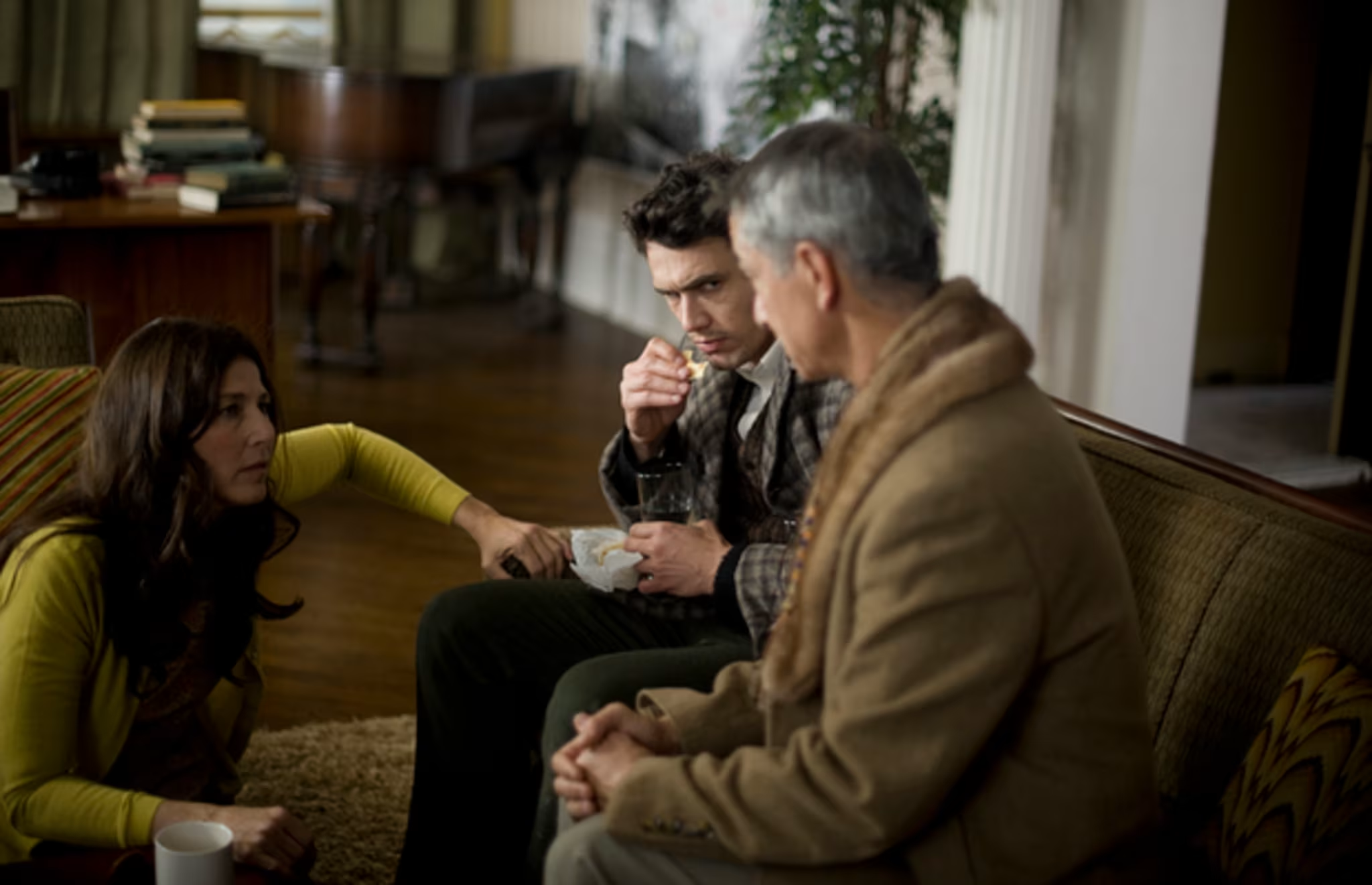
James Franco seems like a shrewd guy, someone who's aware of what he's doing with any given project. One can only hope that his intention for making Maladies was to star in an artsy version of Tommy Wiseau's The Room with real actors. If so, mononymous director Carter's film is a rousing success. Until that's confirmed, Maladies will exist as a vapid, not-as-smart-as-it-thinks exercise in self-stroking, made occasionally tolerable by some preposterously funny scenes, whether intentional or not.
Franco plays, yes, James, "an actor who is no longer acting," but instead working on a novel. He's prone to giving overlong, bizarrely simplistic monologues, like one about how pencils work and another that expresses his wonderment over the fact that Moby Dick actually wasn't written at one point. His friend, Catherine (Catherine Keener), draws pictures and enjoy dressing up as a man, replete with a pen-drawn mustache. Their neighbor, Delmar (David Straithairn), has an infatuation with James' stint on the soap opera General Hospital. And James' antisocial sister, Patricia (Fallon Goodson), sits around and stares confusedly.
In that regard, Patricia could be seen as the audience's on-screen double. Franco and Keener, in particular, two gifted actors who somehow manage to not embarrass themselves here, slot through numerous dialogue exchanges that open up dully and devolve into quasi-insightful gobbledygook. Carter's film—his follow-up to the experimental 2009 project Erased James Franco—so desperately wants to taken as a meaningful look at an artist's creative process, to the point where a Magnolia-like narrator dispenses obtuse wisdom (talk of "Point C" being where characters are "transformed") whenever he's not speaking directly to Franco ("Isn't that right, James?").
On more than one occasion, Franco's character serves up this elementary dose of enlightenment: "Everything needs to be made, and it needs to be made by someone." One time with Maladies should finitely disprove that theory.
Some Girl(s)
Director: Daisy von Scherler Mayer
Stars: Adam Brody, Kristen Bell, Zoe Kazan, Mía Maestro, Jennifer Morrison, Emily Watson
Running time: 89 minutes
✭✭✭✭✭✩✩✩✩✩
Score: 5/10
Actors love playing characters written by renown playwright Neil LaBute, and it's easy to see why. Fascinated by sexual politics, LaBute draws characters of both sexes that philosophize about love, connection, and trust, and, sometimes, exhibit aloof misogyny. His latest screenplay, Some Girl(s) (based on his own play of the same name), brings LaBute back to his In the Company of Men side after years in Hollywood spent trying to stretch his storytelling range with disastrous results (see: the Nicolas Cage-starring The Wicker Man remake).
True to form, Some Girl(s) is a thespian's dream production, taking place in six hotel rooms with only two characters per scene. The constant is Adam Brody, whose nicely controlled performance as the unnamed and self-centered protagonist, a former heartbreaker who's hoping to right some of his past romantic wrongs before getting married to his new squeeze. Flying around the country, he arranges hotel meetings with six of his most memorable exes, each run-in more intense and revealing than the last.
The problem with a film like Some Girl(s), however, is that it's emotional center is hollow. Unaware that he's a hurtful asshole, Brody's character doesn't grow from any of the experiences, whether it's with the Boston professor (Emily Watson) with whom he had an affair, his high school friend's kid sister (Zoe Kazan) who "became a woman" through kissing him as an 11-year-old, or the best one who got away (Kristen Bell).
The stakes remain at a low level throughout Some Girl(s) since, despite Brody's tight acting, the guy's a real douche. All of his old flings know it, the audience knows it, but he doesn't, and LaBute's script keeps viewers looking for something more than just a performers' showcase. But there's nothing there.
The Act of Killing
Directors: Joshua Oppenheimer, Christine Cynn, "Anonymous"
✭✭✭✭✭✭✭✭✭✭
Score: 10/10
If someone you'd just met and had a wonderful chat with admitted that he had once killed dozens of people, would you continue speaking with him? Or, for that matter, allow yourself to be entertained by his playful side as he charmed you with everything he's done since the murders?
Those are just two of the many questions that power the marvelous and profoundly disturbing documentary The Act of Killing, a film in which the horrific becomes banal, the real difficult to believe. Co-director Joshua Oppenheimer traveled to Indonesia, located a former right wing paramilitary baddie, named Anwar Congo, and presented him with a gutsy challenge: recreate some of the homicides Congo and his colleagues committed against Chinese people deemed "communists" back in the 1960s for both a feature film and Oppenheimer's making-of doc about their production. These days, Congo is a friendly, loving grandfather who's harboring sadness over his past actions, which prompts him to take part in Oppenheimer's work as a means to finally expose the brutal truth.
The Act of Killing is deeply surreal, filled with unsettling comedy by showing how much fun Congo's group of one-time killers, rapists, and torturers have playing dress-up on a movie set. Oppenheimer and his collaborators (Christine Cynn and "anonymous") wisely just let the subjects speak for themselves without utilizing any too-clever editing trickery or invasive newsreel footage to sway viewers' opinions—as if there's any response to The Act of Killing's featured players other than complicated discontent. In one moment, a father takes his wife and daughter to the mall for sweet, endearing family time, but minutes later he's casually reflecting upon the time when he walked down the street and murdered every Chinese person he saw.
As Congo and his associates reveal in the film, the countless hours spent watching "gangster movies" inadvertently helped them to rationalize their crimes—the characters on screen in Hollywood releases seemed so cool that whenever they killed others, they felt just as cool. But in the present day—and this is where The Act of Killing really soars—Congo receives the opportunity to live in the victim's shoes, portraying one of the innocents in a scene for the movie within the movie. It's during that instance where the monster's eyes truly open, though Oppenheimer doesn't go for the easy move of giving Congo a chance to repent—forgiveness isn't an option anymore.
Through The Act of Killing and its matter-of-fact depiction of mankind's worst members, the notion that, for some, taking another person's life can be as effortless as chewing gum is as amazingly startling as realizing that, for others, seeking redemption is utterly hopeless.




