Long before Anthony Bourdain became the globe-trotting icon who ate his way through culture with effortless cool, he was just a young man trying to find his footing. In his upcoming film Tony, Canadian director Matt Johnson turns back the clock to explore the raw, unrefined formative years of the late chef and author, played by Dominic Sessa.
Tony follows a 19-year-old Anthony Bourdain (Sessa), who travels to Provincetown and stumbles into a restaurant kitchen, offering him a peek into a whole new culinary world that ends up shaping the course of his life.
For Johnson, bringing this early chapter of Bourdain’s life to the screen was more about capturing a vulnerable reality of a young man growing into adulthood.
"I wanted to show somebody who had not yet developed any powers and reminded me of the way that I was," Johnson explains. While audiences might view Bourdain – or even Johnson through his own filmography with the critically acclaimed BlackBerry and Nirvanna the Band the Show the Movie – as socially bulletproof, the director sees it differently. "People have expectations of me now that I'm an adult... but I don't think anybody realizes that when I was young, I was an insecure, extremely scared boy and I wish I could show people that because in my own movies, I always portray myself as almost invincible,”
He continued, “I'm as invincible as a Clorox bottle when it comes to social situations, but that's not the way I actually am. Here was an opportunity to show the way that I actually was, the way that Dominic [Sessa] actually was, and what we're trying to maybe explore is that Anthony Bourdain also was not the invincible social adult that we all knew."
That search for identity in a pressure-cooker environment immediately resonated with Sessa, who plays the young Tony. Tapping into Bourdain’s early years required Sessa to draw on his own past and worldviews.
"It reminded me of myself in a lot of ways," Sessa says. "I think I viewed the world in a very similar way that this character does, for better or for worse. And for me, it was really just channeling those sides of myself that I think aligned with that, and maybe things that I wasn't proud of or embarrassed about, and opening myself up to that in order to kind of show a way to change yourself in an impactful way at an important age."
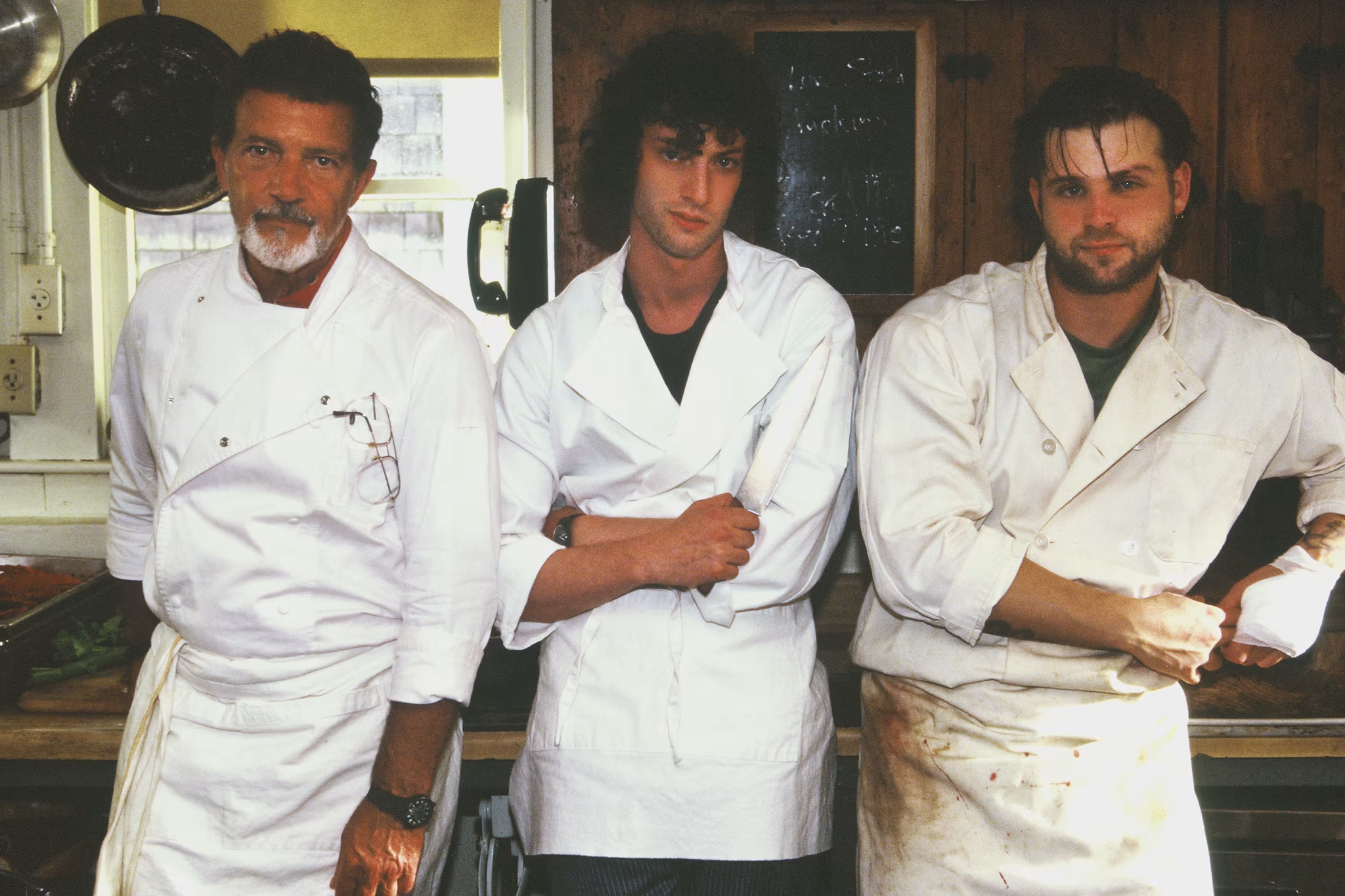
Part of that growth comes from navigating complex dynamics in the kitchen, particularly with mentor figures played by Antonio Banderas and Leo Woodall. Central to Tony is the friction between the wildly clashing forces that shaped Bourdain's legendary identity: the rebellious free spirit and the strict kitchen authoritarian.
“The idea that Anthony Bourdain is at once a libertine, free spirit, drinks everything, eats everything, almost like a sexual ballet dancer, but at the same time, an extremely strict disciplinarian,” he explained.
"There's a great irony in being an iconoclastic punk legend and the head of the restaurant. He's also everyone's actual boss," Johnson notes. "So, you tell me, Anthony Bourdain, how you're also going to be Sid Vicious at the same time. They can't be the same thing... This movie divides those two personas into two people, Antonio Banderas and Leo Woodall. And Dom is kind of stuck between them as these two father figures, both of whom are deeply flawed, but very enticing... I'm a rebel, I'm the boss."
For Sessa, working alongside a powerhouse like Banderas added an authentic intensity to Tony's trial-by-fire experience. "He's such a pro," Sessa shares. "Like he was intense with me, did everything, didn't take it easy on me... throwing stuff at me in the kitchen, splashing water on me. But also like protected me in a way... He really did respect me in the role and on set as much as I did him."
While the lore of Bourdain provides a rich backdrop, Johnson’s core motivation as a filmmaker remains rooted in his ensemble cast, creating an environment where improv and authentic connection thrive.
"Every movie I make is about the cast," Johnson says. "My interest in making films is just to give people the opportunity to do performances that I love... My interest is very limited to a kind of adolescent male mind as it's slowly entering the world. But that's just because that's my life... I want to see people I love win... I don't have an approach other than let me set them up as best I can so that they can win and I can watch."
To capture the kinetic, loose-wire energy of a real line kitchen, Johnson turned comedian Stavros Halkias loose, allowing the cast to rely heavily on improvisation to build natural camaraderie.
"I don't think we stuck to a single line," Halkias laughs. "It was really thrilling as a performer to be trusted to do that... To improvise, you have to do some embarrassing stuff that doesn't work to find the good stuff. Even in stand-up, it's like, you know, some clip might be hilarious, but there's a thousand shows where you bomb."
That freedom translated into an environment where the line between off-camera friendship and on-camera chemistry completely blurred. "The kitchen really felt like a real kitchen, and it just felt like I was goofing off with my friends," Halkias adds. "What we were doing on camera was not much different than what we were doing in the house, like our green room house, where we were just playing Mario Kart... So, whether the cameras were rolling or they weren't, we were kind of behaving pretty similarly."
Tony is a compelling entry showcasing a vulnerable snapshot of transformation. The film doesn't just honor the legend Bourdain eventually became, it honors the messy, uncertain process of getting there, and offers audiences an intimate look at a young man on the precipice of finding his voice.
Tony is in theatres across the country on Friday, August 14.