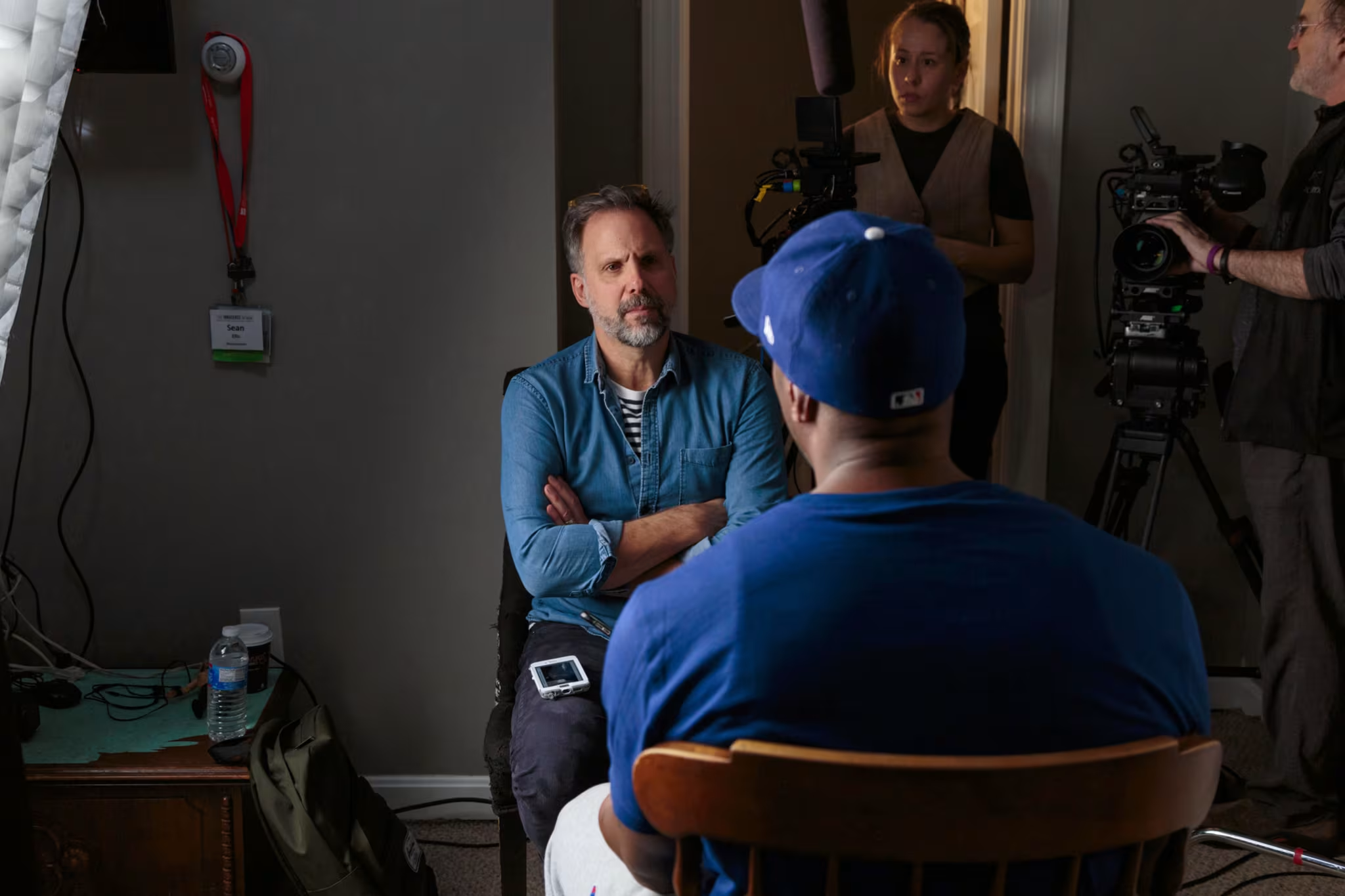
Image via Netflix/Casey Joseph
One night in Boston back in 1993, Sean Ellis' life changed forever. It all went down in a Walgreen's parking lot, where Boston Police Detective John Mulligan was gunned down in his vehicle. Through a wild set of circumstances, Ellis was at that Walgreen's, but it took 22 years (and three trials) for Ellis to finally be exonerated. Ellis' fourth trial, which was granted back in 2015, is the subject of a new Netflix docuseries, Trial 4, which premieres on November 11, 2020.
Roughly 24 hours after Netflix released the Trial 4 trailer, we caught up with the film's director, Rémy Burkel, who worked on Sin City Law with Jean-Xavier de Lestrade of the acclaimed docuseries The Staircase (who is also producing Trial 4). H spoke with us from Paris about meeting Sean Ellis, getting Boston PD on camera to talk about this case, and how Sean's story mirrors what's at the heart of the Black Lives Matter movement, as well as how all of this plays into the importance of elections.
I just got the screeners for Trial 4 and I'm really engrossed in the story. It's a really unique look at the justice system.
I agree with you. We plunge into the system, we get a very, very in-depth look into how the justice system works through Sean Ellis's story, and through this case.
Was there a certain element of Sean's story that really grabbed you?
What really grabbed us, what grabbed a lot of people's attention from the start is that this is a horrific crime. A Boston police officer was shot five times in the face at point-blank while he was dozing in his SUV in front of a Walgreens in 1993. And it just pulls you in, the horrific crime and the way that suddenly this young man is pulled into this case having apparently nothing to do with it, he's pulled in because he had two cousins who were murdered; two days after the police officer's murdered, his two cousins were murdered about a mile away in their apartment. This guy is pulled into this case, he says he was at Walgreen's the night of the murder buying Pampers, and then from there it just becomes weirder and weirder.
They find the police officers and how they investigate it, how they find these witnesses, you kind of think, "Oh, maybe witness tampering." One of the witnesses, the main eye witness is the niece of one of the police officers. And then you learn about the trial that took them three trials to convict Sean Ellis, which is exceptional, and it's very weird. And that's only the backstory. Because then there's after he's released and the whole 20 years it takes him to get him out of prison to begin to fight for his fourth trial and having a fourth trial, again, I say the day was set 23 or 24 years after the actual crime. It was a great chance for him to get out and be able to prove his innocence or go back to jail for the rest of his life and die in prison. That was what he was facing. It's tough.
Tough is probably one of the best words to even describe that situation. What was the timeframe from when you guys, after you get into the case, when did you start filming and how long was that process?
We started filming. We knew [about] the case about a year before we started filming and just our investigation and to get all the documents. We started filming in February of 2018 and we filmed right through until we finished principal filming just before the confinement, I was in Paris, so the French confinement, which was in March 2020. We filmed all the way through.
When did you guys start getting in contact with Sean?
The contact with Sean I would say was probably May, June 2017. I was not the first person to meet Sean. I met Sean once I came onto the project. It was a project that was led by Jean-Xavier de Lestrade, the producer and director of The Staircase and Allyson Luchak and Matthieu Belghiti. They introduced me to Sean and the first meeting was just amazing. You see pictures [of] when he was 19-years-old and suddenly I saw this very well-spoken, quiet, 43-year-old man at the time, with a very youthful face, very, very powerful. When you see him when he was a kid, he was like pencil-thin and suddenly he's this broad-shouldered guy and he was impressive and very calm, very soft-spoken and very calm. For a man who spent 22 years in prison for a crime he says he didn't do, that's pretty amazing.
Did it take time for you to gain enough trust for him to sit down and dive into some of these deeper stories about his life?
Yeah, it takes time. Sean was not used to having a camera with him [for] the first couple of days of shooting. We just film people, we don't ask a lot of questions. We do interviews, but then our perspective is kind of fly on the wall, just look at it, observe what's happening and let it take place. He had to feel a little bit of that, and little by little, I think we came to trust each other and to trust that we were not trying to get that little soundbite, that little piece of information, but to let just things happen and take their time. That's why eight episodes is necessary to tell this kind of a story.
Talk about the decision to utilize animation for certain moments in Trial 4.
The animation came in during the process. It wasn't originally planned on; we didn't know how we were going to do a "recreation" [of the murder], because we were filming in real-time, so things changed and politics changed and a lot of things changed in Boston. There were big changes going on while we were filming.
I always wanted to do animation in documentaries for recreation and to [examine] the different perspectives? All the different people have different [way of seeing the situation]. I [also] thought that animation took us a little step back from the reality of the situation. It's a horrific crime, but you have to show the brutality of that crime, and I didn't want to do it in a realistic way. I hope it works.
Was it hard to get Boston police officers and people who were involved in the case or around the case back then on camera now to talk about it?
Well, I would say that it wasn't easy because they had to trust us, but we did get a couple of very top-ranked individuals. Ed McNelley went on camera and he had no problem, he's retired, but he had no problem. To him, Sean Ellis is guilty anyway, so he didn't shy away from saying they did a great investigation. The police commissioner came on right after, the police commissioner at the time was William Bratton, who became the police commissioner under Giuliani of New York, just after that. Paul Evans, he came on a couple of months after him and took over the investigation, was third in command during the crime.
They opened up, they talked, but we didn't get everybody. Some people said, "no, I don't want to go on camera, I don't want to take the chance because you never know. My words can be taken out of context," which is not the way we work, but I understand that. They don't want the publicity, they didn't want to become "famous."
With the way the world is right now, especially in America, the Black Lives Matter movement is still going strong; actually there's protests that have been going on in Philly. Sean's situation is one story out of many; talk about Trial 4's impact in America during this time.
We tell a lot of things that are very timely through Sean's story. I would say Sean's story is more about mass incarceration, wrongful convictions. He's very much...after George Floyd was killed, he was out there. I know he did participate in a lot of marches and was very active in the New England Innocence Project and Black Lives Matter as well. It all links in because his case was not exactly only a case of systemic racism. It is a case of police corruption of district attorneys, not being accountable, not turning over documents, politics, [and a] strong police union. To me, it goes to all the issues that Black Lives Matter obviously raised because it says there's got to be police accountability. Prosecutors have to be accountable. You have to look into mass incarceration.
[In Trial 4], we deal with the power of a district attorney, and the fact that the district attorney is an elected official. Most people did not know that and did not know that in Boston when these elections were happening. They now have Rachael Rollins, an African-American woman who was very progressive and who was elected as district attorney during this, which we filmed. It all goes together; we've got to reform the justice system, and the people have the power to vote in the right people. In America, it's time to vote.




