None
"Sometimes we stand on the shoulders of our ancestors. Sometimes we stand on their necks," tweeted American poet Saul Williams. And this is exactly what is happening with the carding discussion in Toronto. While Desmond Cole has played an instrumental role in bringing the issue back into mainstream media with his recent article in Toronto Life, the focus on Cole's recent clamour has erased the anti-racial profiling giants who fought this fight before him. Decades of activism and mobilization have led us to this moment—where the trampling of human rights beneath the banner of ‘carding’ is a citywide discussion—and we cannot forget those who came before.
Here's a look at the recent history of racial profiling in Toronto.
Pierre Elliott Trudeau Opens Canada With The Immigration Act Of 1976
In 1971, Prime Minister Pierre Elliott Trudeau announced that Canada would step away from its assimilationist approach to immigration and would instead adopt a multicultural policy. In 1976, the Immigration Act was passed that opened Canada to newly independent countries in Africa, Asia and the Caribbean. This influx of people of colour led to a simultaneous increase in racial profiling.
Founding Of The Black Action Defence Committee
In 1988, a string of police murders of Black men—including Buddy Evans, Albert Johnson, Michael Wade Lawson, Lester Donaldson—led to the formation of the Black Action Defence Committee. The BADC was founded by Dudley Laws, Charles Roach, Sherona Hall and Lennox Farrell and was an organization dedicated to fighting violence and racism in the criminal justice system through community organizing and mobilizing.
Founding Of The Special Investigations Unit
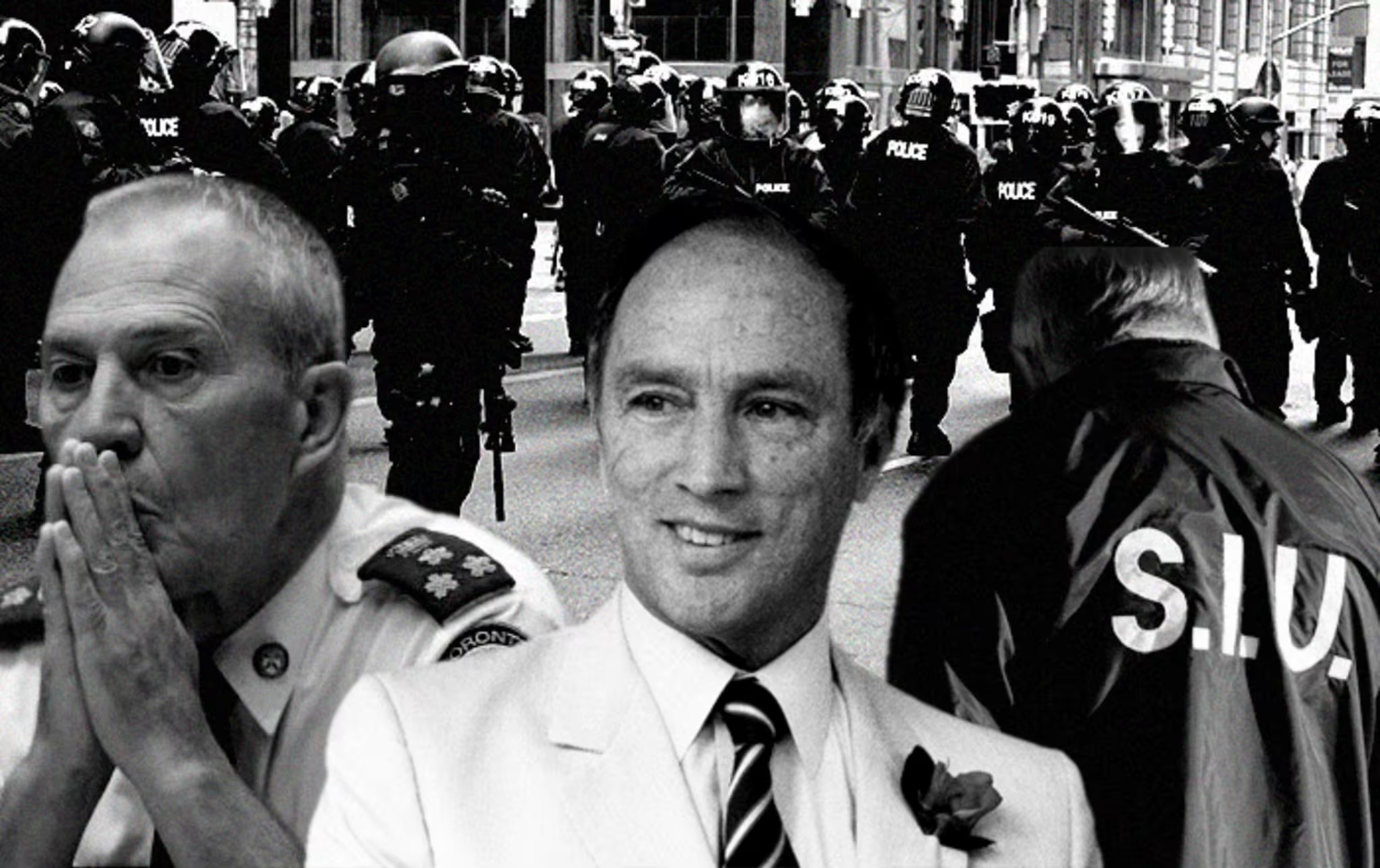
In 1990, after sustained pressure for police accountability from the Black Action Defence Committee, the Special Investigations Unit was formed. The SIU, is an independent civilian oversight agency with the power and jurisdiction to investigate police incidents where serious injury or death is the outcome. Previously, the police investigated their own wrongdoing, a clear conflict of interest.
The Just Desserts Shooting Of Vivi Leimonis
In 1994, 23 year-old hairdresser Georgina "Vivi" Leimonis was killed in a botched armed robbery at the Just Desserts Café restaurant. This crime, the shooting of a white women by three Black men, led to the over-policing of Black communities, an increase in police brutality and anti-Jamaican sentiments from Toronto media. Inadequate immigration policies were blamed and Jamaican men were targeted by police.
Toronto Police Attempt To Improve Community Relations With Tavis
In 2006, after the notorious Summer of the Gun and the Boxing Day shooting of Jane Creba, the Toronto Police started the Toronto Anti-Violence Intervention Strategy (TAVIS) with the goal of addressing crime in high-violence communities and improving community-police relations. Instead, TAVIS became a paramilitary arm of the police that continues to terrorize predominantly Black communities. Recently, four teenaged boys were stopped and harassed by TAVIS in Lawrence Heights. The incident ended with one boy getting a gun pulled on him and the all four boys being arrested.
Jim Rankin And The Toronto Star Release "Known To Police"
Toronto Star reporter and photographer Jim Rankin has been instrumental in providing many of the statistics and stories that we cite today when we talk about racial profiling in Toronto. In 2013, Rankin leveraged the power and resources of the Toronto Star to produce "Known To Police," a series of articles that analyzed police data proving the existence of racial profiling in the Metropolitan Toronto Police force. Rankin's work built upon the research and analysis of academics like Dr. Scot Wortley and forced then-Police Chief Bill Blair to admit that the TPS force had a racism problem.
Desmond Cole's 'The Skin I'm In' Reignites The Racial Profiling Discussion
Toronto-based journalist Desmond Cole documents his experiences with racism in the Toronto Life article “The Skin I’m In: I’ve been interrogated by police more than 50 times—all because I’m black.” The cover story pushed the discussion of racial profiling, beneath the banner of "carding," into the public eye once again. While Toronto Mayor John Tory vowed to eliminate the Canadian Charter-violating policy, he later reneged and, along with Premier Kathleen Wynne and Toronto Police Chief Mark Saunders, supported the racist policy.