Photography by Ryan Dinham
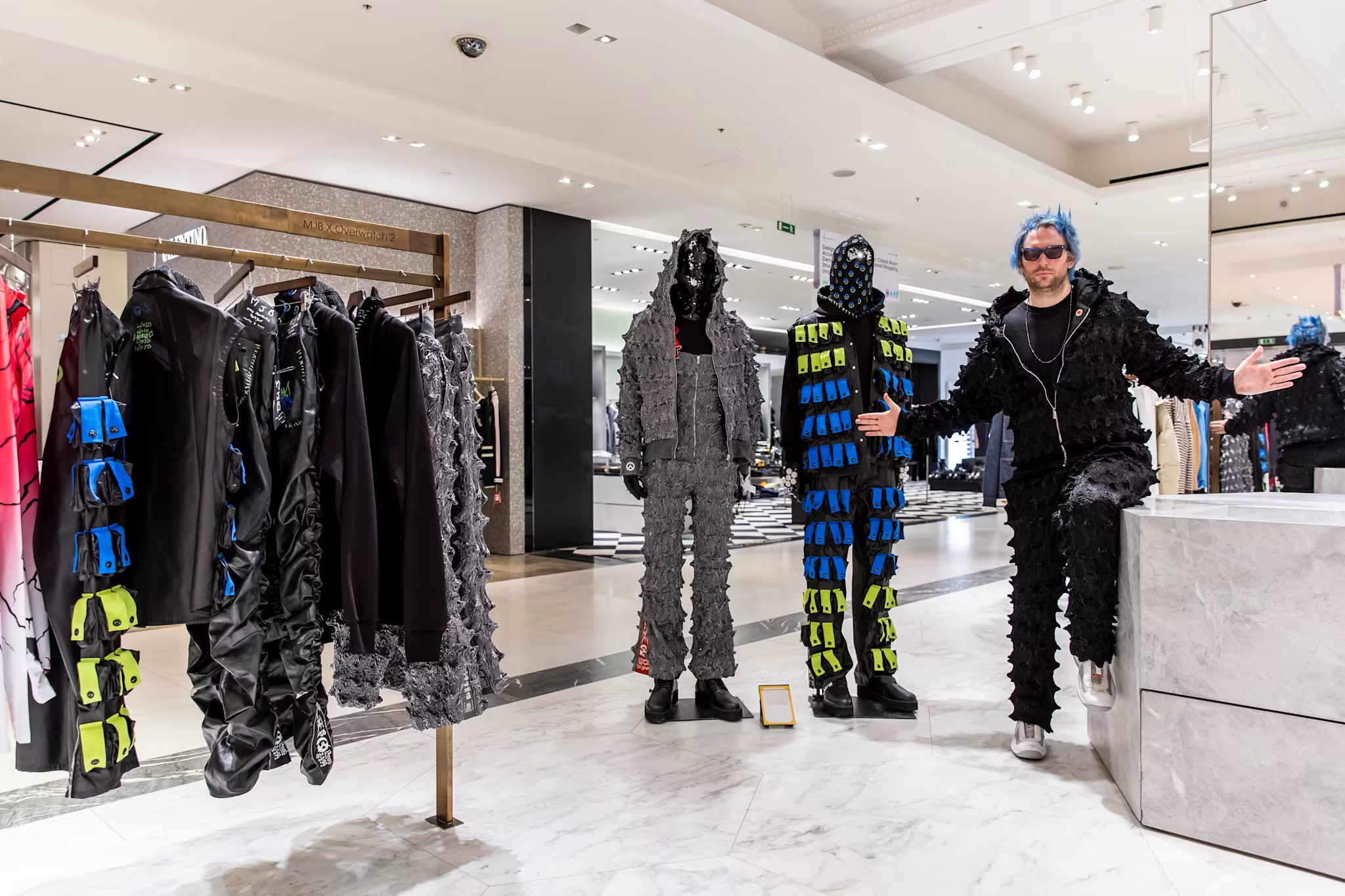
Overwatch, the first-person shooter game by Blizzard Entertainment, has launched its official fashion partnership with British creative Marc Jacques Burton. A staple in luxury streetwear, the London-born designer has continued to up the ante since launching his namesake brand in 2015, which first garnered attention from stars like Tom Holland, Zayn Malik, the Migos and the late Juice WRLD.
MJB’s latest line draws on the brand’s signature styles, rebellious aesthetic and bold, rockstar appeal. The campaign stars a roster of talents from the worlds of music and film—including UK rap don Giggs, Batwoman star Wallis Day, Top Boy star Hope Ikpoku Jnr and UK Afrobeats talent Darkoo—each of whom sport pieces inspired by Overwatch characters Lúcio, Kiriko, Genji and Sojourn. The partnership was commemorated with a private launch in London, hosted by MJB himself. Guests on the night included Micheal Ward, Ted Lasso, Bugzy Malone, Nick Grimshaw, Prodigy’s Maxim and model Hana Martin. Meanwhile, Giggs, Hope Ikpoku Jnr and Darkoo kept attendees highly entertained with live performances.
Following the release of his capsule with Overwatch, we caught up with Marc Jacques Burton to learn more about his start as a creative, why he enjoys collaborating, the importance of following your dreams, and much more.
“We all have dreams within us and one of the slogans from my brand is to ‘Live Your Dream’. It’s almost our duty to fight for those dreams and to try and live them.”
COMPLEX: How did growing up in London influence your identity and creative style?
Marc Jacques Burton: I’ve always been drawn to the punk era. As a kid growing up, there were so many visual references, like the haircuts and hairstyles, but I also really respected the way people made their own clothes—there was a DIY element to it. I loved how they integrated political messages that would be written on their clothes and how the movement then influenced places like New York during the ‘80s art scene. I was really into art—I loved Haring and Basquiat, and they were the kind of people I wanted to implement in my designs.
Did you always want to be a fashion designer?
Deep down, I did. When I was 19, I worked in Paris as an investment banker for six months and also interned with L’Oréal on the product development team. Their offices were based on Rue Saint Honoré, so a lot of big designers and their stores were based there and during lunchtimes, I would go round the stores and it got me dreaming. Then, I started to read books on the Gucci and Louis Vuitton family and I kept seeing these massive billboards, but realised that they were actually started by one person who had a dream based on one product. Suddenly, in my mind, I realised if someone can do this then I would definitely give it a go. Working in Paris really opened my mind.
You owned a few clubs in London at one point, too. How do you feel that aided your career as a designer?
I was always very social. I love people, and what I loved about nightclubs in my twenties is that, despite the fact that we were in a southern area and had certain friends, in a nightclub you were introduced to a huge group of diverse people of different ages and backgrounds. From that world, I got to see what people were wearing, because when they went to these places, they wanted to be seen. It was the cutting edge of people that were going to these music places. That’s how it all started. I was also in touch with big musicians at the time: Drake, Jay-Z, Beyoncé, Rihanna, all of these people would come to the club and I was able to develop relationships with various artists and musicians. Eventually, I wanted to be unique and have my own clothes, so I started wearing clothes that I made, or I got made by other people. I didn’t plan on making a fashion brand; I just wanted to wear different clothes to everyone else.
A lot of people will know you for your collaborative work with musicians like The Rolling Stones and Joy Division. What is it that you enjoy about collaborations?
When you collaborate, you need to be open and see other people’s perspectives while understanding what they’re interested in. Collaboration opens my eyes and expands my horizons because, whenever I’m working with an artist and they tell me what they’re into at the moment—it might be a book or another creative that’s influencing them—nine times out of ten, I haven’t heard of these people so I start to research and it leads me down a whole new path where I learn more as a person. I find it’s the best way for self-growth, if you can collaborate with someone and really find out what they’re into and why they do what they do.
What’s been your proudest moment? Was it the pieces you created for Mick Jagger?
I never knew someone like Mick Jagger would want to wear the brand. I mean, he could work with any designer in the world, so when his team reached out, it was a real honour. When I started the brand, I was working with a lot of hip-hop artists, like the Migos, who were super-supportive right from the beginning. Just before they released “Bad & Boujee”, they wore my brand a lot—the consistency was amazing! Through their stylists at the time, I was able to create one-off pieces; they also wore my stuff a lot during their tour with Drake, which was amazing to see.
How did the collaboration with Overwatch come about, and what inspired you to enter the world of gaming?
Over the course of MJB as a brand, we’ve worked with a lot of musicians and that eventually led to brands seeing the work we’ve been doing with these artists. I think, bit by bit, word spread that we were a great brand to collaborate with because, when we’ve done collaborations, we’ve always tried to incorporate the partner’s brand within the design. So if you take Overwatch, for example, we haven’t just randomly designed Overwatch-themed outfits—I’ve specifically chosen the four hero characters that I resonate with and created a collection around that.
Because we have so many musicians wearing the brand, from Mick Jagger to Wizkid and Lil Baby, these brands have realised that when they collaborate with us, we’re able to create very high-end pieces that go into stores like Selfridges and Harrods, and then later on there’s a high probability that musicians will wear them in a video or on stage. I think Overwatch had seen I’d done work in the video game sphere before. Last year, I did some work for Sonic The Hedgehog’s 30th anniversary, which was amazing, and we’d also created three projects with Mortal Kombat to help them launch different video games. When we got a call to meet, initially, they had several video game brands and I was like: “Look, I love Overwatch. I played the first one and can’t wait for the second.” And that’s how it developed, really.
Had you previously been into gaming yourself? If so, what were some of the first games you played?
I got given a Gameboy by my father when I was younger, and my mum always said to him, “You didn’t get that for your son, you got it for yourself!” [Laughs] Basically, my dad and I would play Tetris and Super Mario all the time together—they were the first video games I really got into. I then got into Nintendo; at first, I really loved Super Mario, Mario Kart, but then I kind of got into more grown-up games, like Street Fighter and Mortal Kombat. Ever since then, I’ve loved video games and how they’ve evolved. I love playing Call Of Duty and Overwatch… I found that, during lockdown, it was a good way to keep in contact with people and still socialise, too.
When it came to designing the Overwatch collection, were there any particular references that you were inspired by?
Each character has their own personality. One of the characters that I was really drawn to was Sojourn; she has a very powerful quote that I love, which is: “Heroes aren’t born, they’re made.” That really resonated with me. I thought about all the great musicians I’ve worked with and, nowadays, so many people just see them as the great person, who’s on stage or in a music video, and they forget that 15 years or 10 years ago they were just a person with a dream. Throughout Sojourn’s pieces, I’ve written that quote in my handwriting—it’s quite punkish, and all over the jacket she wears. Another character that really resonates with me is a guy called Lucio, who in the game is a world-famous musician. I wanted to create pieces that a real-life musician could wear, and for the campaign I chose Giggs to lead it. I wanted to create pieces that Lucio could save the world in, but also ones that could be worn on stage by Giggs in the music world.
Giggs has incredibly supportive of MJB as a brand, and me as a person. When I announced him at the event, I said that he was like a big brother to me. I wanted someone that everyone knew, and everyone knows Giggs! I think he’s really pushed British culture and the London scene. When I go to Paris Fashion Week, I hear Giggs’ music there and when I go America, everyone knows who he is, so I wanted to work with someone that genuinely wears and cares about the brand. I also really respect people that really follow their dreams. Hope Ikpoku Jnr is a great example of this. We all know him as ‘Aaron’ from Top Boy and he’s done incredibly well as an actor, but I also know that he’s got an amazing side to him as a musician, so I wanted to create a platform where he could perform for everyone and we can all see him as an artist.
I also worked with the amazing Darkoo, who grew up in Nigeria and was raised in London. She comes from that beautiful Afrobeats wave. I’d done a lot of work with Wizkid, who’s supported me tremendously, and it was him who told me about Darkoo, saying that she was a top artist coming through. I wanted different kinds of music genres working together; it was important to have Afrobeats artists and rap artists who could not only be in the campaign, but could perform at the launch too.
How does music influence you as a creative?
Music is why I do what I do. From a selfish perspective, seeing a performer on stage wearing my outfits is an unbelievable feeling. It’s a really special moment because there are lonely moments and, sometimes, it can feel a little difficult, so it’s an incredible feeling when those people who wear your brand—and could have chosen any brand in the world—decide to choose you in the moment when they need to feel their best. When designing, I’m always thinking of the musician. I define my brand in two ways: there are the stage-ready pieces, where I’m thinking of these artists who are going on stage or doing music videos and are designed in a way which is very unique for them to shine in, and the second side is what I call “studio pieces” for when the artist is in the shadows, when they’re travelling on tour or in the recording studio late at night. I do big hoods and balaclavas because I want to make sure they can hide in them if they need to.
What do you think the future of fashion and gaming will look like?
It’s super exciting! Gaming has gone from something which was initially just a hobby to now something that is very much part of people’s lives. This summer, I went to EVO, which is a fight tournament where games like Mortal Kombat and other games are played like a real-life sporting event. For me, I’m excited to see the 360 element where fashion brands can design pieces for video games, which can also be integrated into the game or even take our favourite musician and put them into the game. I did a project with Mortal Kombat and my friend, Dimitri Vegas—who’s an incredible EDM DJ—and he was actually an avatar in the last video game. It’s amazing to see how technology is moving forward and how things can be integrated. There are so many opportunities for maybe fashion shows within games, avatars of celebrities or skins which can be purchased that have been made by designers. I think it would be nice to see it in both the physical and digital worlds.
What advice would you give to young creatives?
I think it’s really important that you believe in yourself and you have a dream. We all have dreams within us and one of the slogans from my brand is to “live your dream”. It’s almost our duty to fight for those dreams and to try and live them, even if you aren’t necessarily coming from the background you need. With me, I didn’t go to fashion or design school, I didn’t have artistic A-levels or GCSEs, so—in theory—I shouldn’t have been able to do what I did but I really believed in myself and took the first step, which was to make a jacket for myself. I think you sometimes have to try, and by doing something small, there are chances where it can build into something much bigger.
And lastly, what’s next for you and the MJB brand? Can we expect more big collabs in the near future?
There are always amazing individuals that I want to collaborate with, but I’ve already been so blessed to work with so many people and brands. I think if you keep doing good work, word will spread and more stuff comes towards you. And if I just keep doing what I am doing then, hopefully, one day, I will be able to fulfil the bucket list. I’ve already done a lot of things that I thought I’d never do, so I’m incredibly grateful for that and being able to work with Overwatch, as well as Giggs, Darkoo and Hope, has been amazing. I just hope that when people see my journey, young designers can realise that they can do it as well. For example, people like the late Virgil Abloh and Palace have shown me what brands can do when they collaborate and have been great role models. Hopefully I can do the same for British and international designers coming up.