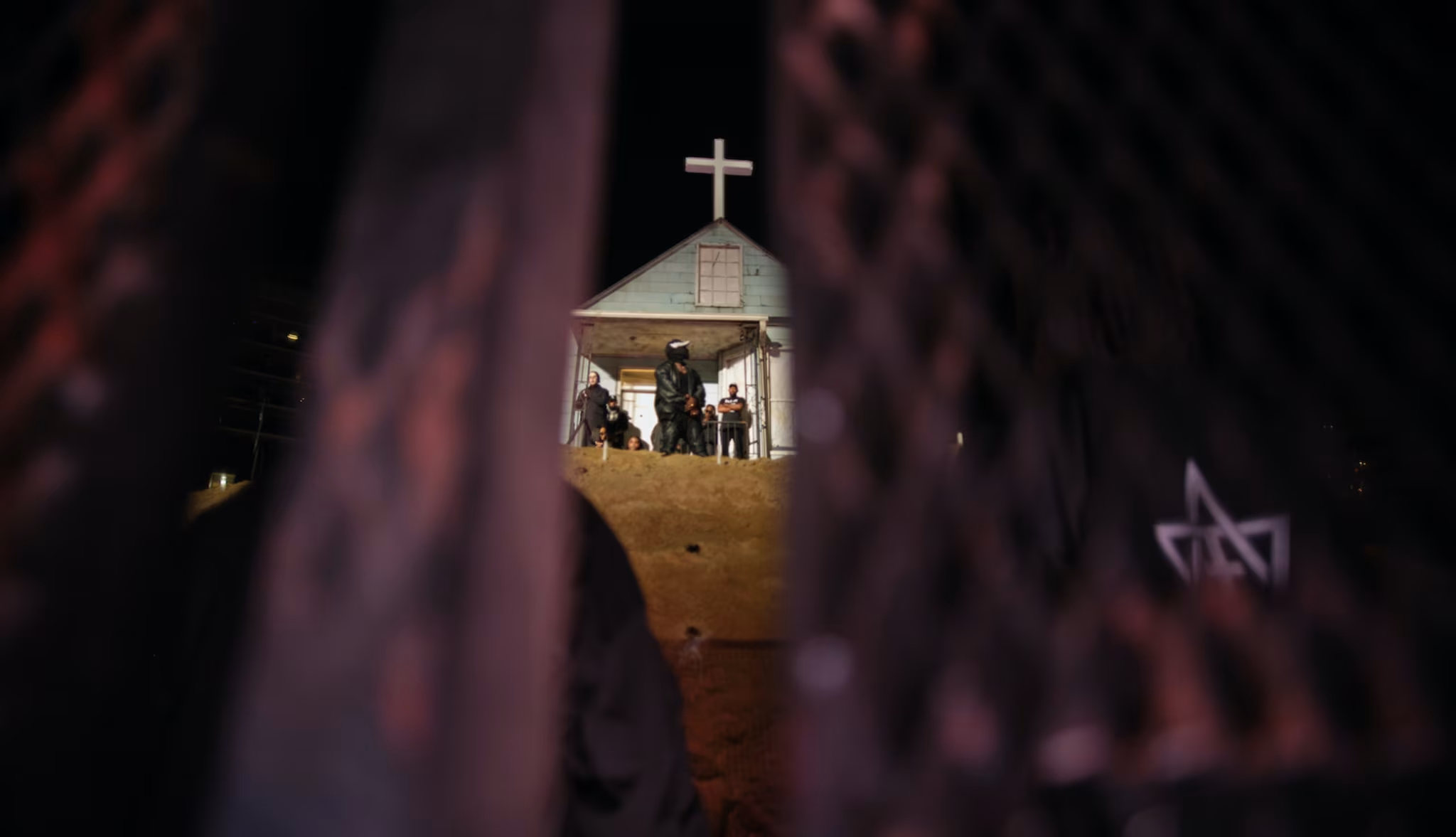
Image via Jesse Lirola/BFA courtesy of DONDA
In January 2020, Kanye West held a Sunday Service at Skid Row in Los Angeles, where he told the world, “Don’t call me secular, because secular is trying to say that I’ll do anything for anyone other than Christ. That’s where they got it messed up. That’s where they got it twisted.”
But a critical listen to his new album Donda reveals that it’s as self-absorbed as any of his previous work. Pusha-T praised Donda on Instagram for being “about power, money, influence, and taste.” It’s unclear if he interpreted the project as a Christian critique of money and power, or a celebration of those same things. The project’s lyrics feel like the latter, which makes it a complicated gospel.
The album is well-produced and laden with melodies and mantras that will, for many, serve as a balm for existential discontent. The project’s “Heaven and Hell” on earth theme is executed well, with confessional verses from the likes of Fivio Foreign, Lil Baby, Lil Durk, and Jay Electronica. Donda’s highs will serve as a soundtrack for those seeking refuge from the world’s challenges. But Kanye’s Donda ruminations compile a self-involved, patriarchal brand of Christianity that’s heavy on piteousness but light on personal accountability. Kanye tabbed a who’s who of rap to give their testimony, but he wasn’t fully forthright about his. For all the feels of “Moon” or “Lord I Need You,” it’s difficult to ignore how some of the album’s participants have made others feel with their past controversial actions—especially Kanye.
If another, less controversial artist had helmed Donda (with less controversial features), perhaps there would be more praise at how someone deftly crafted gospel hip-hop that wasn’t so obviously made to be gospel hip-hop. We all fight private battles that songs on Donda could be solace for. But considering all of Kanye’s very public battles, the limited scope of Donda’s self-inventory feels like intentional omission.
He shines the most on “Hurricane,” where he explores his personal and marital woes, and “Jonah” and “Pure Souls,” where he speaks to his Chicago heritage in different manners. But there’s not much candor beyond those tracks. Lines like “nothing else ever feels right” but God present the image of a mistreated artist in a misunderstanding world. But as forgiveness goes, some people aren’t going to overlook his dalliance with Trump. Or before that, his misogyny or colorism or unread musings about race. On an album where so many artists took stock of their life, he offered no explanation or reflection on his own worst moments.
Kanye’s political pitfalls have been so prevalent in the news cycle that ignoring them on such a personal album is glaring. Perhaps he doesn’t care about public opinion, and he said all he had to say about the past several years by simply rhyming, “Don’t agree with the message, don’t agree with the methods” on “Believe What I Say.” But that’s not enough for many. He made sure to slip in timely references to Giannis and Messi, but nothing about his own recent headlines.
He castigates other people’s snake behavior on “Ok Ok,” but doesn’t offer much reflection on his own actions. On “Praise God,” he proclaims, “I serve, follow your word,” but doesn’t go into detail about what it looks like in practice. Aside from Lil Durk talking about taking care of his late brother’s children on “Jonah,” or Young Thug crooning, “I treat you lovely and righteous and kind” on “Remote Control,” there are very few lyrics that explicitly express kind gestures to other people—though Kanye raps about a “throat coat for a throat goat” and dysfunctional relationships on “New Again” and “Believe What I Say.” Even on an album presented as an ode to serving God, the self-involved male ego rears its head. Many of us know someone who evades responsibility for their misdeeds by evoking their singular journey with God, or decreeing that only God “understands” them. Donda is the soundtrack for them, as Kanye does the same thing.
More troubling than what Kanye isn’t saying are appearances by a slew of controversial artists. Fivio Foreign’s show-stealing verse on “Off The Grid” is tempered by the reality that the Brooklyn drill artist was accused of sexual assault this March, making him one of several accused abusers on the album. The brightness of Don Toliver’s lush chorus on “Moon” is dimmed by recent sexual assault accusations from a Houston woman. And Chris Brown, who has been accused of violence against women multiple times, shows up on “New Again.” Soulja Boy is upset that he was left off of “Remote Control” after Kanye asked him to be on the album, but he should feel grateful that people are still looking to work with him after multiple accusations of assaulting women.
It’s unclear if Kanye wanted these artists on the album because they, like him, face constant public scrutiny for their actions. But it’s fair to assume that it was part of the criteria based on his 11th-hour additions of DaBaby and Marilyn Manson, two other artists rightfully in the public ire. Manson, who is on “Jail Pt 2,” is currently facing four sexual assault lawsuits. And Kanye posted a screenshot of a text conversation between him and his manager Bu where he championed DaBaby as “the only one who said he’d vote for me in public.” But if that was the reason he was on “Jail Pt 2,” he’d have likely been on the album from the first listening session. It seems more like Kanye saw DaBaby losing shows and being lambasted on social media after his insensitive Rolling Loud comments and opted to give him a pulpit to speak his peace. If DaBaby had jumped on “Jail Pt 2” expressing genuine contrition for his ill-advised tangent about AIDS and gay people, the moment would have been more tolerable. But he led by rhyming, “I said one thing they ain’t like, threw me out like they ain’t care for me/ Threw me out like I’m garbage.”
His reductive, victimized perception of what happened parallels Kanye’s unjustified disposability complex. The concept of “Jail” is a classic Kanye reflection on human hypocrisy, buoyed by the mantra that “I’ll be honest, we all liars.” That’s pretty much true. The album’s greatest deception is Kanye’s manipulation of the concept of man’s flawed nature amid worldly suffering in attempts to exculpate himself and his cohort of their misdeeds. On “New Again” he rhymes, “I repent for everything I’mma do again,” which is part comedic Kanye-ism but also an apropos rallying cry of men who seek forgiveness for their behavior without changing (or acknowledging) it.
Kanye lumped heartfelt rhymes from the likes of Kid Cudi, Lil Durk, and Lil Baby with the presence of abusers, and presented it as himself and his all brothers seeking communion and salvation from the cruel world. But not everyone’s testimony was the same, and some of the artist’s actions were more self-inflicted than others.
Kanye has historically used his platform to support and amplify men accused of patriarchal violence. In September 2018, he took to Instagram and seemingly stood up for A$AP Bari, noting he “challenged me when no one else did and when he got in trouble I was scared to say he was my friend just like I did with xxx and that was some pussy shit on my part,” and proclaiming: “Jedis never let perception and cancel culture get between them.” Bari was accused of sexual assault in 2018, while the late XXXTentacion was previously acused of physical abusing his ex.
Kanye has also collaborated with 6ix9ine and kept ties with fashion designer Ian Connor after abuse allegations were levied against them. Marilyn Manson, DaBaby, and Don Toliver were all guests at the third Donda listening session in Chicago. All three men have recently been “canceled” on social media for their actions, which is a fate Kanye has repeatedly expressed disdain for. It’s not far-fetched to perceive his alliance with these men as a bond against so-called cancel culture. And the spectre of religion makes for an even more sanctimonious dynamic, as if the cacophony of tweeters who simply want accountability for mistreatment are a modern corollary to the people who disbelieved and stoned Jesus. Kanye intentionally chose to use his “mother’s porch” as a safe space for men who’s actions, comments, and male fanbases create unsafe spaces for women. For many, that reality trumps any of Donda’s calls to glory.
It’s unclear what kind of conversations Kanye has privately held with Donda collaborators. Maybe he prays with them and they counsel each other through whatever trauma and pain they’re feeling. But all the public has is the optic of a Kanye album dedicated to his mother and God, speckled by people who have violated women and haven’t expressed any contrition for it—not even on the album. The project is billed as an ode to God, but the actuality feels like a disservice to everyone but the actual artists.
The Donda era’s biggest disappointments harken to criticisms of the modern church’s patriarchal leanings, which ultimately help sustain domestic violence. So many religious leaders use biblical text as their basis to enforce gender roles. Men are “meant to be” providers, and women are encouraged to be subservient and ever-forgiving of their mate through his struggles. Under this construct, men, the so-called leaders of the “nuclear family,” are given space to have their abuses absolved as temporary imperfections along their divine path in a way that other identities aren’t offered. In too many religious environments, forgiving a man’s trials takes precedence over helping a woman mend her trauma. Perhaps that’s why, of over 30 featured artists, Sheenseea is the only solo woman vocalist on Donda (and her presence may have only been sparked by an attempt to poke at Drake.)
At best, the church coddling men is over-empathetic, and at worst it willfully sustains an environment where men get free reign to mistreat whoever and “repent for everything I’mma do again.” As Australian religious leader Tim Harris notes, “It is well recognized that males (usually) seeking to justify abuse will be drawn to misinterpretations [of the Bible] to attempt to legitimize abhorrent attitudes.” It’s hard not to see Donda in that egotistical light. Women and gay people have the right to be the most offended at Donda’s tracklist. And they’re also two of the groups most at odds with Christianity’s judgemental, controlling emissaries.
Another troubling aspect of the lyrical themes on Donda is the project’s plutocratic linkage of wealth with “God’s plan.” Tracks like “Junya” and “Believe What I Say” step away from the gospel as secular glimpses of materialism and toxic relationships, respectively. They’re both enjoyable tracks best perceived outside the spectre of the church. But on “Pure Souls,” Kanye rhymes, “Personal worth is not what a person is worth,” then confusingly brags, “I can give a dollar to every person on Earth /Man, it’s gotta be God’s plan.” He curiously followed a plea to humility with a line about absurd wealth. But the idea of wealth as “God’s plan” is in conflict with Jesus’ quote that, “It is easier for a camel to go through the eye of a needle than for a rich person to enter the kingdom of God.” Everyone has their own interpretation of what prosperity looks like to them, but it’s tenuous to express the virtue in hoarding wealth in a system that necessitates so many poor people suffering and needing aid.
It can’t be forgotten that harmful notions of masculinity, the ignorance of abuse, absurd wealth, and conservative Christianity are the major touchstones of Trump’s hateful movement, and may have been in part what drew Kanye to him. And now, all these self-serving ideas are present in the storyline around on an album that’s supposed to be about serving God. There are fans who will acknowledge all of the faults of Kanye, Donda, and the chaotic album cycle, and still enjoy the album because it shines in its most vulnerable moments. But for others, the project’s flaws make it unlistenable.
“Jesus Walks” was a revolutionary single choice in 2004. And many of the songs on Donda follow its edict as an all-encompassing invitation for anyone seeking salvation. But so much has changed for Kanye (and the world) since then. It would have been impressive to see him match the bravery of that unconventional single choice with an album that took on his demons head-on, becoming the rare moment when a powerful male entertainer owned their mistakes, spoke on the factors that caused them, and sought understanding from the public. At that point, the ball would be in the public’s court.
Social media isn’t going to stop calling out patriarchal violence. One would think that eventually one of the artists of disdain will shake the victim complex and use the moment as a catalyst to correct their misdeeds—not for “PR,” but because they generally want to be better. Vic Mensa has previously admitted he “peeped game and started to break down why I was so violent” after reading bell hooks and reckoning with his own past abuse against women. Kanye, or one of the controversial artists he invited onto Donda, could have been another. But instead, Donda is a project where Kanye and too many men called on God as protection from an ugly world, without acknowledging that their actions sustain the ugliness.




