

Image via Complex Original
No matter the season, Paris is always a good idea. The art, the architecture…the bread. It’s like rehab for your spirit.
But before you pack your bags in search of joie de vivre, here are some pointers for getting the most out of your first Parisian adventure.
1. Know the difference between a real croissant and an imposter

A true croissant is made with butter and little else. You might be thinking, "Le duh," but many bakeries in France peddle croissants ordinaires, which are made with margarine. So, when you follow your nose to the local pâtisserie, be sure to order a croissant au beurre. Your mouth will thank you.
As long as we’re on the subject, all of you chocoholics should note that the French call a chocolate croissant “chocolate bread” or pain au chocolat. And if you want a really decadent start to your morning, I highly recommend going H.A.M. on a croissant aux amandes, which is a normal croissant filled with marzipan, and topped with sliced almonds and powdered sugar.
2. Ban the banette
Now that we’ve got croissants covered, a word of caution on the equally famed baguette. This baton-shaped loaf, characterized by its firm, crunchy crust and holey interior, is the bread of all breads. In fact, the French take baguettes so seriously, they actually have laws on how and where it’s baked.
In recent years, I’ve noticed a new addition to the shelves of many local boulangeries (bakeries that mainly offer breads): the Banette. It's a trademarked product of the commercial French bread company named—you guessed it—Banette. Local bakeries simply pop the industrial frozen dough in the oven, et voilà: a sorry excuse for a baguette that borders on treason.
To make sure you get a taste of the real thing, look for a baguette tradition or baguette à l’ancienne, which have markedly pointier ends, and are shaped by hand.
3. Master the French art of not giving a f*ck
Parisians have a nasty reputation for being rude, and to an extent, they are—but it’s only the natural consequence of not caring. The French are spectacularly blasé about everything, and this attitude lends itself to a sort of lazy pretension that can be particularly irksome to an uppity American.
There’s a wonderful French expression that perhaps best characterizes the Parisian disposition: Je m’en fous. This roughly translates to “I don’t give a f*ck,” but is polite enough to say with much more regularity.
4. Dressing à la Parisienne
Despite the fact that Paris is the center of the fashion world and the birthplace of couture, everyday Parisian style is not nearly as intense as you might think. If you want to blend in with locals, it’s less about what you should wear than what you shouldn’t.
For starters, you’ll rarely see a woman in high heels, unless it’s for a special occasion. Short shorts and skirts are also frowned upon. For the French, dressing sexy is much more about being understated. As far as men are concerned, baggy or ill-fitted clothes are a major faux-pas.
5. Supermarket lingerie (yes, it's a thing)
This one’s for the girls, but the boys will definitely benefit. Be sure to stop by a local retailer like Monoprix to refresh your top drawer. It's the French equivalent of a Target, but better.
Good lingerie is a matter of course for Parisian women, rather than something on which you need to splurge, so it’s no surprise that major commercial retailers offer an impressive selection for shockingly low prices. Make sure you swing by the makeup aisle, too!
6. Farmer’s markets are a must
France is the leading agricultural producer in the European Union. The deliciousness of French cuisine is largely due to the country's commitment to growing its own food, and honoring the land from which it's procured. For example, champagne can only be called champagne if it's made with grapes grown in the French region of Champagne.
Fortunately, you don’t have to go to the countryside to get the farm-to-table experience. Paris hosts a variety of farmers markets, where you can sample regional produce and seasonal delicacies. There are almost too many to count, though one of my favorites is Marché Avenue du Président Wilson.
7. Avoid these dining faux-pas
French tourists are notoriously bad tippers, and that’s probably because tipping is not obligatory in France. Servers typically receive a salary and a service charge is already included on the bill, so while it’s customary to leave something, it’s not the standard 20 percent that we have Stateside. Even the French are somewhat confused over what to leave behind; that said, in all my 28 years, I have rarely seen a tip larger than 10 percent of the total bill.
Another note when dining out: Taking leftovers to go is considered tacky. This isn't as wasteful as you might think, since Parisian portions are notably smaller than what Americans are used to. Also, you’d be hard-pressed to find a French person eating on the run or at their desk. Dining is a somewhat sacred experience in France, meant to be enjoyed purposefully and mindfully.
8. Burgers are a thing in Paris, too
Shockingly, burgers have become a bit of a culinary phenomenon in Paris, with entire websites dedicated to ranking them. So, if you’ve had your fill of foie gras and escargots, there are places you can go for a taste of home—and no, it’s not McDonald’s (although France’s McDonald’s are surprisingly good).
I’d recommend Paris New York, which has three locations and quite the foodie following. If you’re in the mood for something a little more basic that doesn't have any food-blog coverage, try Frog XVI.
9. Cheap wine is what's up
When dining out, no need to impress your guest (or the waiter) with your wine knowledge by ordering the most expensive bottle. Wine is such a cultural staple that it has to be affordable, otherwise the French would be very, very poor. Casual establishments may offer a house wine served by the carafe or pichet, which are usually very decent—maybe too decent, as I learned the morning after a night fueled by the house red at a jazz club in Saint-Germain-des-Prés.
10. Soak up the vibes at historical eateries
Paris café and restaurant culture is sometimes better than the food being served. Many establishments are saturated in history, having been frequented by the most renowned artists, writers, and musicians of our time.
For breakfast or lunch, step into Café de Flore in Saint-Germain-des-Prés. The famous coffee house opened in the late 1800s, and became quite the scene. From existentialist thinker Jean-Paul Sartre to couturier Yves Saint Laurent, it's been visited by a veritable who’s who of famous French people throughout the years. In addition, copious outdoor seating makes Café de Flore a perfect place to see and be seen. Enjoy the ambiance over an omelette, which, by the way, the French typically enjoy during lunch rather than breakfast.
For dinner, there’s La Coupole in Montparnasse, a vast Art Deco space that was graced by the likes of entertainer Josephine Baker, Picasso, and writer Henry Miller. Order the famous tartare de boeuf (steak tartare), which is prepared tableside.
For dessert, pick up a something sweet at the oldest pâtisserie in Paris, Stohrer. Opened in 1730 by Louis XV's pastry chef, Nicolas Stohrer, it's the birthplace of the baba au rhum, a liquor-soaked cake that's typically topped with whipped or pastry cream.
11. Pickpockets are too real
Violent crimes are rare in the French capital, but pickpocketing is a major problem, and tourists are easy targets. Pickpockets thrive in busy, crowded areas, like airports, the subway, department stores, and sightseeing destinations. They won’t just go for your wallet, either—electronic devices, passports, and jewelry are also up for grabs.
In general, it’s best not to wear expensive jewelry on the subway, but at the very least, keep it out of sight by turning rings inward and tucking in necklaces. Also, be mindful of zipping up or clasping bags and backpacks, which are especially vulnerable. Ladies would be wise to wear shoulder bags across the body; and if you’re in a car, put your bag on the floor, so nobody can reach in through the window and grab it (this might sound hyperbolic, but it really happens).
12. Where the hell is the bathroom?
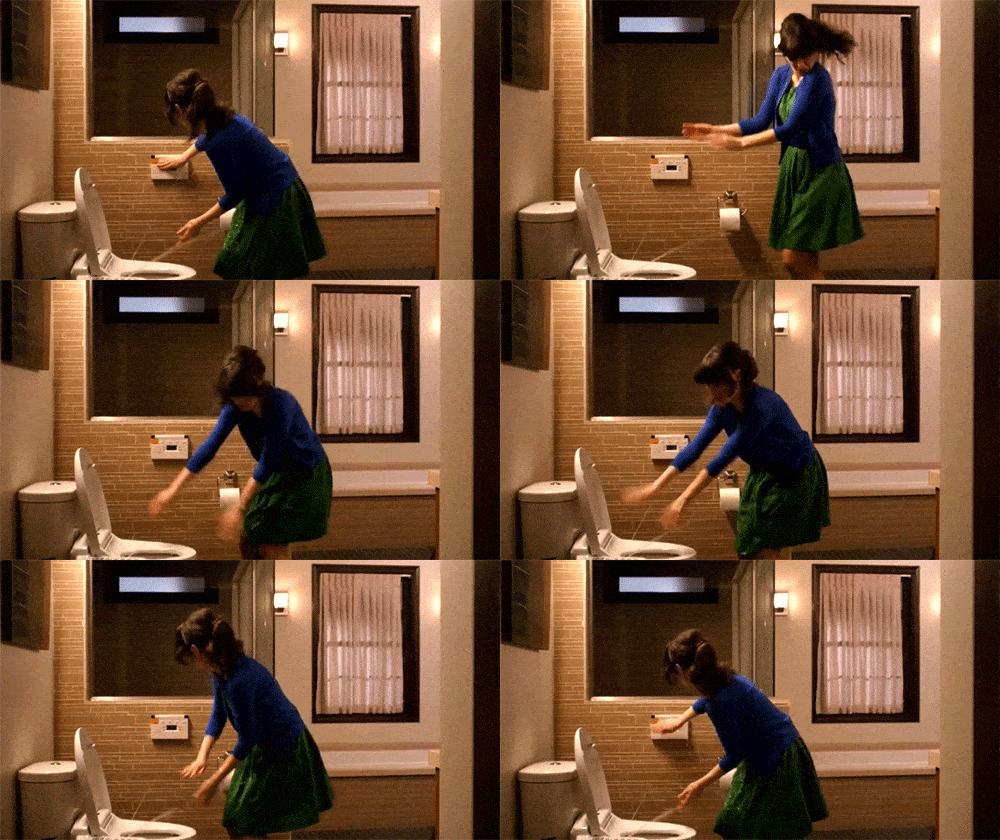
If you need to go, ask for la toilette (the toilet), which is not the same thing as the salle de bain (the bathroom). A bathroom is where you literally bathe, and in traditional French homes and hotels, showers and bathtubs are located in a separate room from the toilet.
There’s also the bidet, which looks like a low urinal, but DO NOT relieve yourself in it; the device is actually meant for washing your private bits.
13. Sunday, no-fun day

God forbid you should need groceries on a Sunday because you’d starve. France and Paris more or less shut down, as is required by certain trading laws. To keep up with the global economy, these laws have become more flexible about working hours, but you still shouldn’t plan on getting a whole lot done on a Sunday (but that shouldn’t matter much since you’re on vacation). C’est la vie!