Key Takeaways
- A discarded SpaceX Falcon 9 upper stage from two January 2025 lunar missions slammed into the moon on August 5, carving a new 65–90-foot-wide crater near Einstein Crater with no danger to Earth.
- NASA’s Lunar Reconnaissance Orbiter and South Korea’s Korean Pathfinder Lunar Orbiter are set to study the impact site, giving scientists a rare chance to see how artificial debris behaves on the lunar surface.
- The crash comes as Elon Musk pushes a more ambitious lunar agenda for SpaceX, from proposed A.I. satellite factories on the moon to the new Starship V3 designed for deep-space cargo and future human exploration.
A discarded SpaceX rocket stage has done exactly what astronomers predicted months ago: slam into the moon and carve out a brand-new crater.
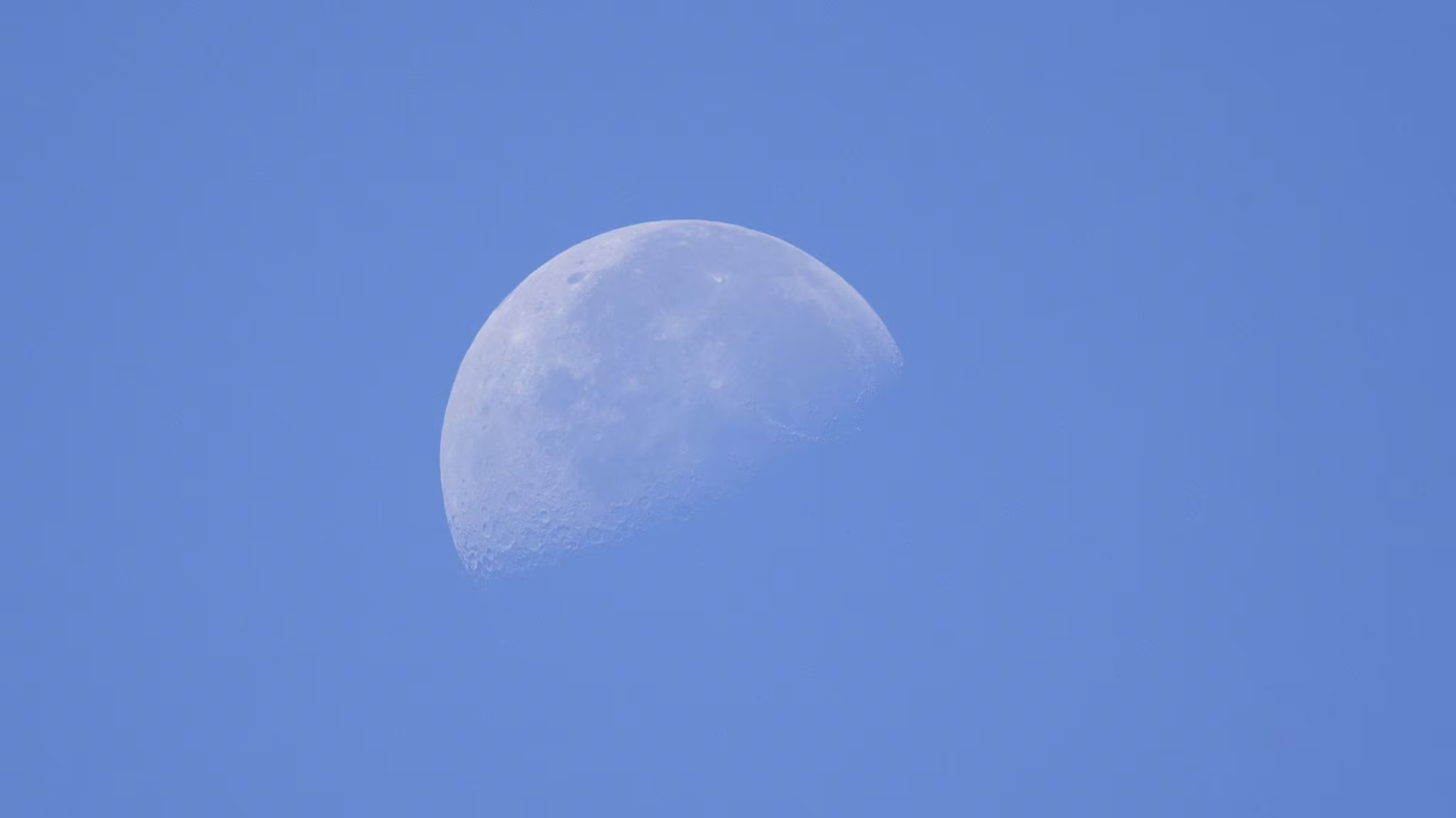
According to CNN, the Falcon 9 upper stage, which had been drifting through space since launching two commercial lunar missions in January 2025, struck the moon early Wednesday morning, August 5, after scientists spent months tracking its trajectory. Researchers estimate the impact blasted out a crater measuring roughly 65 to 90 feet across near the massive Einstein Crater on the moon's far western edge, turning an abandoned piece of rocket hardware into an unexpected lunar science experiment.
Fortunately, the booster wasn't carrying anything when it hit. After helping send Firefly Aerospace's Blue Ghost lander and ispace's RESILIENCE mission toward the moon, the rocket's upper stage was left in deep space.
Unlike Falcon 9 missions headed to low-Earth orbit—which typically end with the upper stage burning up in Earth's atmosphere—this mission required a different disposal plan.
"But for high-energy missions, we need to perform a different maneuver to ensure the second stage itself is safe per the appropriate rules and regulations," SpaceX's Director of NASA Science and Dragon Programs, Julianna Scheiman, said before the impact.
Instead, she explained, "a mixture of solar activity and gravity forces have put it on a path towards the moon."
NASA emphasized there was "no danger to Earth," but the agency plans to study the crash site after the dust settles. While the impact itself wasn't visible to the naked eye, scientists had spacecraft and observatories lined up to capture what they could.
NASA's Lunar Reconnaissance Orbiter is expected to image the fresh crater, while South Korea's Korean Pathfinder Lunar Orbiter also attempted to observe the event before impact.
The collision arrives at an interesting moment for Elon Musk and SpaceX. In recent months, Musk has made the moon an increasingly central part of the company's future. He recently told employees at xAI that he wants to build A.I. satellite factories on the lunar surface, describing the moon as a steppingstone to Mars.
This week's impact, however, underscores the less glamorous side of that expansion.
Scientists say intentional observations of artificial objects hitting the moon are rare, making this a valuable chance to better understand how debris behaves on the lunar surface. "We know it makes a crater," said Western University astronomy professor Dr. Paul Wiegert. "But we don't really understand that process in great detail."




