intro
Going into PAX East, there were several games I was excited to check out, but Spec Ops: The Line was not one of them. That changed almost as soon as I picked up the controller.
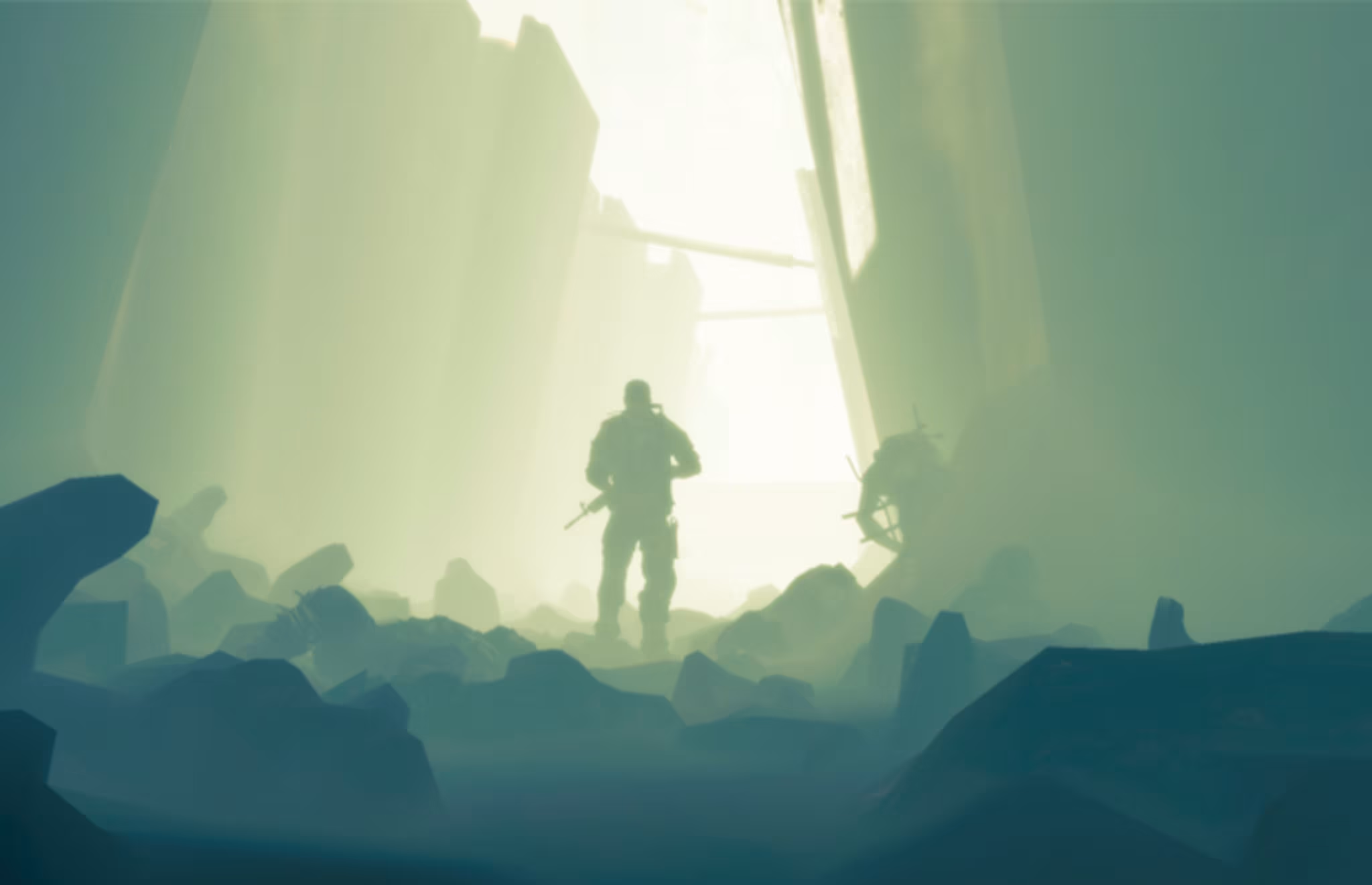
The game takes place in a version of Dubai that's been swallowed up by an apocalyptic sandstorm. There's been no communication with anyone in the city for months, and the world fears the worst.
The preview began as a three-man team led by Cpt. Martin Walker approached a ruined metropolis to investigate a distress call from Colonel John Konrad. Konrad was last seen months prior evacuating refugees, and was presumed dead. It should have been a simple recon mission, but obviously things don't go as planned.
Dubai
Dubai
The game's virtual depiction of a Dubai that's recently been engulfed by a Biblical-proportioned sandstorm is beautiful, and it begs to be explored. More importantly, it begs to have the brains and insides of rogue American soldiers and refugees-turned-guerilla warriors splattered all over it.
Massive skyscrapers are half submerged in sand. Others have been gutted by forces both natural and human. There are signs of the months-long struggle everywhere; graffiti and art adorns walls, while survivors are holed up in pockets of violence. It's a poetic killing ground.
Dynamic slow-mo
Dynamic slow-mo
There are plenty of enemies willing to throw their lives away crossing paths with your bullets. The weapons you come across feel pleasantly chunky and real when you're spraying bullets, but it's when you take the time to aim that you're really rewarded.
When you score a head-shot the game slows down for the briefest of moments, sound sucking inward as if a bomb has gone off. It's a gorgeous effect that's indicative of the detail afforded every aspect that I saw.
Look forward to getting your hands dirty
Look forward to getting your hands dirty
Walker and his team (the class clown, Lugo, and the less funny Adams) didn't know what to expect when they reached the city, and I guarantee none of them would have guessed that there'd be a war going on.
It's Lugo's first mission, and though he uses humor to deal with the stress, he begins to close up as the game progresses. All three soldiers, especially the player-controlled Walker, are willing to do what's necessary to find out what's really going on; for example, if an enemy is knocked down by an explosion, you have the option to kneel on his chest and deliver a quick and fatal punch.
It's brutal, but effective.
Smart banter
Smart banter
Many games are ruined for me by incessant chatter between enemies. Rather than show any modicum of fear, they'll taunt and threaten the player's character as if he or she hasn't just murdered scores of their coworkers. It's absurd.
During my time with The Line, I noticed no such transgression; in fact, the game's lead writer, Walt Williams, told me that was a conscious choice.
"When you just have people constantly yelling, it's much more obvious that you're playing a game," he said, "and we wanted the player to be thinking less about hearing enemies just screaming at them and thinking more about the squad and where they are and what they're doing in that moment and hearing the tone and the shift and the change in the people around them."
You might feel bad
You might feel bad
Williams also told me that most war games are afraid to make players "feel bad".
"The fact is, as a people and in our cultures, we explore our emotions through our art," he said. "We spend so much money making ourselves feel sad or feel angry or feel happy because that's how we're able to safely feel emotions or these thoughts about ourselves without necessarily having it occur in our real life and experiences. I think we're ready for that in games."
Get tactical
Get tactical
The game went to some lengths to get me to think hard about what I was doing, often in ways that I didn't even notice until I had replayed the same segments a few times. I was playing on an easy difficulty, but even so, trying to rush through areas infested with enemies got me quickly destroyed.
A later level, set on the top floors of a sand-encrusted skyscraper, surprised me with two enemies on the middle landing of a flight of stairs. Multiple times, I took the two enemies out with guns blazing, only to be murdered by the battle-ready troops in the next room. It wasn't until after I quit the demo that I remembered I had a silencer waiting to be equipped all along.
It's not a mistake I'll make next time I get to play the game.
Command your teammates
Command your teammates
Another tactical layer comes in ordering your teammates around, which I'm hoping will pop up more often in the full game than it did in the demo. I played for around 40 minutes, and twice I was given the opportunity to tap right bump and have Lugo and Adams flash-bang and stun a room full of enemies.
That's contextual, but at any time you can hold RB and pick out a target for your squad members to focus on. Given how often you'll find yourself pinned behind cover by multiple enemies, this can come in extremely handy.
A personal story
A personal story
Walker doesn't go all the way to Dubai to investigate some phantom distress call just because that's his orders; he's got a personal stake in rescuing Konrad. Though it wasn't spelled out in the levels I played, a loading screen tip revealed that Walker feels indebted to Konrad because of an incident years past when Konrad saved his life.
The characters in The Line aren't static. "I think it's time to move beyond simply 'I'm the hero, I'm the cocky hero,' or 'I'm a little scared Japanese girl.' There's so much more we can do emotionally with games, and I think people are waiting for that," Williams told me. "We were trying to make the characters really evolve."
The writing
The writing
Above all, from the game's first scene it was apparent that the writing is far more subtle than in many other games, and particularly other war games. At first it struck me as especially funny; the joker, Lugo, quips at the outset that "enemy airborne units" (sand) have infiltrated his pants, causing major "chafing". He was making fewer quips in the later level I played, though.
The game's battles are fought on multiple fronts. The remnants of the Army's 33rd have gone all Lord of the Flies within the ruins, while other refugees are being led by a rogue CIA agent. The devastated city has even got a radio DJ, a role filled by a former journalist who'd been embedded in the 33rd.
Throughout the demo, the writing was absolutely top-notch. And if you need any more assurances, well, you wouldn't be far off if you noticed a similarity between Colonel John Konrad and a certain Joseph Conrad—the author of the classic novel (and inspiration for Apocalypse Now), Heart of Darkness.
crossing the line
Crossing the line
That brings us to the core of the game: that heart of darkness at the center of human nature, or, as Williams likes to call it, "the line". How far do people have to be pushed to cross it?
"I think it's the line between the man that you are and the soldier that you choose to be," Williams said. "It's the line between order and chaos; what you consider moral and what you consider necessary. I've said it a few times here: for me, I think it's the line between expectation and reality. Because that's really, I think, ultimately the largest theme in the game."
Watch out for our full interview with Williams, the game's lead writer, and let us know what you're looking forward to in the comments or on Twitter.




